GCSE Arabic Class Sets Matter: Do They Really?
GCSE Arabic class sets matter less than tier choice and consistent practice. Learn what affects your result and how to take control of all four skills today.
A set number can feel like a prediction. Move into a higher class and confidence rises; move down and it can seem as though a grade has already been chosen for you. But do GCSE Arabic class sets matter to your final result?
The short answer is: your set can affect your learning environment, but it does not directly determine your grade. The examiner marks what you demonstrate in listening, speaking, reading and writing. Your class label never appears on the paper. Tier entry matters because it controls the grades available, while teaching quality, feedback, attendance and consistent practice influence how well prepared you become.
That distinction matters. A set is a starting arrangement, not a final judgement.
The quick answer: what actually affects your GCSE Arabic grade?
Use this checklist to separate the things that matter from the things that merely feel important:
- Your tier of entry: Foundation and Higher offer different grade ranges.
- Your command of all four skills: listening, speaking, reading and writing each contribute 25%25\%25%.
- The teaching and feedback you receive: clear explanations and precise corrections can accelerate progress.
- Your practice outside lessons: vocabulary retrieval, listening exposure and regular writing matter.
- Your exam technique: timing, answering the exact task and checking language all affect marks.
- Your set: this may influence pace, expectations and classroom experience, but it is not assessed.
Research summarised by the Education Endowment Foundation indicates that setting and streaming produce no additional progress on average compared with mixed-attainment teaching. The evidence is limited and individual schools differ, but it does not support the idea that being placed in a particular set automatically decides attainment.
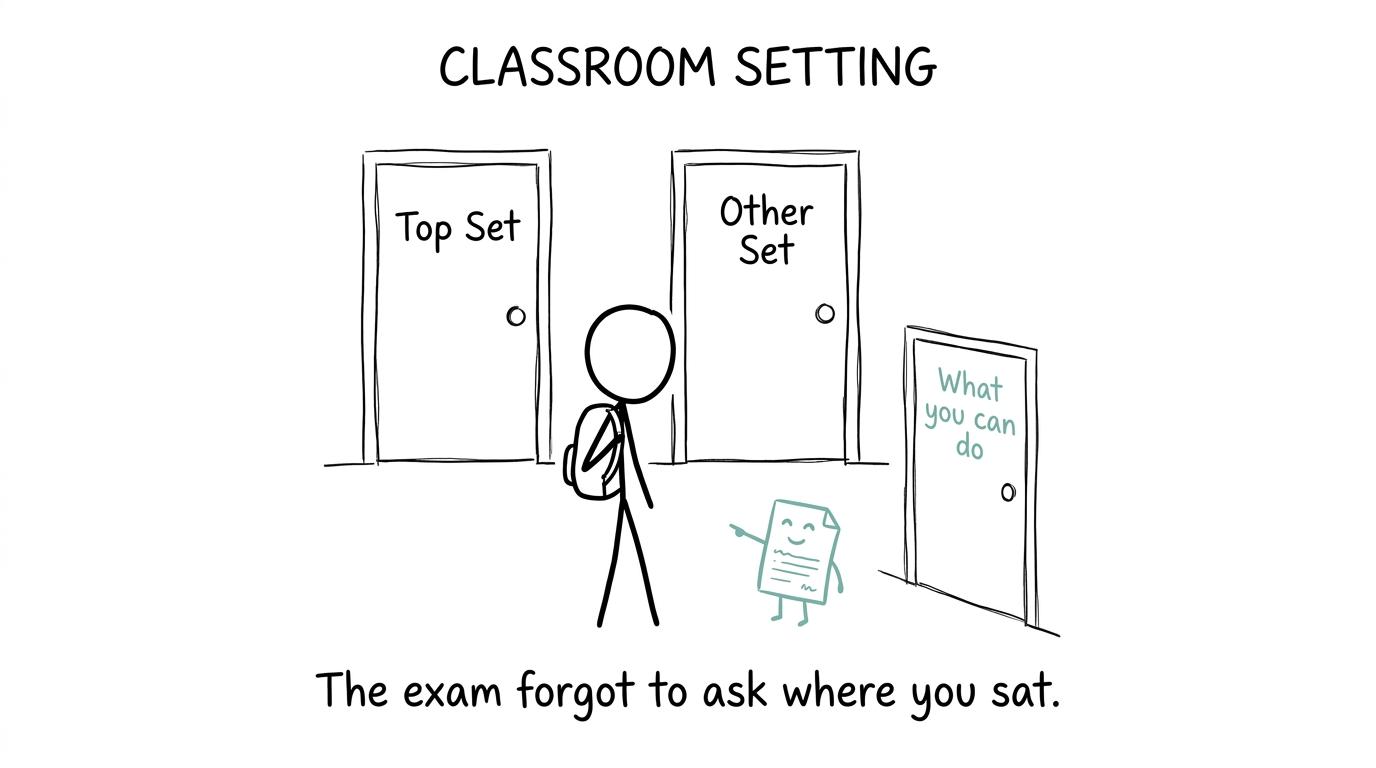 A student discovers that the exam does not ask for their class set
Class set and exam tier are not the same thing
This is the most important practical distinction.
A class set is an internal decision made by your school. It determines which group you are taught in and may reflect previous assessments, classroom performance, staffing or timetable arrangements. Schools can organise sets differently, and some teach Arabic in one mixed-attainment group.
An exam tier is part of the qualification entry. Under the current Pearson Edexcel GCSE Arabic specification, students take one tier across all four papers:
- Foundation tier offers grades 111 to 555.
- Higher tier offers grades 444 to 999, with a possible grade 333 for a result just below the grade 444 boundary under the awarding rules.
Therefore, a student in a lower set could still be entered for Higher tier if the school considers that entry appropriate. Equally, being in the highest class does not guarantee Higher entry or a high grade.
Ask your teacher directly: Which tier am I currently expected to take, and what evidence would change that decision? That question is more useful than asking whether your set number is good or bad.
Maths students will recognise the same distinction between classroom grouping and tier entry. The GCSE Maths revision hub lets students select the correct board and tier because effective practice must match the assessment being taken.
What the GCSE Arabic examiner actually assesses
The current Pearson Edexcel GCSE Arabic qualification has four compulsory papers. Each skill contributes 25%25\%25% of the qualification:
Overall result=0.25L+0.25S+0.25R+0.25W\text{Overall result}=0.25L+0.25S+0.25R+0.25WOverall result=0.25L+0.25S+0.25R+0.25WHere, LLL, SSS, RRR and WWW represent the scaled outcomes for listening, speaking, reading and writing.
Your set is absent from that calculation. So are your teacher's expectations, the speed of your class and how confident other students appear. The assessment evidence comes from what you produce.
Listening
You need to understand spoken Arabic across different contexts and speakers. Progress comes from frequent exposure, not simply sitting in a faster class. Short, repeated listening practice can help you recognise vocabulary, tense and opinion without translating every word.
Speaking
Speaking assesses communication and interaction. A student needs opportunities to answer spontaneously, extend responses and recover when unsure. If your class provides limited speaking time, ask for practice prompts, record your responses and seek feedback on accuracy and clarity.
Reading
Reading requires understanding different types of text and includes translation into English. Vocabulary is essential, but so is using context intelligently rather than stopping whenever one word is unfamiliar.
Writing
Writing rewards relevant communication, linguistic range and accuracy. Improvement depends on producing work, receiving corrections and using those corrections in later tasks. Reading a model answer is useful; writing your own response from memory is the real test.
This balanced structure creates an important warning: strength in one area cannot completely hide neglect elsewhere. A confident speaker still needs to prepare for reading, listening and writing.
When being in a higher set can help
Higher sets sometimes move faster, encounter more demanding vocabulary and receive earlier exposure to Higher-tier tasks. The atmosphere may also create stronger expectations. These are possible advantages, not guarantees.
A higher class only helps when you convert its opportunities into learning. It is possible to sit through difficult material, understand little and remain silent because everyone else appears confident. Pace is not the same as progress.
If you are in a higher set, check that you can:
- explain why a corrected sentence is better;
- retrieve vocabulary without seeing a list;
- respond without relying entirely on memorised scripts;
- complete unfamiliar Higher-tier tasks independently;
- maintain accuracy when working under time pressure.
The principle transfers directly to maths revision. Choosing Higher-tier material is useful only when weaknesses are identified and repaired. MathsGenie's Edexcel GCSE Maths revision pathway combines lessons, questions and revision tools so that difficulty leads to feedback rather than guesswork.
When being in a lower set can hold you back
A lower set can become a problem if it leads to reduced expectations, slower curriculum coverage or insufficient access to Higher-tier material. It can also affect confidence if students begin treating a temporary grouping as a fixed description of ability.
This is where the evidence on setting deserves care. Research suggests that lower-attaining pupils may experience small disadvantages from setting, although the overall evidence is limited. The lesson is not that lower sets cause failure. It is that expectations and opportunities must remain ambitious.
Look for concrete signs rather than worrying about the label:
- Are you covering the complete content needed for your intended tier?
- Are you regularly practising all four skills?
- Do you receive specific feedback?
- Can you access Higher-tier questions if that is your goal?
- Does your teacher review tier decisions using current evidence?
If the answer to one of these is no, speak to your teacher calmly. Bring evidence such as recent assessments, corrected writing and practice-paper results. A request supported by consistent work is more persuasive than simply saying that you belong in another class.
Does it all come down to effort?
Effort matters enormously, but saying that results come down to effort alone is too simple.
Students do not all receive identical teaching time, feedback, prior exposure or opportunities to speak Arabic. Effective learning also depends on knowing how to practise. An hour spent rereading vocabulary can feel industrious while producing less improvement than a shorter closed-book retrieval session.
A better model is:
Progress=purposeful practice+feedback+time+opportunity\text{Progress}=\text{purposeful practice}+\text{feedback}+\text{time}+\text{opportunity}Progress=purposeful practice+feedback+time+opportunityThis is not a literal grade formula. It is a useful way to remember that effort becomes valuable when it is directed and corrected.
The same principle shapes effective GCSE maths revision. MathsGenie's guide to finding weak topics recommends using assessed work to identify specific gaps rather than revising everything equally. For Arabic, your categories are listening, speaking, reading, writing, vocabulary, grammar and exam technique.
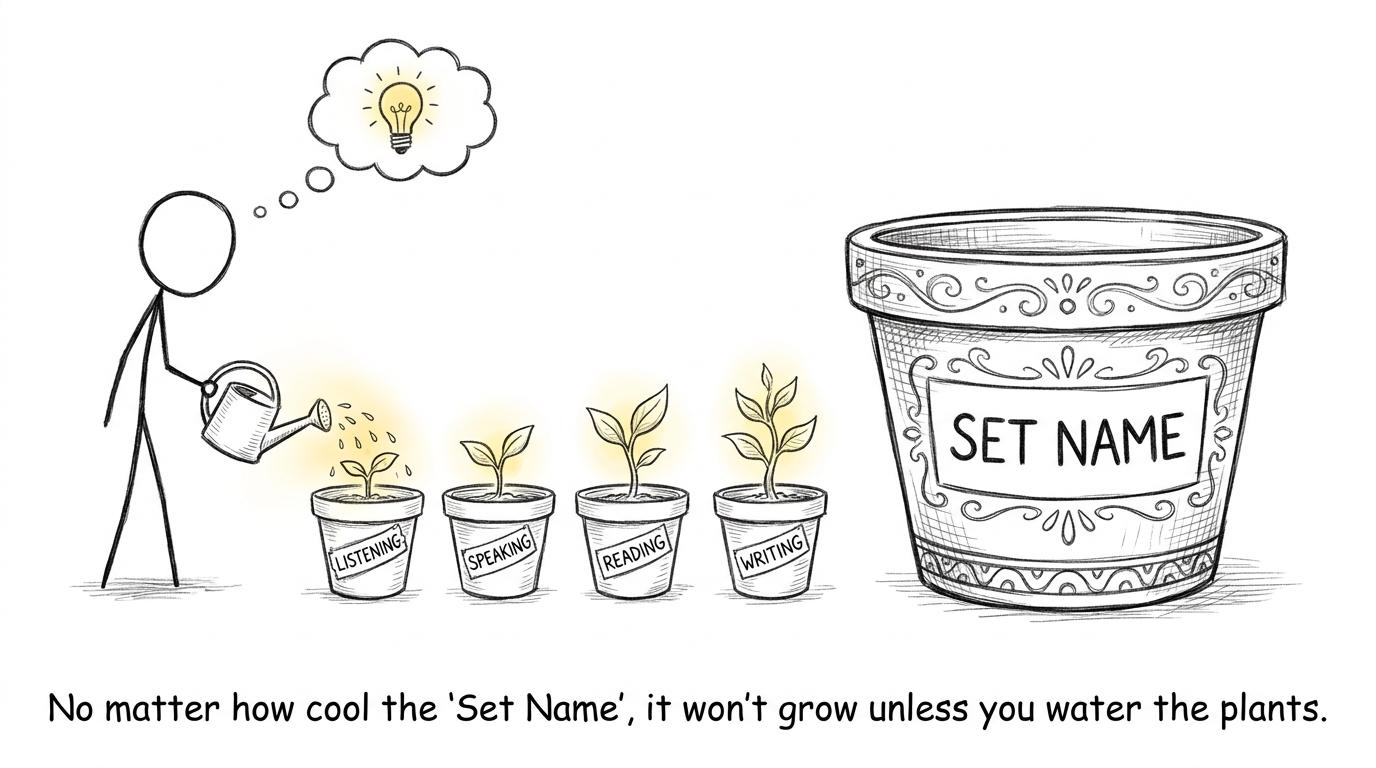 Four language skills receive attention while the set label sits unused
How to take control from any GCSE Arabic set
Build a four-skill revision record
Keep one page divided into listening, speaking, reading and writing. After each assessment, note:
- what cost you marks;
- why it happened;
- what you will practise;
- when you will test it again.
Avoid vague entries such as “bad vocabulary”. Write something actionable, such as “could not recognise travel verbs in the past tense”. Specific problems create specific revision.
Practise retrieval, not recognition
Seeing an Arabic word and thinking it looks familiar is recognition. Producing it without help is retrieval. Cover your notes, translate in both directions and revisit missed vocabulary on later days.
MathsGenie's active-recall revision guidance explains the same underlying habit: attempt first, check second, then return to the material after a delay.
Use assessment evidence intelligently
A practice paper should change your next revision session. Mark it carefully, classify errors and repeat weak task types. Do not reduce the whole experience to one total mark.
For maths, students can use Edexcel GCSE Maths past papers with mark schemes and worked solutions. Your Arabic resources will differ, but the process remains valuable: attempt, mark, diagnose, repair and retest.
Ask for the route to a different tier
If tier entry concerns you, ask for measurable criteria. These might include performance across several assessments, sustained completion of work or secure results on tier-specific tasks. Your school makes the entry decision, so early communication is essential.
Common mistakes when thinking about class sets
Treating a set as a permanent ability label
Sets describe a school's current grouping decision. They do not measure your full potential or appear on your certificate.
Confusing Higher tier with a guaranteed higher grade
Higher tier makes grades above 555 available, but it also contains more demanding material. The right entry should reflect current evidence and your target grade.
Revising only your strongest skill
Speaking may feel comfortable while listening is repeatedly avoided. Because every skill contributes 25%25\%25%, balanced preparation matters.
Trying to prove yourself with one good test
One result can be affected by the topic or conditions. A pattern of secure performance provides stronger evidence for a set or tier discussion.
Mistaking more work for better work
Copying vocabulary for hours is not automatically effective. Short retrieval sessions, marked tasks and repeated corrections provide clearer evidence of learning.
Maths students can use Edexcel GCSE Maths mini tests to practise this short feedback cycle, then move to predicted papers once topic weaknesses are less fragile.
Your set is context, not destiny
Your GCSE Arabic set may shape the pace, support and expectations around you. Those things are real, and it would be unhelpful to pretend otherwise. But the set itself earns no marks. Your tier defines the available grade range; your demonstrated listening, speaking, reading and writing determine the evidence the examiner sees.
Find out your tier. Ask what would justify changing it. Track all four skills, practise from memory and use every assessment to choose the next task. That is how a label loses its power.
For your maths exams, make MathsGenie your free revision base. Start with the GCSE Maths revision hub, then combine revision lessons and practice questions with mini tests, past papers, predicted papers, mark schemes and video solutions. A class tells you where you currently sit. Deliberate practice shows where you can go next.