GCSE Arabic Careers: Jobs That Value the Grade
GCSE Arabic careers explained: discover where the qualification helps, which apprenticeships value it, and what skills you need to build next in the UK.
A GCSE can feel like a destination while you are revising for it. In reality, it is usually a signpost. You may be wondering whether Arabic leads to a recognisable job, strengthens an apprenticeship application or simply becomes another grade on your certificate.
The honest answer about GCSE Arabic careers is encouraging but nuanced: the qualification can make you more noticeable in roles involving Arabic-speaking customers, communities or markets, but most specialist language careers require greater fluency, further qualifications or relevant professional skills. GCSE Arabic is evidence of a useful foundation. It is rarely the final entry requirement.
That distinction matters. You are not choosing between being “an Arabic translator” and never using Arabic again. Language becomes particularly valuable when combined with something else: business, law, technology, healthcare, journalism, education, security or strong numerical skills.
The quick career checklist
A good GCSE Arabic grade can help you:
- demonstrate reading, writing, listening and speaking skills;
- support applications for sixth form, college or further language learning;
- stand out in customer-facing apprenticeships serving multilingual communities;
- show cultural awareness and communication ability;
- begin a route towards translation, interpreting, diplomacy or intelligence work;
- complement maths in careers involving finance, data, technology or international business.
It does not normally prove professional fluency by itself. Specialist employers may test your language directly, while regulated or sensitive roles can require advanced qualifications, professional training, security clearance or subject-specific expertise.
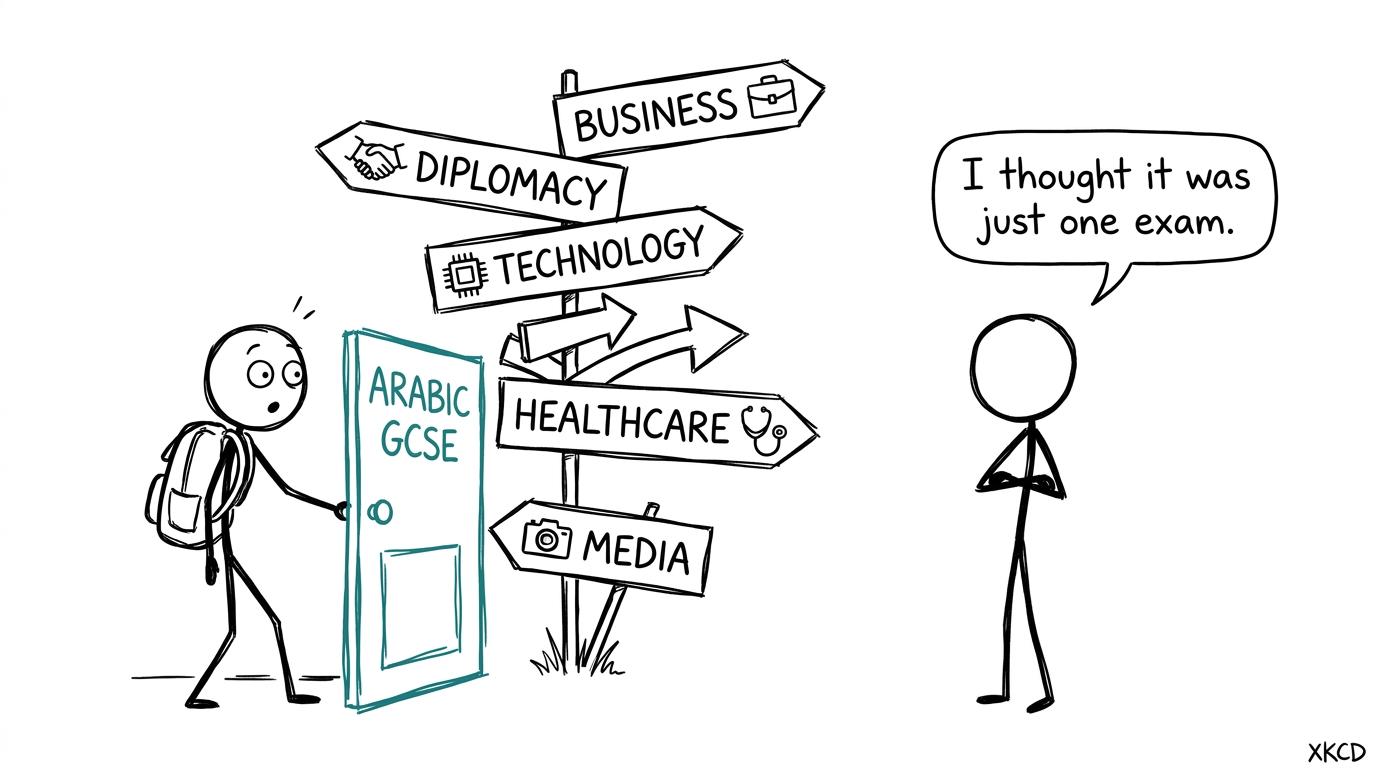 A student discovers that one language qualification can point towards several careers
Where GCSE Arabic actually gets noticed
The grade is most relevant when an employer or training provider has a practical reason to value Arabic. It may appear under desirable skills rather than essential qualifications, but it can still give you something specific to discuss in an application or interview.
Customer service, administration and business
Banks, airlines, travel companies, retailers, councils and international businesses may serve Arabic-speaking customers or work with organisations across Arabic-speaking regions. In these settings, language awareness can support roles such as:
- customer service adviser;
- business administrator;
- sales or account support assistant;
- bilingual administrative assistant;
- travel consultant;
- import, export or logistics assistant;
- marketing or social media assistant.
A GCSE does not automatically qualify you to conduct important negotiations in Arabic. However, it shows that you have formally developed the language and may be able to continue towards workplace proficiency.
Numbers matter in many of these jobs too. Percentages, currency, budgets, spreadsheets and data interpretation make GCSE maths an important partner qualification. If that side of your application needs attention, use the GCSE Maths revision hub to select your exam board and tier.
Public services and community-facing work
Arabic can be relevant in local government, housing, policing, immigration services, charities, schools and community organisations. A staff member who understands both language and cultural context may communicate more effectively with families and service users.
Possible routes include public service apprenticeships, administrative jobs and community support roles. You must still respect professional boundaries: knowing Arabic at GCSE level does not make someone a qualified legal, medical or public-service interpreter. Important conversations may require a trained professional.
That boundary is not a weakness of the qualification. It is evidence that language has consequences. Accuracy matters when someone’s health, legal position or access to services is involved.
Translation and interpreting
These are the careers most students associate with Arabic, but they require much more than a good GCSE grade. Professional translators need excellent writing, research and cultural knowledge. Interpreters must understand speech quickly and communicate accurately under pressure, including informal language and regional variation.
Official UK career guidance describes degree courses, college routes and professional qualifications as common pathways. Translators and interpreters may specialise in law, healthcare, business, media or public services. GCSE Arabic is therefore a sensible first stage, not a professional licence.
If this route interests you, continue building both Arabic and English. Translation is not simply replacing one word with another; it involves preserving meaning, tone and context.
Diplomacy, government and intelligence
Arabic skills can be relevant to the Foreign, Commonwealth and Development Office and the UK intelligence services. Language specialists may translate material, research context, produce reports and work alongside analysts.
These careers should be viewed realistically. Current official recruitment information shows that specialist language roles look for high proficiency, often assessed directly. Some routes do not demand a particular language degree, but they still expect excellent practical ability. Diplomatic graduate schemes generally have their own degree, nationality, residency and vetting requirements, which can change between recruitment rounds.
A strong GCSE Arabic grade may help establish the direction of travel. It does not replace advanced Arabic, broader cultural knowledge or the eligibility checks attached to sensitive work.
Media, journalism and digital content
Arabic can support careers in journalism, broadcasting, publishing, subtitling, research, content moderation and website localisation. Digital localisation means adapting material for a particular audience rather than translating it mechanically.
These jobs often reward combinations: Arabic plus journalism, Arabic plus video editing, or Arabic plus software and user-experience knowledge. As automated translation develops, human judgement remains important where tone, ambiguity, cultural meaning and accuracy matter.
Education and healthcare
A student might eventually combine Arabic with teaching, education support, nursing, medicine, pharmacy, counselling or healthcare administration. Arabic can help build trust and understanding, but professional entry requirements remain central.
A future teacher will need the appropriate teacher-training route. A healthcare professional will need the required scientific qualifications and clinical training. Arabic is an additional capability, not a substitute for them.
Apprenticeships where Arabic may strengthen an application
There is no single “GCSE Arabic apprenticeship”. Instead, look for apprenticeships in occupations where communication with Arabic-speaking clients, suppliers or communities could be useful.
Relevant searches may include:
- business administrator apprenticeships;
- customer service apprenticeships;
- travel and aviation roles;
- marketing and communications apprenticeships;
- public service operational delivery;
- housing or local authority administration;
- international trade and logistics;
- digital support or data roles with international organisations.
Apprenticeships in England are available at different levels, from intermediate routes broadly aligned with GCSE-level learning through to advanced, higher and degree apprenticeships. Each vacancy sets its own entry requirements. Employers often place particular emphasis on English and maths, so do not assume that an additional language compensates for weak core qualifications.
If you are preparing for AQA, the AQA GCSE Maths revision area brings together foundation and higher-tier lessons, questions and papers. Edexcel students can use short GCSE maths mini tests to find gaps without sitting a complete paper every evening.
When reading apprenticeship adverts, look for phrases such as “additional languages desirable”, “multilingual customers”, “international clients” or “community engagement”. Then explain your Arabic accurately. State the qualification and grade, describe how recently you have used the language and never claim fluency unless you can demonstrate it.
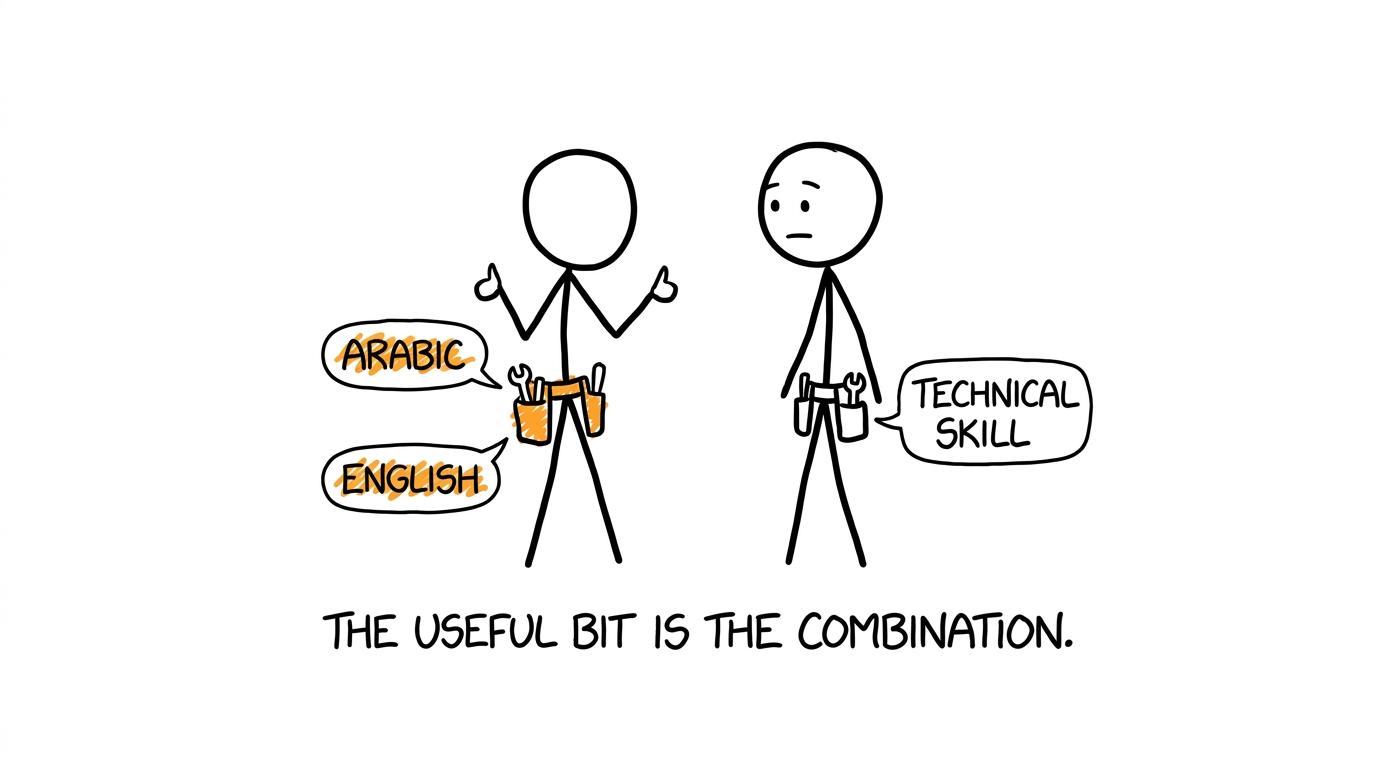 A bilingual student discovers that language becomes stronger when combined with another skill
Why Arabic plus maths can be a strong combination
Language helps you understand people. Maths helps you understand quantities, patterns and evidence. Together, they can support several less obvious directions:
- international finance and accounting;
- economics and market research;
- logistics and supply-chain planning;
- data analysis;
- software, cybersecurity and technology consulting;
- engineering projects with international teams;
- business intelligence and risk analysis.
For example, an international organisation may need someone who can analyse a spreadsheet accurately and understand the context behind information from an Arabic-speaking market. The valuable employee is not merely bilingual. They can solve the organisation’s problem.
This is the broader career lesson: qualifications usually work in combinations. Arabic may distinguish you from two applicants with similar technical skills. Technical ability may distinguish you from two applicants who both speak Arabic.
If you plan to take maths further, explore the free A Level Maths revision hub. It covers board-specific resources for AQA, Edexcel, OCR and other specifications.
How to make GCSE Arabic more valuable
A certificate records what you achieved at one moment. Your next choices determine whether the skill grows or fades.
Continue using the language
Read age-appropriate news, listen to different speakers, write regularly and seek feedback from a qualified teacher. Be aware of the distinction between Modern Standard Arabic and regional dialects. Different careers may require different forms of language knowledge.
Add a professional specialism
Consider what you want to do through Arabic. That might be helping patients, analysing international markets, teaching, writing software or reporting news. Choose post-161616 subjects and training that develop the other half of that combination.
Keep evidence of practical skills
Record relevant school projects, presentations, volunteering and responsibilities. Do not exaggerate informal interpreting experience, particularly in legal or healthcare contexts. Instead, explain what you learned about communication, accuracy and confidentiality.
Research each vacancy separately
Language needs change by employer and location. Check the live apprenticeship advert or job description rather than relying on a generic careers list. A role may value Arabic highly, treat it as desirable or not use it at all.
Common mistakes when planning GCSE Arabic careers
Assuming one GCSE creates professional fluency
A high grade is a real achievement, but professional translation, interpreting and language-specialist work normally demand a much higher practical standard. Treat GCSE Arabic as a foundation to build upon.
Searching only for jobs with “Arabic” in the title
This misses roles in business, technology, public services, logistics, media and healthcare where Arabic is an additional advantage. Search by occupation first and language second.
Neglecting English and maths
Apprenticeship providers and employers frequently specify English and maths requirements. Protect these grades while developing Arabic. If revision feels scattered, the guide to finding your weakest GCSE topics can help turn lost marks into a focused plan.
Overstating language ability
“GCSE Arabic” and “professionally fluent in Arabic” are different claims. Employers may assess speaking, listening, reading or writing. Honest descriptions build more trust than an impressive label that collapses during testing.
Treating predicted papers as predictions of your future
One difficult paper does not define your career options. It identifies what to practise next. Use Edexcel GCSE Maths predicted papers alongside official past papers, then follow the mark scheme back to the topics costing you marks.
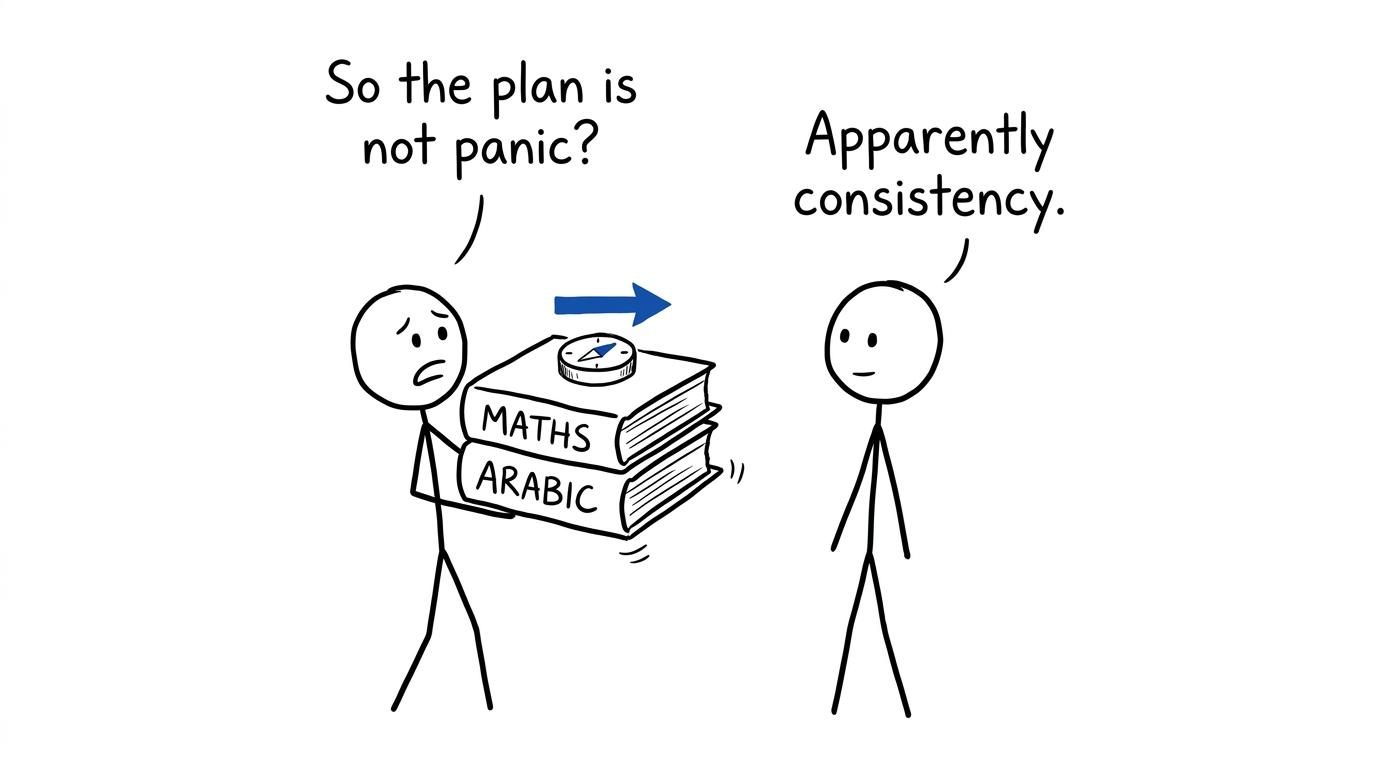 A student discovers that a calm revision routine is more useful than balancing everything at once
Build the qualification combination employers notice
GCSE Arabic can help with careers in multilingual customer service, administration, international business, community work, media and travel. It can also begin a longer route towards interpreting, translation, diplomacy, education or intelligence. Its value is greatest when your Arabic remains active and is paired with another credible skill.
You do not need to settle your entire career while preparing for GCSEs. Your immediate task is smaller: earn the strongest set of grades you reasonably can, understand what each next step requires and keep useful doors open.
Let MathsGenie make the maths part manageable. Start with a realistic one-month GCSE maths revision plan, then use free revision lessons and practice questions to repair individual topics. Finish with mini tests, past papers and predicted papers, checking your work against mark schemes and video solutions.
Arabic may help you communicate across borders. Strong maths may help you solve the problem waiting on the other side. Build both carefully, and your future options become wider than any single GCSE title suggests.