

GCSE Arabic Access Arrangements: How to Request Them
GCSE Arabic access arrangements explained: request extra time, rest breaks or modified papers, gather evidence and meet your school's exam deadlines.

A student can know the vocabulary, understand the recording and still struggle to show it under standard exam conditions. That gap matters. GCSE Arabic access arrangements can include extra time, supervised rest breaks, a word processor, modified papers or other support where there is evidence of need.
The first step is to speak to your school's SENCo, exams officer or learning-support team as early as possible. Students and parents do not normally apply directly to the exam board. The school assesses the need, gathers evidence, trials the arrangement and submits any required application.
This guide explains how that process works, including the important differences between the listening, speaking, reading and writing papers. It is based on the JCQ access-arrangement rules valid from September 2025 to August 2026, updated in March 2026. JCQ publishes new guidance for each academic year, so your centre must check the rules and deadlines for your examination series.
Your access arrangements checklist
Start with these practical actions:
- Contact the SENCo, exams officer or learning-support team early.
- Explain the difficulty you experience, not simply the arrangement you want.
- Ask whether teachers have observed the same difficulty in lessons and mocks.
- Use the proposed support regularly where appropriate.
- Complete any assessment arranged by the school.
- Confirm how the arrangement applies to each Arabic component.
- Practise with the approved arrangement before the real assessment.
- Ask for the final arrangements in writing, including room and timing details.
The essential principle is simple: an access arrangement should remove a disadvantage without changing the knowledge or skill being assessed.
 A student reaches the exams office before the deadline monster
What counts as an access arrangement?
Access arrangements change how an assessment is taken. They do not make the questions easier or reduce the standard needed for a grade.
Common possibilities include:
- 25%25\%25% extra time;
- supervised rest breaks;
- a word processor;
- a computer reader or human reader where permitted;
- a scribe or speech-recognition technology where permitted;
- modified enlarged, Braille or other adapted papers;
- coloured overlays or examination papers;
- amplification equipment or a live speaker for some listening assessments;
- a smaller or separate room where this is justified by the candidate's needs.
Some arrangements require approval through Access Arrangements Online. Others can be decided by the centre under JCQ rules. Your SENCo or exams officer determines which process applies.
A diagnosis does not automatically produce a particular arrangement. Equally, a student does not always need a named diagnosis before the school can investigate a substantial, persistent difficulty. The evidence, the current JCQ criteria and the student's normal way of working all matter.
How extra time works in GCSE Arabic
Extra time is usually approved because a disability, learning difficulty, medical condition or other substantial impairment affects the candidate's speed of working. It is not awarded merely because Arabic is challenging or because a student would feel more confident with longer.
For many candidates, the approved allowance is 25%25\%25%. The centre must hold the evidence required by JCQ and show that extra time reflects the student's normal way of working. Depending on the reason for the application, this may involve an assessment by the centre's appointed assessor, school evidence, teacher observations, mock papers or medical evidence.
Under the 2025-26 rules, evidence for 25%25\%25% extra time may include samples from internal tests or mocks showing how the additional time is used, alongside comments from relevant teachers. This is one reason to raise the issue well before the examination season: the school needs time to trial the support properly.
English being an additional language does not, by itself, establish an underlying learning difficulty for ordinary extra-time applications. JCQ has separate, tightly defined rules concerning bilingual dictionaries and additional time for some candidates who are new to English.
Why Arabic papers need separate planning
Pearson Edexcel GCSE Arabic assesses four skills: listening, speaking, reading and writing. Each contributes 25%25\%25% of the qualification, and students enter foundation or higher tier across the whole qualification.
An arrangement cannot be applied identically without considering what each component assesses:
- Listening: approved extra time may require controlled pauses or another board-approved method. The exams officer should follow Pearson's current administrative guidance rather than simply extending the recording informally.
- Speaking: extra time is commonly applied to preparation time. If extra time is needed during the recorded speaking assessment itself, the centre may need specific approval and evidence from speaking mocks.
- Reading: support cannot replace the candidate's own ability to understand written Arabic. Certain reader arrangements may therefore be restricted where reading is the skill being assessed.
- Writing: a word processor may be available where it is the student's normal way of working, but spelling, grammar and written communication must still remain the candidate's own work. Scribe arrangements can be restricted in modern foreign language papers because the candidate's ability to produce the language is being assessed.
The school should check the current Pearson specification and JCQ rules for every arrangement. Approval in another subject does not mean that support can be used in exactly the same way in Arabic.
 An exam support plan arrives with its own organised pit crew
Can you use a bilingual dictionary in GCSE Arabic?
Do not assume that an Arabic / English dictionary is allowed.
JCQ rules generally prevent a bilingual translation dictionary from being used in a modern foreign language examination testing one of the languages contained in that dictionary. The Pearson Edexcel GCSE Arabic specification also states that dictionaries are not permitted, including during speaking preparation.
There is a separate JCQ arrangement under which eligible candidates may receive a bilingual dictionary with 25%25\%25% extra time in permitted subjects. That does not make the dictionary available in GCSE Arabic. Where an EAL-based approval exists but the dictionary is prohibited in a particular subject, the centre must check the current JCQ provisions to establish whether extra time may still be applied.
This distinction is especially relevant to students also sitting GCSE Maths. A bilingual dictionary may be permitted in some examinations if it reflects the student's normal way of working, while an Arabic dictionary remains prohibited in the Arabic language assessment. The exams officer should confirm the position subject by subject.
How to request GCSE Arabic access arrangements
Tell the right person what happens in practice
Speak to the SENCo, exams officer or learning-support lead. Describe the barrier precisely. For example, explain whether you lose your place while reading, need breaks because of a medical condition, cannot write for sustained periods or require enlarged text.
The most useful question is not, "Can I have extra time?" It is, "What stops me showing what I know under the current conditions?"
Let the centre gather evidence
The school may review classwork, timed assessments, mock papers and teacher observations. It may arrange a formal assessment or ask for relevant medical evidence. Requirements differ according to the arrangement and the reason it is needed.
Privately obtained reports do not automatically require a school to submit a particular application. The centre remains responsible for confirming the evidence, need and normal way of working under JCQ rules.
Trial the arrangement
An arrangement should usually be familiar before the real exam. If supervised rest breaks help more than extra time, the trial may reveal that. If a word processor slows the student down, that matters too.
Use Arabic mocks to test component-specific arrangements. Use maths mocks as well if the support will also apply there. MathsGenie's GCSE Maths revision hub provides board-specific questions, while the GCSE past-paper platform helps students rehearse timing and review mark schemes.
Ask the centre to submit the application
Where online approval is required, the school or registered exam centre submits the application. The student or parent cannot normally bypass the centre and apply independently.
Ask when the application will be processed, whether further evidence is needed and how you will be told the outcome. Private candidates should discuss access needs with a prospective centre before paying an entry fee because not every centre can provide every arrangement.
The approval timeline
Waiting until the examination month creates avoidable risk. A sensible timeline looks like this:
During Year 10 or earlier
Raise persistent difficulties as soon as they become clear. This gives the school time to observe your normal way of working and introduce appropriate support in lessons.
Early in Year 11
Confirm that your SENCo and exams officer know you are taking GCSE Arabic. Complete any required assessment and begin using the arrangement in internal tests and mocks.
Autumn and early spring
The centre should gather evidence, finalise applications and order any modified papers. Modified-paper deadlines arrive earlier than deadlines for most other arrangements.
For the June 2026 series, JCQ's deadline for ordering modified papers was 31 January 2026, while the deadline for processing most other access-arrangement applications was 21 March 2026. These dates have passed and should not be reused for another series. Always ask your centre for the current year's deadlines, allowing for its earlier internal cut-off.
Before the speaking assessment and written papers
Confirm exactly how the arrangement will operate. Ask about preparation time, pauses in listening, rest-break supervision, equipment, rooming and who to speak to if something is missing.
If a new injury or condition appears after the normal deadline, contact the exams officer immediately. Late or temporary arrangements may be possible, but they depend on the circumstances and evidence.
Practising with extra time without weakening your revision
Access arrangements provide access, not preparation. The strongest approach is to build two plans: an access plan for the conditions you need and a revision plan for the knowledge you must demonstrate.
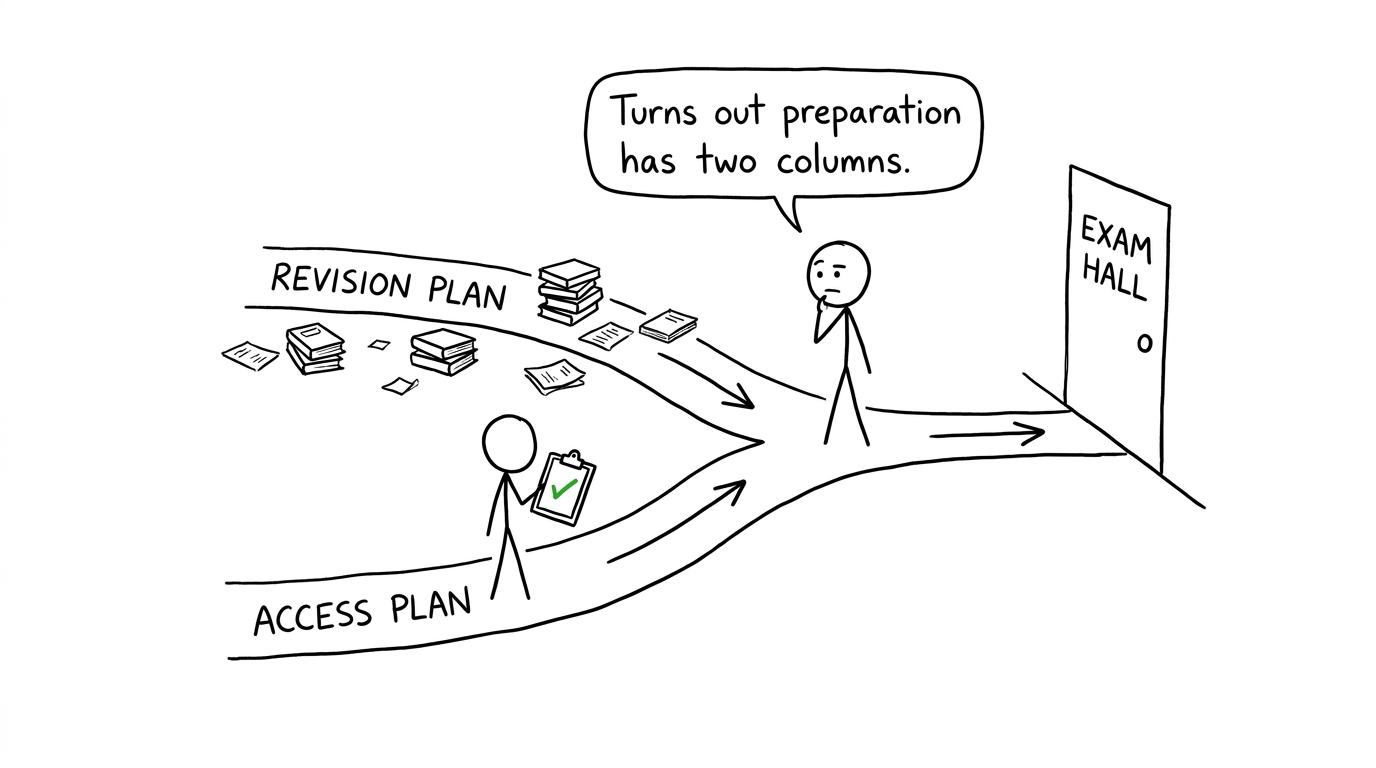 A revision plan and access plan merge at the exam hall
When practising maths, use the timing you expect in the real examination, but also track whether the additional time is genuinely useful. Students can work through Edexcel GCSE Maths past papers or use the OCR GCSE Maths revision hub for board-specific practice.
If full papers feel overwhelming, start with a structured one-month GCSE Maths revision plan. Check that you are practising the correct content using the GCSE Maths topics by board and tier guide, then add GCSE predicted papers near the examination as fresh practice rather than as a replacement for past papers.
The aim is not merely to spend longer at a desk. It is to use the available time purposefully, check your work and finish without the barrier overwhelming the skill being tested.
Common mistakes when requesting support
- Waiting until the final term: evidence, assessments and modified-paper orders take time.
- Assuming a diagnosis guarantees extra time: JCQ criteria and normal way of working still matter.
- Requesting a percentage rather than explaining the barrier: describe what happens during timed work.
- Assuming every arrangement applies to every Arabic paper: speaking, listening, reading and writing assess different skills.
- Expecting an Arabic dictionary: dictionaries are not permitted in Pearson Edexcel GCSE Arabic.
- Never using the arrangement in mocks: unfamiliar support can become another distraction.
- Forgetting the centre's internal deadline: schools often set cut-offs before the official JCQ date.
- Confusing access arrangements with special consideration: arrangements are normally planned before an assessment; special consideration concerns unexpected circumstances affecting an assessment.
Make the exam plan ordinary before exam day
A good access arrangement should feel unremarkable by the time the real paper arrives. You know where you will sit, how breaks work and what happens to the listening recording. That certainty leaves more attention for the Arabic or maths in front of you.
Speak to your SENCo or exams officer now, ask for the current timeline and practise under the approved conditions. Then let MathsGenie support the revision itself: use free revision lessons, practice questions and mini tests to strengthen individual skills, followed by past papers, predicted papers, mark schemes and video solutions to prepare for the real examination.










