GCSE Arabic 20-Minute Study Routine
GCSE Arabic 20 minute study routine for building vocabulary, listening, speaking and writing while keeping maths revision on track without cramming.

Some revision plans fail because they ask for an imaginary version of you: one with endless evenings, no homework and unlimited concentration. Real students are balancing several GCSE subjects, and maths alone can demand serious practice.
A gcse arabic 20 minute study routine offers a more realistic answer. Spend 202020 focused minutes retrieving vocabulary, using Arabic and correcting mistakes. Stop when the timer ends. Repeating that small cycle is more useful than postponing everything until an exhausting pre-exam all-nighter.
This routine is designed around Pearson Edexcel GCSE Arabic, but you should always check your own specification and teacher guidance. It also leaves room for the maths revision that students following Edexcel, AQA, OCR or Eduqas still need to complete.
Your 202020-minute routine at a glance
Use the same structure each day so that starting requires almost no decision-making:
- Minutes 000 to 333: retrieve old vocabulary without notes
- Minutes 333 to 888: listen to a short piece of Arabic
- Minutes 888 to 131313: speak aloud from a prompt
- Minutes 131313 to 181818: read or write a short response
- Minutes 181818 to 202020: check, correct and choose tomorrow’s target
The purpose is not to cover the entire course every evening. It is to keep listening, speaking, reading and writing active across the week.
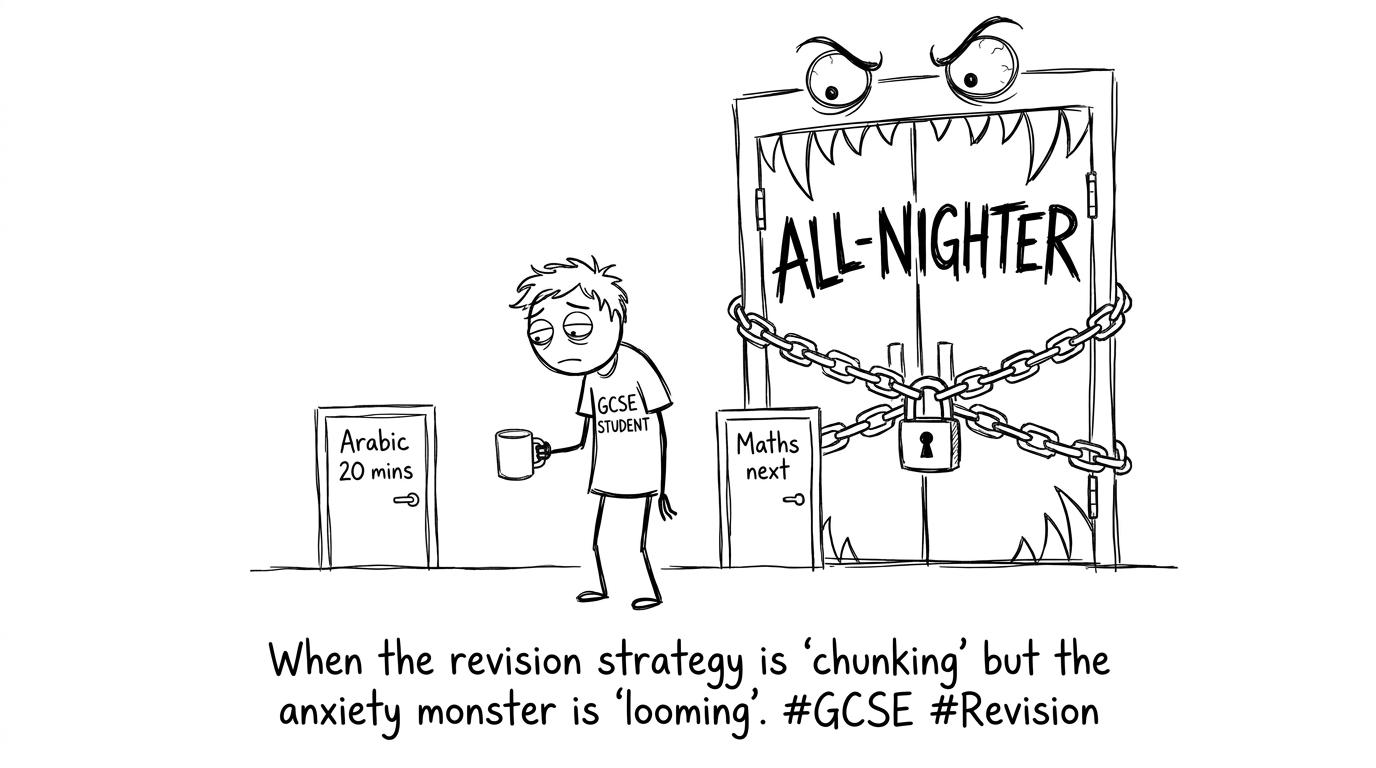 A student choosing manageable revision instead of an all-nighter
Why short daily Arabic revision works
Learning a language involves remembering information and being able to retrieve it when a question, recording or conversation demands it. Simply looking over a vocabulary list can feel fluent because every answer is visible. The exam removes that support.
Research into learning consistently distinguishes between rereading and retrieval practice. Retrieval means trying to produce an answer from memory before checking it. Spacing those attempts across different days can create more durable learning than concentrating the same work into one sitting.
That makes a daily routine particularly suitable for vocabulary and structures. One imperfect attempt today, followed by feedback and another attempt later, gives your memory repeated work to do.
There is also a practical advantage. Across a five-day school week, the routine provides:
5×20=100 minutes 5 \times 20 = 100\text{ minutes} 5×20=100 minutesThat is 111 hour and 404040 minutes of focused Arabic without requiring a long weekday session. The consistency matters more than pretending every one of those minutes will be perfect.
What GCSE Arabic actually assesses
The current Pearson Edexcel GCSE Arabic specification, qualification code 1AA01\mathrm{AA0}1AA0, assesses four skills: listening, speaking, reading and writing. Each contributes 25%25\%25% of the qualification. Foundation and higher tier papers are available, and students enter the same tier across the papers.
This matters because vocabulary-only revision is incomplete. Knowing many isolated words helps, but the qualification also expects you to understand spoken and written Arabic, communicate in speech and produce accurate writing. Reading includes translation from Arabic into English, while writing includes translation into Arabic.
Dictionaries are not permitted in the assessments. Your routine therefore needs regular closed-book recall rather than permanent dependence on a vocabulary list.
Start by confirming your board, tier and paper requirements with your teacher. You can then use the free GCSE Arabic revision resources on MathsGenie to find relevant papers and revision material.
How to use each part of the routine
Retrieve vocabulary for 333 minutes
Choose a small set of words from one specification theme. Hide the answers and retrieve Arabic from English, then reverse the direction. Include verbs, connectives and opinion phrases rather than collecting nouns alone.
Keep missed words in a separate pile. Correct recall should gradually remove words from that pile, while recurring mistakes tell you what tomorrow’s session should contain.
Do not spend the full 333 minutes decorating flashcards. The card is not the learning. The attempt to remember is.
Listen for 555 minutes
Use a brief recording appropriate to your course. Before replaying it, note what you understood: the setting, speakers, time reference, opinions and any negative expressions.
On the second listen, focus on what changed the meaning. A familiar word can attract attention while a nearby negative or time phrase determines the correct answer. Check with a transcript or solution where one is available.
Listening practice should sometimes happen without pausing. Pausing helps during learning, but uninterrupted listening develops the concentration required in an assessment.
Speak for 555 minutes
Choose one theme prompt and respond aloud. Aim for a complete answer containing an opinion, reason and more than one time frame where appropriate to your level.
Record yourself occasionally. Listen for hesitation, unclear pronunciation and sentences that stop because you lack a linking phrase. Then repeat the answer once, improving one specific feature.
Silent speaking practice is a contradiction. Thinking about an answer does not test whether you can produce it when somebody is waiting.
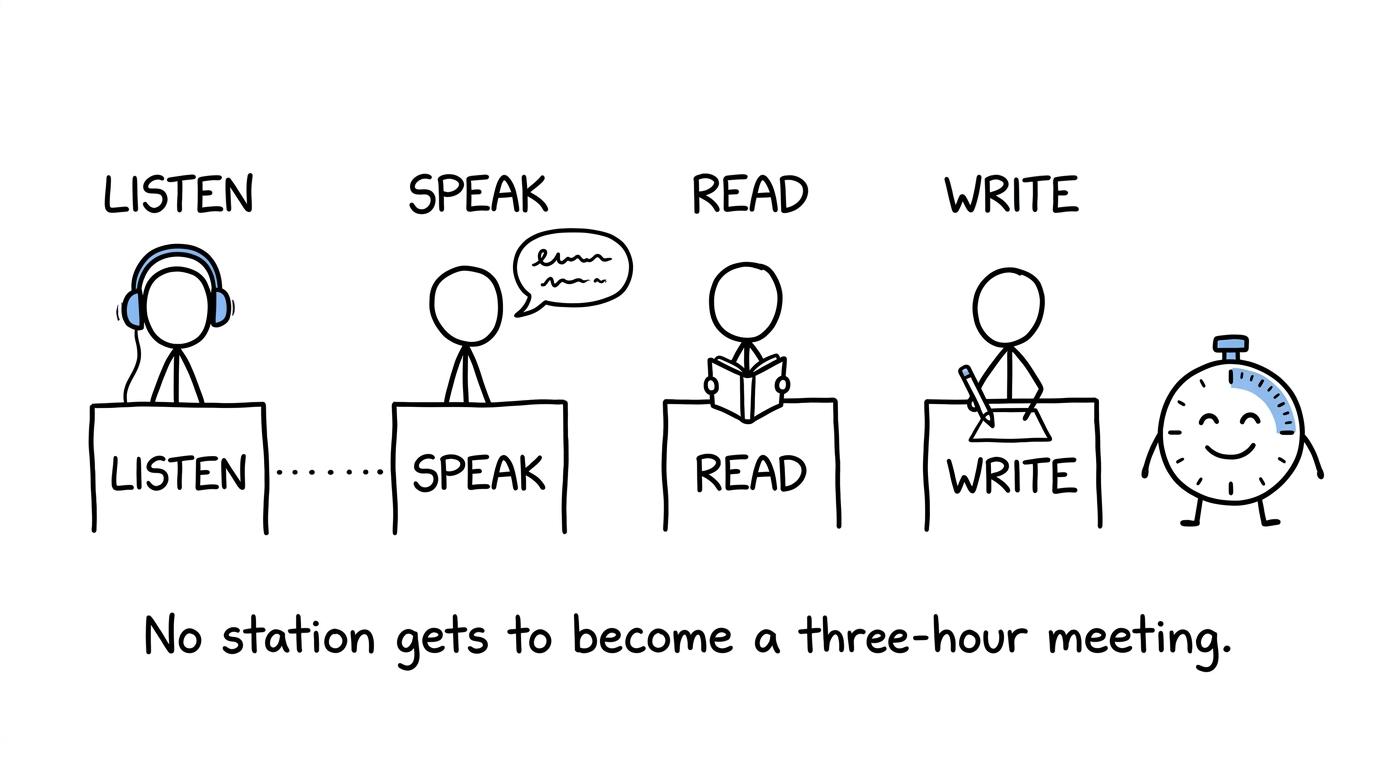 A four-station language revision relay watched by a timer
Read or write for 555 minutes
Alternate the skill by day. For reading, use a short extract and identify its purpose, key details, opinions and time references. Answer before reaching for a translation tool.
For writing, respond to one small bullet point rather than attempting an entire paper every evening. Practise building accurate sentences and checking agreements, verb forms, spelling and whether each idea answers the prompt.
Translation can also fit here. Work with a few sentences, mark them carefully and record the exact gap: unknown vocabulary, misunderstood grammar or an English translation that lost the original meaning.
Correct and plan for 222 minutes
Feedback is the hinge of the routine. Without it, you may repeat an error until it feels familiar.
Finish by writing three short notes:
- one word or phrase you forgot;
- one correction you need to remember;
- one target for tomorrow.
Keep this error log brief. Its purpose is to direct the next session, not become another revision project.
A weekly pattern that covers every skill
The daily structure can remain stable while the emphasis changes:
- Monday: vocabulary and listening
- Tuesday: vocabulary and speaking
- Wednesday: reading and translation
- Thursday: speaking and short writing
- Friday: mixed retrieval and correction
- Weekend: one longer exam-style section when your timetable permits
A longer weekend task is useful because 202020 minutes cannot fully reproduce every exam paper. Complete a properly selected section, mark it and feed the mistakes back into the next week’s short sessions.
Past papers are evidence, not punishment. They show whether the words and structures you recognise in isolation remain available under assessment conditions.
Fitting Arabic around GCSE maths revision
The answer is not to make Arabic and maths compete for the same undefined stretch of evening. Give each subject a clear job.
Place the Arabic routine at a reliable cue, such as after arriving home or before dinner. Schedule maths separately around questions and feedback. The GCSE Maths revision hub lets you choose the correct exam board, while the MathsGenie revision planner can help organise your available time.
On a crowded school day, you might use the Arabic routine followed by the GCSE 202020-minute maths revision routine. That creates two bounded sessions rather than one vague instruction to revise all evening.
For maths, use GCSE mini tests to identify weak topics and then return to the relevant revision lesson and practice questions. Nearer the examinations, add board-specific papers such as Edexcel GCSE Maths past papers, complete with mark schemes and available worked solutions.
The subjects require different material, but the productive loop is similar: attempt, check, record the mistake and revisit it.
Adjusting the routine as exams approach
Keep the daily habit, but change what enters it.
Early in the course, prioritise specification vocabulary, core grammar and comfortable sentence building. In the middle phase, use more unseen listening, reading and translation. During the final weeks, let marked paper mistakes choose the content of your daily sessions.
Do not replace official past-paper practice with guesses about likely questions. The same principle applies to maths. GCSE predicted papers provide useful fresh practice, but they should complement past papers rather than become a promise about what will appear.
If several subjects are approaching at once, the GCSE one-month revision plan offers a wider framework for diagnosing gaps, practising them and building towards timed work.
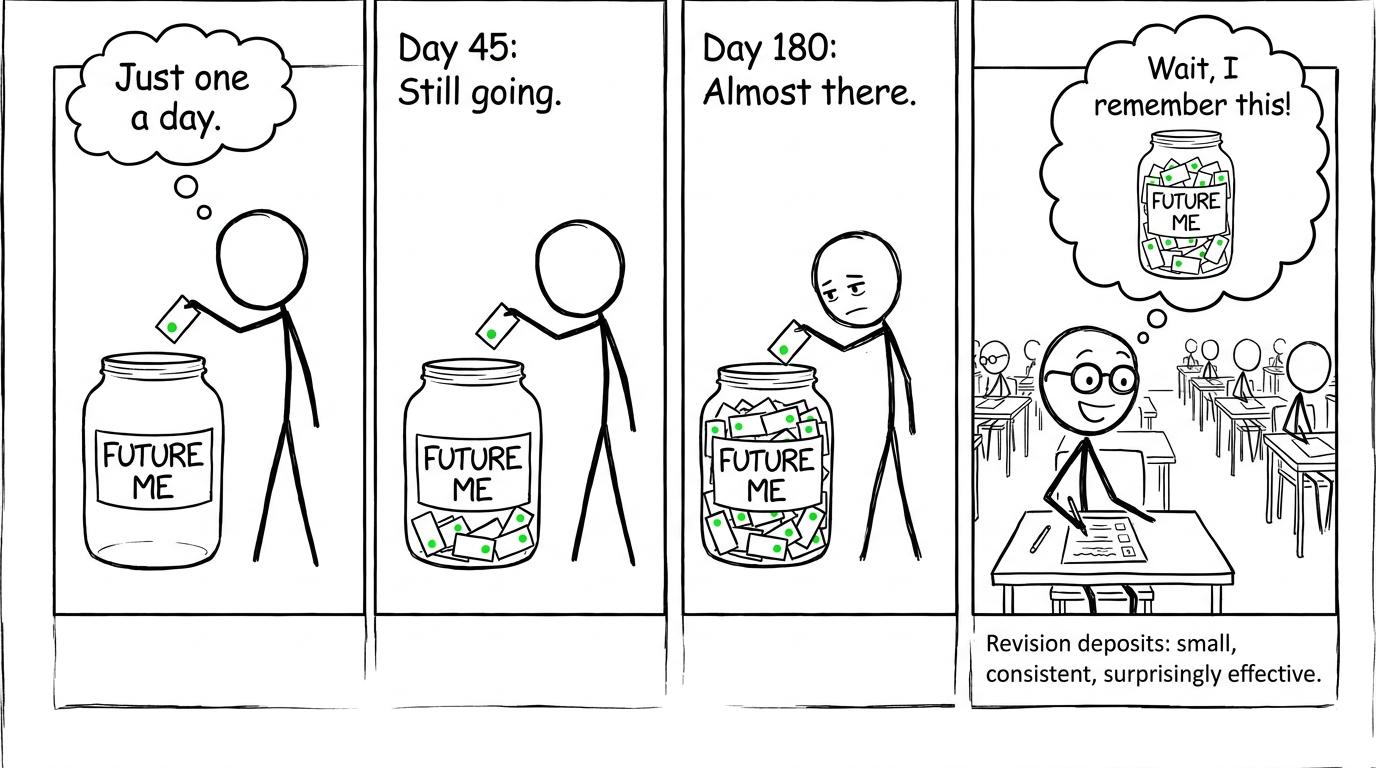 A student saving one small piece of revision for their future self
Common mistakes in a GCSE Arabic study routine
Revising only vocabulary
Vocabulary supports every skill, but isolated recall does not automatically become listening comprehension, fluent speech or accurate writing. Use new words in complete sentences and meet them in recordings and texts.
Spending the session making resources
A beautifully organised notebook can hide very little retrieval. Keep preparation short. Most of the timer should involve recalling, listening, speaking, reading or writing.
Avoiding speaking until school
Speaking needs physical practice. Say answers aloud regularly, even when they feel awkward, and use occasional recordings to identify one improvement at a time.
Checking answers too quickly
Looking immediately turns a recall task into recognition. Allow yourself a genuine attempt before revealing the word, transcript or model response.
Ignoring repeated errors
A marked answer is not automatically a learned answer. Put recurring mistakes into your error log and retest them on a later day.
Turning missed days into an all-nighter
If you miss Tuesday, continue on Wednesday. Do not create a punishing catch-up session that makes Thursday less likely. A sustainable routine survives imperfect weeks.
Small sessions, serious preparation
Twenty minutes can look insignificant because it does not feel dramatic. That is its strength. It is short enough to fit beside homework, maths practice and ordinary life, yet structured enough to touch the skills GCSE Arabic actually assesses.
Set one timer today. Retrieve vocabulary, listen, speak, read or write, then correct what happened. Tomorrow, return to the error rather than starting again from nothing.
Use MathsGenie as your free revision base: begin with the GCSE Arabic revision page, then keep your maths preparation moving through revision lessons, practice questions, mini tests, past papers, predicted papers, mark schemes and video solutions. The goal is not one heroic night. It is a routine your future self can rely on.