Functions Exam Questions: GCSE Worked Examples
Functions exam questions explained through three GCSE examples. Learn substitution, composite and inverse functions, method marks and common mistakes.
Functions exam questions can feel harder than the algebra they contain. The notation is compact, several operations may be hidden inside one instruction, and a single order mistake can change everything.
The useful truth is that most GCSE functions questions test a short sequence of dependable skills: substitute carefully, apply functions in the correct order, and reverse operations accurately. This guide follows a student through three exam-style questions of rising difficulty, showing the working that is likely to earn method marks as well as the final answer.
A quick functions checklist
Before answering a functions GCSE exam question, ask:
- What does the notation tell me to do?
- Which function must be applied first?
- Have I substituted using brackets?
- If I need an inverse, have I reversed every operation in reverse order?
- Can I show one clear algebraic step for each part of my method?
Function notation is simply a concise way of describing a rule. If
f(x)=3x+2, f(x)=3x+2, f(x)=3x+2,then f(5)f(5)f(5) means substitute 555 wherever xxx appears:
f(5)=3(5)+2. f(5)=3(5)+2. f(5)=3(5)+2.It does not mean f×5f\times5f×5. Keeping that distinction clear prevents many lost marks.
Question one: evaluating a function
A student, Sam, begins with the most direct type of functions exam question.
The function fff is defined by f(x)=x2−3x+4f(x)=x^2-3x+4f(x)=x2−3x+4. Find f(−2)f(-2)f(−2).
Sam knows that evaluating a function means replacing every xxx with the given input. The safest first line is:
f(−2)=(−2)2−3(−2)+4. f(-2)=(-2)^2-3(-2)+4. f(−2)=(−2)2−3(−2)+4.Now calculate each term:
f(−2)=4+6+4=14. f(-2)=4+6+4=14. f(−2)=4+6+4=14.Therefore,
f(−2)=14. \boxed{f(-2)=14}. f(−2)=14.Where the marks may come from
A typical short question may award a mark for correct substitution or a valid intermediate method, followed by a mark for the correct answer. Exact allocation depends on the paper and its mark scheme, but Sam's first line makes the method visible.
If Sam wrote only 141414, the answer could still be correct. However, shown working protects method marks if a later arithmetic slip occurs. This matters particularly on longer questions.
The brackets around −2-2−2 are important. Without them, it is easy to treat (−2)2(-2)^2(−2)2 incorrectly. A negative input should usually trigger an immediate habit: substitute with brackets.
Question two: composite functions
The next question adds a second rule.
f(x)=2x+5 f(x)=2x+5 f(x)=2x+5The functions fff and ggg are defined by
g(x)=x2−1. g(x)=x^2-1. g(x)=x2−1.and
Find fg(3)fg(3)fg(3).
At GCSE, fg(3)fg(3)fg(3) means apply ggg first and then apply fff to the result. It can be read as:
fg(3)=f(g(3)). fg(3)=f(g(3)). fg(3)=f(g(3)).Sam separates the journey into two stages.
First, find g(3)g(3)g(3):
g(3)=32−1=8. g(3)=3^2-1=8. g(3)=32−1=8.Then use that output as the input of fff:
f(8)=2(8)+5=21. f(8)=2(8)+5=21. f(8)=2(8)+5=21.Therefore,
fg(3)=21. \boxed{fg(3)=21}. fg(3)=21.Where the marks may come from
On an exam-style composite-functions question, useful evidence includes:
- correctly interpreting fg(3)fg(3)fg(3) as f(g(3))f(g(3))f(g(3));
- obtaining the correct inner value g(3)=8g(3)=8g(3)=8;
- substituting that value into fff;
- reaching the correct final answer.
The actual mark structure varies, so students should use the mark scheme belonging to the paper. Still, writing the inner calculation first is an excellent exam habit because it exposes the key method.
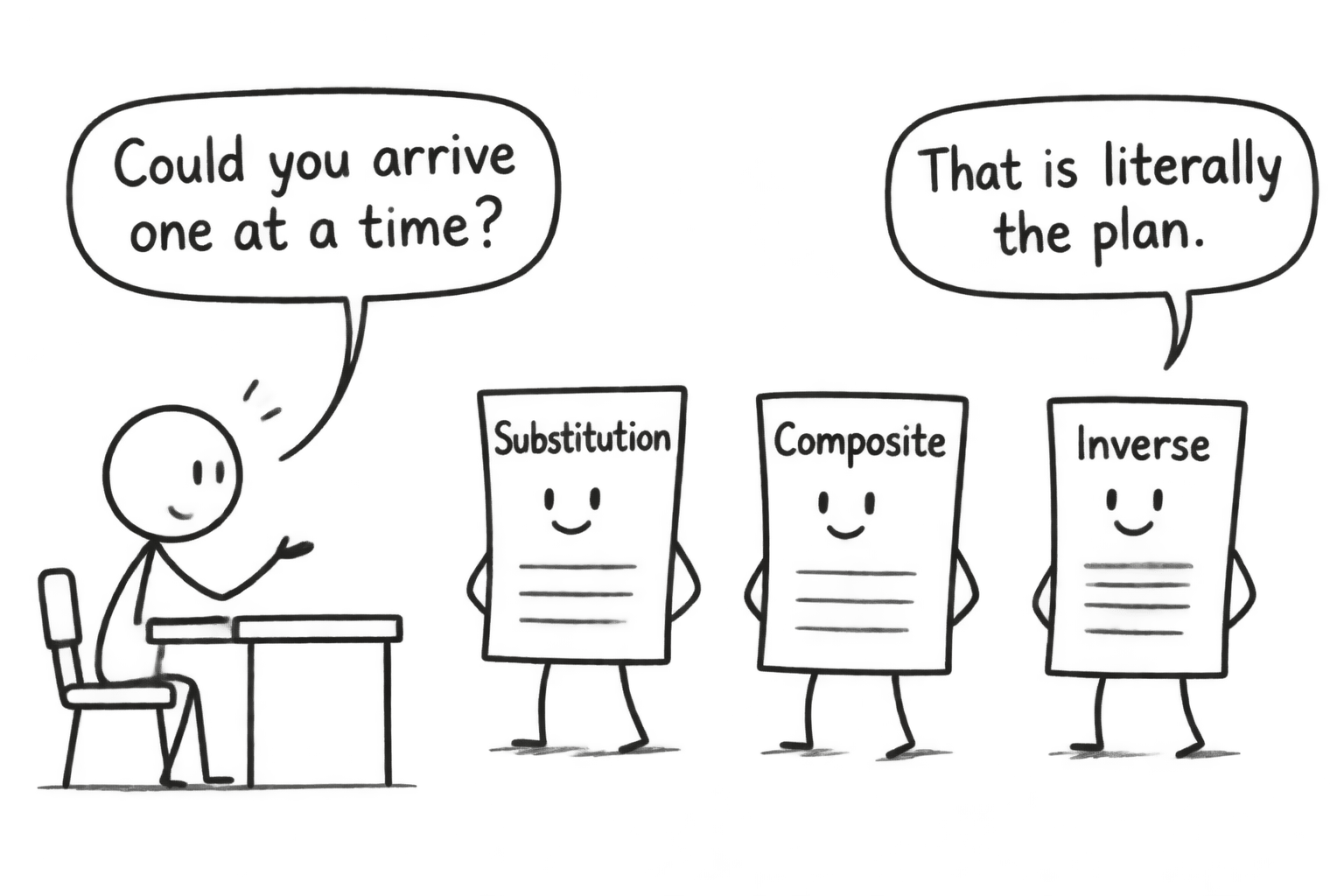 A student asks three functions questions to arrive one at a time
Sam nearly calculates g(f(3))g(f(3))g(f(3)) instead. That would be gf(3)gf(3)gf(3), not fg(3)fg(3)fg(3). Composite notation works from right to left: the function nearest the input acts first.
You now have the core method, so use the Maths Genie GCSE functions lesson and its questions to practise applying it without having to assemble examples yourself.
Question three: finding and using an inverse function
The final question asks Sam to reverse a function.
h(x)=3x−45. h(x)=\frac{3x-4}{5}. h(x)=53x−4.The function hhh is defined by
Find h−1(x)h^{-1}(x)h−1(x) and hence solve h−1(x)=8h^{-1}(x)=8h−1(x)=8.
The notation h−1h^{-1}h−1 means the inverse function. It does not mean 1h(x)\frac{1}{h(x)}h(x)1.
Sam starts by writing the function using yyy:
y=3x−45. y=\frac{3x-4}{5}. y=53x−4.To find the inverse, make xxx the subject. Multiply both sides by 555:
5y=3x−4. 5y=3x-4. 5y=3x−4.Add 444:
5y+4=3x. 5y+4=3x. 5y+4=3x.Divide by 333:
x=5y+43. x=\frac{5y+4}{3}. x=35y+4.Swap the input and output notation:
h−1(x)=5x+43. \boxed{h^{-1}(x)=\frac{5x+4}{3}}. h−1(x)=35x+4.Sam can now solve the second part:
5x+43=8. \frac{5x+4}{3}=8. 35x+4=8.Multiply by 333:
5x+4=24. 5x+4=24. 5x+4=24.Subtract 444 and divide by 555:
5x=20, 5x=20, 5x=20, x=4. \boxed{x=4}. x=4.Checking the inverse
A reliable check is to apply the original function and its inverse consecutively. Since the answer is x=4x=4x=4 and h−1(4)=8h^{-1}(4)=8h−1(4)=8, the original function should take 888 back to 444:
h(8)=3(8)−45=205=4. h(8)=\frac{3(8)-4}{5}=\frac{20}{5}=4. h(8)=53(8)−4=520=4.The check succeeds.
Where the marks may come from
This question contains several mark-worthy algebraic steps. Sam demonstrates rearrangement by removing the denominator, isolating xxx, stating the inverse correctly and then solving the resulting equation. Even if the final arithmetic were wrong, valid earlier work could still earn credit where the mark scheme allows it.
That is why method marks are best thought of as a record of mathematical decisions. Examiners cannot award credit for a method they cannot see.
A method for functions past paper questions
The three questions suggest a repeatable routine:
Translate the notation
Rewrite a composite function in nested form if needed:
fg(x)=f(g(x)). fg(x)=f(g(x)). fg(x)=f(g(x)).For an inverse, think: reverse the mapping.
Show the substitution
Place negative numbers and algebraic expressions in brackets. For example, if f(x)=x2+1f(x)=x^2+1f(x)=x2+1, then:
f(a−2)=(a−2)2+1. f(a-2)=(a-2)^2+1. f(a−2)=(a−2)2+1.Keep stages separate
For a composite function, calculate the inner function before the outer function. For an inverse, rearrange one operation at a time.
Check when possible
An inverse should undo the original function. A composite answer can be checked by repeating each function rule slowly and confirming the order.
Once individual questions feel secure, practise them within complete GCSE past papers. Timed papers test a different skill: recognising a functions question when it appears among geometry, number and statistics.
Common mistakes in functions exam questions
Applying composite functions in the wrong order
For fg(x)fg(x)fg(x), apply ggg first and fff second. Writing f(g(x))f(g(x))f(g(x)) before calculating can prevent the mistake.
Treating f(x)f(x)f(x) as multiplication
The letter fff names the function. The expression f(3)f(3)f(3) means the output when the input is 333, not f×3f\times3f×3.
Losing a negative sign
If the input is negative, substitute it using brackets. Compare (−3)2=9(-3)^2=9(−3)2=9 with −32=−9-3^2=-9−32=−9.
Confusing an inverse with a reciprocal
In function notation, f−1(x)f^{-1}(x)f−1(x) is the rule that reverses f(x)f(x)f(x). It is not generally equal to 1f(x)\frac{1}{f(x)}f(x)1.
Skipping algebraic lines
A correct answer is valuable, but clear intermediate steps make your reasoning available to the examiner. This is especially important in inverse and composite questions worth several marks.
Ignoring the command word
“Find f(4)f(4)f(4)”, “find fg(x)fg(x)fg(x)” and “find f−1(x)f^{-1}(x)f−1(x)” require different processes. Circle or underline the exact notation before starting.
Turn the method into exam practice
Sam's progress came from reducing each question to a sequence: interpret, substitute, simplify and check. Knowing that sequence is the first step; following it accurately under exam conditions requires focused repetition.
Use the Maths Genie functions lesson to review the technique, then open the Maths Genie GCSE question bank and practise functions exam questions from straightforward substitution through to composite and inverse functions. Start with the Functions lesson and continue into the Question Bank.