Forming Equations Exam Questions: GCSE Guide
Forming equations exam questions explained through three GCSE examples, with clear steps, method-mark guidance, common mistakes and focused practice.
A worded algebra question can feel like detective work: the numbers are hidden inside a story, and the unknown has no name. Yet forming equations exam questions test a repeatable skill: translate relationships into algebra, connect equal quantities, solve and interpret the result.
The challenge is separating those stages. You do not need to guess the examiner's equation. You need to explain what each quantity represents and how the information connects.
Start with the Forming and Solving Equations lesson if you need guided teaching before practising independently.
A checklist for forming equations
- Choose a letter for the unknown.
- Express related quantities using that letter.
- Identify two quantities that must be equal.
- Write the equation before solving it.
- Show your algebraic steps.
- Answer the question in context.
- Check against the original information.
Remember: name it, express it, equate it, solve it, check it.
Choose an unknown that keeps the expressions simple. In an age question, starting with the younger person often avoids subtraction. Write a short definition beside your working so you remember whether the letter represents an age, a length or a number. The letter is a label for a quantity, not the final answer itself.
Both foundation and higher tier questions can assess this skill, although the algebraic difficulty varies. The Forming and Solving Equations booklet provides focused practice with different wording.
Question one: forming an equation from ages
Aisha is 777 years older than Ben. Their ages total 313131. Find both ages.
Let Ben's age be xxx. Aisha's age is therefore x+7x+7x+7. Their combined age gives the equation:
x+(x+7)=31x+(x+7)=31x+(x+7)=31Collect like terms, subtract 777 and divide by 222:
2x+7=312x+7=312x+7=31 2x=242x=242x=24 x=12x=12x=12Ben is 121212 years old. Aisha is 12+7=1912+7=1912+7=19 years old.
Check both relationships: 12+19=3112+19=3112+19=31 and 19−12=719-12=719−12=7. A solution must satisfy the whole question, not just one sentence.
Why show the equation?
A mark scheme may reward a valid equation even if later arithmetic goes wrong. Exact allocations depend on the paper and question, so never assume a particular step guarantees a mark. Clear working makes your method visible.
Keep each algebraic change on its own line, with equals signs connecting expressions that genuinely have the same value. If you subtract a number from one side, subtract it from the other too. This layout helps you spot an arithmetic slip without losing the correct equation you formed from the original words.
Question two: forming an equation with perimeter
A rectangle has width x−1x-1x−1 cm and length 2x+32x+32x+3 cm. Its perimeter is 343434 cm. Find its dimensions.
A rectangle has two widths and two lengths, so:
2(x−1)+2(2x+3)=342(x-1)+2(2x+3)=342(x−1)+2(2x+3)=34Expand both brackets:
2x−2+4x+6=342x-2+4x+6=342x−2+4x+6=34Simplify and solve:
6x+4=346x+4=346x+4=34 6x=306x=306x=30 x=5x=5x=5The question asks for dimensions, not simply xxx. Substitute into each expression:
Width=5−1=4 cm\text{Width}=5-1=4\text{ cm}Width=5−1=4 cm Length=2(5)+3=13 cm\text{Length}=2(5)+3=13\text{ cm}Length=2(5)+3=13 cmThe rectangle is 444 cm by 131313 cm. Checking gives 2(4)+2(13)=342(4)+2(13)=342(4)+2(13)=34, matching the stated perimeter.
This question adds two demands: remembering both pairs of sides and expanding brackets accurately. If expansion causes problems, revisit Expanding and Factorising revision before attempting another perimeter problem.
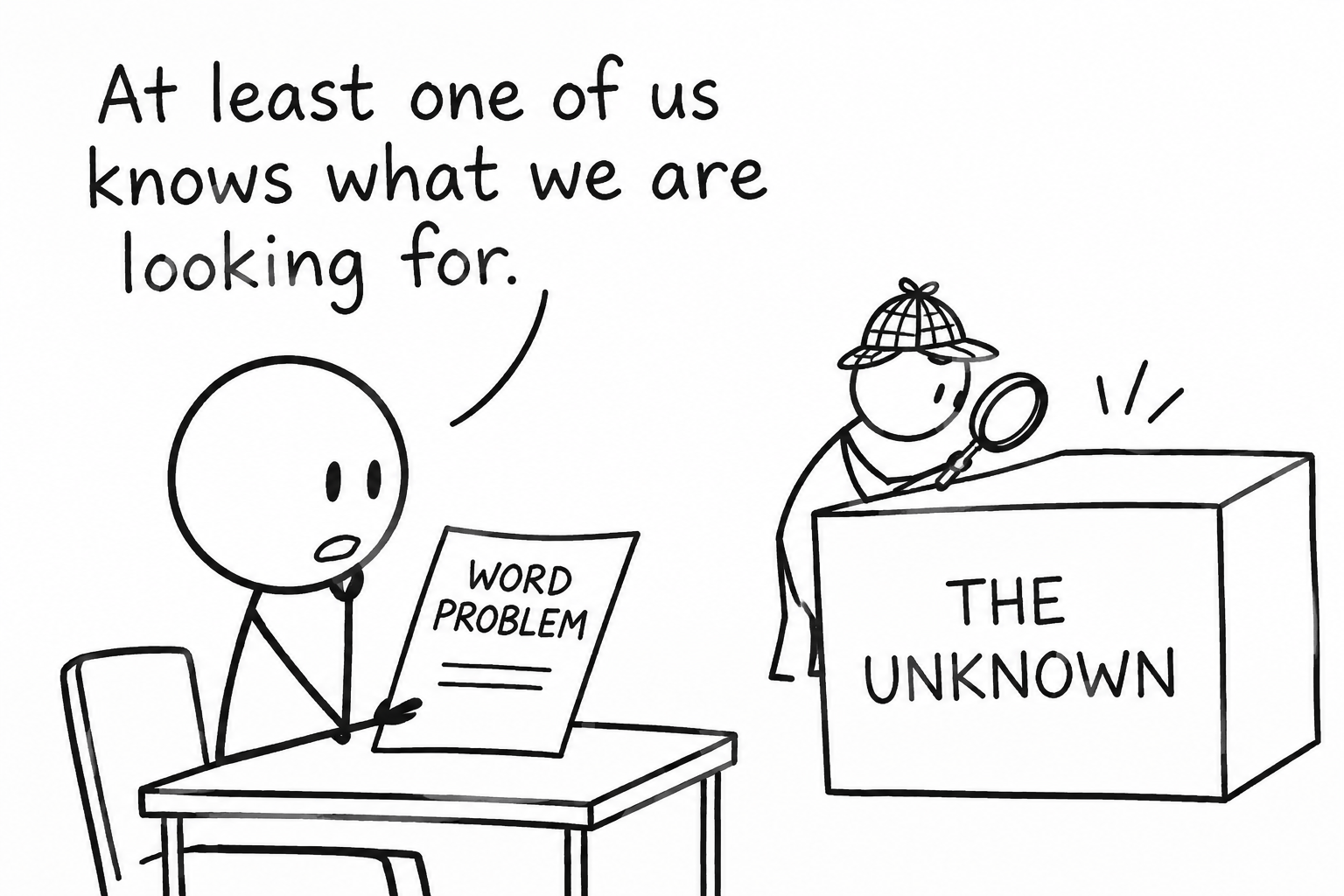 A student and a tiny detective search for the unknown in a word problem
Question three: forming a quadratic equation
Two consecutive positive integers have a product of 727272. Find the integers.
This higher-tier style problem needs multiplication rather than addition. Let the smaller integer be xxx. The next consecutive integer is x+1x+1x+1, giving:
x(x+1)=72x(x+1)=72x(x+1)=72Expand and rearrange so one side equals zero:
x2+x−72=0x^2+x-72=0x2+x−72=0To factorise, find two numbers with product −72-72−72 and sum 111. They are 999 and −8-8−8:
(x+9)(x−8)=0(x+9)(x-8)=0(x+9)(x−8)=0Therefore, x=−9x=-9x=−9 or x=8x=8x=8.
The question requires positive integers, so reject x=−9x=-9x=−9. The required integers are 888 and 999, and 8×9=728\times9=728×9=72.
Notice that the algebra produces possible solutions, while the context decides which are acceptable. Defining the integers, forming the equation, solving and interpreting are separate stages worth showing clearly.
Use the Edexcel GCSE Maths Question Bank to practise recognising whether a situation produces a linear or quadratic equation.
Recognising relationships in words
Certain phrases suggest useful starting points:
- “Twice” means multiply by 222.
- “Total” suggests adding quantities.
- “Product” means multiplication.
- “Consecutive integers” can be represented by xxx and x+1x+1x+1.
- “Perimeter” means the total distance around a shape.
- “The same as” identifies equal quantities.
Read the whole relationship rather than translating isolated words. For example, “555 less than xxx” means x−5x-5x−5, not 5−x5-x5−x.
Before calculating, ask what the equals sign will mean. It might connect two expressions for the same length, or connect a sum of costs to a stated total. This small pause helps prevent an equation that uses every number but describes the wrong relationship.
Students following OCR can use the OCR Forming and Solving Equations resources to practise the same reasoning.
Common mistakes in forming equations exam questions
Losing the relationship
If one person is 444 years older than another, their ages cannot both be xxx. Use xxx and x+4x+4x+4 so the difference remains visible.
Missing brackets
Three identical bags containing x+2x+2x+2 objects each contain 3(x+2)3(x+2)3(x+2) objects altogether, not 3x+23x+23x+2. The multiplier applies to the entire expression.
Stopping at the unknown
In the rectangle example, x=5x=5x=5 was an intermediate result. Read the final instruction again and give the requested dimensions, ages or numbers, including units where appropriate.
Rejecting every negative root
A negative answer is not automatically incorrect. Reject it only when it conflicts with the question, such as a positive-integer requirement or a physical length.
Exam-style practice
Try these without looking back:
- Two numbers differ by 111111 and total 474747. Find both numbers.
- An isosceles triangle has equal sides of x+4x+4x+4 cm and a base of x−2x-2x−2 cm. Its perimeter is 353535 cm. Find its side lengths.
- Two consecutive positive integers have a product of 156156156. Find them.
Check your unknown, equation, solving and interpretation separately. These are revision checkpoints, not an official mark scheme.
After checking your answers, cover the solution and form each equation again without solving it. This isolates translation from arithmetic. Then return to any incorrect question later and explain the relationship aloud before writing. If you can say why both sides are equal, you are checking your reasoning rather than simply recognising a familiar pattern.
Make the method reliable
Progress comes from applying the same routine to unfamiliar wording. Use MathsGenie's lesson, practise with the booklet, then tackle mixed questions. When an answer goes wrong, identify the stage that failed rather than restarting blindly. That makes your next attempt more purposeful.