Factorising Harder Quadratics Exam Questions
Factorising harder quadratics exam questions: follow three worked GCSE examples, find method marks and practise confidently for the Higher tier exam.
Factorising a quadratic often feels straightforward until the coefficient of x2x^2x2 is no longer 111. Suddenly there are more factor pairs, more signs and more places for a small error to spread.
The reliable answer to factorising harder quadratics exam questions is not to guess brackets repeatedly. Use the product-and-sum method: multiply the coefficient of x2x^2x2 by the constant, split the middle term, then factorise by grouping.
We will follow a hypothetical student, Maya, through three GCSE exam-style questions of rising difficulty. Her working also shows where method marks may come from. Exact allocations vary between papers and exam boards, so always read the question and its mark value carefully.
The method to remember
For a quadratic in the form
ax2+bx+c,ax^2+bx+c,ax2+bx+c,use this checklist:
- Calculate a×ca\times ca×c.
- Find two numbers that multiply to a×ca\times ca×c and add to bbb.
- Split bxbxbx using those two numbers.
- Factorise the first pair and the second pair of terms.
- Take out the common bracket.
- Expand your answer mentally to check it.
This method works because splitting the middle term creates two groups with a shared factor. If you need to see the process before attempting questions, begin with the Factorising Harder Quadratics lesson.
Question one: both signs are positive
Maya starts with:
Factorise fully 6x2+11x+36x^2+11x+36x2+11x+3.
First, multiply the first and last coefficients:
6×3=18.6\times 3=18.6×3=18.She needs two numbers with a product of 181818 and a sum of 111111. They are 999 and 222:
9×2=18,9\times 2=18,9×2=18, 9+2=11.9+2=11.9+2=11.Now split the middle term:
6x2+9x+2x+3.6x^2+9x+2x+3.6x2+9x+2x+3.Factorise each pair:
3x(2x+3)+1(2x+3).3x(2x+3)+1(2x+3).3x(2x+3)+1(2x+3).Both terms contain the same bracket, so:
6x2+11x+3=(3x+1)(2x+3).6x^2+11x+3=(3x+1)(2x+3).6x2+11x+3=(3x+1)(2x+3).Where might the method marks come from?
On a question with several marks available, a valid split such as 9x+2x9x+2x9x+2x demonstrates the central method. Correctly factorising the two groups shows further progress, while the accurate final pair of brackets earns the accuracy mark.
A mark scheme may accept a different valid route, including systematic inspection. The important point is that visible working gives an examiner evidence of your method. A crossed-out guess followed only by an incorrect answer usually gives much less to reward.
You now have the full routine; use the Maths Genie lessons and Factorising Harder Quadratics question bank to repeat it until choosing the two middle numbers becomes familiar.
Question two: handling opposite signs
The next question is less forgiving:
Factorise fully 12x2−7x−1012x^2-7x-1012x2−7x−10.
Maya calculates:
12×(−10)=−120.12\times(-10)=-120.12×(−10)=−120.Because the product is negative, the two numbers must have opposite signs. Their sum must be −7-7−7. The required pair is 888 and −15-15−15:
8×(−15)=−120,8\times(-15)=-120,8×(−15)=−120, 8+(−15)=−7.8+(-15)=-7.8+(−15)=−7.She splits the middle term:
12x2+8x−15x−10.12x^2+8x-15x-10.12x2+8x−15x−10.Then she factorises by grouping:
4x(3x+2)−5(3x+2).4x(3x+2)-5(3x+2).4x(3x+2)−5(3x+2).The repeated bracket is (3x+2)(3x+2)(3x+2), giving:
12x2−7x−10=(4x−5)(3x+2).12x^2-7x-10=(4x-5)(3x+2).12x2−7x−10=(4x−5)(3x+2).Maya checks the middle terms by expanding only the cross-products:
8x−15x=−7x.8x-15x=-7x.8x−15x=−7x.That ten-second check matters. The first and last terms can look correct even when the signs in the brackets produce the wrong middle term.
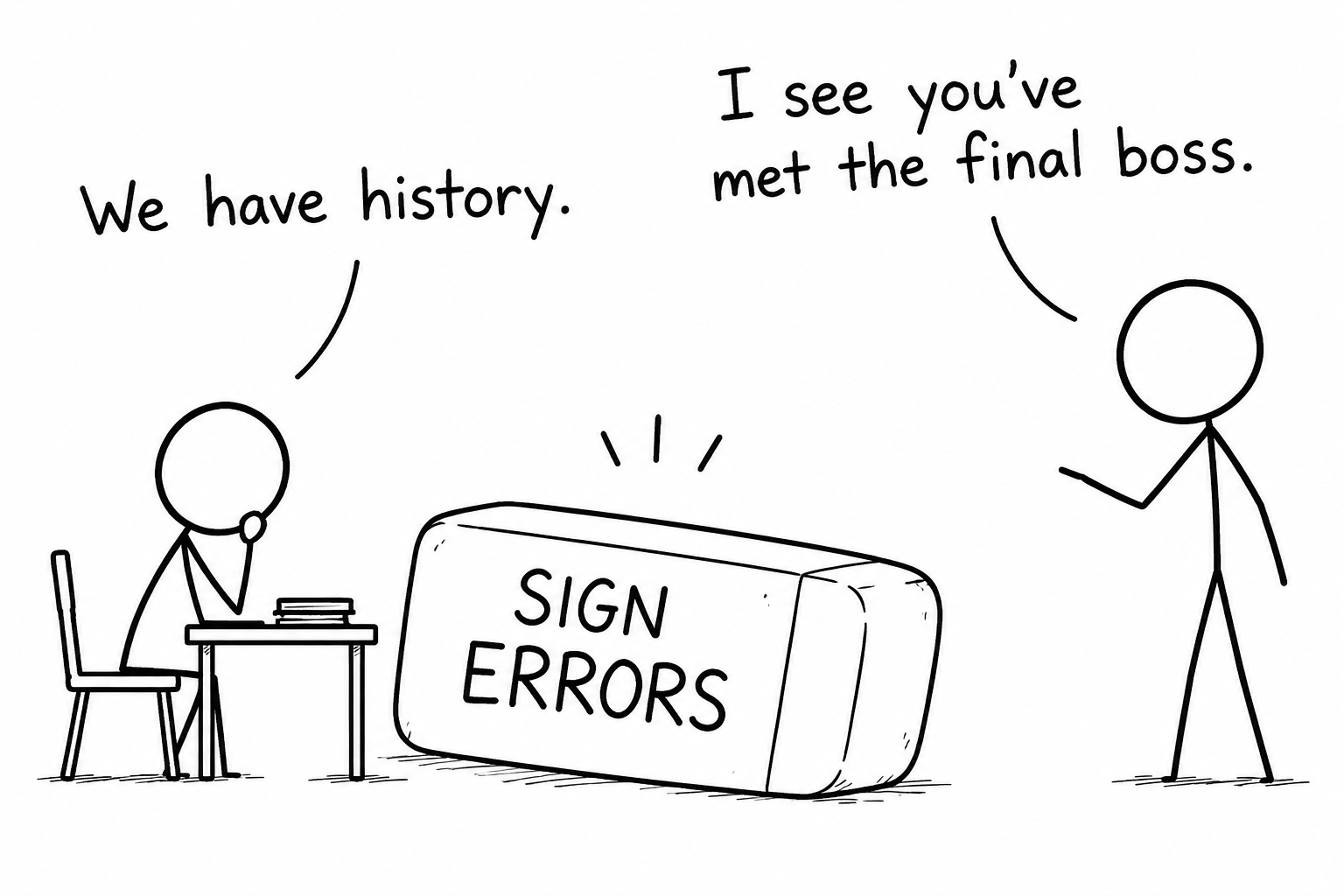 XKCD-style comic about confronting sign errors during algebra revision
For more examples arranged around the same skill, the Factorising Harder Quadratics revision guide provides a useful bridge between learning the process and answering independent questions.
Question three: take out the common factor first
Maya's final question adds a step that is easy to overlook:
Factorise fully 18x2−21x−1218x^2-21x-1218x2−21x−12.
Every term is divisible by 333, so she begins with the highest common factor:
18x2−21x−12=3(6x2−7x−4).18x^2-21x-12=3(6x^2-7x-4).18x2−21x−12=3(6x2−7x−4).She now factorises the quadratic inside the bracket. The product is:
6×(−4)=−24.6\times(-4)=-24.6×(−4)=−24.She needs two numbers that multiply to −24-24−24 and add to −7-7−7. These are −8-8−8 and 333:
−8×3=−24,-8\times 3=-24,−8×3=−24, −8+3=−5.-8+3=-5.−8+3=−5.That sum is wrong. Maya pauses rather than forcing the method. The correct sum required is −7-7−7, so the pair should still multiply to −24-24−24. The correct pair is −?-?−?
At this point, the check reveals that the proposed expression does not factorise over integers as written. This is exactly why testing the product and sum before splitting the middle term matters. In an exam, continuing with an invalid pair would lose the method.
Suppose the intended question is instead:
18x2−15x−12.18x^2-15x-12.18x2−15x−12.Taking out the common factor gives:
3(6x2−5x−4).3(6x^2-5x-4).3(6x2−5x−4).Now −8-8−8 and 333 multiply to −24-24−24 and add to −5-5−5:
3(6x2−8x+3x−4).3(6x^2-8x+3x-4).3(6x2−8x+3x−4).Factorising by grouping gives:
3(2x(3x−4)+1(3x−4)),3\bigl(2x(3x-4)+1(3x-4)\bigr),3(2x(3x−4)+1(3x−4)),and therefore:
18x2−15x−12=3(2x+1)(3x−4).18x^2-15x-12=3(2x+1)(3x-4).18x2−15x−12=3(2x+1)(3x−4).This correction teaches a valuable exam habit: arithmetic checks are part of the method, not something saved for the end. In a genuine paper, never alter the printed question. If no integer pair exists, reread your multiplication and signs before deciding whether another technique is required.
Common mistakes in harder quadratic questions
Forgetting the highest common factor
If every term has a common factor, remove it first. An answer such as
(6x+3)(3x−4)(6x+3)(3x-4)(6x+3)(3x−4)may expand correctly, but it is not fully factorised because 6x+36x+36x+3 still contains a factor of 333.
Using factors of ccc instead of a×ca\times ca×c
For 6x2+11x+36x^2+11x+36x2+11x+3, the product-and-sum search uses 181818, not merely 333. That distinction is what separates harder quadratics from expressions where the coefficient of x2x^2x2 is 111.
Losing a negative sign while grouping
From
12x2+8x−15x−10,12x^2+8x-15x-10,12x2+8x−15x−10,the second group is
−5(3x+2),-5(3x+2),−5(3x+2),not −5(3x−2)-5(3x-2)−5(3x−2). Dividing both terms by −5-5−5 changes both signs.
Solving when the question says factorise
If the instruction is to factorise, stop at the brackets. Do not set each bracket equal to zero unless the expression is part of an equation and the question asks you to solve it.
Giving only the final answer
A correct answer earns the marks, but clear intermediate work protects you when a final sign is wrong. Write the product, the chosen pair and the split middle term. This makes your reasoning visible.
How to practise exam-style questions
Begin with untimed questions and use the checklist beside you. Next, remove the checklist and complete a short set independently. Finally, try mixed questions where you must decide whether to take out a common factor first.
The GCSE exam booklets and worksheets are useful for written practice. You can also inspect an individual Factorising Harder Quadratics exam-style question and mark scheme to compare your working with an accepted solution.
When reviewing factorising harder quadratics past paper questions, record the cause of each error. A note such as “wrong opposite-sign pair” is more useful than simply writing “careless”. It tells you what to check next time.
Turn the method into exam marks
Maya's progress did not come from guessing faster. It came from using the same sequence each time, checking the product and sum, and leaving enough working for method marks. Your remaining gap is repetition under exam conditions.
Start the Maths Genie Factorising Harder Quadratics Lessons and Question Bank and turn this six-step method into a routine you can trust.