Factorising GCSE Maths: A Clear Step-by-Step Guide
Factorising GCSE maths explained with clear steps, worked examples, common mistakes and exam-style questions to build accuracy and confidence.
Factorising can feel strangely unfair. You may understand every word your teacher says, copy the method correctly, then lose the answer because one sign changes or one factor stays hidden.
Imagine a GCSE student called Sam. Sam’s usual approach is to stare at an expression until two brackets somehow appear. Sometimes it works. Often it does not. The breakthrough comes when Sam stops treating factorising as a guessing game and starts seeing it as the reverse of expanding.
That is the central idea behind factorising GCSE maths questions: rewrite an expression as a multiplication. To check the result, expand the brackets. If expanding returns the original expression exactly, the factorisation is correct.
Your factorising checklist
Before choosing a method, ask:
- Is there a common factor in every term?
- Is the expression a quadratic such as x2+bx+cx^2+bx+cx2+bx+c?
- Is it the difference of two squares?
- Does the question say fully factorise?
- Can I expand my answer to check it?
Those five questions turn an uncertain search into a repeatable process. The Expanding and Factorising lesson introduces the connection between the two operations, while the Expanding and Factorising revision guide provides focused notes and examples.
What does factorising mean?
Expanding removes brackets:
3(x+4)=3x+123(x+4)=3x+123(x+4)=3x+12Factorising reverses that process:
3x+12=3(x+4)3x+12=3(x+4)3x+12=3(x+4)The number 333 is a factor of both terms. Taking it outside the bracket shows that the expression is a multiplication.
This matters because factorised expressions are often easier to simplify or use when solving equations. GCSE specifications include taking out common factors and factorising quadratic expressions, although the precise demand and tier placement depend on the exam board and specification.
Factorising with a common factor
Sam first tries to factorise:
8x+128x+128x+12The first thought is to take out 222:
8x+12=2(4x+6)8x+12=2(4x+6)8x+12=2(4x+6)That is mathematically correct, but it is not fully factorised because 4x4x4x and 666 still share a factor of 222. The highest common factor of 888 and 121212 is 444, so the complete answer is:
8x+12=4(2x+3)8x+12=4(2x+3)8x+12=4(2x+3)Expand to check:
4(2x+3)=8x+124(2x+3)=8x+124(2x+3)=8x+12Worked example with letters
Fully factorise:
15x2y+20xy215x^2y+20xy^215x2y+20xy2The highest common numerical factor is 555. Both terms also contain xxx and yyy, so the complete common factor is 5xy5xy5xy:
15x2y+20xy2=5xy(3x+4y)15x^2y+20xy^2=5xy(3x+4y)15x2y+20xy2=5xy(3x+4y)Check each multiplication:
5xy×3x=15x2y5xy\times3x=15x^2y5xy×3x=15x2y 5xy×4y=20xy25xy\times4y=20xy^25xy×4y=20xy2Sam’s new rule is simple: find what every term shares, not merely the first factor that comes to mind.
You can reinforce this method with the Expanding and Factorising exam booklet, using its answers to check whether each expression is fully factorised.
You now have the method, so start the matching Maths Genie Lesson and Question Bank when you want structured factorising questions without having to assemble your own practice set.
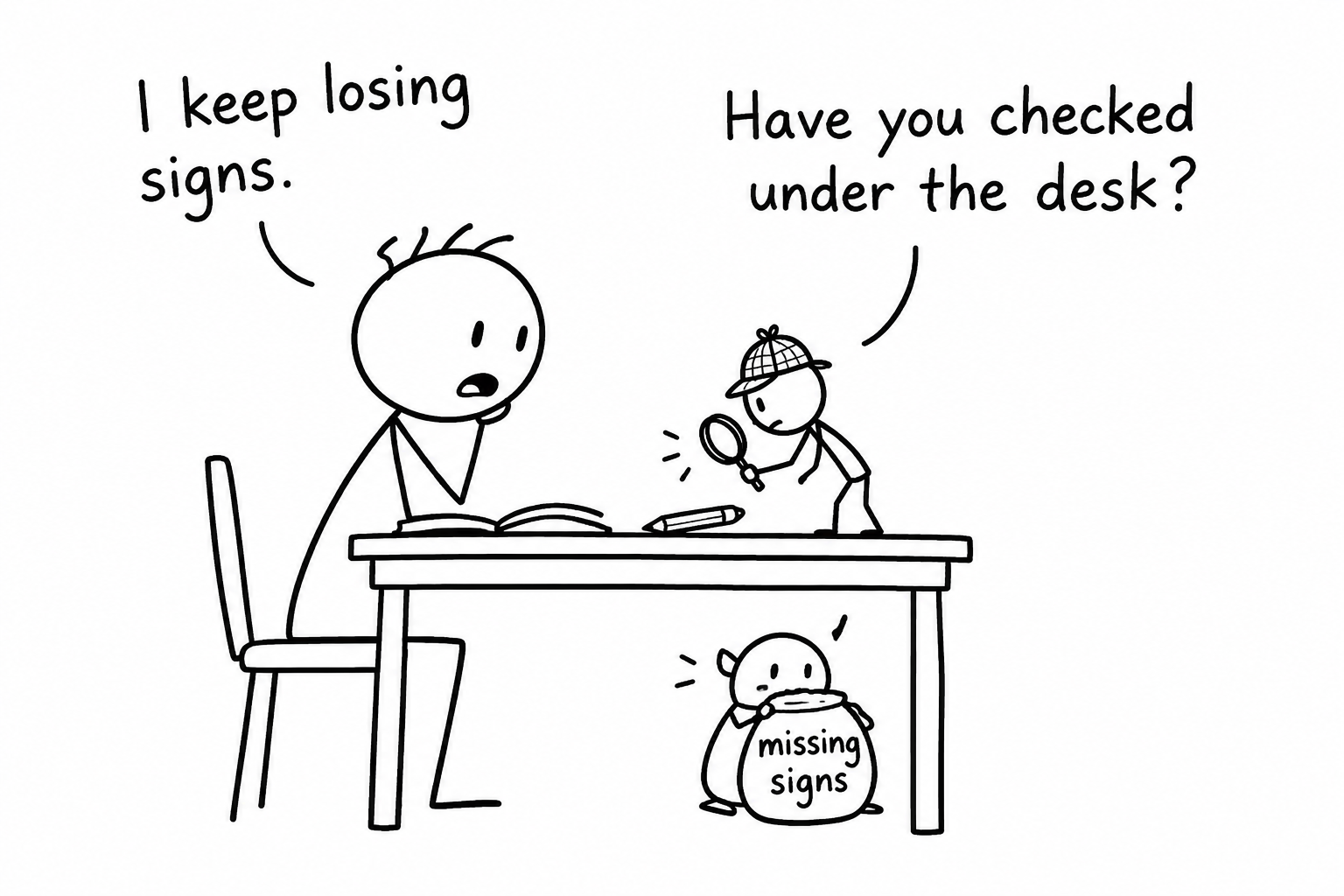 A stick-figure detective investigates the case of the missing algebra signs
Factorising quadratics into two brackets
A quadratic such as
x2+7x+12x^2+7x+12x2+7x+12can be factorised into two brackets. For an expression of the form
x2+bx+c,x^2+bx+c,x2+bx+c,find two numbers that:
- multiply to make ccc;
- add to make bbb.
Factorising worked example with two positive signs
Factorise:
x2+7x+12x^2+7x+12x2+7x+12Sam lists the factor pairs of 121212:
1×12,2×6,3×41\times12,\qquad 2\times6,\qquad 3\times41×12,2×6,3×4The numbers 333 and 444 multiply to make 121212 and add to make 777. Therefore:
x2+7x+12=(x+3)(x+4)x^2+7x+12=(x+3)(x+4)x2+7x+12=(x+3)(x+4)Expanding checks the answer:
(x+3)(x+4)=x2+4x+3x+12=x2+7x+12(x+3)(x+4)=x^2+4x+3x+12=x^2+7x+12(x+3)(x+4)=x2+4x+3x+12=x2+7x+12Factorising worked example with mixed signs
Factorise:
x2−x−12x^2-x-12x2−x−12The required numbers multiply to make −12-12−12 and add to make −1-1−1. They must have different signs. The pair is −4-4−4 and 333:
−4×3=−12-4\times3=-12−4×3=−12 −4+3=−1-4+3=-1−4+3=−1So:
x2−x−12=(x−4)(x+3)x^2-x-12=(x-4)(x+3)x2−x−12=(x−4)(x+3)This is where Sam used to reverse the signs. The reliable fix is to check the product and sum separately before writing the brackets.
For more examples, use the Expanding and Factorising Quadratics revision guide. Students preparing for more demanding higher-tier algebra can then move to the Factorising Harder Quadratics lesson.
The difference of two squares
Some expressions fit a pattern:
a2−b2=(a−b)(a+b)a^2-b^2=(a-b)(a+b)a2−b2=(a−b)(a+b)It works only when two square terms are separated by subtraction.
Factorise:
x2−25x^2-25x2−25Since 25=5225=5^225=52:
x2−25=x2−52=(x−5)(x+5)x^2-25=x^2-5^2=(x-5)(x+5)x2−25=x2−52=(x−5)(x+5)The middle terms cancel when the brackets are expanded:
(x−5)(x+5)=x2+5x−5x−25=x2−25(x-5)(x+5)=x^2+5x-5x-25=x^2-25(x−5)(x+5)=x2+5x−5x−25=x2−25A common factor should still be considered first. For example:
3x2−27=3(x2−9)=3(x−3)(x+3)3x^2-27=3(x^2-9)=3(x-3)(x+3)3x2−27=3(x2−9)=3(x−3)(x+3)Stopping at 3(x2−9)3(x^2-9)3(x2−9) would not be fully factorised.
Common factorising mistakes
Forgetting the highest common factor
Writing
12x+18=2(6x+9)12x+18=2(6x+9)12x+18=2(6x+9)is incomplete. The fully factorised answer is:
12x+18=6(2x+3)12x+18=6(2x+3)12x+18=6(2x+3)Choosing numbers with the wrong sum
For x2+2x−15x^2+2x-15x2+2x−15, the numbers must multiply to −15-15−15 and add to 222. The correct pair is 555 and −3-3−3:
x2+2x−15=(x+5)(x−3)x^2+2x-15=(x+5)(x-3)x2+2x−15=(x+5)(x−3)Ignoring a common algebraic factor
For
6x2+9x,6x^2+9x,6x2+9x,both terms contain 3x3x3x, not just 333:
6x2+9x=3x(2x+3)6x^2+9x=3x(2x+3)6x2+9x=3x(2x+3)Factorising when the question asks you to solve
Factorising an equation is only part of solving it. If
x2+7x+12=0,x^2+7x+12=0,x2+7x+12=0,then
(x+3)(x+4)=0.(x+3)(x+4)=0.(x+3)(x+4)=0.Therefore:
x=−3orx=−4x=-3\qquad\text{or}\qquad x=-4x=−3orx=−4Read the command word carefully. Factorise asks for brackets; solve asks for values of the variable.
Exam-style factorising questions
Try these without looking back at the worked examples:
- Fully factorise 10x+2510x+2510x+25.
- Fully factorise 12x2y−18xy212x^2y-18xy^212x2y−18xy2.
- Factorise x2+9x+20x^2+9x+20x2+9x+20.
- Factorise x2−2x−24x^2-2x-24x2−2x−24.
- Fully factorise 2x2−322x^2-322x2−32.
Answers:
- 5(2x+5)5(2x+5)5(2x+5)
- 6xy(2x−3y)6xy(2x-3y)6xy(2x−3y)
- (x+4)(x+5)(x+4)(x+5)(x+4)(x+5)
- (x−6)(x+4)(x-6)(x+4)(x−6)(x+4)
- 2(x−4)(x+4)2(x-4)(x+4)2(x−4)(x+4)
Do not merely mark each answer right or wrong. Expand every incorrect answer, identify the first mismatch, then attempt the original question again. That short correction loop is where Sam’s factorising starts to click. A further exam-style quadratic factorising question can help you practise the method in a GCSE format.
Turn the method into marks
Knowing that factorising reverses expanding is the first step. Following the checks under exam pressure is the harder gap: take out the complete common factor, test the product and sum, then expand your brackets to verify the result. Your turn: start the Maths Genie factorising Lesson and Question Bank, work through the questions in order, and correct each mistake by expanding your answer.