Factorising Exam Questions: GCSE Worked Examples
Factorising exam questions explained with three GCSE examples. Learn each method, avoid common errors and see how clear working can earn method marks.

Factorising can feel straightforward during revision, then strangely uncertain in an exam. You recognise the topic, but which numbers belong in the brackets? Should you take out a common factor first? How much working should you show?
The reliable way to answer factorising exam questions is to identify the type, make the key numerical decision visible, then expand your answer to check it. This guide follows a hypothetical student, Maya, through three GCSE examples of rising difficulty.
Exact mark allocations vary between exam boards and papers, so the marks discussed here are illustrative. However, a valid method can sometimes earn credit even when a later slip prevents the correct final answer.
A quick factorising checklist
Use this routine:
- Look for a common factor in every term.
- Identify whether the expression is linear or quadratic.
- For x2+bx+cx^2+bx+cx2+bx+c, find two numbers that multiply to ccc and add to bbb.
- For ax2+bx+cax^2+bx+cax2+bx+c, multiply aaa by ccc, then split the middle term.
- Factorise fully.
- Expand the brackets to check your answer.
Factorising reverses expansion. If expanding your brackets recreates the original expression, your factorisation is correct. Review the method in the Expanding and Factorising Quadratics lesson before attempting the examples.
The common-factor check comes first because it can make the remaining algebra simpler. Look at both the numerical coefficients and any variables shared by every term. A factor appearing in only some terms cannot be taken outside a bracket containing the whole expression.
For quadratic questions, write down the required product and sum before searching for a pair. This separates two decisions that are easy to muddle under pressure. If no pair works, check the signs and arithmetic before assuming that you need a different technique.
Question one: taking out a common factor
Factorise fully 6x+156x+156x+15.
Find the highest common factor
Both terms are divisible by 333. The variable xxx is not common to both, so it remains inside the bracket:
6x+15=3(2x+5)6x+15=3(2x+5)6x+15=3(2x+5)Check by expanding:
3(2x+5)=6x+153(2x+5)=6x+153(2x+5)=6x+15For an illustrative two-mark question, one mark might recognise the common-factor method and another the fully factorised answer. The exact mark scheme may differ.
Writing 3(2x)+153(2x)+153(2x)+15 is not a factorisation because the bracket does not contain the whole expression. An answer such as 2(3x+7.5)2(3x+7.5)2(3x+7.5) is equivalent, but it is not fully factorised using the highest integer common factor. Maya's first useful habit is simple: notice the word fully.
Question two: factorising a quadratic
Factorise x2+x−12x^2+x-12x2+x−12.
Maya recognises the form x2+bx+cx^2+bx+cx2+bx+c. She needs two numbers that multiply to −12-12−12 and add to 111.
Because the product is negative, one number must be positive and the other negative. The pair 444 and −3-3−3 works:
4×(−3)=−124\times(-3)=-124×(−3)=−12 4+(−3)=14+(-3)=14+(−3)=1She writes:
x2+x−12=(x+4)(x−3)x^2+x-12=(x+4)(x-3)x2+x−12=(x+4)(x−3)Expanding checks both the signs and the middle term:
(x+4)(x−3)=x2−3x+4x−12=x2+x−12(x+4)(x-3)=x^2-3x+4x-12=x^2+x-12(x+4)(x−3)=x2−3x+4x−12=x2+x−12In a short GCSE question, credit may be available for a correct factor pair or suitable bracket structure before the final accuracy mark. Recording 444 and −3-3−3 therefore gives the examiner evidence of Maya's method.
Practise the same routine with these exam-style expanding and factorising questions.
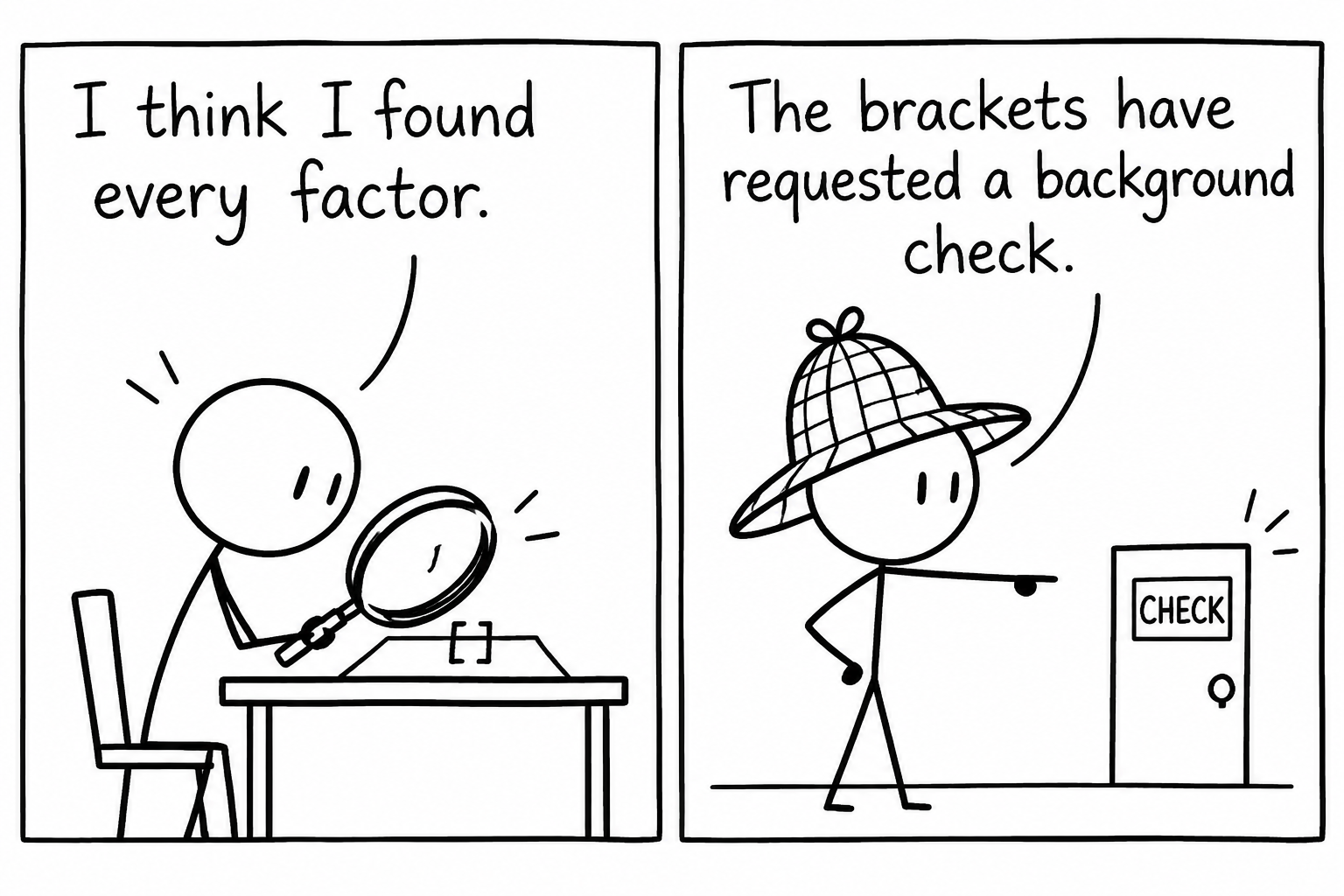 XKCD-style comic of a student inspecting brackets while another requests a background check
Question three: a harder quadratic
Factorise fully 6x2+x−26x^2+x-26x2+x−2.
The coefficient of x2x^2x2 is not 111, so Maya uses splitting the middle term.
Multiply, split and group
First multiply the first and last coefficients:
6×(−2)=−126\times(-2)=-126×(−2)=−12She needs two numbers that multiply to −12-12−12 and add to 111. These are 444 and −3-3−3, so she splits the middle term:
6x2+x−2=6x2+4x−3x−26x^2+x-2=6x^2+4x-3x-26x2+x−2=6x2+4x−3x−2Next, she factorises each pair:
6x2+4x−3x−2=2x(3x+2)−1(3x+2)6x^2+4x-3x-2=2x(3x+2)-1(3x+2)6x2+4x−3x−2=2x(3x+2)−1(3x+2)The repeated bracket is (3x+2)(3x+2)(3x+2), giving:
6x2+x−2=(2x−1)(3x+2)6x^2+x-2=(2x-1)(3x+2)6x2+x−2=(2x−1)(3x+2)The check is:
(2x−1)(3x+2)=6x2+4x−3x−2=6x2+x−2(2x-1)(3x+2)=6x^2+4x-3x-2=6x^2+x-2(2x−1)(3x+2)=6x2+4x−3x−2=6x2+x−2An illustrative three-mark scheme might reward the correct split, the grouped factorisation and the final answer. Showing these stages matters because each line records a mathematical decision.
Use the Factorising Harder Quadratics lesson, harder quadratics video solutions and Factorising Harder Quadratics Question Bank to repeat this method.
How to show enough working
Good exam working is not the longest possible solution. It is the shortest solution that makes your method visible.
For a common-factor question, show the completed factorisation. For a simple quadratic, record the chosen number pair when useful. For a harder quadratic, show the split middle term and grouped expression.
Do not confuse factorising with solving. If the question says factorise, finish with factors, usually in brackets. If it says solve, you need values of the unknown. The Factorising Harder Quadratics revision guide offers further explanation.
When checking, compare the expanded expression term by term rather than simply looking at the constant. Correct first and last terms do not guarantee a correct middle term. If your check fails, keep the original expression visible and trace the first line where the expressions stop being equivalent.
Common mistakes in factorising exam questions
Not factorising fully
For 8x+128x+128x+12, the answer 2(4x+6)2(4x+6)2(4x+6) can be simplified further. The complete factorisation is:
4(2x+3)4(2x+3)4(2x+3)Satisfying only one condition
For x2+7x+12x^2+7x+12x2+7x+12, the numbers must multiply to 121212 and add to 777. The pair 222 and 666 has the correct product but the wrong sum. Use 333 and 444.
Losing a negative sign
If the constant is negative, the bracket numbers need different signs. Expand your answer to confirm which sign creates the required middle term.
Grouping unequal brackets
When splitting the middle term, both grouped parts must produce an identical bracket. If they do not, check your common factors and chosen number pair.
Practise the process
Try factorising these expressions:
- 10x+2510x+2510x+25
- x2−2x−15x^2-2x-15x2−2x−15
- 8x2+10x+38x^2+10x+38x2+10x+3
The answers are 5(2x+5)5(2x+5)5(2x+5), (x−5)(x+3)(x-5)(x+3)(x−5)(x+3) and (4x+3)(2x+1)(4x+3)(2x+1)(4x+3)(2x+1). Expand each result yourself. That check is part of the method, not an optional extra.
Attempt these without looking back at the worked examples. Afterwards, label any error precisely: choosing factors, handling signs, grouping terms or stopping too early. Your next revision session can then target the actual difficulty rather than repeat everything. Return to the missed question later and complete it from a blank page. An answer you can reproduce independently tells you more than one you recognise while reading a solution.
Maya's progress comes from using one repeatable process: identify the type, choose the factors, show the important step and check by expanding. Start the MathsGenie lesson and question bank to practise factorising exam questions with free revision resources, worked solutions and mark schemes.