Extra Practice Material GCSE Geography: Worth It?
Extra practice material GCSE Geography students use well can target weak skills. Learn what to request, how to ask your teacher, and turn feedback into marks.
A blank page can make a reasonable request feel strangely difficult. You want more questions, but you worry that asking will sound as though you ignored the work already provided. In reality, requesting extra practice material GCSE Geography revision can be worthwhile, provided you show what you have attempted and explain the precise skill you want to improve.
The short answer is yes: ask your teacher. But do not simply ask for “more work”. Bring evidence, identify one weakness and request a manageable resource that matches your exam board. That changes the conversation from I need rescuing to I am taking responsibility.
The quick checklist
Before speaking to your teacher:
- confirm whether you take AQA, Edexcel, OCR or Eduqas;
- complete and mark the material you already have;
- identify one topic or question type causing difficulty;
- bring an attempted answer or your mistake log;
- ask for a specific resource, such as fieldwork questions or source-analysis practice;
- explain when you plan to complete it;
- return later with the finished work and one focused question.
The amount you request matters less than the quality of your follow-through.
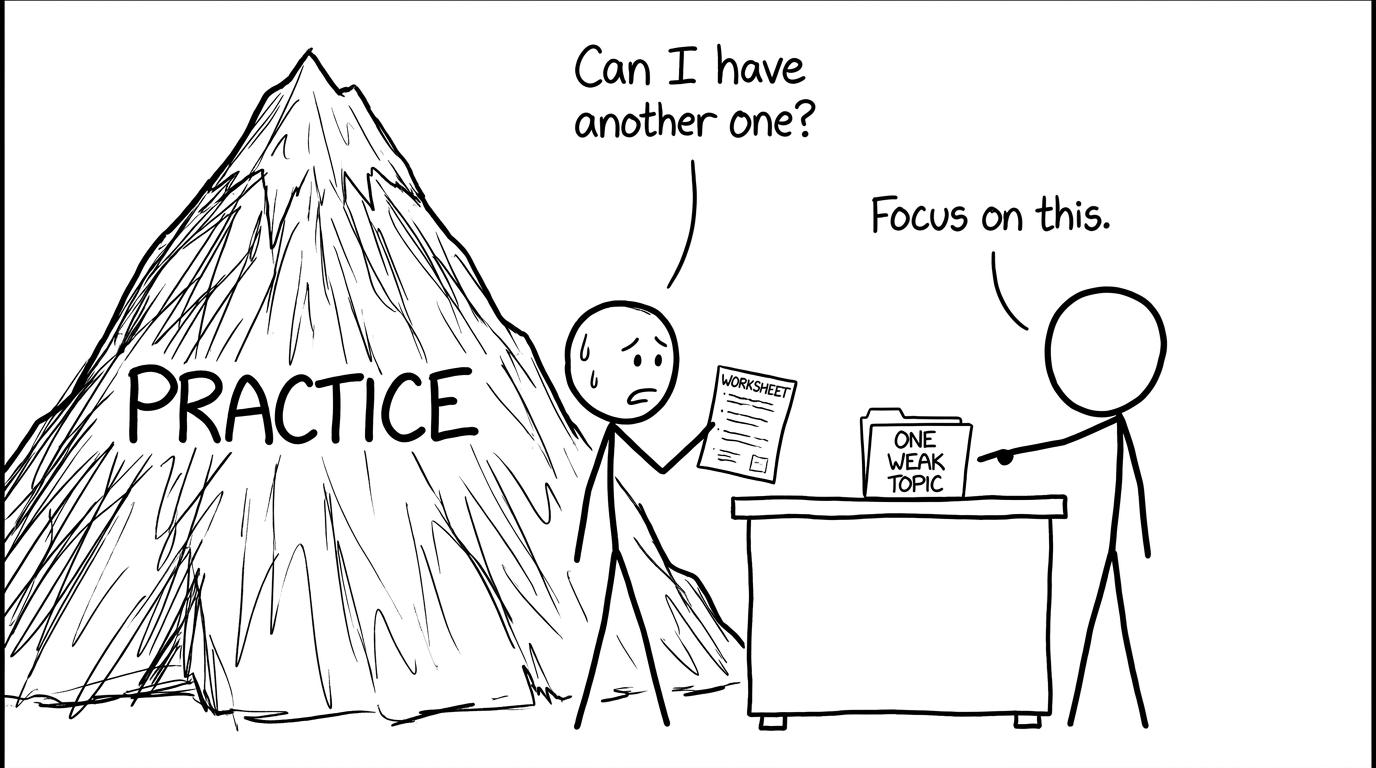 A student asks for one targeted practice folder rather than an enormous mountain of worksheets
Why extra GCSE Geography practice can help
GCSE Geography is not only a memory test. Across regulated GCSE Geography specifications, students must demonstrate knowledge and understanding, but they must also apply ideas, interpret evidence, evaluate issues, make judgements and use geographical skills.
The official assessment objectives give substantial weight to application and skills. AO3 accounts for 35%35\%35% of the qualification, while AO4 accounts for 25%25\%25%. Exact paper structures vary between exam boards, but the underlying lesson is clear: knowing a case study is not enough if you cannot use that knowledge in an unfamiliar question.
This is where targeted practice becomes valuable. It lets you rehearse tasks such as:
- interpreting maps, photographs, graphs and tables;
- responding accurately to command words;
- applying knowledge to an unfamiliar place;
- using evidence in an extended response;
- evaluating fieldwork methods and conclusions;
- managing time across questions with different mark values.
For example, an OCR A student can use the OCR A GCSE Geography revision hub to find specification-focused lessons, questions and revision tools. The broader OCR A Geography revision guides also separate knowledge topics from cartographic, graphical, numerical, source and fieldwork skills.
More material is not automatically better, however. Completing ten generic worksheets without marking them may reveal less than completing one relevant set, checking it carefully and correcting every weak response.
Show that you have already tried
The easiest way to avoid sounding as though you are not trying is to make your effort visible.
Take one of the following to your teacher:
- a completed worksheet with mistakes highlighted;
- a marked past-paper section;
- an extended answer you could not improve independently;
- a short list of topics that repeatedly cost you marks;
- your notes beside a question you could not start.
You do not need to pretend that you understand more than you do. A crossed-out attempt is useful evidence. It shows where your reasoning stopped, which allows your teacher to recommend something appropriate rather than guess.
A useful opening is:
“I completed and marked this section, but I am still losing marks when I have to evaluate fieldwork methods. Is there another short set of questions I could use to practise that skill?”
That request contains three helpful details: what you completed, what went wrong and what you want next.
How to ask your teacher for more practice material
Choose a sensible moment
Ask at the end of a lesson, during a scheduled revision session or at another time your teacher has said is suitable. Avoid beginning a long conversation while they are teaching, dealing with equipment or helping another student.
If time is short, ask when you could return. Respecting your teacher's workload strengthens the impression that you are organised and serious.
Make the request specific
“Can I have more revision?” is difficult to answer because it could mean almost anything. Narrow the request to one area:
- unfamiliar fieldwork contexts;
- case-study application;
- map and scale skills;
- graph interpretation;
- command words such as assess or evaluate;
- timed extended responses;
- questions from a particular paper or component.
If numerical data is the problem, the GCSE Geography numerical and statistical skills guide covers percentages, ratios, averages, spread, relationships and fieldwork data. AQA students can also review the AQA GCSE Geography statistical skills guide.
Ask for feedback, not unlimited marking
Teachers may be able to share questions more easily than they can mark several extra essays every week. Offer a manageable arrangement:
“Could you recommend one question for me to complete? I will use the mark scheme first, then could I ask you about the part I still cannot improve?”
This shows independence. It also makes your request realistic.
Explain your plan
Add a simple deadline: you will complete the material by Friday, during the weekend or before the next revision session. Then keep that promise.
Nothing communicates effort more clearly than returning with finished work, corrections and a better question.
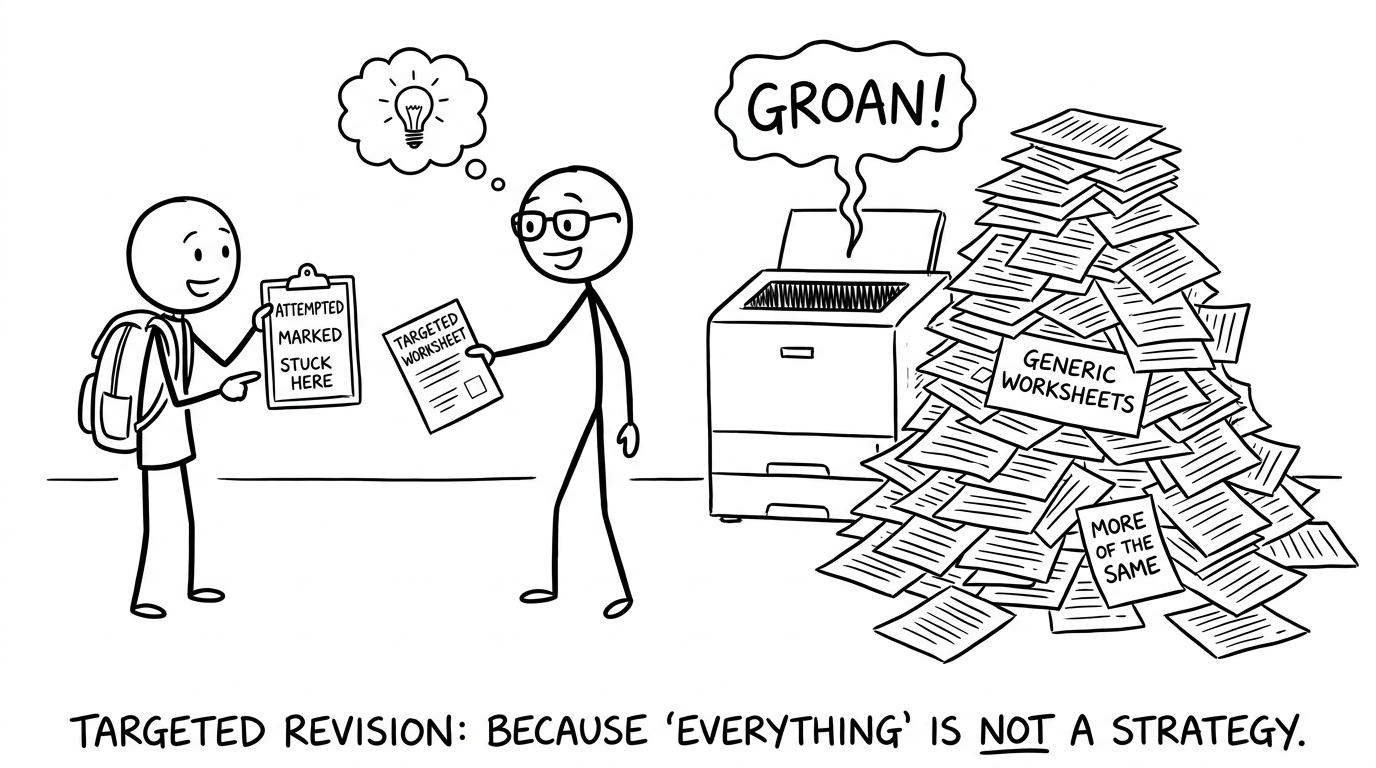 A prepared student receives targeted material while the generic worksheet printer struggles
What extra material should you request?
The best resource depends on why you are losing marks.
| Your difficulty | Useful material to request |
|---|---|
| Facts disappear under pressure | Short retrieval questions or case-study prompts |
| You misread command words | Mixed questions grouped by command word |
| Extended answers lack judgement | Model responses, level descriptors and essay questions |
| Unfamiliar sources feel confusing | Resource-booklet and source-analysis questions |
| Fieldwork answers are vague | Familiar and unfamiliar fieldwork questions |
| Calculations or graphs cause errors | Numerical, statistical and cartographic practice |
| You run out of time | A timed paper section with a mark scheme |
For source work, the visual and source skills revision guide explains how to move from observation to interpretation, analysis and evaluation. It also encourages students to consider a source's scale, date, viewpoint and reliability.
Ask for material from your own specification. A question can be mathematically or geographically useful while still covering content your class does not study. Your teacher knows your taught case studies, fieldwork enquiries and paper structure, so their guidance is especially valuable here.
Turn extra material into better marks
A worksheet has little value while it remains in your bag. Use a repeatable cycle:
- Attempt: work without notes where possible.
- Mark: use the mark scheme carefully.
- Diagnose: record why each mark was lost.
- Correct: improve the original answer in another colour.
- Revisit: attempt a similar question several days later.
Your diagnosis should be precise. “Bad at geography” is not actionable. Better labels include “used no source evidence”, “confused reliability with accuracy”, “gave advantages but no judgement” or “divided percentage change by the new value rather than the original value”.
The MathsGenie guide to using past papers properly describes the same paper, mark, fix and retest cycle for maths revision. The principle transfers well to Geography: the score measures the attempt, but the correction creates the improvement.
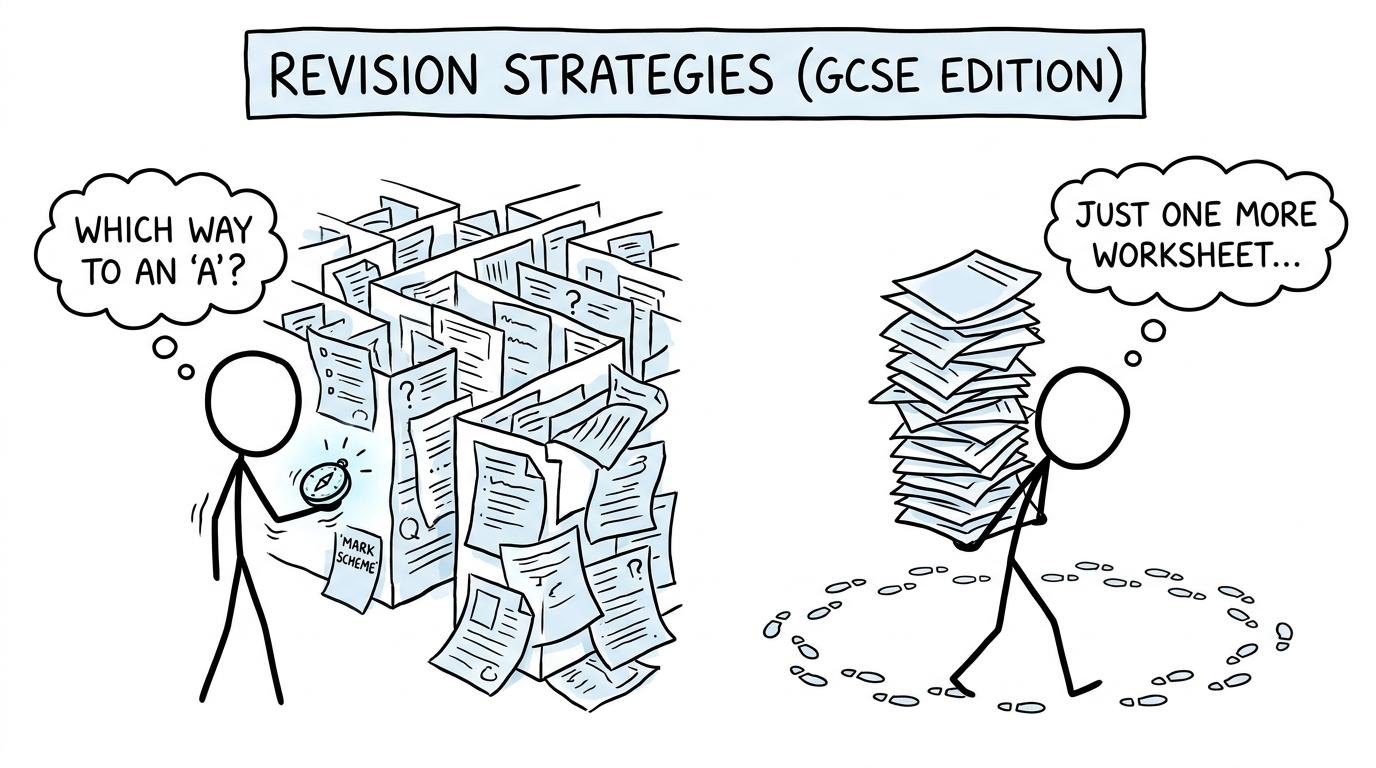 A mark scheme compass guides one student through an exam-paper maze
Use your maths revision to strengthen Geography
For students preparing for maths exams, some Geography practice has a useful second effect. Maps, fieldwork and resource questions may involve scale, percentages, averages, graphs, sampling and relationships between variables.
If the geographical idea is clear but the calculation is unreliable, isolate the underlying maths skill. The free GCSE Maths revision hub provides lessons, topic questions, worksheets and exam-board resources. You can also practise interpreting relationships through the OCR GCSE Maths scatter graphs resources.
Keep the two stages distinct. First secure the calculation or graph skill. Then return to a Geography question and interpret the result in context. A correct calculation without a geographical conclusion may not answer the whole question.
Common mistakes when asking for extra work
Asking before using existing resources
If your teacher has already provided questions, complete those first. Otherwise, your request may look like resource collecting rather than revision.
Requesting an enormous pack
A large folder can feel productive on the day it is printed and discouraging the next evening. Ask for one topic or one short question set, then return when it is complete.
Hiding your attempts
Do not erase every uncertain line before seeking help. Your method often tells the teacher more than your final answer.
Using material from the wrong specification
AQA, Edexcel, OCR and Eduqas organise content and assessment differently. Check your board, specification and paper before investing time in a resource.
Expecting the teacher to mark everything
Use available mark schemes first. Ask your teacher about the judgement calls you cannot resolve, particularly extended answers and fieldwork evaluation.
Completing questions without revisiting errors
Repeated practice only works when feedback changes the next attempt. MathsGenie's mark scheme revision guide offers a useful approach: identify the exact lost mark, rewrite the response and attempt another question of the same type.
Ask clearly, then follow through
Asking for extra material is not an admission that you have failed to try. When supported by an attempted answer, a specific weakness and a realistic plan, it demonstrates the opposite.
Start small. Complete one existing question, mark it and identify the obstacle. Ask your teacher for one targeted next step. Then return with evidence that you used it.
For the quantitative skills that connect Geography with your GCSE maths exams, make MathsGenie your free revision base. Use the revision lessons to rebuild weak methods, practice questions and mini tests to check them, then move to past papers and predicted papers. Mark every attempt with the mark scheme, use video solutions where available and let each mistake choose what you practise next.