Expanding Single Brackets Exam Questions: GCSE Guide
Expanding single brackets exam questions explained through three worked examples, with sign checks, method-mark guidance and GCSE practice to try yourself.

Expanding brackets starts with one reliable habit
You recognise the question, begin confidently, then hesitate over a minus sign. Expanding single brackets exam questions often test a small skill very precisely: multiply every term inside the bracket by the term outside it, then collect like terms if needed.
The challenge is not remembering a complicated formula. It is keeping that same routine when the multiplier is negative, contains a letter, or appears beside another bracket.
Imagine a student working through three questions of increasing difficulty. Their aim is not to become faster immediately. It is to make each multiplication visible, so their answer is easier to check and their method is clear to an examiner.
Your expanding single brackets checklist
Before you start, identify:
- The instruction: does it say expand, or expand and simplify?
- The multiplier: include its sign and any letters.
- Every term inside: each needs multiplying, including constants.
- The finishing step: collect like terms only after expanding.
The general rule is the distributive law:
a(b+c)=ab+aca(b+c)=ab+aca(b+c)=ab+acSubtraction follows the same principle:
a(b−c)=ab−aca(b-c)=ab-aca(b−c)=ab−acExpanding produces an equivalent expression without the bracket. It does not mean finding a value for the letter. Unless you have an equation to solve, your answer will usually remain an algebraic expression.
For a guided explanation alongside these examples, MathsGenie's expanding and factorising lesson covers the matching topic.
How marks relate to your working
Short expansion questions may award a single mark for the correct expression. Longer questions can reward a correct expansion before the final simplification, depending on the mark scheme.
A method mark, often labelled M, rewards a specified mathematical process. An accuracy mark, often labelled A, rewards a correct result, usually following a valid method. Some answers receive independent marks labelled B.
There is no universal rule that drawing arrows or writing an intermediate line earns a mark. The examples below are original exam-style questions, not quoted past-paper questions, so their mark guidance explains what working demonstrates rather than promising an official allocation.
The useful habit is simple: show the expansion before collecting terms. That makes a correct method visible even if a later calculation goes wrong.
Three expanding single brackets exam questions
First question: a positive multiplier
Expand:
4(x+3)4(x+3)4(x+3)Our imagined student starts by identifying the multiplier, which is 444. They write both products rather than trying to jump straight to the answer:
4(x+3)=4×x+4×34(x+3)=4\times x+4\times34(x+3)=4×x+4×3Then they simplify:
4x+12\boxed{4x+12}4x+12The important decision happened before the arithmetic: both terms received the multiplier. Writing 4x+34x+34x+3 would show that only the first term had been multiplied.
What the working demonstrates: a complete expansion. On a short question, the correct final expression may be all that earns credit; do not assume there must be a separate method mark.
A quick check is to substitute x=1x=1x=1. The original expression gives 161616, and the expanded expression also gives 161616. This can catch a mistake, although agreement for one value does not prove that two expressions are equivalent.
Second question: a negative multiplier
Expand:
−3(2x−5)-3(2x-5)−3(2x−5)The student now pauses before writing. The multiplier is not merely 333: it is −3-3−3.
They multiply it by each term, keeping the second term's negative sign:
−3(2x−5)=(−3)×2x+(−3)×(−5)-3(2x-5)=(-3)\times2x+(-3)\times(-5)−3(2x−5)=(−3)×2x+(−3)×(−5)The first product is negative. The second is positive because a negative multiplied by a negative gives a positive:
−6x+15\boxed{-6x+15}−6x+15This is where slowing down helps. Treating −5-5−5 as a complete term is safer than remembering a vague instruction to “change the signs”.
What the working demonstrates: both required products, with their signs attached. Where a question's mark scheme allows partial credit, correct products can matter. The exact credit still depends on that scheme.
Now you have the routine, use MathsGenie's Lessons and Question Bank to practise applying it without skipping the sign checks.
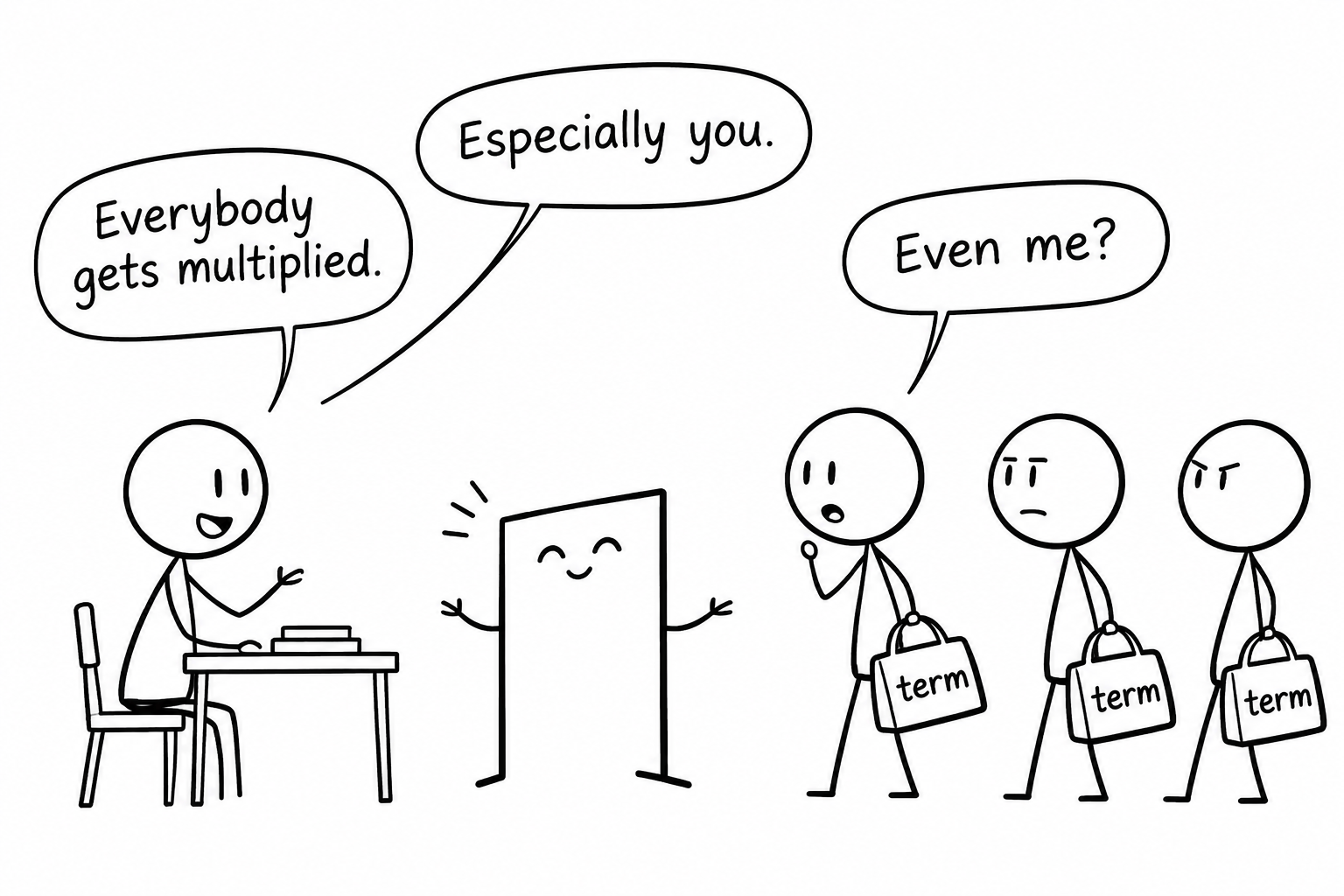 Stick-figure comic about making sure every term gets multiplied
Third question: algebraic multipliers and collecting terms
Expand and simplify:
3x(2x−5)−2(x+4)3x(2x-5)-2(x+4)3x(2x−5)−2(x+4)There are two single brackets here. The student handles them separately, carrying the negative multiplier into the second expansion.
First:
3x(2x−5)=6x2−15x3x(2x-5)=6x^2-15x3x(2x−5)=6x2−15xNotice that x×x=x2x\times x=x^2x×x=x2. The multiplier contains a letter, so multiplying the coefficients alone would not be enough.
Next:
−2(x+4)=−2x−8-2(x+4)=-2x-8−2(x+4)=−2x−8Putting those expansions together gives:
6x2−15x−2x−86x^2-15x-2x-86x2−15x−2x−8Only now does the student collect like terms:
6x2−17x−8\boxed{6x^2-17x-8}6x2−17x−8The x2x^2x2 term stays separate from the xxx terms because they are different types of term.
Where method marks can come from: in a multi-mark question, a mark scheme may reward a correct expansion or another specified intermediate step before the final answer. Showing the expanded line gives the examiner evidence of that work. It does not guarantee a mark for every line written.
Common mistakes and how to catch them
Multiplying only the first term
The bracket applies to everything inside it:
5(x+4)=5x+205(x+4)=5x+205(x+4)=5x+20Check that you have formed one product for every original term. This also works when a bracket contains more than two terms.
Losing a negative sign
Write the multiplier with its sign. For example:
−2(x−6)=−2x+12-2(x-6)=-2x+12−2(x−6)=−2x+12The positive constant comes from multiplying two negative numbers, not from an arbitrary sign-changing rule.
Combining unlike terms
You can collect xxx terms together, but not merge an xxx term with an x2x^2x2 term:
3x2+2x3x^2+2x3x2+2xThat expression cannot be simplified further by collecting terms. The expanding and factorising revision page provides further topic practice when expansion and simplification need attention together.
Stopping before answering the instruction
“Expand and simplify” asks for both stages. A fully expanded expression can still need like terms collecting. Underline the instruction before starting, then check it again before moving on.
Exam-style practice to try independently
Cover the answers and write an expansion line for each question.
| Instruction | Expression |
|---|---|
| Expand | 7(x+2)7(x+2)7(x+2) |
| Expand | −4(3y−2)-4(3y-2)−4(3y−2) |
| Expand and simplify | 2a(3a−4)+3(a−5)2a(3a-4)+3(a-5)2a(3a−4)+3(a−5) |
Answers:
- First: 7x+147x+147x+14.
- Second: −12y+8-12y+8−12y+8.
- Third: 6a2−5a−156a^2-5a-156a2−5a−15.
If your answer differs, find the first incorrect product, rather than copying the final expression. Then attempt the question again without looking. This separates a multiplication mistake from a misunderstanding of the method.
When choosing expanding single brackets past paper questions, use answers and mark schemes to check both your result and the working required. MathsGenie's expanding and factorising exam booklet offers further topic questions with answers. If you follow AQA, the AQA expanding and factorising topic page is another relevant starting point.
Turn the method into a reliable exam habit
Our imagined student has moved from a positive multiplier to negative signs and algebraic terms without changing the underlying routine. Your next step is to make that routine reliable when the question looks unfamiliar, not simply to recognise a worked answer. Start with expanding single brackets in MathsGenie's Lessons, then apply the same method independently in the Question Bank.