Equations With Unknowns on Both Sides GCSE Maths
Equations with unknowns on both sides GCSE maths explained through clear steps, worked examples, common mistakes and exam-style questions.
A student sees 5x+2=3x+145x+2=3x+145x+2=3x+14 and thinks, “Move the 3x3x3x over.” It sounds familiar. But somewhere between moving, changing signs and rushing to divide, the answer goes wrong again.
The turning point comes when they stop thinking of algebra as moving symbols and start thinking of it as keeping an equation balanced. That is the central idea behind equations with unknowns on both sides GCSE maths questions: perform the same operation on both sides until all the terms containing the unknown are together.
The reliable method is:
- simplify each side if necessary;
- subtract one variable term from both sides;
- collect the remaining constant terms;
- divide by the coefficient of the unknown;
- substitute the answer into the original equation to check it.
This skill is part of solving linear equations in one unknown, including equations where the unknown appears on both sides. It can appear across GCSE Maths specifications, so it is worth making the method automatic.
Why these equations feel different
In a simpler equation such as 4x+3=194x+3=194x+3=19, the unknown appears on only one side. You can isolate it by undoing the addition and multiplication.
With an equation such as
5x+2=3x+14,5x+2=3x+14,5x+2=3x+14,both sides contain an xxx term. Before isolating xxx, you need to create an equivalent equation in which the unknown appears on only one side.
The word “equivalent” matters. Each new line must have exactly the same solution as the line before it. That happens when you apply the same operation to both sides.
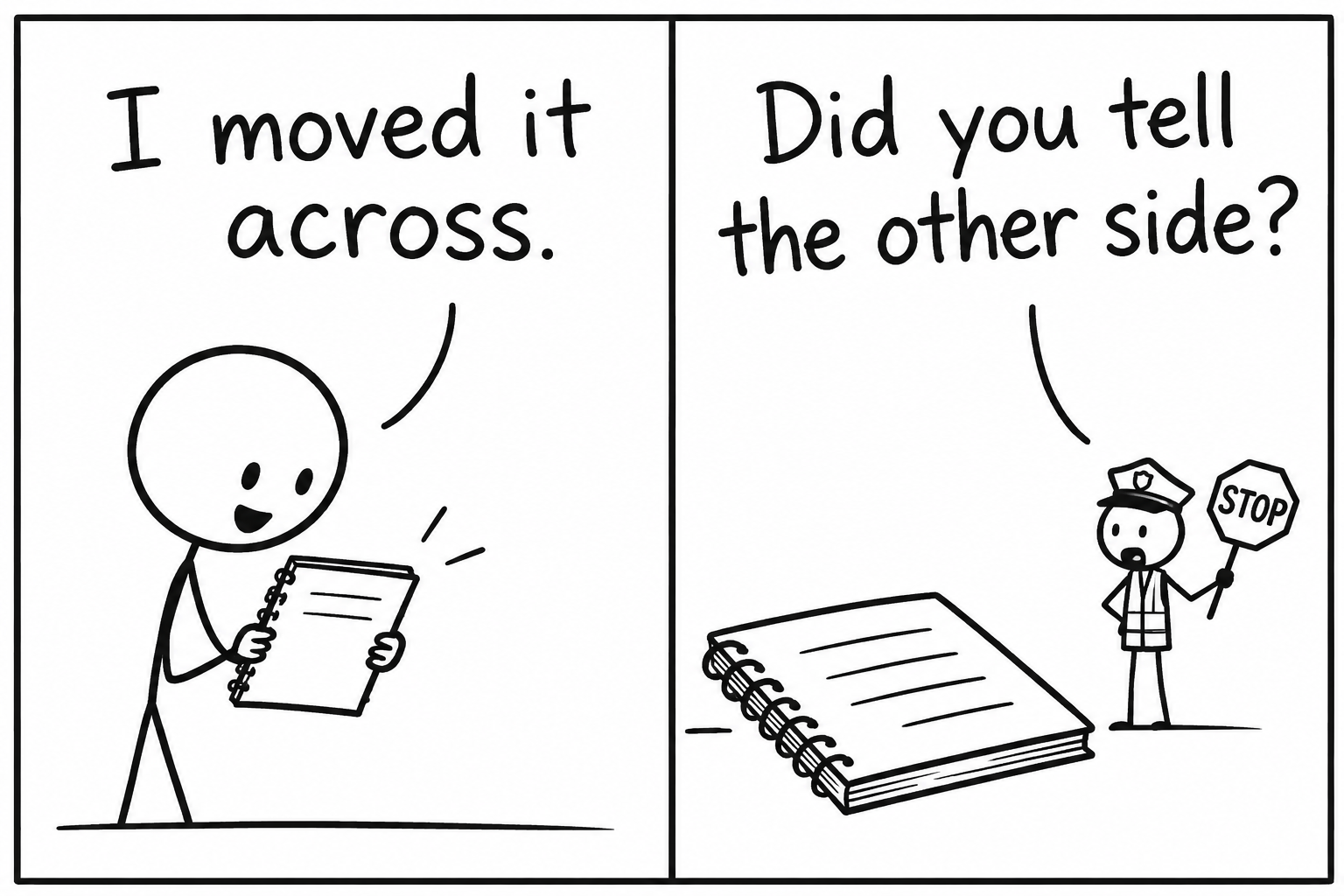 A student discovers that moving an algebra term requires balancing both sides
The balance method that makes it click
Imagine the equals sign as the centre of a balanced scale. If you subtract 3x3x3x from the left, you must subtract 3x3x3x from the right too.
A useful decision rule is to subtract the smaller variable term from both sides. This often leaves a positive coefficient, which makes the remaining arithmetic easier. It is not compulsory, but it reduces avoidable errors.
For
5x+2=3x+14,5x+2=3x+14,5x+2=3x+14,subtract 3x3x3x from both sides because 3x3x3x is the smaller variable term. The equation becomes 2x+2=142x+2=142x+2=14. From there, subtract 222 and divide by 222.
Once that sequence feels natural, equations with unknowns on both sides become ordinary linear equations with one extra opening step.
If you want to rehearse that sequence beside guided questions, use the Maths Genie GCSE revision lessons and select the solving equations lesson before moving into the Question Bank.
Equations with unknowns on both sides worked examples
Example with a positive answer
Solve
7x+4=3x+24.7x+4=3x+24.7x+4=3x+24.Subtract 3x3x3x from both sides:
4x+4=24.4x+4=24.4x+4=24.Subtract 444 from both sides:
4x=20.4x=20.4x=20.Divide both sides by 444:
x=5.x=5.x=5.Check by substituting x=5x=5x=5 into the original equation:
7(5)+4=397(5)+4=397(5)+4=39and
3(5)+24=39.3(5)+24=39.3(5)+24=39.Both sides equal 393939, so the solution is correct.
Example with a negative answer
Solve
4x+11=6x+3.4x+11=6x+3.4x+11=6x+3.Subtract 4x4x4x from both sides:
11=2x+3.11=2x+3.11=2x+3.Subtract 333 from both sides:
8=2x.8=2x.8=2x.Divide both sides by 222:
x=4.x=4.x=4.Although equations of this form can produce negative answers, this one does not. That is a useful reminder: never predict the sign from appearance alone.
Now consider
8x+5=10x+13.8x+5=10x+13.8x+5=10x+13.Subtract 8x8x8x from both sides:
5=2x+13.5=2x+13.5=2x+13.Subtract 131313 from both sides:
−8=2x.-8=2x.−8=2x.Divide by 222:
x=−4.x=-4.x=−4.A negative solution is perfectly valid. Substitution confirms it.
Example involving brackets
Solve
3(x+2)=2x+11.3(x+2)=2x+11.3(x+2)=2x+11.Expand the bracket first:
3x+6=2x+11.3x+6=2x+11.3x+6=2x+11.Subtract 2x2x2x from both sides:
x+6=11.x+6=11.x+6=11.Subtract 666 from both sides:
x=5.x=5.x=5.The important lesson is order. Simplify first, then collect the variable terms. Trying to move terms before expanding usually creates unnecessary confusion.
Example requiring collection of like terms
Solve
2x+5+x=5x−7.2x+5+x=5x-7.2x+5+x=5x−7.Collect like terms on the left:
3x+5=5x−7.3x+5=5x-7.3x+5=5x−7.Subtract 3x3x3x from both sides:
5=2x−7.5=2x-7.5=2x−7.Add 777 to both sides:
12=2x.12=2x.12=2x.Divide by 222:
x=6.x=6.x=6.The student in our opening problem used to treat every equation as a race to move terms. What finally changed was slower and simpler: one operation per line, with both sides shown. The working became longer by a line or two, but the mistakes became much easier to spot.
What to write in an exam
Clear algebra earns trust because each transformation can be followed. Write one equivalent equation per line and keep the equals signs aligned where practical.
For example:
9x−5=4x+205x−5=205x=25x=5\begin{aligned} 9x-5&=4x+20\\ 5x-5&=20\\ 5x&=25\\ x&=5 \end{aligned}9x−55x−55xx=4x+20=20=25=5Avoid unexplained jumps when you are still learning the method. A mark scheme may award credit for correct intermediate work even if a later arithmetic slip affects the final answer. Clear lines also help you find that slip before you move on.
Common mistakes and how to prevent them
Changing a sign without understanding why
Students are often told that a term “changes sign when it crosses the equals sign”. This shortcut hides the real operation.
In
5x+2=3x+14,5x+2=3x+14,5x+2=3x+14,3x3x3x does not change by travelling across the page. You subtract 3x3x3x from both sides. Writing that operation mentally or explicitly makes sign errors less likely.
Applying an operation to only one side
Changing 4x+7=194x+7=194x+7=19 directly into 4x=194x=194x=19 breaks the balance. Subtracting 777 must happen on both sides, producing 4x=124x=124x=12.
Combining unlike terms
You cannot combine 3x3x3x and 555 to make 8x8x8x. One is a variable term and the other is a constant. Collect xxx terms with xxx terms and constants with constants.
Forgetting to expand every term
For 4(x−3)4(x-3)4(x−3), multiplication applies to both terms:
4(x−3)=4x−12.4(x-3)=4x-12.4(x−3)=4x−12.Writing 4x−34x-34x−3 changes the expression and leads to the wrong equation.
Dividing only one term
If 3x=183x=183x=18, divide both sides by 333 to obtain x=6x=6x=6. When an entire side contains several terms, use brackets or simplify before dividing so it is clear what the division applies to.
Not checking the answer
Substitution is especially valuable when negatives or brackets are involved. Replace every occurrence of xxx in the original equation. If both sides produce the same value, the solution works.
Equations with unknowns on both sides questions
Try these without looking back at the examples. Show one operation per line.
- Solve 6x+3=2x+196x+3=2x+196x+3=2x+19.
- Solve 9x−8=5x+129x-8=5x+129x−8=5x+12.
- Solve 4x+17=7x+24x+17=7x+24x+17=7x+2.
- Solve 5(x+1)=3x+175(x+1)=3x+175(x+1)=3x+17.
- Solve 2(x−4)+3x=3x+102(x-4)+3x=3x+102(x−4)+3x=3x+10.
- Solve 7x+4−2x=2x+197x+4-2x=2x+197x+4−2x=2x+19.
Answers:
- x=4x=4x=4
- x=5x=5x=5
- x=5x=5x=5
- x=6x=6x=6
- x=9x=9x=9
- x=5x=5x=5
If an answer differs, do not erase everything immediately. Check three places first: expansion, the sign used when adding or subtracting, and the final division. That review habit is more useful than simply reading a correct solution.
For broader exam preparation, work through Maths Genie GCSE past papers and compare your written method with the accompanying mark schemes and video solutions.
Turn the method into a reliable exam skill
The student’s breakthrough was not a clever shortcut. It was the decision to balance first, simplify one line at a time and check by substitution. Knowing that method is the first gap; following it consistently under exam pressure is the next.
Your turn: start with the matching topic in Maths Genie Lessons and the Question Bank, then practise equations with unknowns on both sides until every line preserves the balance.