Equations With Unknowns on Both Sides Questions
Equations with unknowns on both sides exam questions explained through three GCSE examples, with method marks, checks and focused practice for revision.

A GCSE equation can feel manageable until the same letter appears on both sides. Suddenly, there seems to be no obvious place to begin. The reassuring truth is that equations with unknowns on both sides exam questions use one dependable idea: collect the unknown terms on one side, collect the numbers on the other, then solve.
That method works whether the question is simple, contains brackets or begins with fractions. We will follow a hypothetical student through three questions of rising difficulty, showing the lines of working that can earn method marks even when the final answer goes wrong.
The method to remember
Treat an equation like a balanced pair of scales. Whatever operation you apply to one side must also be applied to the other.
For an unknown on both sides:
- simplify each side first, expanding brackets if necessary;
- move the smaller unknown term to the side containing the larger one;
- move the constant terms to the opposite side;
- divide by the coefficient of the unknown;
- substitute the answer into the original equation to check it.
Choosing the side with the larger unknown coefficient is not compulsory, but it often avoids negative coefficients. The full technique is covered in the Maths Genie solving equations lesson, alongside videos and practice resources.
Start with the Lessons and Question Bank when you want to turn this five-step method into a repeatable exam routine.
Question one: collecting the unknown terms
Imagine the student begins with:
5x+3=2x+185x+3=2x+185x+3=2x+18The larger coefficient is 555, so the student decides to keep the unknown on the left. They subtract 2x2x2x from both sides:
3x+3=183x+3=183x+3=18Next, they subtract 333 from both sides:
3x=153x=153x=15Finally, they divide both sides by 333:
x=5x=5x=5The student checks by substitution. The left side becomes
5(5)+3=28,5(5)+3=28,5(5)+3=28,and the right side becomes
2(5)+18=28.2(5)+18=28.2(5)+18=28.Both sides agree, so x=5x=5x=5 is correct.
A typical mark scheme might award a method mark for correctly collecting the unknown terms, followed by an accuracy mark for reaching the correct answer. Exact marking varies between exam boards and papers, but a clear line such as 3x+3=183x+3=183x+3=18 gives an examiner useful evidence of the method.
Question two: expanding a bracket first
The next equation looks more complicated:
4(2x−3)=5x+94(2x-3)=5x+94(2x−3)=5x+9The student remembers that rearranging too early would make the work harder. They expand the bracket first:
8x−12=5x+98x-12=5x+98x−12=5x+9They subtract 5x5x5x from both sides:
3x−12=93x-12=93x−12=9They add 121212 to both sides:
3x=213x=213x=21Then divide by 333:
x=7x=7x=7A sensible mark allocation might recognise three stages: expanding the bracket correctly, rearranging to isolate the unknown term, and obtaining x=7x=7x=7. This is why writing only the final answer is risky. If a small arithmetic error appears at the end, correct earlier algebra may still earn method marks.
For more questions in this format, use the solving equations exam booklet. If a question begins with a written situation rather than an equation, the forming and solving equations lesson develops the extra step of translating information into algebra.
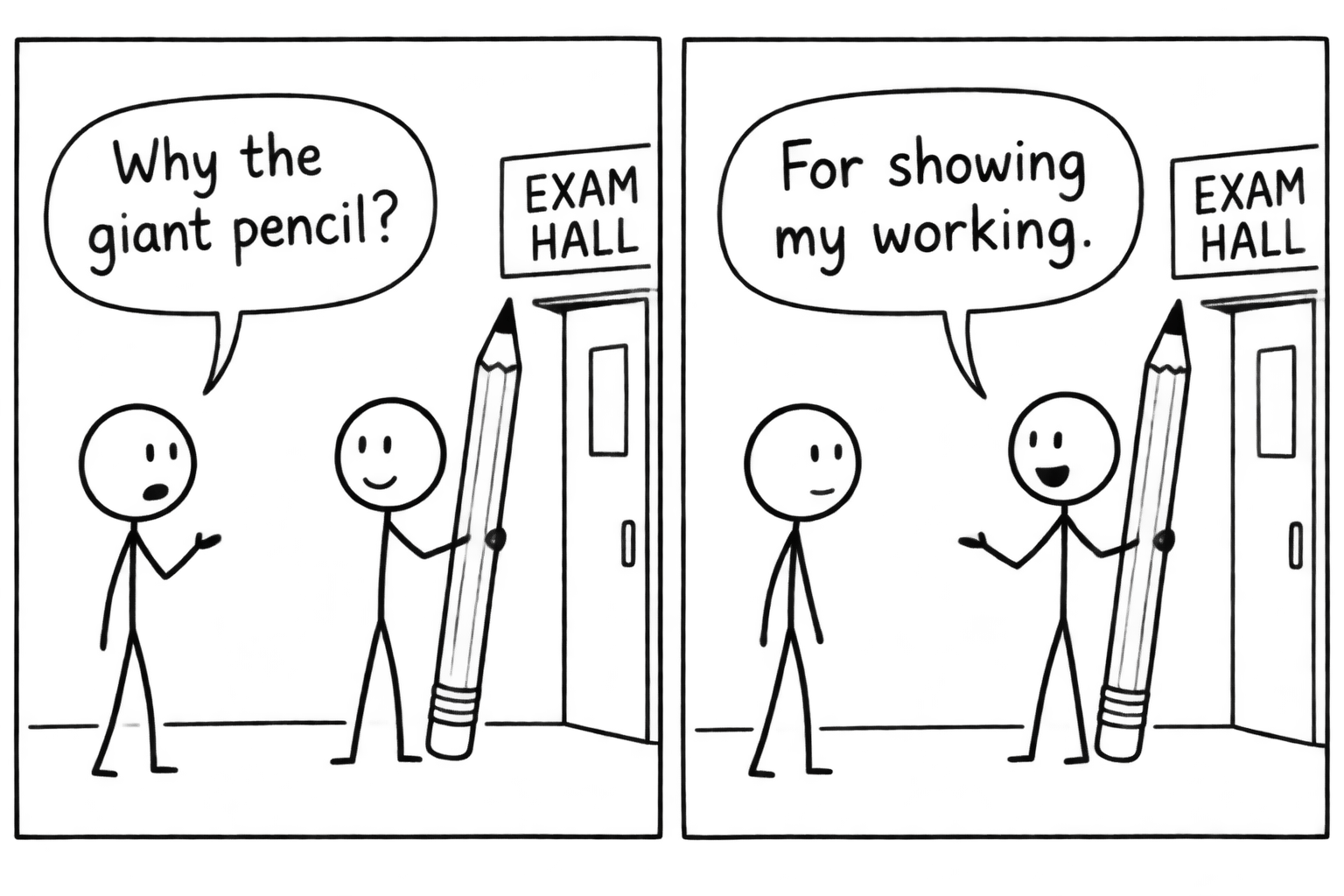 A student brings an oversized pencil to show their exam working
Question three: clearing fractions safely
The final equation contains fractions and leads to a negative answer:
3x−14=x+52−3\frac{3x-1}{4}=\frac{x+5}{2}-343x−1=2x+5−3Fractions often create hesitation. The student pauses and finds the lowest common multiple of the denominators, which is 444. They multiply every term on both sides by 444:
3x−1=2(x+5)−123x-1=2(x+5)-123x−1=2(x+5)−12Now they expand and simplify the right side:
3x−1=2x+10−123x-1=2x+10-123x−1=2x+10−12 3x−1=2x−23x-1=2x-23x−1=2x−2Subtracting 2x2x2x from both sides gives:
x−1=−2x-1=-2x−1=−2Adding 111 gives:
x=−1x=-1x=−1The negative answer may look suspicious, but negative solutions are perfectly valid. Substitution confirms it:
3(−1)−14=−1\frac{3(-1)-1}{4}=-143(−1)−1=−1and
−1+52−3=−1.\frac{-1+5}{2}-3=-1.2−1+5−3=−1.Here, method marks could come from clearing the fractions correctly and completing a valid rearrangement. The final accuracy mark would depend on reaching x=−1x=-1x=−1. For extra help with signs during rearrangement, read the guide to solving linear equations without sign errors.
How to show working for method marks
When attempting equations with unknowns on both sides GCSE exam questions, make each meaningful algebraic change visible. You do not need to write a sentence beside every line, but the mathematical route should be clear.
A strong answer usually shows:
- the expanded or simplified equation;
- the line where unknown terms are collected;
- the line where constant terms are collected;
- the final division;
- the solution written clearly as x=valuex=\text{value}x=value.
Do not assume that every paper uses an identical mark allocation. Edexcel, AQA, OCR and Eduqas publish question-specific mark schemes. However, valid working matters because it lets an examiner see what you understood before any arithmetic slip occurred.
Common mistakes to avoid
Changing sides without changing the operation
Students sometimes say that a term “moves across and changes sign”. This shortcut can hide mistakes. Instead, write the operation being applied to both sides. For example, change
6x+4=2x+206x+4=2x+206x+4=2x+20by subtracting 2x2x2x from both sides, not by moving symbols without explanation.
Expanding only part of a bracket
In 3(x−4)3(x-4)3(x−4), the multiplier applies to both terms:
3(x−4)=3x−12.3(x-4)=3x-12.3(x−4)=3x−12.Writing 3x−43x-43x−4 changes the equation.
Multiplying only one fractional term
When clearing fractions, multiply every term on both sides by the common denominator. Missing the constant term is one of the easiest ways to lose an otherwise secure solution.
Rejecting a negative or fractional answer
An answer does not need to be a positive integer. Check it in the original equation before deciding it must be wrong.
Hiding all the working
A correct answer may earn full marks, but an unsupported incorrect answer cannot reveal a sound method. One algebraic step per line makes checking easier for both you and the examiner.
Exam-style practice
Try these without looking back at the examples:
7x+4=3x+247x+4=3x+247x+4=3x+24 5(2x+1)=7x+205(2x+1)=7x+205(2x+1)=7x+20 2x+33=x−12+4\frac{2x+3}{3}=\frac{x-1}{2}+432x+3=2x−1+4The solutions are x=5x=5x=5, x=5x=5x=5 and x=15x=15x=15. If your answer differs, locate the first line where your equation stops being equivalent to the previous one. That is usually more useful than simply reading the final solution.
Once these feel secure, practise topic-by-topic questions in the GCSE Question Bank. Equations with unknowns on both sides past paper questions may be presented directly or hidden inside perimeter, angle and number problems, but the underlying balancing process remains the same.
Turn the method into exam confidence
Knowing the steps is different from following them accurately when brackets, fractions and exam pressure appear together. Your goal is to make collecting terms and checking solutions feel routine before the fixed exam date arrives. Build that routine now with the Maths Genie Lessons and Question Bank.