Equations with Fractions Exam Questions: GCSE Guide
Equations with fractions exam questions explained through three GCSE worked examples. Learn to clear denominators, show your method and avoid common mistakes.
Fractions can make a familiar equation look like an unfamiliar problem. You may know how to collect terms and isolate the unknown, yet hesitate when a fraction bar appears. For equations with fractions exam questions, the reliable approach is to multiply every term by a suitable common denominator, solve the resulting equation, and check your answer in the original.
Imagine a student working through three questions in a revision session. Their aim is not to spot a clever shortcut. It is to make each line follow clearly from the last, so that both they and the examiner can see the method.
The questions below are original GCSE exam-style examples, not reproduced past paper questions. The marking comments explain where useful method evidence appears; exact mark allocations depend on the question’s official mark scheme.
The method at a glance
Before you begin, use this checklist:
- Identify every denominator.
- Choose a common multiple of numerical denominators, preferably the lowest.
- Multiply every term on both sides, including whole-number terms.
- Keep brackets around numerators containing more than one term.
- Expand carefully, collect like terms and solve.
- Substitute your answer into the original equation.
Multiplying both sides by the same non-zero number preserves equality. Choosing a common denominator removes the fractions, leaving an equation you can handle with ordinary algebra.
If a denominator contains the unknown, first note any values that would make it zero. Those values cannot be solutions.
Start with MathsGenie’s Solving Equations lesson, then use the Question Bank to practise turning this checklist into written working.
Equations with fractions exam questions: three worked examples
A single fraction with a bracketed numerator
Our hypothetical student begins with:
2x+35=7\frac{2x+3}{5}=752x+3=7The fraction bar means that the whole numerator is divided by 555. The student therefore multiplies both sides by 555:
5×2x+35=5×75\times\frac{2x+3}{5}=5\times75×52x+3=5×7This gives:
2x+3=352x+3=352x+3=35Subtract 333 from both sides:
2x=322x=322x=32Divide both sides by 222:
x=16x=16x=16Finally, check the original equation:
2(16)+35=355=7\frac{2(16)+3}{5}=\frac{35}{5}=752(16)+3=535=7Where method evidence appears: the line 2x+3=352x+3=352x+3=35 shows that the student has correctly reversed division by 555. The subsequent rearrangement shows how the unknown is isolated. In a multi-mark question, clear intermediate working can demonstrate a correct method even if a later arithmetic slip occurs.
The important change is small: the student treats the numerator as one complete expression, rather than trying to remove its denominator piece by piece.
Two fractions with different numerical denominators
The next question introduces a subtraction sign:
3x+14−x−23=2\frac{3x+1}{4}-\frac{x-2}{3}=243x+1−3x−2=2The lowest common multiple of 444 and 333 is 121212. Multiplying every term by 121212 gives:
3(3x+1)−4(x−2)=243(3x+1)-4(x-2)=243(3x+1)−4(x−2)=24The student pauses here. This line is worth writing clearly because it records the central method: both denominators have disappeared, and the right-hand side has also been multiplied.
Expand the brackets:
9x+3−4x+8=249x+3-4x+8=249x+3−4x+8=24Notice that −4(x−2)-4(x-2)−4(x−2) becomes −4x+8-4x+8−4x+8. The negative multiplier affects both terms.
Collect like terms and solve:
5x+11=245x+11=245x+11=24 5x=135x=135x=13 x=135x=\frac{13}{5}x=513A fractional answer is perfectly acceptable. There is no reason to change it into a decimal unless the question requires a particular form.
Check by substitution:
3(135)+14−135−23=115−15=2\frac{3\left(\frac{13}{5}\right)+1}{4}-\frac{\frac{13}{5}-2}{3} =\frac{11}{5}-\frac{1}{5}=243(513)+1−3513−2=511−51=2Where method evidence appears: clearing the denominators correctly and then collecting terms are distinct mathematical stages. These are the kinds of steps that can attract method marks, depending on the scheme. Do not assume that every written line earns a separate mark.
The Solving Equations revision topic brings together relevant learning and practice resources if this rearrangement needs more attention.
Fractions with the unknown in the denominators
The final question requires an extra precaution:
3x−1=2x+2\frac{3}{x-1}=\frac{2}{x+2}x−13=x+22The student first records the excluded values:
x≠1,x≠−2x\ne1,\qquad x\ne-2x=1,x=−2These would make an original denominator zero. This algebraic-fraction extension is particularly relevant to higher-tier revision.
Multiply both sides by (x−1)(x+2)(x-1)(x+2)(x−1)(x+2). For the permitted values of xxx, this gives:
3(x+2)=2(x−1)3(x+2)=2(x-1)3(x+2)=2(x−1)Expand:
3x+6=2x−23x+6=2x-23x+6=2x−2Subtract 2x2x2x and then subtract 666:
x=−8x=-8x=−8This is not an excluded value. Check it in the original equation:
3−8−1=−13\frac{3}{-8-1}=-\frac{1}{3}−8−13=−31 2−8+2=−13\frac{2}{-8+2}=-\frac{1}{3}−8+22=−31Both sides agree.
Where method evidence appears: the equation 3(x+2)=2(x−1)3(x+2)=2(x-1)3(x+2)=2(x−1) demonstrates correct removal of the algebraic denominators. Expansion and rearrangement show the remaining method. Writing restrictions is good mathematical practice, but it does not automatically earn an additional mark.
For further work involving unknown denominators, MathsGenie’s Algebraic Fractions question booklet provides related practice.
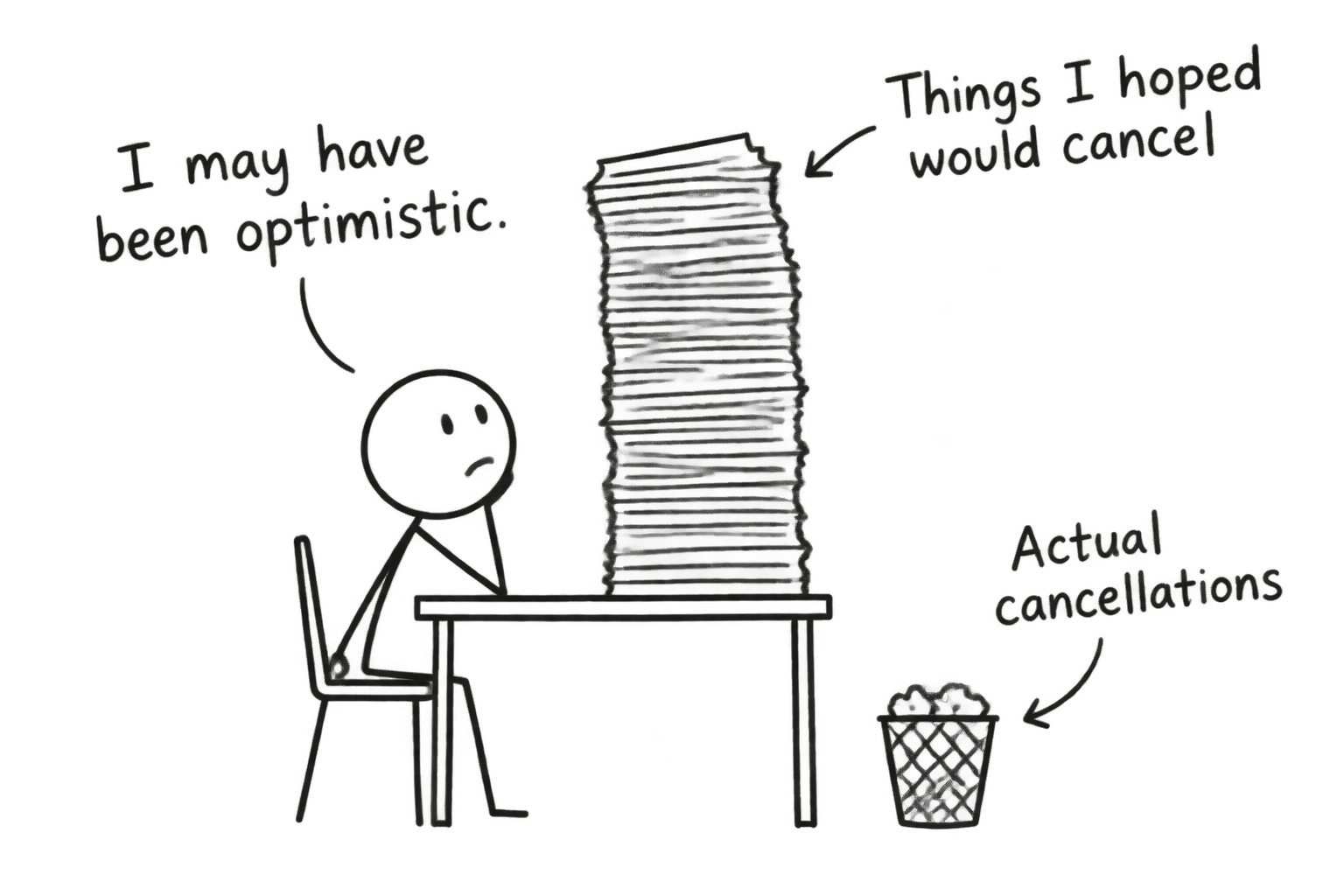 A stick-figure student considers an optimistic pile of hoped-for cancellations during algebra revision
Common mistakes and how to avoid them
Forgetting the whole-number term
Multiplying an equation by a common denominator affects everything, not just the fractions. In the second example, the right-hand side becomes 242424, not 222.
Write the multiplication explicitly if you tend to miss a term. One extra line is cheaper than restarting the question.
Losing a negative sign
A subtraction before a fraction applies to its entire numerator. Keep brackets until you have expanded carefully. Saying “multiply both terms by negative four” is safer than thinking only about removing the bracket.
Cancelling individual terms inside a sum
Cancellation works with common factors, not selected pieces of an addition or subtraction. In the first example, you cannot cancel the denominator against only part of 2x+32x+32x+3.
Using cross-multiplication indiscriminately
Cross-multiplication is useful when one fraction equals another, as in the final example. It is not a general instruction to multiply whichever numbers sit diagonally across an equation. When several terms are present, multiplying every term by a common denominator is clearer.
Hiding the method
You do not need to explain every arithmetic operation in prose. However, show the equation after clearing denominators and enough rearrangement to make your reasoning traceable. An examiner cannot reliably credit a method that exists only in your head.
Exam-style practice and past paper revision
Try these without looking back at the examples. Show the denominator-clearing line in each solution.
- Single fraction: 3x−45=4\frac{3x-4}{5}=453x−4=4
- Different numerical denominators: x+13+x−24=3\frac{x+1}{3}+\frac{x-2}{4}=33x+1+4x−2=3
- Algebraic denominators: 4x+1=3x−2\frac{4}{x+1}=\frac{3}{x-2}x+14=x−23
Answers: respectively, x=8x=8x=8, x=387x=\frac{38}{7}x=738 and x=11x=11x=11. For the final question, exclude x=−1x=-1x=−1 and x=2x=2x=2 before solving.
When using equations with fractions past paper questions, compare your working with the mark scheme, not just the final answer. Ask whether you multiplied every term, preserved signs and displayed the key rearrangement. For related algebraic-fraction work, the worked solutions help you inspect the mathematical steps.
Then redo any incorrect question without copying. That separates recognising someone else’s solution from being able to produce your own.
Turn the method into reliable exam working
Our hypothetical student finishes with a repeatable approach: remove denominators, solve carefully and check the original equation. Your next challenge is applying that approach when the numbers and signs change, rather than merely recognising these examples. Start with MathsGenie Lessons, then practise equations with fractions in the Question Bank.