Equation of a Line Through Two Points Exam Questions
Equation of a line through two points exam questions: three GCSE worked examples, method-mark guidance and focused practice to help you answer confidently.
Two coordinates, one reliable method
Equation of a line through two points exam questions become manageable when you separate two jobs: calculate the gradient, then use either point to find the intercept. Write the equation, check both coordinates, and you have a repeatable method rather than a formula you hope to remember.
Imagine a student working through three GCSE questions. The first has friendly coordinates. The second introduces negative numbers. The third produces fractions and asks for a different answer form. These are hypothetical, original exam-style questions, not reproduced past-paper questions.
The numbers change, but the underlying decisions do not. That is what makes this topic worth practising carefully.
Your equation-of-a-line checklist
For a non-vertical straight line, use:
y=mx+cy=mx+cy=mx+cHere, mmm is the gradient and ccc is the yyy-intercept, the value of yyy when x=0x=0x=0.
Your checklist is:
- Find the change in yyy divided by the change in xxx.
- Substitute the gradient and one complete coordinate pair into y=mx+cy=mx+cy=mx+c.
- Solve for ccc.
- Write the complete equation in the requested form.
- Check that both original points satisfy it.
For points (x1,y1)(x_1,y_1)(x1,y1) and (x2,y2)(x_2,y_2)(x2,y2):
m=y2−y1x2−x1m=\frac{y_2-y_1}{x_2-x_1}m=x2−x1y2−y1Keep the subtraction order consistent. If you begin with the second point in the numerator, begin with it in the denominator too. MathsGenie's Gradient of a Line lesson resources can help if this first step feels uncertain.
Once you have this checklist, use MathsGenie's Equation of a Line Lessons and Question Bank to practise the same sequence with different coordinates.
Three GCSE exam-style worked examples
First question: build the method with positive coordinates
Question: Find the equation of the straight line through (2,5)(2,5)(2,5) and (6,13)(6,13)(6,13). Give your answer in the form y=mx+cy=mx+cy=mx+c.
Our imagined student starts with the gradient rather than trying to guess the equation:
m=13−56−2=84=2m=\frac{13-5}{6-2}=\frac{8}{4}=2m=6−213−5=48=2The equation must therefore have the form:
y=2x+cy=2x+cy=2x+cSubstitute (2,5)(2,5)(2,5):
5=2×2+c5=2\times2+c5=2×2+c c=1c=1c=1So the answer is:
y=2x+1\boxed{y=2x+1}y=2x+1The student checks the unused point. Substituting x=6x=6x=6 gives y=13y=13y=13, as required.
Where the marks come from: The gradient calculation shows a valid method. Substituting a point shows how the intercept was found. The final equation demonstrates accuracy and completes the task. Exact allocations vary between questions, so these are marking checkpoints, not a guaranteed three-mark scheme.
Second question: handle a negative gradient
Question: Find the equation of the straight line through (−3,8)(-3,8)(−3,8) and (1,−4)(1,-4)(1,−4).
The student notices that moving right takes the line downwards. That suggests a negative gradient, a useful check before calculating:
m=−4−81−(−3)=−124=−3m=\frac{-4-8}{1-(-3)}=\frac{-12}{4}=-3m=1−(−3)−4−8=4−12=−3Now write:
y=−3x+cy=-3x+cy=−3x+cUsing (1,−4)(1,-4)(1,−4) keeps the substitution straightforward:
−4=−3×1+c-4=-3\times1+c−4=−3×1+c c=−1c=-1c=−1Therefore:
y=−3x−1\boxed{y=-3x-1}y=−3x−1Check the other point:
−3×(−3)−1=9−1=8-3\times(-3)-1=9-1=8−3×(−3)−1=9−1=8Where the marks come from: Writing the gradient as a fraction makes the subtraction method visible, even if an arithmetic error follows. Correct substitution provides further evidence of the approach. Whether later marks remain available after an earlier error depends on the question's mark scheme.
The important habit is not writing more. It is writing the steps that explain your reasoning.
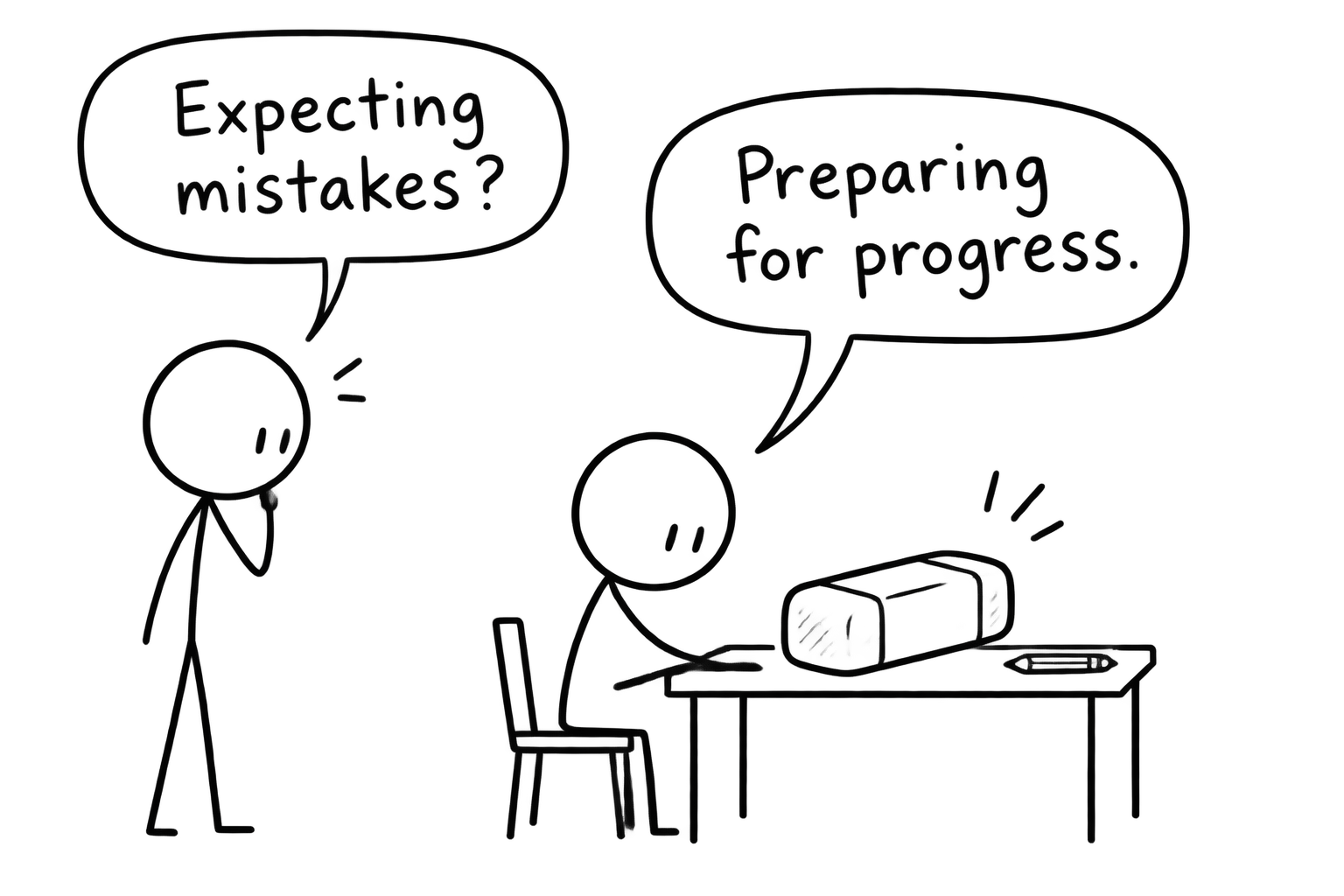 A hand-drawn stick-figure revision comic about preparing for mistakes and progress
Third question: keep fractions exact and change the form
Question: A straight line passes through (−2,4)(-2,4)(−2,4) and (4,1)(4,1)(4,1). Find its equation in the form ax+by=dax+by=dax+by=d, where aaa, bbb and ddd are integers.
The student follows the familiar route:
m=1−44−(−2)=−36=−12m=\frac{1-4}{4-(-2)}=\frac{-3}{6}=-\frac{1}{2}m=4−(−2)1−4=6−3=−21Then:
y=−12x+cy=-\frac{1}{2}x+cy=−21x+cSubstitute (4,1)(4,1)(4,1):
1=−12×4+c1=-\frac{1}{2}\times4+c1=−21×4+c 1=−2+c1=-2+c1=−2+c c=3c=3c=3This gives:
y=−12x+3y=-\frac{1}{2}x+3y=−21x+3But the question is not finished. Multiply every term by 222, then rearrange:
2y=−x+62y=-x+62y=−x+6 x+2y=6\boxed{x+2y=6}x+2y=6Both points work: −2+2×4=6-2+2\times4=6−2+2×4=6 and 4+2×1=64+2\times1=64+2×1=6.
Where the marks come from: The gradient and intercept calculations establish the line. The final rearrangement meets the requested answer form. An equivalent equation can be mathematically correct without fully following the instruction, so always reread the final sentence.
What exam mark schemes need to see
An equation of a line through two points GCSE exam question tests more than substitution. It asks whether you can connect coordinates, gradient and an equation.
In mark schemes, an M mark generally rewards a method, while an A mark rewards accuracy. The precise requirements belong to the individual scheme. Do not assume every line of working earns a separate mark, or that every question has the same allocation.
A useful working layout is one gradient calculation, one substitution, the completed equation and a short check. MathsGenie's Equation of a Line worked solutions let you compare your reasoning with a complete solution, not just an answer.
Common mistakes that change the line
Reversing only one subtraction
You may subtract the coordinates in either direction, but both parts must match. Reversing only the numerator or denominator changes the gradient's sign.
Using a coordinate as the intercept
The yyy-coordinate of a point is not automatically ccc. It equals the intercept only when that point has x=0x=0x=0. Otherwise, substitute to calculate ccc.
Dropping brackets around negative numbers
Write 1−(−3)1-(-3)1−(−3) before simplifying it to 444. Brackets keep subtraction separate from the sign belonging to the coordinate.
Forcing every line into the same form
If both points share an xxx-coordinate, the line is vertical and has equation x=kx=kx=k, where kkk is that shared value. Its gradient is undefined. If both share a yyy-coordinate, the line is horizontal, with equation y=ky=ky=k and gradient 000.
Exam-style practice: try before checking
Cover the worked examples and find each equation independently:
- Positive gradient: Through (1,4)(1,4)(1,4) and (3,10)(3,10)(3,10), in the form y=mx+cy=mx+cy=mx+c.
- Negative gradient: Through (−2,7)(-2,7)(−2,7) and (2,−1)(2,-1)(2,−1), in the form y=mx+cy=mx+cy=mx+c.
- Fractional gradient: Through (−3,5)(-3,5)(−3,5) and (3,1)(3,1)(3,1), in the form ax+by=dax+by=dax+by=d with integer coefficients.
Answers: y=3x+1y=3x+1y=3x+1; y=−2x+3y=-2x+3y=−2x+3; 2x+3y=92x+3y=92x+3y=9.
If an answer differs, check the gradient first, then the intercept, then the rearrangement. This locates the error instead of restarting blindly. For equation of a line through two points past paper questions, apply the same routine and consult the accompanying mark scheme rather than assuming the allocations above.
If the algebra works but the graph feels disconnected, the Drawing Linear Graphs practice booklet helps connect equations with coordinates.
Turn the method into a dependable answer
Our hypothetical student has moved from guessing to a clear routine: gradient, substitution, equation, check. Your next challenge is using it independently when the coordinates look less friendly. Start your next practice session with MathsGenie's Equation of a Line Lessons and Question Bank.