Difference of Two Squares GCSE Maths Guide
Difference of two squares GCSE maths explained with a simple method, worked examples, common mistakes and exam-style practice questions.
A student can factorise ten ordinary quadratics correctly, meet x2−49x^2-49x2−49, and suddenly hesitate. It looks easier. That is often what makes it harder.
Imagine a student called Sam. Each time a difference of two squares GCSE maths question appears, Sam either leaves it unchanged or writes two identical brackets. The missing idea is small but decisive: a difference of two squares factorises into two brackets that are almost identical, except one contains a plus and the other a minus.
a2−b2=(a+b)(a−b) a^2-b^2=(a+b)(a-b) a2−b2=(a+b)(a−b)This guide explains how to recognise that pattern, apply it step by step and check the result. It then gives you exam-style questions to practise.
The quick difference of two squares checklist
Before factorising, ask:
- Are there exactly two terms?
- Is there subtraction between them?
- Is each term a perfect square?
- Can I write the answer as one plus bracket and one minus bracket?
If every answer is yes, use:
a2−b2=(a+b)(a−b) a^2-b^2=(a+b)(a-b) a2−b2=(a+b)(a−b)The order of the brackets does not matter, so (a+b)(a−b)(a+b)(a-b)(a+b)(a−b) and (a−b)(a+b)(a-b)(a+b)(a−b)(a+b) are equivalent.
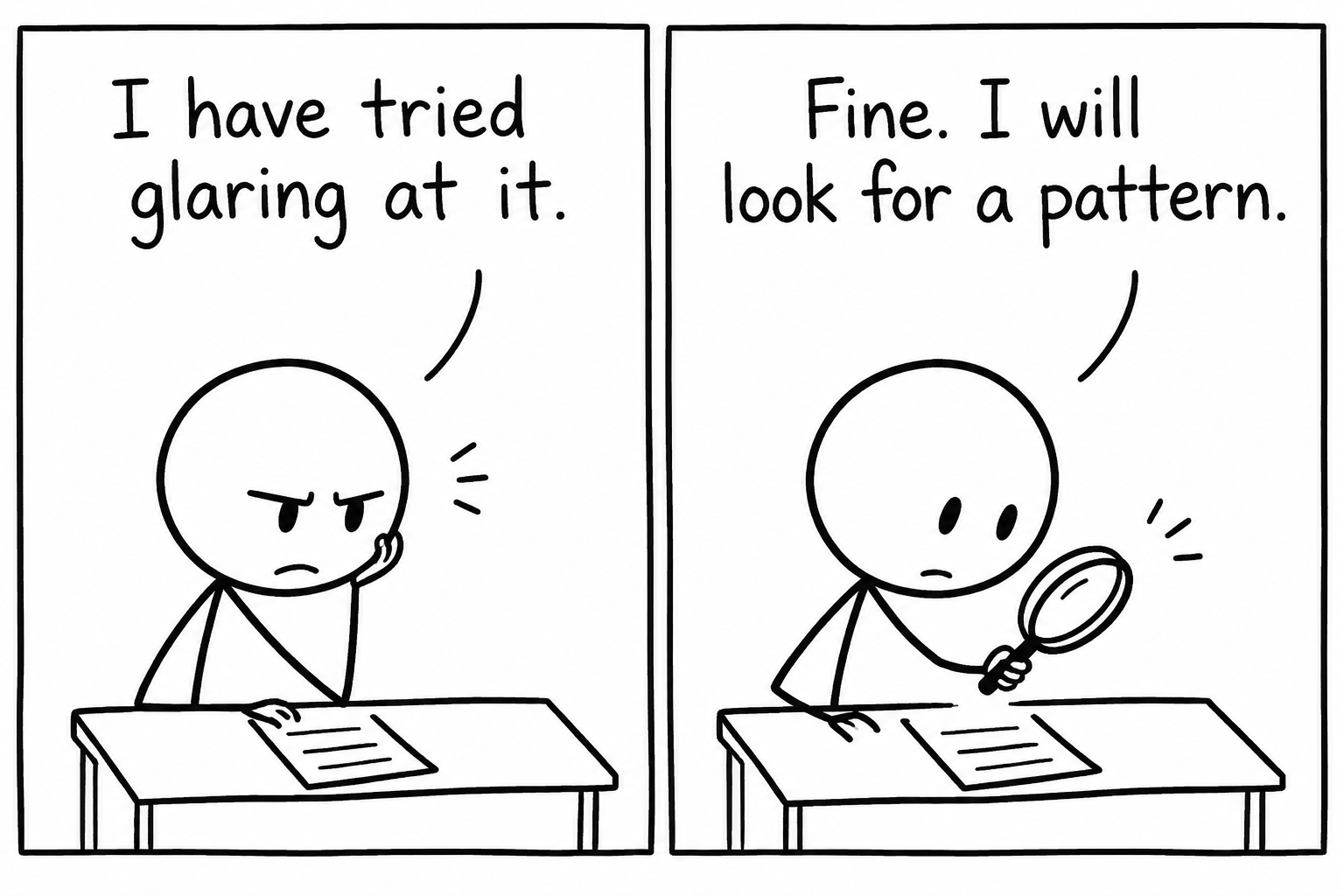 A student stops glaring at algebra and starts looking for a pattern
Why the identity works
Sam had tried to memorise the formula without understanding it. That worked until exam pressure made the signs blur together. Expanding the brackets made the pattern easier to remember:
(a+b)(a−b)=a2−ab+ab−b2 (a+b)(a-b)=a^2-ab+ab-b^2 (a+b)(a−b)=a2−ab+ab−b2The middle terms cancel because −ab+ab=0-ab+ab=0−ab+ab=0. This leaves:
a2−b2 a^2-b^2 a2−b2That cancellation explains both signs in the answer. If both brackets contained plus signs, the middle terms would not cancel. If both contained minus signs, they would not cancel either.
The formula is therefore not a trick. It is simply the reverse of expanding two conjugate brackets.
How to factorise a difference of two squares
Use this three-step method:
- Find the square root of the first term.
- Find the square root of the second term.
- Put those expressions into two brackets, using a plus in one and a minus in the other.
Sam began writing the two square roots above the original terms before attempting the brackets. That short pause prevented most of the previous errors.
Once you have the method in hand, use the matching Maths Genie GCSE revision lessons and Question Bank to turn recognition into a repeatable exam skill.
Difference of two squares worked examples
Factorise x2−25x^2-25x2−25
Both terms are squares:
x2=x2 x^2=x^2 x2=x2 25=52 25=5^2 25=52Substitute a=xa=xa=x and b=5b=5b=5 into the identity:
x2−25=(x+5)(x−5) x^2-25=(x+5)(x-5) x2−25=(x+5)(x−5)A quick expansion confirms the answer:
(x+5)(x−5)=x2−5x+5x−25=x2−25 (x+5)(x-5)=x^2-5x+5x-25=x^2-25 (x+5)(x−5)=x2−5x+5x−25=x2−25Factorise 9x2−169x^2-169x2−16
This time, take the square root of the whole first term, including its coefficient:
9x2=(3x)2 9x^2=(3x)^2 9x2=(3x)2 16=42 16=4^2 16=42Therefore:
9x2−16=(3x+4)(3x−4) 9x^2-16=(3x+4)(3x-4) 9x2−16=(3x+4)(3x−4)Sam's earlier answer had been (9x+4)(9x−4)(9x+4)(9x-4)(9x+4)(9x−4). Expanding that would begin with 81x281x^281x2, not 9x29x^29x2. The square root of 9x29x^29x2 is 3x3x3x, which is the expression needed in each bracket.
Factorise 49a2−81b249a^2-81b^249a2−81b2
Both terms contain variables, but the same rule applies:
49a2=(7a)2 49a^2=(7a)^2 49a2=(7a)2 81b2=(9b)2 81b^2=(9b)^2 81b2=(9b)2So:
49a2−81b2=(7a+9b)(7a−9b) 49a^2-81b^2=(7a+9b)(7a-9b) 49a2−81b2=(7a+9b)(7a−9b)The letters do not change the structure. Look for two squared expressions separated by subtraction.
Factorise 2x2−502x^2-502x2−50 fully
At first sight, neither term gives the cleanest version of the standard pattern. First take out the highest common factor:
2x2−50=2(x2−25) 2x^2-50=2(x^2-25) 2x2−50=2(x2−25)Now factorise the expression inside the brackets:
2(x2−25)=2(x+5)(x−5) 2(x^2-25)=2(x+5)(x-5) 2(x2−25)=2(x+5)(x−5)Therefore, the fully factorised answer is:
2(x+5)(x−5) 2(x+5)(x-5) 2(x+5)(x−5)This example matters because exam questions may require an expression to be factorised fully. Always check for a common factor before using the difference of two squares.
Factorise x4−16x^4-16x4−16
The first term is still a square because x4=(x2)2x^4=(x^2)^2x4=(x2)2:
x4−16=(x2)2−42 x^4-16=(x^2)^2-4^2 x4−16=(x2)2−42Therefore:
x4−16=(x2+4)(x2−4) x^4-16=(x^2+4)(x^2-4) x4−16=(x2+4)(x2−4)But x2−4x^2-4x2−4 is another difference of two squares:
x2−4=(x+2)(x−2) x^2-4=(x+2)(x-2) x2−4=(x+2)(x−2)The fully factorised expression is:
x4−16=(x2+4)(x+2)(x−2) x^4-16=(x^2+4)(x+2)(x-2) x4−16=(x2+4)(x+2)(x−2)For GCSE factorisation over real numbers, x2+4x^2+4x2+4 does not factorise further.
How to recognise questions where the rule does not apply
The identity requires a difference, not a sum. For example:
x2+36 x^2+36 x2+36is a sum of two squares, so it cannot be factorised using (a+b)(a−b)(a+b)(a-b)(a+b)(a−b). Expanding (x+6)(x−6)(x+6)(x-6)(x+6)(x−6) gives x2−36x^2-36x2−36, not x2+36x^2+36x2+36.
The terms must also be squares. For example, x2−12x^2-12x2−12 is not a difference of two integer squares because 121212 is not a perfect square. At GCSE, it would not normally be factorised into integer brackets using this method.
Useful perfect squares to recognise quickly include:
1,4,9,16,25,36,49,64,81,100,121,144 1,4,9,16,25,36,49,64,81,100,121,144 1,4,9,16,25,36,49,64,81,100,121,144Knowing these makes pattern recognition faster, but checking by expansion is still valuable.
Common mistakes with difference of two squares
Using two identical signs
An answer such as (x−7)(x−7)(x-7)(x-7)(x−7)(x−7) is not a difference of two squares. It expands to:
(x−7)2=x2−14x+49 (x-7)^2=x^2-14x+49 (x−7)2=x2−14x+49Use opposite signs:
x2−49=(x+7)(x−7) x^2-49=(x+7)(x-7) x2−49=(x+7)(x−7)Forgetting to square-root the coefficient
For 25x2−925x^2-925x2−9, the term needed in each bracket is 5x5x5x, not 25x25x25x:
25x2−9=(5x+3)(5x−3) 25x^2-9=(5x+3)(5x-3) 25x2−9=(5x+3)(5x−3)Missing the common factor
The expression 3x2−753x^2-753x2−75 should first become:
3(x2−25) 3(x^2-25) 3(x2−25)It then factorises fully to:
3(x+5)(x−5) 3(x+5)(x-5) 3(x+5)(x−5)Stopping too early
With x4−81x^4-81x4−81, one application gives:
x4−81=(x2+9)(x2−9) x^4-81=(x^2+9)(x^2-9) x4−81=(x2+9)(x2−9)The second bracket can also be factorised:
x4−81=(x2+9)(x+3)(x−3) x^4-81=(x^2+9)(x+3)(x-3) x4−81=(x2+9)(x+3)(x−3)After each step, inspect every factor again.
Solving when the question only asks for factorising
Factorising produces brackets. Solving finds values of the variable and requires an equation, usually one equal to zero. Read the command word before beginning.
Difference of two squares questions
Try these without looking back at the examples. Factorise each expression fully.
- x2−64x^2-64x2−64
- 4x2−494x^2-494x2−49
- 100a2−b2100a^2-b^2100a2−b2
- 5x2−455x^2-455x2−45
- x4−1x^4-1x4−1
- 16p4−81q216p^4-81q^216p4−81q2
Answers
- (x+8)(x−8)(x+8)(x-8)(x+8)(x−8)
- (2x+7)(2x−7)(2x+7)(2x-7)(2x+7)(2x−7)
- (10a+b)(10a−b)(10a+b)(10a-b)(10a+b)(10a−b)
- 5(x+3)(x−3)5(x+3)(x-3)5(x+3)(x−3)
- (x2+1)(x+1)(x−1)(x^2+1)(x+1)(x-1)(x2+1)(x+1)(x−1)
- (4p2+9q)(4p2−9q)(4p^2+9q)(4p^2-9q)(4p2+9q)(4p2−9q)
For each incorrect answer, expand your brackets. That check shows whether the error came from the square roots, the signs or incomplete factorisation. More targeted algebra practice is available through the Maths Genie Question Bank, while the GCSE past papers collection helps you practise recognising the pattern among other topics.
Make the pattern stick
The moment it clicked for Sam was not the moment the formula was repeated again. It was the moment every answer was checked by expansion. The plus and minus signs stopped feeling arbitrary because their job was clear: they made the middle terms cancel.
Use this final routine in an exam:
- check for a common factor;
- confirm that there are two squared terms with subtraction;
- square-root both terms;
- write one plus bracket and one minus bracket;
- look for further factorisation;
- expand to check if needed.
Continue with Maths Genie Lessons and Question Bank
Knowing the pattern is the first step; recognising it reliably among mixed algebra questions comes from deliberate practice. Sam improved by pairing each lesson with questions and checking every uncertain factorisation rather than merely rereading the rule. Your turn: start the matching Maths Genie Lessons and Question Bank and practise the difference of two squares method until the pattern is immediate.