

Constructions and Loci GCSE Maths Resit: Grade 4
Constructions and loci GCSE maths resit revision for grade 4: learn key ruler-and-compass methods, loci rules, exam mistakes and focused practice now.
A construction question can feel strangely unfamiliar in a GCSE Maths resit. You may have revised percentages, algebra and graphs, only to reach for a pair of compasses and wonder where to begin.
The good news is that constructions and loci GCSE maths resit questions rely on a small set of repeatable methods. For a grade 4 target, focus on recognising the condition, choosing the correct construction and leaving every construction arc visible. You do not need artistic talent. You need accurate equipment and a method you can repeat under pressure.
Your grade 4 checklist
Before attempting exam-style questions, make sure you can:
- construct the perpendicular bisector of a line segment;
- bisect an angle using a ruler and compasses;
- construct a perpendicular from a point to a line;
- recognise loci involving fixed distances and equal distances;
- combine two conditions and identify the required region;
- keep construction arcs visible for the examiner;
- use a scale correctly when distances are given in metres or kilometres.
MathsGenie places this work within its grade 4 resources. You can use the appropriate Edexcel Loci and Construction lesson or AQA Loci and Construction lesson to review the method before practising it independently. There is also a dedicated CCEA Loci and Construction lesson.
What constructions and loci actually mean
A construction is an accurate geometric drawing made using specified equipment, normally a straight edge and compasses. Measuring approximately with a protractor is not the same as carrying out a ruler-and-compass construction.
A locus is the set of all points satisfying a condition. The language may sound formal, but most GCSE loci questions come from a few simple rules:
- Points a fixed distance from one point form a circle.
- Points a fixed distance from a straight line form two parallel lines.
- Points equidistant from two points lie on the perpendicular bisector joining those points.
- Points equidistant from two intersecting lines lie on the angle bisectors.
The important habit is to translate words into geometry. If a question says “equidistant from AAA and BBB”, think perpendicular bisector. If it says “within 4 cm4\text{ cm}4 cm of PPP”, think inside or on a circle with centre PPP and radius 4 cm4\text{ cm}4 cm.
The constructions worth mastering
Perpendicular bisector
A perpendicular bisector crosses a line segment at its midpoint and at an angle of 90∘90^\circ90∘.
To construct it for a line segment ABABAB:
- Open the compasses to more than half the length of ABABAB.
- Put the compass point on AAA and draw arcs above and below the segment.
- Without changing the compass width, repeat from BBB.
- Join the two arc intersections with a straight line.
The line you draw is also the locus of points equidistant from AAA and BBB.
Angle bisector
An angle bisector divides an angle into two equal angles.
- Place the compass point at the vertex and draw an arc crossing both arms.
- Place the compass point on one crossing and draw an arc inside the angle.
- Keep the same compass width and repeat from the other crossing.
- Join the vertex to the intersection of the two new arcs.
Do not assume an angle bisector is simply a line that “looks central”. The arcs provide the geometric evidence.
Perpendicular from a point
You may be asked to construct the shortest route from a point to a line. That route meets the line at 90∘90^\circ90∘.
Use an arc centred on the point to mark two positions on the line. Then construct equal arcs from those positions and join their intersection to the original point.
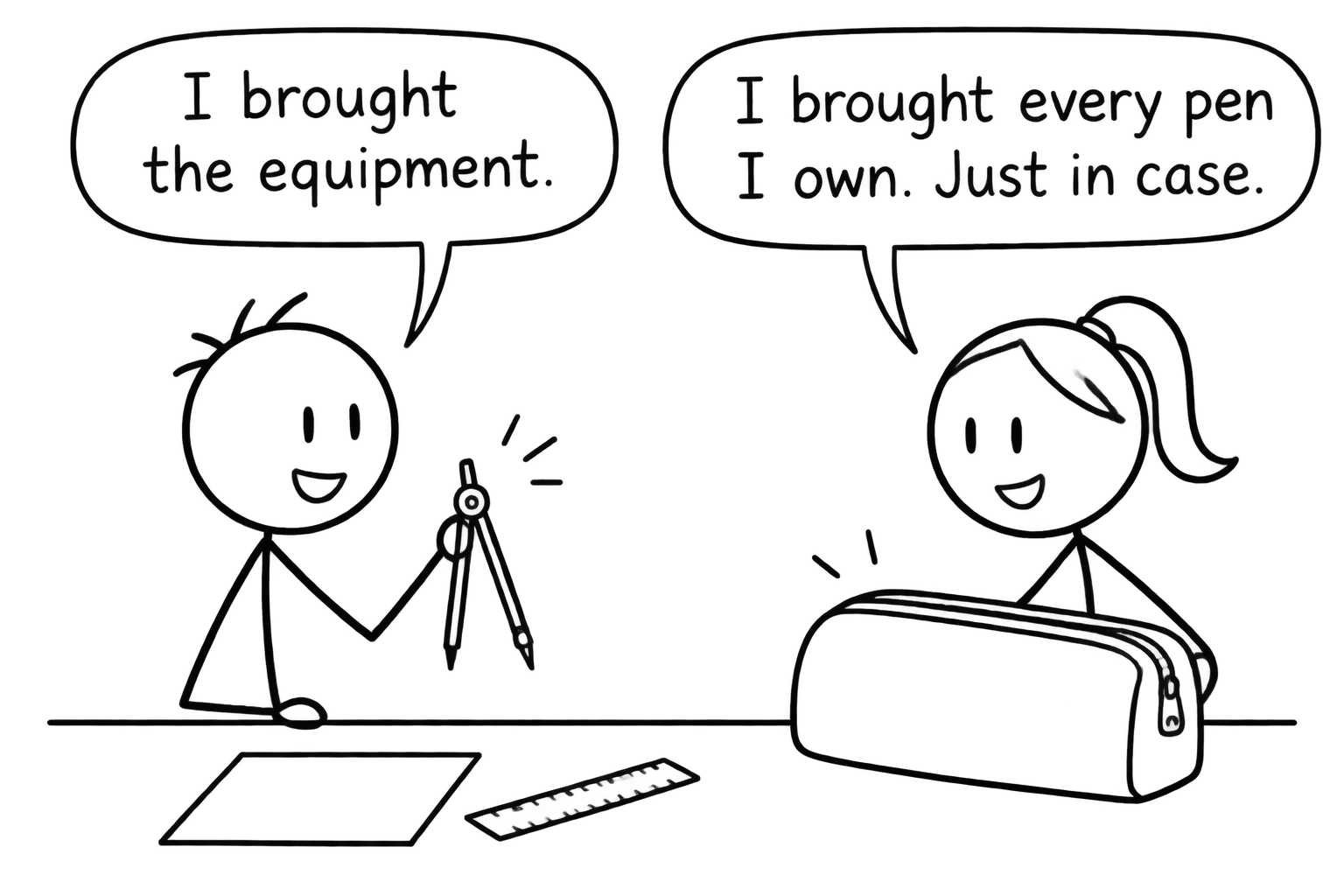 Stick figures comparing useful construction equipment with an enormous pencil case
Worked example: constructing an equidistant path
Question: Two trees are marked by points AAA and BBB. Construct the path containing every point that is the same distance from both trees.
The phrase “the same distance from both” identifies the required locus as the perpendicular bisector of ABABAB.
Method:
- Draw matching arcs from AAA and BBB, using a compass radius greater than half of ABABAB.
- Make sure the arcs intersect on both sides of ABABAB.
- Draw a straight line through the two intersections.
- Leave the arcs visible.
Every point on this constructed line is equidistant from AAA and BBB. If a point XXX lies on the line, then:
XA=XBXA = XBXA=XBA common error is to measure the midpoint of ABABAB and draw a line that appears perpendicular. That may produce a reasonable picture, but it does not demonstrate the requested ruler-and-compass construction. The visible arcs matter because they show how the answer was obtained.
For additional repetition, use the Edexcel GCSE Maths exam booklets, which include topic-based loci and construction worksheets with answers.
Worked example: combining two loci conditions
Question: On a scale drawing, 1 cm1\text{ cm}1 cm represents 100 m100\text{ m}100 m. A campsite must be no more than 400 m400\text{ m}400 m from a water point PPP. It must also be closer to road ABABAB than road ACACAC. Show the region where the campsite can be placed.
Start by converting the real distance to the drawing distance:
400÷100=4400 \div 100 = 4400÷100=4The first condition means the campsite must be inside or on a circle centred at PPP with radius 4 cm4\text{ cm}4 cm.
For the second condition, roads ABABAB and ACACAC meet at AAA. Points equidistant from those roads lie on the angle bisector of ∠BAC\angle BAC∠BAC. Construct the angle bisector using arcs.
The angle bisector separates points closer to ABABAB from points closer to ACACAC. Select the side containing road ABABAB, then shade only the part that is also inside the circle.
This question is not asking for two unrelated drawings. The answer is the overlap of both allowed regions. A useful checking question is: “Does every point I have shaded satisfy both conditions?”
Words describing the boundary also matter:
- “No more than” includes the boundary.
- “Less than” usually excludes the boundary.
- “Closer to” requires you to choose one side of an equal-distance boundary.
Mistakes that cost marks
Rubbing out the construction arcs
The arcs are working, not clutter. Removing them can make a correct line look like an unsupported estimate.
Changing the compass width
Matching arcs depend on an unchanged radius. Tighten the compasses if they slip, and hold them near the hinge rather than squeezing the legs.
Using the wrong boundary
Equidistant from two points means a perpendicular bisector. Equidistant from two intersecting lines means angle bisectors. Identifying what you are measuring from prevents many errors.
Drawing only the boundary
If the question asks for a region, a circle or bisector may only be one boundary. Shade or clearly label the complete region satisfying every condition.
Ignoring the scale
Convert the stated real distance before setting the compass radius. Write the conversion beside the diagram so that your reasoning is clear.
Bringing unsuitable equipment
A worn pencil creates thick, uncertain boundaries, while loose compasses change radius as you draw. Pack a sharp pencil, ruler, compasses, protractor and eraser. The GCSE Maths exam equipment checklist can help you prepare before the paper.
A focused resit revision routine
Post-16 revision time is often limited, so avoid spending an entire evening watching methods without drawing anything. A more useful routine is:
- Watch one MathsGenie revision lesson or video solution.
- Copy each standard construction once, slowly and accurately.
- Complete a short set of practice questions without the video.
- Check your work against the answers or mark scheme.
- Record the mistake in your revision planner.
- Return to the topic with a mini test several days later.
The wider GCSE Maths topics by exam board and tier guide can help you place constructions alongside other geometry topics in your revision plan.
A resit is not a demand to relearn everything at once. It is a chance to turn uncertain topics into reliable marks, one method at a time. Once you can recognise the four main locus rules and reproduce the standard constructions, these questions become much less mysterious.
Finish by opening the MathsGenie Loci and Construction revision hub, then use Mock Exam Builder to build a targeted practice paper. Complete it with your own ruler and compasses, mark it carefully, and repeat the constructions that still cost you marks.















