Completing the Square GCSE Maths Explained
Completing the square GCSE maths explained with clear steps, worked examples, common mistakes and free exam-style questions for confident GCSE revision.
A student can get almost every line of completing the square right and still lose the answer at the final step. That is what makes the topic frustrating. The method is not especially long, but one small sign error changes everything.
For completing the square GCSE maths questions, halve the coefficient of xxx, build a squared bracket, then subtract the extra constant that bracket creates. If the quadratic has a leading coefficient, factor it out first.
Imagine a student called Sam. Each time a completing the square question appears, Sam halves the coefficient of xxx, writes a bracket and hopes the rest will sort itself out. Sometimes it does. Usually it does not.
What Sam needs is one clear idea: when you create a squared bracket, you also create an extra constant. You must remove that constant to keep the original expression unchanged.
Completing the square checklist
For an expression beginning x2+bxx^2+bxx2+bx, use this structure:
x2+bx+c=(x+b2)2+c−(b2)2x^2+bx+c=\left(x+\frac{b}{2}\right)^2+c-\left(\frac{b}{2}\right)^2x2+bx+c=(x+2b)2+c−(2b)2In practical terms:
- Check that the coefficient of x2x^2x2 is 111.
- Halve the coefficient of xxx.
- Put that value inside a squared bracket with xxx.
- Square the value you added and subtract it outside the bracket.
- Include the original constant.
- Simplify carefully.
The expression has changed form, but not value. You can explore the method first in the Completing the Square GCSE lesson, then return to these examples.
Why the method works
Suppose the expression is:
x2+6xx^2+6xx2+6xHalf of 666 is 333, so the bracket begins as (x+3)2(x+3)^2(x+3)2. Expanding that bracket gives:
(x+3)2=x2+6x+9(x+3)^2=x^2+6x+9(x+3)2=x2+6x+9The bracket contains an unwanted 999. Subtracting 999 immediately afterwards keeps the expression balanced:
x2+6x=(x+3)2−9x^2+6x=(x+3)^2-9x2+6x=(x+3)2−9For our hypothetical student, this explains the correction: the number outside the bracket removes the extra constant created when the bracket is squared.
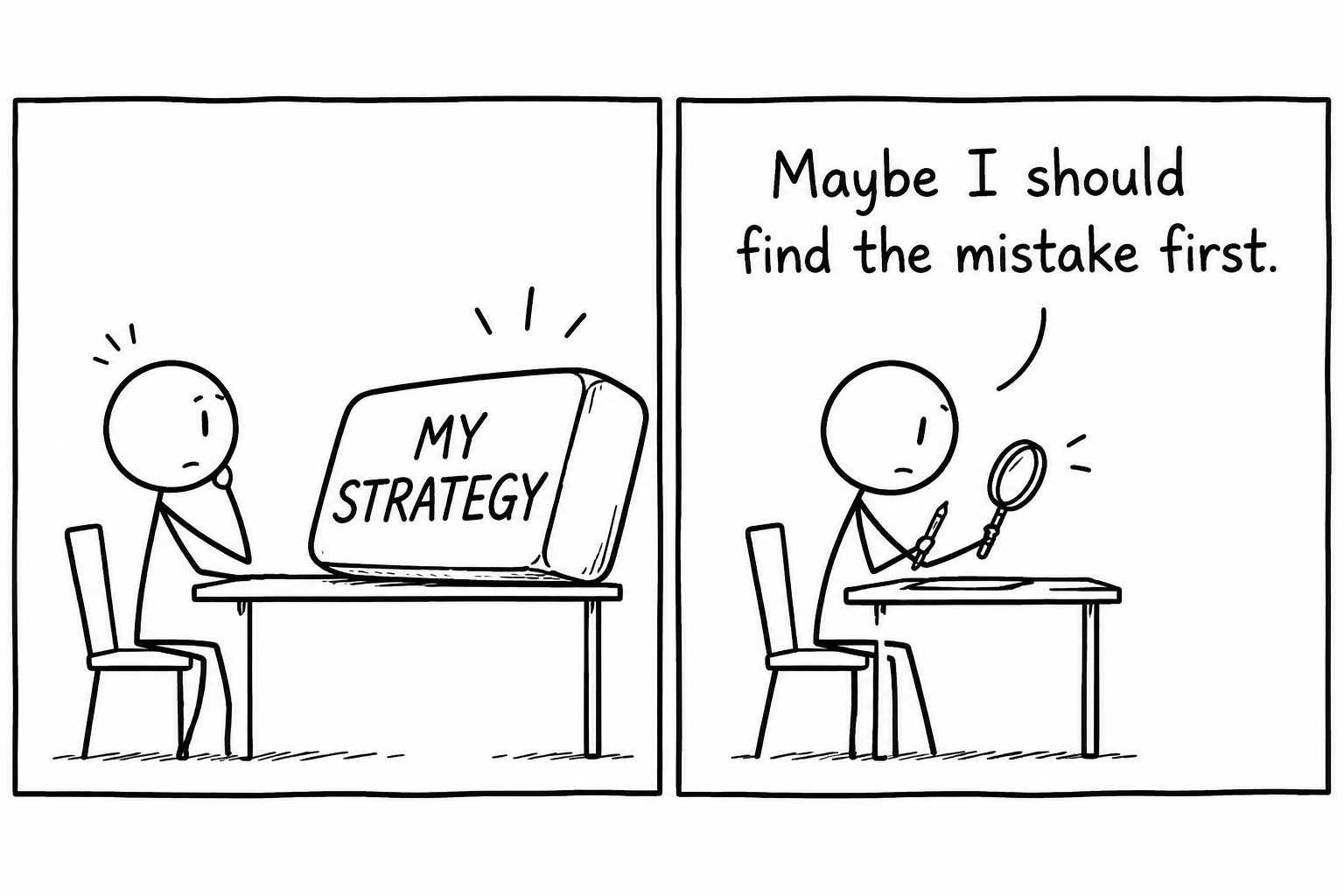 A student replaces an enormous eraser strategy with checking one mistake at a time
Completing the square worked examples
Example with a positive middle term
Write x2+8x+3x^2+8x+3x2+8x+3 in completed square form.
Halve the coefficient of xxx:
8÷2=48\div2=48÷2=4Create the squared bracket:
(x+4)2(x+4)^2(x+4)2This bracket creates an extra 42=164^2=1642=16, so subtract 161616 and include the original 333:
x2+8x+3=(x+4)2−16+3x^2+8x+3=(x+4)^2-16+3x2+8x+3=(x+4)2−16+3Therefore:
x2+8x+3=(x+4)2−13x^2+8x+3=(x+4)^2-13x2+8x+3=(x+4)2−13A quick expansion confirms the result:
(x+4)2−13=x2+8x+16−13=x2+8x+3(x+4)^2-13=x^2+8x+16-13=x^2+8x+3(x+4)2−13=x2+8x+16−13=x2+8x+3Example with a negative middle term
Write x2−10x+7x^2-10x+7x2−10x+7 in completed square form.
Half of −10-10−10 is −5-5−5, so:
x2−10x+7=(x−5)2−25+7x^2-10x+7=(x-5)^2-25+7x2−10x+7=(x−5)2−25+7Simplify the constants:
x2−10x+7=(x−5)2−18x^2-10x+7=(x-5)^2-18x2−10x+7=(x−5)2−18Writing (x+5)2(x+5)^2(x+5)2 would create a positive middle term:
(x+5)2=x2+10x+25(x+5)^2=x^2+10x+25(x+5)2=x2+10x+25The sign inside the bracket must produce the middle term in the original expression.
Example where the coefficient of x2x^2x2 is not 111
Write 2x2+12x+52x^2+12x+52x2+12x+5 in completed square form.
First, factor 222 from the terms containing xxx:
2x2+12x+5=2(x2+6x)+52x^2+12x+5=2(x^2+6x)+52x2+12x+5=2(x2+6x)+5Complete the square inside the bracket:
x2+6x=(x+3)2−9x^2+6x=(x+3)^2-9x2+6x=(x+3)2−9Substitute this result:
2((x+3)2−9)+52\left((x+3)^2-9\right)+52((x+3)2−9)+5Now simplify:
2(x+3)2−18+5=2(x+3)2−132(x+3)^2-18+5=2(x+3)^2-132(x+3)2−18+5=2(x+3)2−13Therefore:
2x2+12x+5=2(x+3)2−132x^2+12x+5=2(x+3)^2-132x2+12x+5=2(x+3)2−13The 222 multiplies everything inside its bracket, including the correction term −9-9−9. Missing that multiplication is a common source of lost marks.
An odd coefficient of xxx produces a fraction when halved. Keep that fraction exact throughout your working, including when you square it for the correction term. There is no need to round. The method stays the same, although the arithmetic needs a little more care. When checking, expand the bracket before combining constants so that you can inspect the middle term separately.
Use the completing the square Question Bank to practise these steps independently.
Using completed square form
Completing the square reveals information hidden in a quadratic expression. The form
a(x−p)2+qa(x-p)^2+qa(x−p)2+qmakes the turning point visible. Its coordinates are (p,q)(p,q)(p,q), provided a≠0a\ne0a=0.
For example:
y=(x−4)2−7y=(x-4)^2-7y=(x−4)2−7has turning point (4,−7)(4,-7)(4,−7). The bracket becomes zero when x=4x=4x=4, not when x=−4x=-4x=−4.
Completed square form can also help solve quadratic equations. Consider:
x2+6x−7=0x^2+6x-7=0x2+6x−7=0Complete the square:
(x+3)2−16=0(x+3)^2-16=0(x+3)2−16=0Rearrange:
(x+3)2=16(x+3)^2=16(x+3)2=16Take both square roots:
x+3=±4x+3=\pm4x+3=±4Therefore:
x=1orx=−7x=1\quad\text{or}\quad x=-7x=1orx=−7The ±\pm± matters because both 424^242 and (−4)2(-4)^2(−4)2 equal 161616. Compare methods in the quadratic equations revision guide, or connect the algebra to curves through drawing quadratic graphs.
Common mistakes to avoid
Forgetting to halve the coefficient
For x2+12xx^2+12xx2+12x, the bracket is (x+6)2(x+6)^2(x+6)2, not (x+12)2(x+12)^2(x+12)2. The number inside the bracket is half the coefficient of xxx when the coefficient of x2x^2x2 is 111.
Losing a negative sign
For x2−8xx^2-8xx2−8x, half of −8-8−8 is −4-4−4. The correct bracket is:
(x−4)2(x-4)^2(x−4)2Keep the sign attached while halving the coefficient.
Forgetting the correction term
The expression (x+3)2(x+3)^2(x+3)2 equals x2+6x+9x^2+6x+9x2+6x+9. The corrected form is:
x2+6x=(x+3)2−9x^2+6x=(x+3)^2-9x2+6x=(x+3)2−9Mishandling a leading coefficient
For 3x2+18x+23x^2+18x+23x2+18x+2, factor 333 from both terms involving xxx:
3(x2+6x)+23(x^2+6x)+23(x2+6x)+2Do not place the original 222 inside that bracket unless you divide it by 333 as well.
Reading the turning point incorrectly
If y=(x+2)2−5y=(x+2)^2-5y=(x+2)2−5, the bracket is zero when x=−2x=-2x=−2. The turning point is therefore (−2,−5)(-2,-5)(−2,−5).
Expanding your final answer is a reliable check. If it returns the original expression, your completed square form is correct.
Exam-style completing the square questions
Try these without looking back at the examples:
- Write x2+14x+8x^2+14x+8x2+14x+8 in the form (x+a)2+b(x+a)^2+b(x+a)2+b.
- Write x2−4x−11x^2-4x-11x2−4x−11 in completed square form.
- Write 3x2+18x−13x^2+18x-13x2+18x−1 in the form a(x+b)2+ca(x+b)^2+ca(x+b)2+c.
- Find the turning point of y=x2−12x+20y=x^2-12x+20y=x2−12x+20.
- Solve x2+8x−9=0x^2+8x-9=0x2+8x−9=0 by completing the square.
Show the bracket, correction term and simplified answer as separate stages. This makes your reasoning clear and errors easier to spot.
Before starting, read the instruction carefully. Rewriting an expression, finding a turning point and solving an equation require different final answers. Completing the square may be the shared method, but you still need to finish the requested task. After marking your attempt, identify the first incorrect line and redo the question from there. Return to it later without your notes to check whether the correction has stayed with you.
For focused practice, use the printable exam booklet. Revisit the completing the square revision guide whenever you need the explanation again.
Make the method stick
For a student like Sam, expanding each answer can reveal a recurring sign mistake. Knowing the steps is the beginning; using them accurately under exam pressure takes deliberate practice.
Choose a question, complete it independently and check by expanding. Then continue with MathsGenie’s completing the square lessons and practice resources.