Common Mistakes with Reverse Percentages in GCSE Maths
Common mistakes with reverse percentages in GCSE Maths: fix incorrect multipliers, understand the original amount and practise with clear worked examples.
The percentage is familiar. The starting point is not.
Common mistakes with reverse percentages in GCSE Maths usually begin with one assumption: undoing a percentage increase means subtracting the same percentage. It does not. The percentage change was calculated from the original amount, not the final amount. To recover the original, identify the multiplier used and divide by it.
Imagine a student checking a marked practice paper. Their percentage calculations look tidy, but several original-price questions are wrong. They know how to calculate a percentage. What they have missed is which amount that percentage belongs to.
Let's follow that hypothetical student as they fix the errors, one decision at a time.
Your reverse percentages checklist
Before reaching for a calculator, check:
- What are you finding? An original amount, rather than an amount after a change?
- What percentage remains? Start from the original 100%100\%100%.
- What is the multiplier? Convert the final percentage into a decimal.
- Which operation reverses it? Divide the final amount by that multiplier.
- Does it check? Apply the stated change to your answer.
The relationship is:
final amount=original amount×multiplier\text{final amount}=\text{original amount}\times\text{multiplier}final amount=original amount×multiplierRearranging gives:
original amount=final amountmultiplier\text{original amount}=\frac{\text{final amount}}{\text{multiplier}}original amount=multiplierfinal amountFor an increase, the multiplier is greater than 111. For a decrease, it lies between 000 and 111. MathsGenie's reverse percentages revision guide explains this forward-and-backward relationship.
Start with MathsGenie's reverse percentages lesson for Eduqas GCSE if you want the method explained before applying it independently in the Question Bank.
Mistake: subtracting the percentage to reverse an increase
A subscription costs £72\pounds72£72 after a 20%20\%20% increase. Find its original cost.
Our hypothetical student subtracts 20%20\%20% of the new price:
72×0.8=57.6072\times0.8=57.6072×0.8=57.60Why it happens: increasing and decreasing sound like opposite actions. But the increase used the original price as its base; this subtraction uses the new price instead.
Correct method: after the increase, the subscription costs 120%120\%120% of its original price.
100%+20%=120%100\%+20\%=120\%100%+20%=120% original cost=72÷1.2=£60\text{original cost}=72\div1.2=\pounds60original cost=72÷1.2=£60Check it forwards:
60×1.2=7260\times1.2=7260×1.2=72The lesson is not simply to remember “divide”. It is to recognise that a percentage always belongs to a particular starting amount.
Mistake: adding the discount back on
A jacket costs £63\pounds63£63 after a 30%30\%30% discount. Find its original price.
The tempting calculation is:
63×1.3=81.9063\times1.3=81.9063×1.3=81.90Why it happens: the student treats the discount as though it were 30%30\%30% of the sale price. It was actually 30%30\%30% of the original price.
Correct method: a 30%30\%30% reduction leaves 70%70\%70% of the original.
100%−30%=70%100\%-30\%=70\%100%−30%=70% original price=63÷0.7=£90\text{original price}=63\div0.7=\pounds90original price=63÷0.7=£90Alternatively, work through 1%1\%1%:
1%=63÷70=£0.901\%=63\div70=\pounds0.901%=63÷70=£0.90 100%=0.90×100=£90100\%=0.90\times100=\pounds90100%=0.90×100=£90Both methods recover the same original amount. The unitary method can be particularly useful when the numbers divide neatly without a calculator.
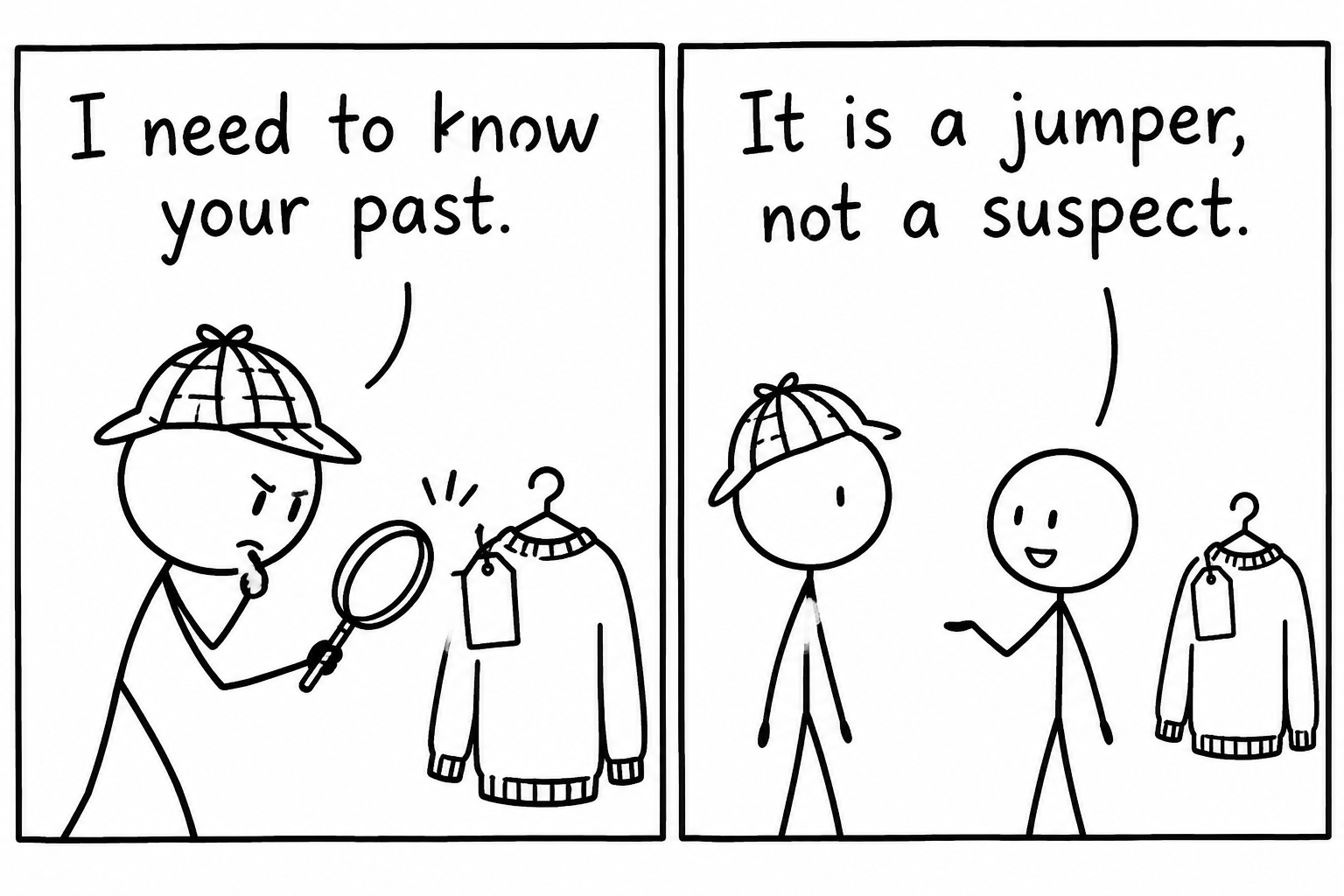 Stick-figure student investigating a jumper's past like a detective
Mistake: dividing by the percentage change
A bicycle costs £230\pounds230£230 after a 15%15\%15% increase. The student now remembers to divide, but writes:
230÷0.15230\div0.15230÷0.15Why it happens: they have identified the operation without identifying what the final amount represents. The bicycle's new price is not 15%15\%15% of the original.
Correct method: the final price represents the whole original price plus the increase.
100%+15%=115%=1.15100\%+15\%=115\%=1.15100%+15%=115%=1.15 original price=230÷1.15=£200\text{original price}=230\div1.15=\pounds200original price=230÷1.15=£200A useful habit is to write one short sentence before calculating: “The new price is 115%115\%115% of the original.” That sentence connects the wording to the multiplier.
In MathsGenie's Edexcel reverse percentages video explanations, the worked examples provide another way to follow this reasoning.
Mistake: multiplying when the question asks you to go backwards
A population is 840840840 after a 5%5\%5% increase. Find the population before the increase.
The student correctly chooses 1.051.051.05, then calculates:
840×1.05=882840\times1.05=882840×1.05=882Why it happens: multiplication is familiar from ordinary percentage-change questions. Under pressure, a familiar operation can override the question's direction.
Correct method: write the forward relationship first.
original population×1.05=840\text{original population}\times1.05=840original population×1.05=840Then reverse the multiplication:
original population=840÷1.05=800\text{original population}=840\div1.05=800original population=840÷1.05=800Notice the sense check: before an increase, the population must have been smaller. An answer of 882882882 should therefore trigger another look.
However, size alone cannot prove an answer correct. The earlier incorrect subtraction also produced a smaller answer. Always combine estimation with a forward check.
Common mistakes in your working and final answer
Once the central method makes sense, smaller habits still matter.
Misreading “reduced by” as “reduced to”
“Reduced by 25%25\%25%” means 75%75\%75% remains. “Reduced to 25%25\%25%” means only 25%25\%25% remains. Underline the word that tells you which interpretation applies.
Rounding before the calculation is finished
Keep the full calculator value until the final answer. Follow the accuracy requested in the question. For a money answer, include appropriate currency units and use two decimal places when needed.
Giving only a calculator answer
Show the percentage represented by the final amount, the multiplier and the division. This makes your reasoning visible and makes your own checking easier. The marks available depend on the individual question and its mark scheme.
Stopping at the original amount when more is asked
A question might ask how much money was saved. Recovering the original price is then an intermediate step. Read the final instruction again before moving on.
Exam-style practice: repair the reasoning
Try these without looking at the answers. For each question, write the final percentage before doing any arithmetic.
- Sale price: trainers cost £68\pounds68£68 after a 15%15\%15% reduction. Find the original price.
- Increased charge: a delivery charge becomes £54\pounds54£54 after a 12.5%12.5\%12.5% increase. Find the original charge.
- Extra step: a desk costs £156\pounds156£156 after a 20%20\%20% discount. Find the amount saved.
Answers and checks
Trainers: the final price represents 85%85\%85%.
68÷0.85=£8068\div0.85=\pounds8068÷0.85=£80Check: 80×0.85=6880\times0.85=6880×0.85=68.
Delivery: the final charge represents 112.5%112.5\%112.5%.
54÷1.125=£4854\div1.125=\pounds4854÷1.125=£48Check: 48×1.125=5448\times1.125=5448×1.125=54.
Desk: the sale price represents 80%80\%80%.
156÷0.8=£195156\div0.8=\pounds195156÷0.8=£195The question asks for the saving, so finish with:
195−156=£39195-156=\pounds39195−156=£39When reviewing mistakes, label the cause: wrong percentage, wrong operation or unfinished answer. That tells you what to change on your next attempt. MathsGenie's Edexcel reverse percentages topic page brings the related explanations and practice resources together.
Turn a corrected mistake into a reliable method
Our hypothetical student now has something more useful than a remembered rule: a way to identify the percentage, reverse the operation and check the result. Your remaining task is to make that sequence reliable when the wording changes. Start fixing your reverse percentage errors with MathsGenie's Lessons, then apply the method independently in its reverse percentages Question Bank for WJEC GCSE.