Rationalising Denominators: Common GCSE Mistakes
Common mistakes with rationalising denominators in GCSE Maths: fix lost marks with clear worked examples, corrections and Higher-tier practice and answers.

A rationalising question can look almost finished before the mistake appears. You know that a surd must disappear from the denominator, so you multiply by something involving a square root. Then a sign changes, a numerator is forgotten or the answer is left one step short.
The common mistakes with rationalising denominators in GCSE Maths usually come from one misunderstanding: whatever you multiply the denominator by, you must also multiply the numerator by. For a binomial denominator, such as 3+23+\sqrt{2}3+2, you also need the conjugate, not simply another copy of the denominator.
Imagine Sam, a GCSE Higher student, correcting the errors that keep costing marks. Each mistake below shows what went wrong, why it felt reasonable and how to repair it.
Rationalising denominators checklist
Before looking at the errors, keep this short method beside your working:
- Simplify any surds first where possible.
- Identify whether the denominator has one term or two terms.
- For a single surd, multiply by that surd.
- For a binomial, multiply by its conjugate.
- Multiply both the numerator and denominator.
- Expand carefully and simplify the final answer fully.
- Check that no surd remains in the denominator.
You can revisit the complete method in the Maths Genie lesson on simplifying surds and rationalising denominators.
Why rationalising works
Rationalising a denominator means rewriting a fraction so that its denominator is rational. The value of the fraction must not change.
For example, multiplying by 33\frac{\sqrt{3}}{\sqrt{3}}33 is allowed because
33=1.\frac{\sqrt{3}}{\sqrt{3}}=1.33=1.Therefore,
53×33=533.\frac{5}{\sqrt{3}}\times\frac{\sqrt{3}}{\sqrt{3}} = \frac{5\sqrt{3}}{3}.35×33=353.The fraction looks different, but it has the same value. That single idea explains both the correct method and most rationalising denominators mistakes.
Common mistakes with rationalising denominators in GCSE Maths
Multiplying only the denominator
Sam starts with
53\frac{5}{\sqrt{3}}35and writes
53×3=53.\frac{5}{\sqrt{3}\times\sqrt{3}}=\frac{5}{3}.3×35=35.The denominator has become rational, but the value of the fraction has changed. Multiplying only one part of a fraction is not equivalent to multiplying by 111.
The correct working is
53×33=533.\frac{5}{\sqrt{3}}\times\frac{\sqrt{3}}{\sqrt{3}} = \frac{5\sqrt{3}}{3}.35×33=353.A useful habit is to write the multiplier as a complete fraction. This makes it harder to forget the numerator.
Forgetting a coefficient in the denominator
Next, Sam sees
725\frac{7}{2\sqrt{5}}257and treats the denominator as though it were only 5\sqrt{5}5. The coefficient 222 does not disappear. Multiply by 55\frac{\sqrt{5}}{\sqrt{5}}55 and keep every factor:
725×55=752×5=7510.\frac{7}{2\sqrt{5}}\times\frac{\sqrt{5}}{\sqrt{5}} = \frac{7\sqrt{5}}{2\times5} = \frac{7\sqrt{5}}{10}.257×55=2×575=1075.The reliable approach is to view 252\sqrt{5}25 as one complete denominator until the multiplication has been carried out.
Using the wrong multiplier for two terms
A denominator such as 2+52+\sqrt{5}2+5 needs a different technique. Sam first tries multiplying by 2+52+\sqrt{5}2+5 again. That produces
(2+5)2=9+45,(2+\sqrt{5})^2=9+4\sqrt{5},(2+5)2=9+45,so the denominator still contains a surd.
Instead, use the conjugate. The conjugate of 2+52+\sqrt{5}2+5 is 2−52-\sqrt{5}2−5. The signs between the terms are opposites:
32+5×2−52−5.\frac{3}{2+\sqrt{5}}\times\frac{2-\sqrt{5}}{2-\sqrt{5}}.2+53×2−52−5.Now use the difference of two squares in the denominator:
(2+5)(2−5)=22−(5)2=4−5=−1.(2+\sqrt{5})(2-\sqrt{5})=2^2-(\sqrt{5})^2=4-5=-1.(2+5)(2−5)=22−(5)2=4−5=−1.The numerator is
3(2−5)=6−35.3(2-\sqrt{5})=6-3\sqrt{5}.3(2−5)=6−35.Therefore,
6−35−1=35−6.\frac{6-3\sqrt{5}}{-1}=3\sqrt{5}-6.−16−35=35−6.The conjugate works because the middle surd terms cancel. Students following Edexcel can reinforce this on the GCSE Surds revision lesson, while AQA students can use the AQA Surds revision guide.
If setting out every stage feels difficult, use the Maths Genie Lessons and Question Bank to watch the method once and then practise the exact error you need to fix.
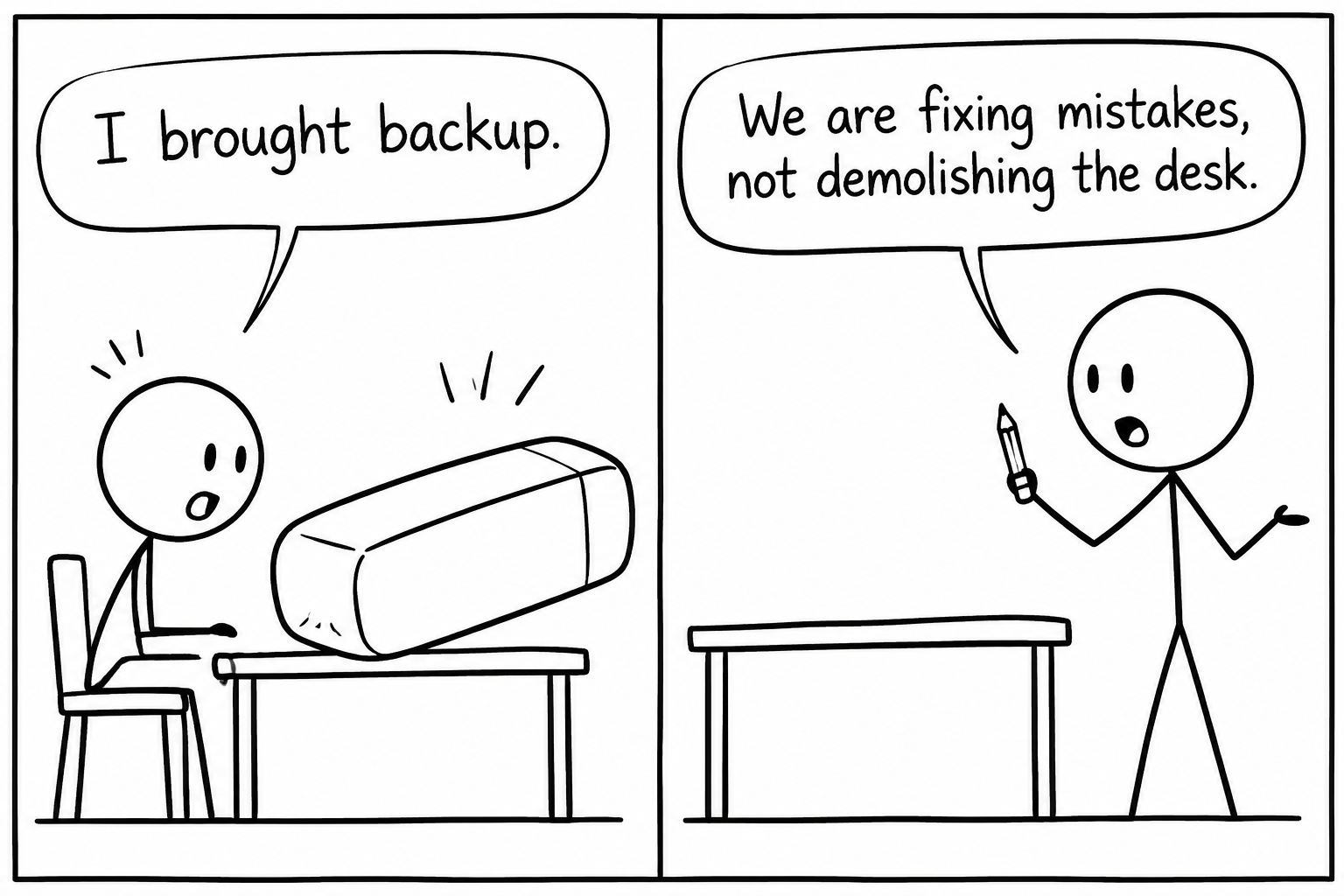 A student brings an enormous eraser to correct a small maths mistake
Making a sign error with the conjugate
Sam now remembers the conjugate but expands too quickly:
(4+3)(4−3).(4+\sqrt{3})(4-\sqrt{3}).(4+3)(4−3).A common incorrect answer is 16+316+316+3. The correct identity is
(a+b)(a−b)=a2−b2.(a+b)(a-b)=a^2-b^2.(a+b)(a−b)=a2−b2.So,
(4+3)(4−3)=42−(3)2=16−3=13.(4+\sqrt{3})(4-\sqrt{3}) =4^2-(\sqrt{3})^2 =16-3 =13.(4+3)(4−3)=42−(3)2=16−3=13.Writing the difference-of-two-squares line before substituting the values can prevent this sign error.
Forgetting to simplify the final answer
Sometimes the rationalising is correct, but the answer is unfinished. Consider
48.\frac{4}{\sqrt{8}}.84.Rationalising immediately gives
48×88=488=82.\frac{4}{\sqrt{8}}\times\frac{\sqrt{8}}{\sqrt{8}} = \frac{4\sqrt{8}}{8} = \frac{\sqrt{8}}{2}.84×88=848=28.However, 8=22\sqrt{8}=2\sqrt{2}8=22, so
82=222=2.\frac{\sqrt{8}}{2} = \frac{2\sqrt{2}}{2} = \sqrt{2}.28=222=2.It is even cleaner to simplify first:
48=422=22=2.\frac{4}{\sqrt{8}} = \frac{4}{2\sqrt{2}} = \frac{2}{\sqrt{2}} = \sqrt{2}.84=224=22=2.Unless a question asks for a particular form, simplify numerical factors and surds fully.
Replacing an exact answer with a decimal
Surd questions usually test exact values. A calculator decimal is an approximation, so changing 533\frac{5\sqrt{3}}{3}353 into a rounded decimal may discard the exact form the question requires.
Keep square roots in the answer unless the question explicitly asks for a decimal or a stated degree of accuracy. A calculator can still be useful for checking that the original fraction and final exact expression have approximately the same value.
A dependable exam method
When Sam slows the process down, each rationalising denominators GCSE question becomes a short sequence rather than a guess:
- Classify the denominator. Is it a single surd or a two-term expression?
- Choose the multiplier. Use the surd itself for one term and the conjugate for two terms.
- Write a fraction equal to 111. This protects the value of the original expression.
- Expand before cancelling. Do not cancel terms across addition or subtraction.
- Simplify and inspect. The final denominator should contain no surd.
For example,
2+32−3\frac{2+\sqrt{3}}{2-\sqrt{3}}2−32+3has the conjugate multiplier 2+32+\sqrt{3}2+3:
2+32−3×2+32+3.\frac{2+\sqrt{3}}{2-\sqrt{3}} \times \frac{2+\sqrt{3}}{2+\sqrt{3}}.2−32+3×2+32+3.The denominator becomes
(2−3)(2+3)=4−3=1.(2-\sqrt{3})(2+\sqrt{3})=4-3=1.(2−3)(2+3)=4−3=1.The numerator becomes
(2+3)2=4+43+3=7+43.(2+\sqrt{3})^2=4+4\sqrt{3}+3=7+4\sqrt{3}.(2+3)2=4+43+3=7+43.Therefore,
2+32−3=7+43.\frac{2+\sqrt{3}}{2-\sqrt{3}}=7+4\sqrt{3}.2−32+3=7+43.Exam-style practice
Try these without looking at the answers. Show the multiplier explicitly and leave each result in exact form.
- Rationalise and simplify 62\frac{6}{\sqrt{2}}26.
- Rationalise and simplify 537\frac{5}{3\sqrt{7}}375.
- Rationalise and simplify 43+5\frac{4}{3+\sqrt{5}}3+54.
- Rationalise and simplify 2+32−3\frac{2+\sqrt{3}}{2-\sqrt{3}}2−32+3.
The answers are:
323\sqrt{2}32 5721\frac{5\sqrt{7}}{21}2157 3−53-\sqrt{5}3−5 7+43.7+4\sqrt{3}.7+43.If one answer is wrong, diagnose it before repeating the question. Was the multiplier incomplete? Did the conjugate have the wrong sign? Was the final surd left unsimplified? That reflection is more valuable than doing several nearly identical questions without checking.
For longer practice, work through the Edexcel Surds exam booklet. If you are unsure where surds sit within your course, use the GCSE topics by exam board and tier to find the relevant revision route.
Fix the error before it becomes a habit
Sam did not need a new trick. The improvement came from making every line preserve the fraction's value, choosing the conjugate deliberately and checking that the final form was fully simplified. Knowing those rules is the first step; applying them consistently under exam pressure requires focused practice.
Your turn. Start the Maths Genie rationalising denominators Lesson, then use the Question Bank to practise until you can spot and correct each mistake yourself.