Common Mistakes With Perpendicular Lines in GCSE Maths
Common mistakes with perpendicular lines in GCSE Maths explained clearly, with worked examples, gradient checks and practice to help you avoid lost marks.

A question can look familiar and still cost marks. You recognise a straight-line equation, remember something about flipping the gradient, then hesitate over the minus sign. The common mistakes with perpendicular lines in GCSE Maths usually come down to three things: reading the original gradient incorrectly, taking the negative reciprocal incorrectly, or stopping before finding the complete equation.
The repair is a repeatable method: rearrange, identify the gradient, take its negative reciprocal, then use the given point. Questions using perpendicular gradients belong to GCSE higher tier, although recognising perpendicular lines starts much earlier.
Imagine a student checking a practice paper. Rather than writing “revise graphs” beside every wrong answer, they identify the exact step that failed. That is the approach we will follow here.
Your perpendicular lines checklist
Perpendicular lines meet at a right angle of 90∘90^\circ90∘. For two non-vertical perpendicular lines, their gradients satisfy:
m1m2=−1m_1m_2=-1m1m2=−1In other words, one gradient is the negative reciprocal of the other.
Before answering, check that you can:
- Rearrange a straight-line equation into y=mx+cy=mx+cy=mx+c.
- Identify mmm, the gradient, without confusing it with ccc, the vertical intercept.
- Find the negative reciprocal, changing both the sign and the reciprocal.
- Substitute a given point to find the new intercept.
- Check the gradients and the completed equation.
The parallel and perpendicular lines revision guide brings these ideas together if you need a reference alongside your practice.
Common mistakes with perpendicular lines in GCSE Maths
Mistake: changing the sign but not taking the reciprocal
Our hypothetical student sees a line with gradient 333 and writes that its perpendicular gradient is −3-3−3.
Why it happens: “negative reciprocal” gets shortened in memory to “make it negative”. But changing the sign is only half the operation.
Correct method: write the whole number as a fraction, take its reciprocal, then change its sign:
3=31⟹m⊥=−133=\frac{3}{1} \quad\Longrightarrow\quad m_{\perp}=-\frac{1}{3}3=13⟹m⊥=−31Check by multiplying:
3×(−13)=−13\times\left(-\frac{1}{3}\right)=-13×(−31)=−1The incorrect choice would give 3×(−3)=−93\times(-3)=-93×(−3)=−9, so it fails the check.
Mistake: taking the reciprocal but keeping the sign
Next, the student meets a gradient of −25-\frac{2}{5}−52 and chooses −52-\frac{5}{2}−25.
Why it happens: flipping the fraction feels like the main task, so the sign is overlooked.
Correct method: reverse the numerator and denominator, then change the sign:
m=−25⟹m⊥=52m=-\frac{2}{5} \quad\Longrightarrow\quad m_{\perp}=\frac{5}{2}m=−52⟹m⊥=25A negative non-zero gradient has a positive perpendicular gradient. A positive gradient has a negative perpendicular gradient. This sign check is quick enough to use before doing any multiplication.
Mistake: reading the gradient before rearranging
Suppose the question gives:
2x+3y=122x+3y=122x+3y=12The student selects 222 as the gradient because it is beside xxx.
Why it happens: the rule “the gradient is the coefficient of xxx” only works when the equation has been written as y=mx+cy=mx+cy=mx+c.
Correct method: isolate yyy first:
3y=−2x+123y=-2x+123y=−2x+12 y=−23x+4y=-\frac{2}{3}x+4y=−32x+4The original gradient is −23-\frac{2}{3}−32, so the perpendicular gradient is 32\frac{3}{2}23.
Notice that every term is divided by 333. Dividing only the term containing xxx would leave an incorrect intercept, even if the gradient happened to be right.
Worked example: finish the whole equation
Finding the gradient is not always the finish line. If the question asks for an equation, a gradient alone does not identify one particular line.
Question: Find the equation of the line perpendicular to y=2x+5y=2x+5y=2x+5 that passes through (4,1)(4,1)(4,1).
Identify the new gradient
The original gradient is 222. Its negative reciprocal is:
m⊥=−12m_{\perp}=-\frac{1}{2}m⊥=−21Write the new line with an unknown intercept:
y=−12x+cy=-\frac{1}{2}x+cy=−21x+cSubstitute the given point
The point (4,1)(4,1)(4,1) means x=4x=4x=4 and y=1y=1y=1:
1=−12(4)+c1=-\frac{1}{2}(4)+c1=−21(4)+c 1=−2+c1=-2+c1=−2+c c=3c=3c=3Therefore:
y=−12x+3\boxed{y=-\frac{1}{2}x+3}y=−21x+3Check both conditions
The gradients multiply to −1-1−1:
2×(−12)=−12\times\left(-\frac{1}{2}\right)=-12×(−21)=−1The given point also satisfies the new equation:
−12(4)+3=1-\frac{1}{2}(4)+3=1−21(4)+3=1These checks test different things. The first checks perpendicularity; the second checks that you have chosen the correct line from all the possible perpendicular lines.
Use MathsGenie's parallel and perpendicular lines Lessons and perpendicular lines Question Bank to practise this same sequence without having to assemble your own questions.
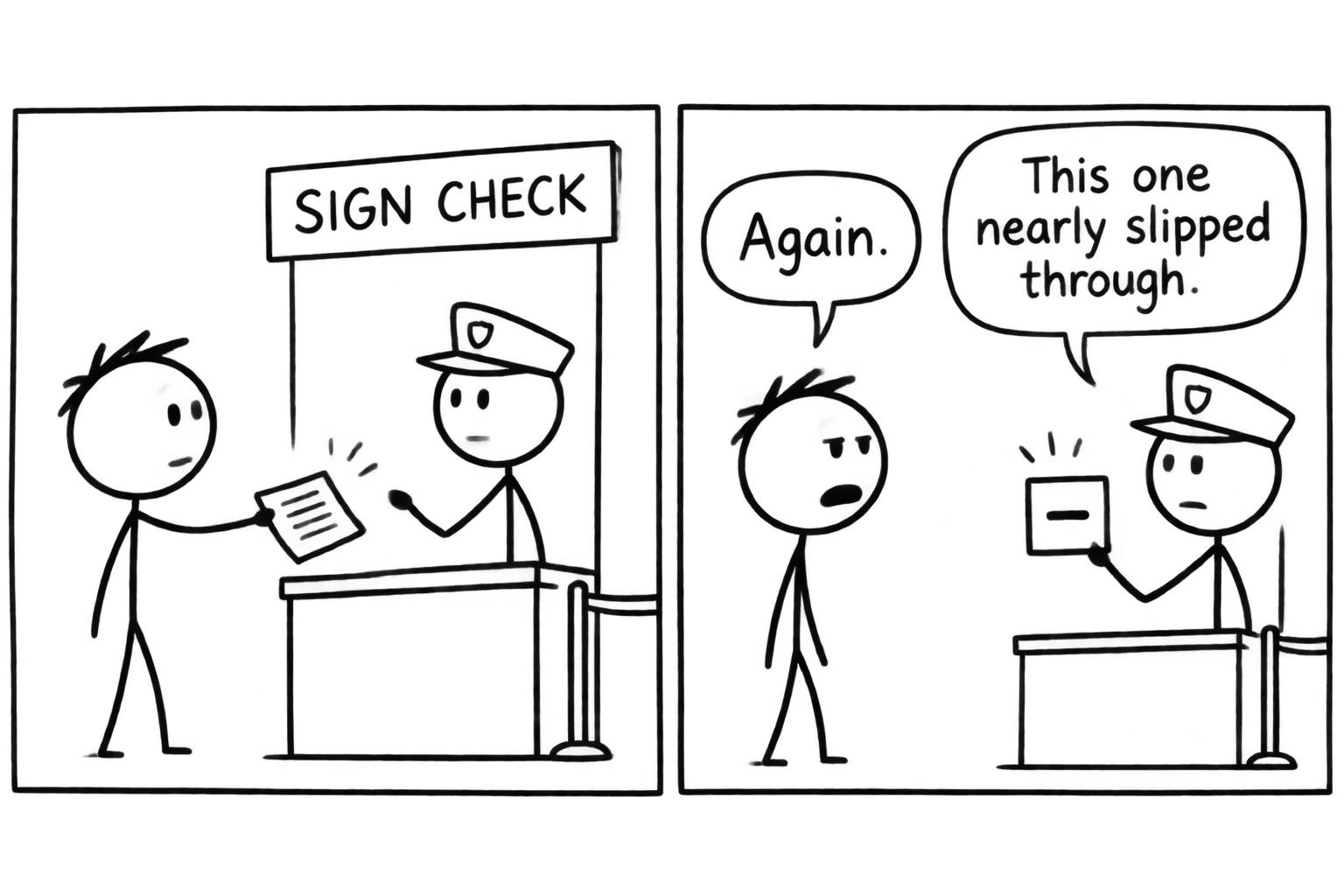 Stick-figure comic showing a student sending their work through a sign-check security checkpoint
More perpendicular lines mistakes to catch
Keeping the original intercept
In the worked example, copying +5+5+5 from the original equation would produce the wrong line.
Why it happens: the student changes the gradient and assumes everything else stays the same. But perpendicularity determines the gradient, not the intercept. Use the supplied point to calculate ccc afresh.
Confusing parallel and perpendicular lines
Parallel lines have equal gradients. Non-vertical perpendicular lines have gradients whose product is −1-1−1.
Before calculating, underline the relationship requested. A correct parallel-line method cannot answer a perpendicular-line question. The parallel and perpendicular lines topic page is useful for practising the distinction.
Trying to divide by zero
A horizontal line such as y=4y=4y=4 has gradient 000. A vertical line has an undefined gradient, so do not try to find it by calculating −10-\frac{1}{0}−01.
Instead, use the geometry: horizontal and vertical lines are perpendicular. The vertical line through (3,4)(3,4)(3,4) is x=3x=3x=3.
Exam-style practice
Try these without looking at the answers. Show the gradient change explicitly, then show any substitution needed.
- Gradient check: Find the gradient of a line perpendicular to y=−4x+7y=-4x+7y=−4x+7.
- Rearranging check: Find the gradient of a line perpendicular to 3x+2y=83x+2y=83x+2y=8.
- Complete equation: Find the equation of the line perpendicular to y=13x−2y=\frac{1}{3}x-2y=31x−2 through (2,5)(2,5)(2,5).
Answers and checks
Gradient check: The negative reciprocal of −4-4−4 is 14\frac{1}{4}41.
Rearranging check: Writing 3x+2y=83x+2y=83x+2y=8 as y=−32x+4y=-\frac{3}{2}x+4y=−23x+4 gives a perpendicular gradient of 23\frac{2}{3}32.
Complete equation: The new gradient is −3-3−3, so write y=−3x+cy=-3x+cy=−3x+c. Substituting (2,5)(2,5)(2,5) gives:
5=−3(2)+c⟹c=115=-3(2)+c \quad\Longrightarrow\quad c=115=−3(2)+c⟹c=11Therefore the equation is y=−3x+11y=-3x+11y=−3x+11.
If an answer differs, locate the first incorrect step rather than copying the finished solution. Label the error “rearranging”, “negative reciprocal” or “substitution”. That tells you what your next practice question needs to test.
Turn corrections into reliable marks
The student in our example now has something more useful than “be careful”: a specific check for each recurring error. Your next task is to make those checks routine when the question looks unfamiliar. Start your next practice session with MathsGenie's Lessons and Question Bank above, working through perpendicular gradients before moving on to complete equations.