

Common Mistakes with Percentages in GCSE Maths
Common mistakes with percentages in GCSE Maths explained through worked examples, correction methods and exam-style practice that helps protect marks.
A percentage question can look reassuringly familiar. Then one small decision changes everything: dividing instead of multiplying, treating the final price as the original, or subtracting the same percentage and expecting to return to where you started.
The common mistakes with percentages in GCSE Maths are rarely caused by difficult arithmetic. They usually come from answering a slightly different question from the one on the page. The solution is to identify what represents 100%100\%100%, choose the correct operation and check whether the answer should be larger or smaller.
Imagine a student, Sam, reviewing a marked paper. The calculator work is accurate, but several answers have lost marks. By sorting each error into a clear category, Sam can turn those lost marks into a practical revision list.
A percentage question checklist
Before calculating, ask:
- What amount represents 100%100\%100%?
- Am I finding a percentage, a new amount or an original amount?
- Is the value increasing or decreasing?
- Should my answer be larger or smaller than the amount given?
- Does the question require money to the nearest penny?
This five-question check is useful across foundation and higher tier. Once you can classify the question, the calculation becomes much less mysterious.
If setting up every method feels like a lot, use the Maths Genie percentage lesson and revision resources before applying the checklist in the GCSE Maths Question Bank.
Mistake: turning the percentage into the wrong decimal
Sam sees 7%7\%7% and writes 0.70.70.7. This is one of the most damaging percentages mistakes because every later step may look perfectly organised.
A percentage means “out of 100100100”, so divide by 100100100:
7%=7100=0.077\% = \frac{7}{100} = 0.077%=1007=0.07By contrast:
70%=70100=0.770\% = \frac{70}{100} = 0.770%=10070=0.7Worked example
Find 7%7\%7% of £480£480£480.
Convert the percentage to a decimal and multiply:
7%=0.077\% = 0.077%=0.07 480×0.07=33.6480 \times 0.07 = 33.6480×0.07=33.6Therefore, the answer is £33.60£33.60£33.60.
A quick sense check helps. Since 10%10\%10% of £480£480£480 is £48£48£48, an answer of £336£336£336 cannot represent only 7%7\%7%.
Mistake: finding the change but not the new amount
There is an important difference between “find the increase” and “find the price after the increase”. Sam calculates the percentage correctly but stops one step too soon.
Worked example
A bicycle costs £640£640£640 and increases in price by 15%15\%15%. Find the new price.
First find the increase:
640×0.15=96640 \times 0.15 = 96640×0.15=96Then add it to the original price:
640+96=736640 + 96 = 736640+96=736The new price is £736£736£736.
Alternatively, an increase of 15%15\%15% leaves a total of 115%115\%115%:
115%=1.15115\% = 1.15115%=1.15 640×1.15=736640 \times 1.15 = 736640×1.15=736Both methods are correct. The multiplier method is often quicker, particularly for repeated percentage change.
Mistake: using the wrong percentage multiplier
A multiplier represents the percentage that remains after the change.
For an increase of r%r\%r%:
multiplier=1+r100\text{multiplier} = 1 + \frac{r}{100}multiplier=1+100rFor a decrease of r%r\%r%:
multiplier=1−r100\text{multiplier} = 1 - \frac{r}{100}multiplier=1−100rSam reduces a value by 23%23\%23% and multiplies by 0.230.230.23. But 0.230.230.23 finds the amount removed. The amount remaining is 77%77\%77%, so the correct multiplier is 0.770.770.77.
Worked example
A coat costing £85£85£85 is reduced by 23%23\%23%.
100%−23%=77%100\% - 23\% = 77\%100%−23%=77% 77%=0.7777\% = 0.7777%=0.77 85×0.77=65.4585 \times 0.77 = 65.4585×0.77=65.45The sale price is £65.45£65.45£65.45.
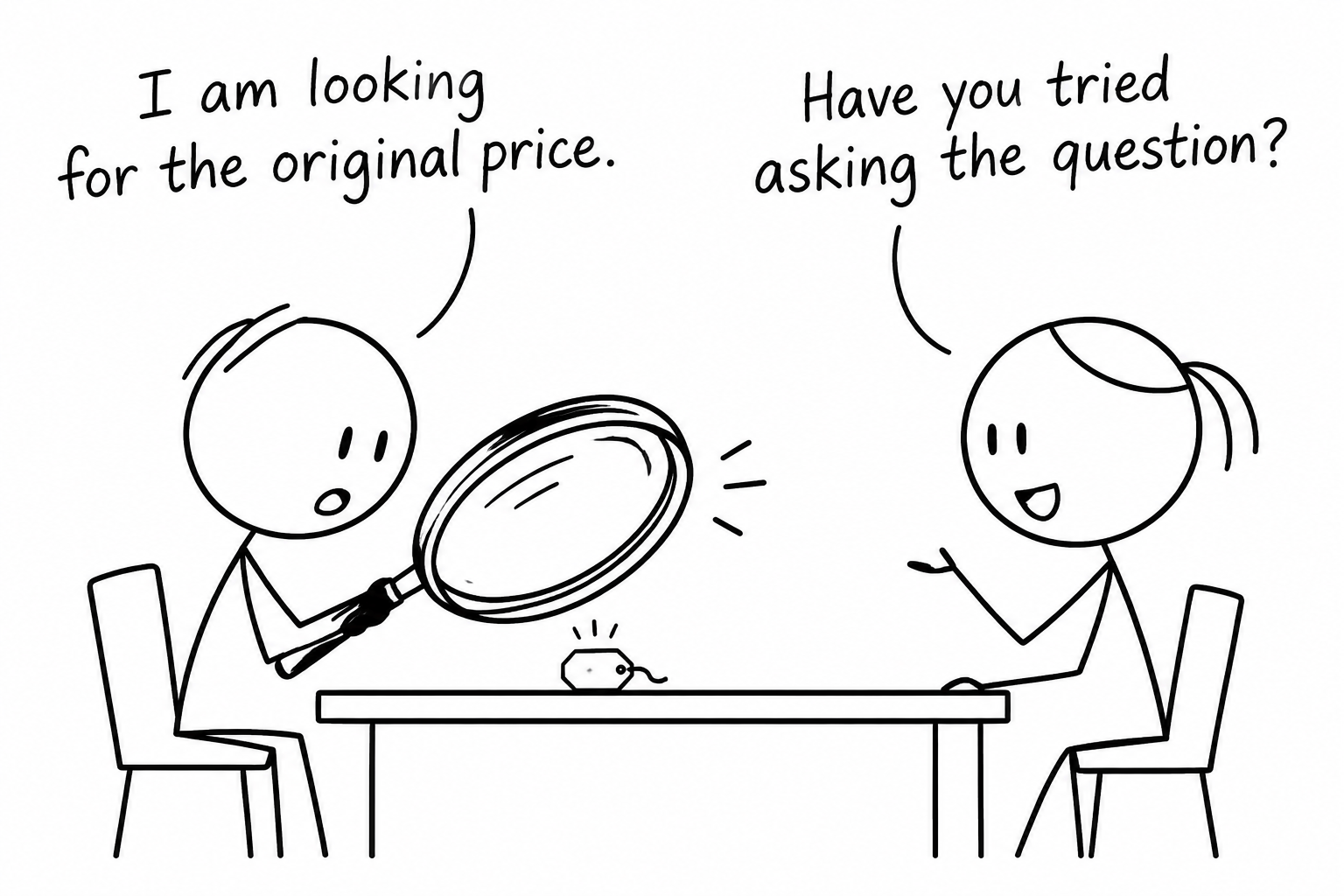 Two students take the search for an original price rather too literally
Mistake: reversing a percentage by subtracting it
Reverse percentages are a common source of lost marks in percentages GCSE questions. If a final amount is given, that amount is not usually 100%100\%100%.
Suppose a price has risen by 20%20\%20%. The final price is 120%120\%120% of the original. To recover the original, divide by 1.21.21.2. Do not reduce the final price by 20%20\%20%.
Worked example
After a 20%20\%20% increase, a laptop costs £780£780£780. Find its original price.
The new price represents 120%120\%120% of the original:
120%=1.2120\% = 1.2120%=1.2Let the original price be xxx:
1.2x=7801.2x = 7801.2x=780 x=7801.2=650x = \frac{780}{1.2} = 650x=1.2780=650The original price was £650£650£650.
Check by applying the increase:
650×1.2=780650 \times 1.2 = 780650×1.2=780The reverse percentages lesson explains this distinction, while the reverse percentages revision guide provides a focused recap.
Mistake: assuming equal increases and decreases cancel
Sam thinks that increasing a quantity by 10%10\%10% and then decreasing it by 10%10\%10% returns it to its starting value. It does not, because the second percentage is calculated from a different amount.
Worked example
A value of £500£500£500 increases by 10%10\%10% and then decreases by 10%10\%10%.
After the increase:
500×1.1=550500 \times 1.1 = 550500×1.1=550After the decrease:
550×0.9=495550 \times 0.9 = 495550×0.9=495The final value is £495£495£495, not £500£500£500.
The complete multiplier calculation is:
500×1.1×0.9=495500 \times 1.1 \times 0.9 = 495500×1.1×0.9=495This happens because 10%10\%10% of £550£550£550 is £55£55£55, whereas the original increase was only £50£50£50. You can practise this idea with the repeated percentage change exam booklet.
Mistake: dividing in the wrong order for percentage change
Percentage change compares the change with the original amount, not the new amount.
percentage change=changeoriginal amount×100%\text{percentage change} = \frac{\text{change}}{\text{original amount}} \times 100\%percentage change=original amountchange×100%Worked example
A club’s membership rises from 240240240 to 276276276.
Find the change:
276−240=36276 - 240 = 36276−240=36Divide by the original membership:
36240×100%=15%\frac{36}{240} \times 100\% = 15\%24036×100%=15%The membership increased by 15%15\%15%.
Dividing by 276276276 instead would compare the change with the final membership, which is not what percentage change means.
Common mistakes to catch before the exam
Sam’s corrected paper now becomes a checklist rather than a record of failure. The main warning signs are:
- writing 8%8\%8% as 0.80.80.8 instead of 0.080.080.08;
- giving the percentage change when the question asks for the new amount;
- multiplying by the percentage removed rather than the percentage remaining;
- treating a final amount as 100%100\%100% in a reverse percentage question;
- expecting equal percentage increases and decreases to cancel;
- dividing percentage change by the final value;
- rounding too early and carrying an inaccurate value forward;
- forgetting units, particularly pounds and pence.
In a multi-step question, keep the full calculator value until the final line. Round money to the nearest penny unless the question gives another instruction.
Exam-style practice
Try these without looking back at the examples.
Question A: Find 18%18\%18% of £350£350£350.
Question B: A television costing £480£480£480 is reduced by 15%15\%15%. Find its sale price.
Question C: After a 12%12\%12% increase, a salary is £31,360£31{,}360£31,360. Find the original salary.
Question D: A population falls from 800800800 to 728728728. Calculate the percentage decrease.
Answers
A: 350×0.18=£63\text{A: } 350 \times 0.18 = £63A: 350×0.18=£63 B: 480×0.85=£408\text{B: } 480 \times 0.85 = £408B: 480×0.85=£408 C: 31,3601.12=£28,000\text{C: } \frac{31{,}360}{1.12} = £28{,}000C: 1.1231,360=£28,000 D: 800−728800×100%=9%\text{D: } \frac{800-728}{800} \times 100\% = 9\%D: 800800−728×100%=9%For further exam-style questions with worked solutions and mark-scheme guidance, continue with the reverse percentages Question Bank.
Turn percentage errors into reliable marks
Knowing the method is the first step; recognising it quickly under exam pressure takes practice. Sam’s improvement begins by naming each mistake, correcting it and then answering a fresh question without copying the model. Your turn: start the matching Maths Genie Lessons, then use the Question Bank to practise each percentage method until the choice of operation feels secure.















