Common Mistakes with Factorising Quadratics in GCSE Maths
Common mistakes with factorising quadratics in GCSE Maths, explained with worked examples, checks and exam-style practice to help protect every mark.
Why factorising errors cost avoidable marks
The most common mistakes with factorising quadratics in GCSE Maths are choosing the wrong factor pair, losing a negative sign, ignoring a common factor and treating every quadratic as though the coefficient of x2x^2x2 were 111. The reliable solution is to slow down just enough to identify the type of quadratic, follow the appropriate method and expand your answer to check it.
Imagine a student, Sam, reviewing a practice paper. Sam understands factorising, yet several answers are wrong. None of the errors looks dramatic. One pair of numbers adds to the wrong total. One minus sign disappears. In another question, the method is correct but unfinished.
That is encouraging. Small, identifiable mistakes can be repaired.
A factorising quadratics checklist
Before looking at individual errors, use this process:
- Check whether every term has a common factor.
- Identify the coefficients aaa, bbb and ccc in ax2+bx+cax^2+bx+cax2+bx+c.
- If a=1a=1a=1, find two numbers that multiply to ccc and add to bbb.
- If a≠1a\neq1a=1, find two numbers that multiply to acacac and add to bbb, then split the middle term.
- Write the final answer as a product of brackets.
- Expand the brackets to check all three original terms.
You can review the complete method in the Expanding and Factorising Quadratics lesson or use the AQA factorising quadratics lesson if that matches your course.
Mistake: choosing factors that only multiply correctly
Sam sees:
x2+7x+10 x^2+7x+10 x2+7x+10The first thought is that 1×10=101\times10=101×10=10, leading to:
(x+1)(x+10) (x+1)(x+10) (x+1)(x+10)The factors multiply to the constant term, but their sum is 111111, not 777. Expanding exposes the error:
(x+1)(x+10)=x2+11x+10 (x+1)(x+10)=x^2+11x+10 (x+1)(x+10)=x2+11x+10For a quadratic of the form x2+bx+cx^2+bx+cx2+bx+c, the chosen numbers must satisfy two conditions. They must multiply to ccc and add to bbb.
The factor pairs of 101010 are 111 and 101010, or 222 and 555. Since 2+5=72+5=72+5=7, the correct factorisation is:
x2+7x+10=(x+2)(x+5) x^2+7x+10=(x+2)(x+5) x2+7x+10=(x+2)(x+5)The middle term is the test that students most often skip.
Mistake: guessing the signs
Now Sam reaches:
x2−x−12 x^2-x-12 x2−x−12Because the constant is negative, the two numbers must have different signs. Sam writes (x+4)(x−3)(x+4)(x-3)(x+4)(x−3) because 4×(−3)=−124\times(-3)=-124×(−3)=−12. But the numbers add to 111, not −1-1−1.
The correct pair is 333 and −4-4−4:
3×(−4)=−12 3\times(-4)=-12 3×(−4)=−12 3+(−4)=−1 3+(-4)=-1 3+(−4)=−1Therefore:
x2−x−12=(x+3)(x−4) x^2-x-12=(x+3)(x-4) x2−x−12=(x+3)(x−4)A useful sign rule is:
- If ccc is positive, the signs are the same and match the sign of bbb.
- If ccc is negative, the signs are different.
- With different signs, the number with greater magnitude has the sign of bbb.
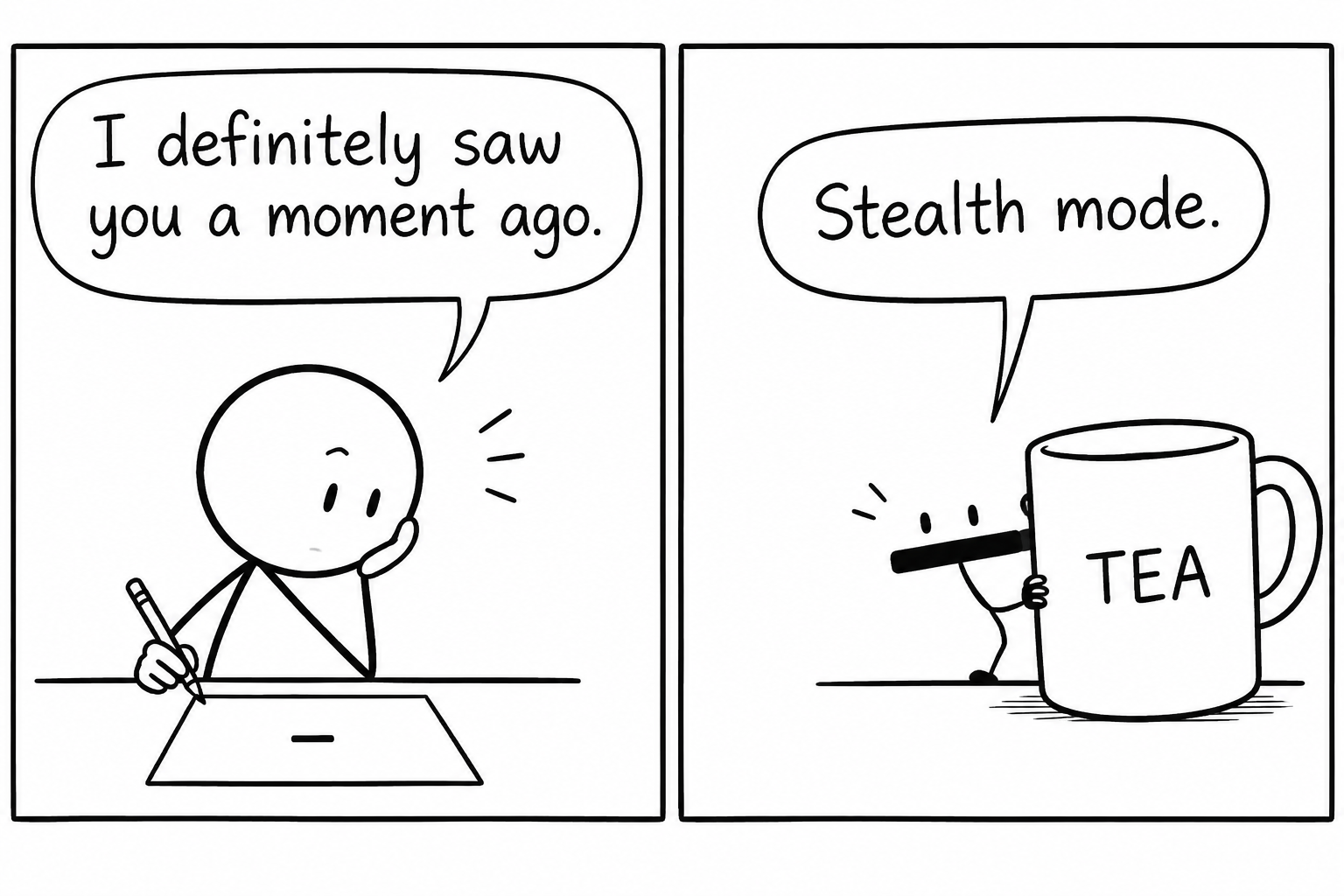 A minus sign hiding from a student during algebra revision
Mistake: forgetting the common factor
Consider:
3x2+12x 3x^2+12x 3x2+12xSam notices that both terms contain xxx and writes:
x(3x+12) x(3x+12) x(3x+12)This is mathematically equivalent to the original expression, but it is not fully factorised. Both coefficients are also divisible by 333.
The highest common factor is 3x3x3x, so:
3x2+12x=3x(x+4) 3x^2+12x=3x(x+4) 3x2+12x=3x(x+4)Always look for a common factor before attempting double brackets. It can simplify a harder expression and prevents an incomplete final answer. The Expanding and Factorising revision guide provides further examples of taking factors outside brackets.
Mistake: ignoring the coefficient of x2x^2x2
The simple factor-pair method changes when the coefficient of x2x^2x2 is not 111. Suppose Sam needs to factorise:
2x2+7x+3 2x^2+7x+3 2x2+7x+3Writing (x+3)(x+1)(x+3)(x+1)(x+3)(x+1) cannot be correct because its leading term would be x2x^2x2, not 2x22x^22x2.
For ax2+bx+cax^2+bx+cax2+bx+c, multiply aaa and ccc:
a×c=2×3=6 a\times c=2\times3=6 a×c=2×3=6Find two numbers that multiply to 666 and add to 777. They are 666 and 111. Split the middle term:
2x2+6x+x+3 2x^2+6x+x+3 2x2+6x+x+3Factorise each pair:
2x(x+3)+1(x+3) 2x(x+3)+1(x+3) 2x(x+3)+1(x+3)The repeated bracket becomes one factor:
(2x+1)(x+3) (2x+1)(x+3) (2x+1)(x+3)Finally, check by expanding:
(2x+1)(x+3)=2x2+6x+x+3=2x2+7x+3 (2x+1)(x+3)=2x^2+6x+x+3=2x^2+7x+3 (2x+1)(x+3)=2x2+6x+x+3=2x2+7x+3For more demanding examples, work through the Factorising Harder Quadratics lesson.
Open the lesson alongside the factorising quadratics Question Bank when you want to apply this checklist without having to find suitable questions yourself.
Mistake: confusing factorising with solving
Factorising rewrites an expression as a product. Solving finds values of the variable that satisfy an equation.
If the question says factorise:
x2+5x+6 x^2+5x+6 x2+5x+6stop at:
(x+2)(x+3) (x+2)(x+3) (x+2)(x+3)If the question says solve:
x2+5x+6=0 x^2+5x+6=0 x2+5x+6=0factorise first, then use the fact that at least one bracket must equal zero:
(x+2)(x+3)=0 (x+2)(x+3)=0 (x+2)(x+3)=0 x=−2orx=−3 x=-2\quad\text{or}\quad x=-3 x=−2orx=−3Reading the command word prevents unnecessary work and ensures that you give the form of answer requested.
Common factorising mistakes to check in an exam
Once the method feels familiar, most lost marks come from execution rather than understanding. Before moving on, ask:
- Have the two selected numbers been checked for both their product and sum?
- Does the sign of the middle term match the original expression?
- Has the highest common factor been removed?
- Does the first term from the brackets reproduce the original x2x^2x2 term?
- Is the expression fully factorised?
- Did the question ask you to factorise or solve?
Expanding your final brackets is the strongest check because it tests the leading term, middle term and constant simultaneously. The check takes a few lines, but it can reveal an error before you move on.
Keep the original expression visible while checking. Comparing your expansion with an expression copied incorrectly will not reveal the copying mistake. Check each coefficient against the question itself, including any missing middle term. If the expansion disagrees, identify which term is wrong before restarting: a wrong constant suggests a product error, while a wrong middle term suggests an addition or sign error. This makes checking a diagnosis rather than another attempt.
Exam-style practice
Factorise each expression fully before checking the answers below.
- x2−2x−15x^2-2x-15x2−2x−15
- 4x2+20x4x^2+20x4x2+20x
- 3x2+11x+63x^2+11x+63x2+11x+6
- 25x2−1625x^2-1625x2−16
Answers
x2−2x−15=(x−5)(x+3) x^2-2x-15=(x-5)(x+3) x2−2x−15=(x−5)(x+3) 4x2+20x=4x(x+5) 4x^2+20x=4x(x+5) 4x2+20x=4x(x+5) 3x2+11x+6=(3x+2)(x+3) 3x^2+11x+6=(3x+2)(x+3) 3x2+11x+6=(3x+2)(x+3) 25x2−16=(5x−4)(5x+4) 25x^2-16=(5x-4)(5x+4) 25x2−16=(5x−4)(5x+4)The final expression is a difference of two squares. Its brackets have matching terms with opposite signs, so the middle terms cancel when expanded. A missing middle term does not mean the expression cannot be factorised. Look for square terms separated by subtraction before trying a longer method. This pattern is worth recognising, but the same expansion check still applies: every term must match the original expression.
If one answer was wrong, classify the error rather than simply copying the correction. Was it the signs, the common factor, the factor pair or the coefficient of x2x^2x2? That diagnosis tells you what to practise next. You can find a larger set in the Expanding and Factorising exam booklet.
Turn the method into marks
Sam's improvement would not come from trying to factorise faster. It would come from using the same short checklist until choosing factors, checking signs and expanding the answer become dependable habits. You now know how to spot the errors, but consistent practice is what stops them returning under exam pressure.
Start the factorising quadratics lesson and then complete the Question Bank.