Colour Coding Notes for GCSE Statistics: Does It Help?
Colour coding notes GCSE Statistics content can improve organisation and attention, but active recall and exam practice matter more. Learn what works.
You sit down to revise statistics. Twenty minutes later, the page looks magnificent: definitions in blue, formulas in green, warnings in red and headings surrounded by carefully drawn boxes. There is only one uncomfortable question. Could you answer an exam question without looking at it?
The honest answer about colour coding notes GCSE Statistics content is that colour can help you organise information and notice important distinctions. It may support recall when colours have consistent meanings. But colour is not a powerful revision method by itself. If most of your time goes into making attractive notes rather than retrieving knowledge and answering questions, it is probably more satisfying than effective.
The best approach is to use colour briefly and deliberately, then close the notes and practise.
The short answer: when does colour-coding help?
Colour-coding is useful when it performs a clear job. It should help you:
- separate definitions from methods;
- distinguish similar statistical ideas;
- draw attention to assumptions or limitations;
- mark errors that need another attempt;
- navigate a page quickly before active practice.
It is less useful when you:
- highlight nearly everything;
- choose colours for appearance rather than meaning;
- repeatedly rewrite notes you already understand;
- avoid testing yourself because practice feels harder;
- spend longer selecting pens than answering questions.
A sensible revision checklist is therefore simple: organise, retrieve, practise, mark and revisit. Colour belongs mainly in the first and fourth stages. It should not consume the whole session.
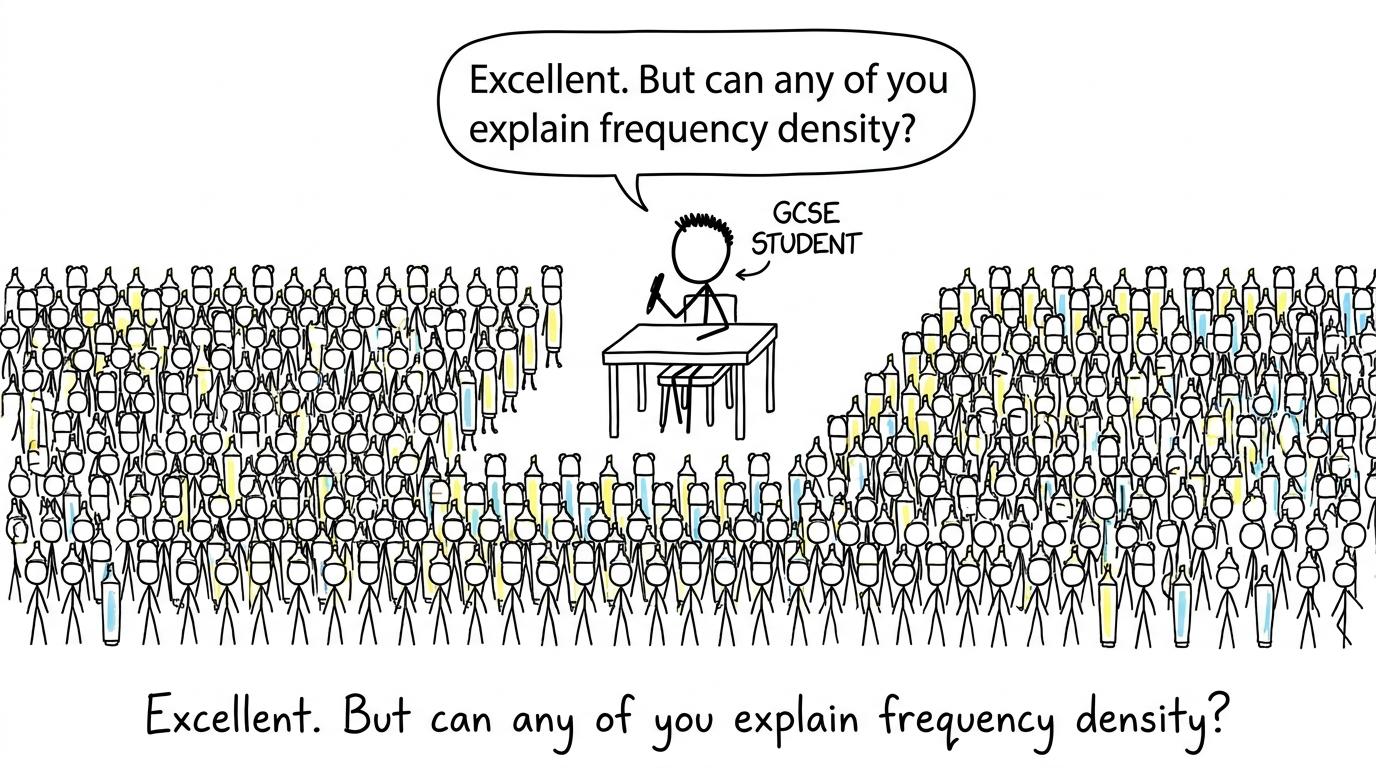 A GCSE student asks an army of highlighters whether they can explain frequency density
What the research actually suggests
Research into colour and memory is more nuanced than the claim that colourful notes automatically improve recall. Reviews suggest colour can direct attention, make material more distinctive and provide useful visual signals. Consistency matters: a colour is more helpful when it repeatedly represents the same kind of information.
However, recent research into colour as a retrieval cue has found that background colour alone may not improve learning from text. Colour is more likely to help when it communicates structure or highlights a meaningful relationship, rather than merely decorating the page.
There is stronger and broader evidence for retrieval practice, actively trying to recall or apply knowledge without immediately consulting notes. Education Endowment Foundation reviews also stress that retrieval should involve a genuine attempt from memory, feedback and repeated recall after a delay.
That distinction matters. Reading a green formula can feel fluent because it is familiar. Recalling the formula on a blank page is harder. The harder activity gives you more useful information about what you actually know.
For GCSE maths, retrieval must eventually lead to application. Remembering that histogram frequency is represented by bar area is helpful, but an examination may require you to connect class width, frequency and frequency density:
frequency density=frequencyclass width\text{frequency density}=\frac{\text{frequency}}{\text{class width}}frequency density=class widthfrequencyColour might help you locate that relationship. Only questions can teach you to use it reliably.
Why statistics is well suited to limited colour-coding
Statistics contains ideas that are related but not interchangeable. Students may confuse mean and median, correlation and causation, or frequency and frequency density. A restrained colour system can make these boundaries visible.
It also helps to recognise the scope of the topic. GCSE maths specifications from Edexcel, AQA, OCR and Eduqas include statistical content such as sampling, charts, averages, measures of spread and scatter graphs. Some students also take a separate GCSE Statistics qualification with wider statistical content. Always match your notes to your own exam board and specification.
The MathsGenie GCSE Maths revision hub lets you choose the appropriate board, while the Edexcel GCSE Statistics revision hub brings together dedicated Statistics lessons, questions, worksheets and papers.
Give every colour one stable meaning
A small palette is usually better than a rainbow. For example:
- Blue: definitions and vocabulary;
- Green: formulas or procedures;
- Red: warnings, assumptions and common errors;
- Purple: interpretation in context.
The particular colours are not important. Their meanings are. If red means “common mistake” on one page but “formula” on the next, the system creates extra decisions rather than reducing them.
Students with colour-vision differences should choose high-contrast colours and combine colour with labels, underlining styles or symbols. Meaning should never depend on colour alone.
Use colour to contrast ideas
Statistics marks are often lost at the boundary between two concepts. Colour can make that boundary memorable:
- mean versus estimated mean;
- discrete versus continuous data;
- bar chart versus histogram;
- interpolation versus extrapolation;
- correlation versus causation;
- population versus sample.
On notes about averages, one colour could identify exact calculations and another could flag estimates from grouped data. The relevant relationship is:
estimated mean=∑(midpoint×frequency)∑frequency\text{estimated mean}=\frac{\sum(\text{midpoint}\times\text{frequency})}{\sum \text{frequency}}estimated mean=∑frequency∑(midpoint×frequency)For a fuller explanation, use the averages from frequency tables revision guide, then answer questions without copying its layout.
Use colour to annotate, not replace, graphs
A statistical diagram needs accurate scales, labels, plotting and interpretation. Colour cannot rescue an incorrect graph.
You might use one colour to mark the upper class boundaries plotted on a cumulative frequency graph, or another to identify where quartiles are read. The mathematical positions remain:
Q1=N4,median=N2,Q3=3N4Q_1=\frac{N}{4},\qquad \text{median}=\frac{N}{2},\qquad Q_3=\frac{3N}{4}Q1=4N,median=2N,Q3=43NReview the method with the cumulative frequency revision guide. For higher-tier histogram work, the histograms revision resources combine lessons, revision guidance, questions and videos.
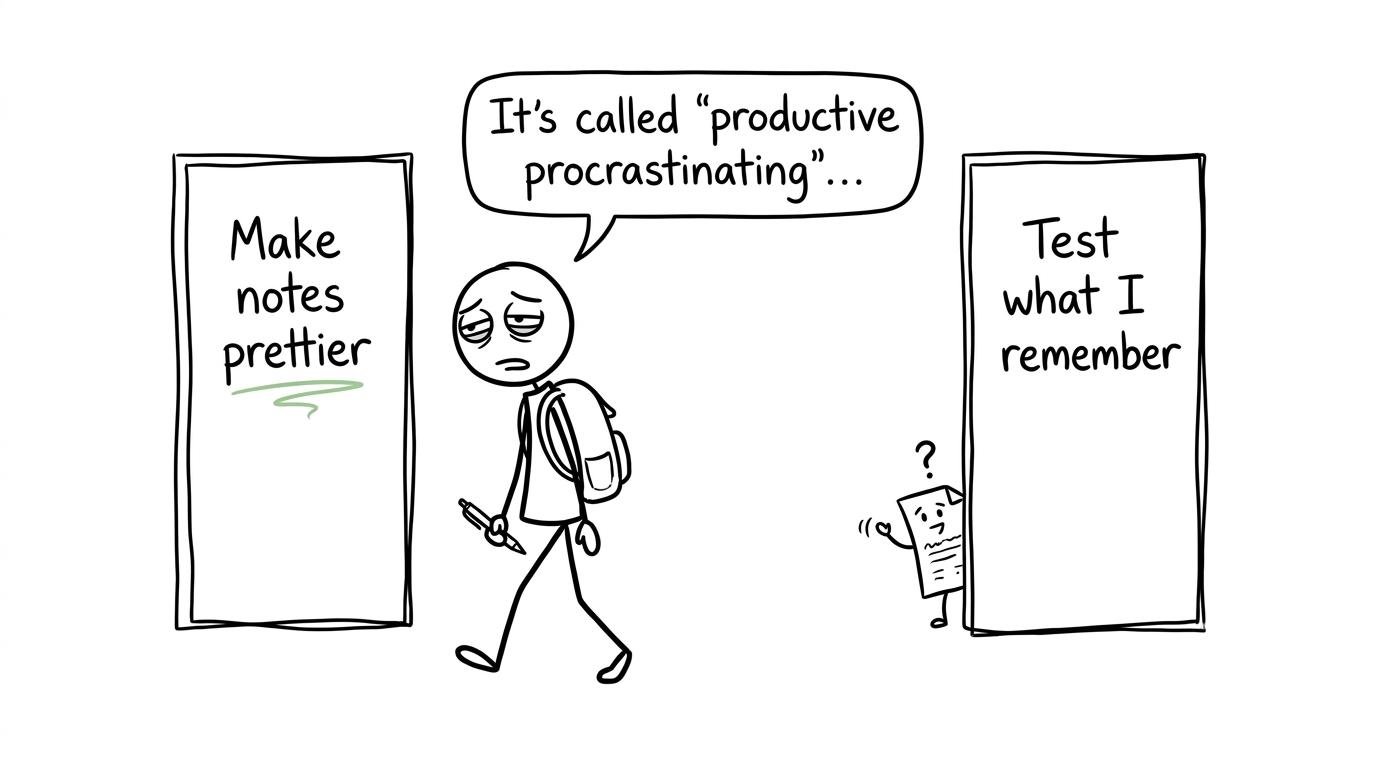 A student chooses between making notes prettier and testing what they remember
Turn colourful notes into active revision
The most useful question is not “Which colour should I use?” It is “What will I do after making the note?”
Build notes from the specification
Start with a topic checklist rather than an empty notebook. Divide statistics into manageable areas such as data collection, sampling, averages, spread, diagrams and interpretation. This stops note-making from becoming an open-ended art project.
Keep each page concise. Record the idea, essential notation, conditions and one warning. Then move to retrieval.
Close the page and reconstruct it
After reviewing a section, close your notes. On blank paper, write what you remember about the topic. You could reconstruct a diagram checklist, list the differences between data types or state the relationships needed for grouped data.
Now reopen the notes and correct omissions in a single contrasting colour. This is where colour becomes diagnostic: it records the gap revealed by retrieval rather than disguising the gap with neatness.
Answer exam-style questions immediately
Statistics is not assessed as a colouring exercise. You must select information, calculate accurately, draw or interpret representations and communicate conclusions in context.
Move from recall to a short set of questions. Mark your attempt, identify why each mark was lost and revisit the method. MathsGenie's GCSE Statistics resources include question-bank practice and worksheets, while GCSE predicted papers can support broader exam preparation nearer the examination.
Revisit the topic after a delay
One successful attempt does not guarantee lasting recall. Return to the topic after a gap and attempt a fresh question without notes. Spacing revision across several sessions is generally more useful than repeating the same page several times in one evening.
A compact routine might look like this:
- scan the colour-coded summary;
- hide it and retrieve the key ideas;
- answer a small question set;
- check with solutions or a mark scheme;
- correct errors in one colour;
- schedule another attempt.
The notes now serve the practice. The practice does not serve the notes.
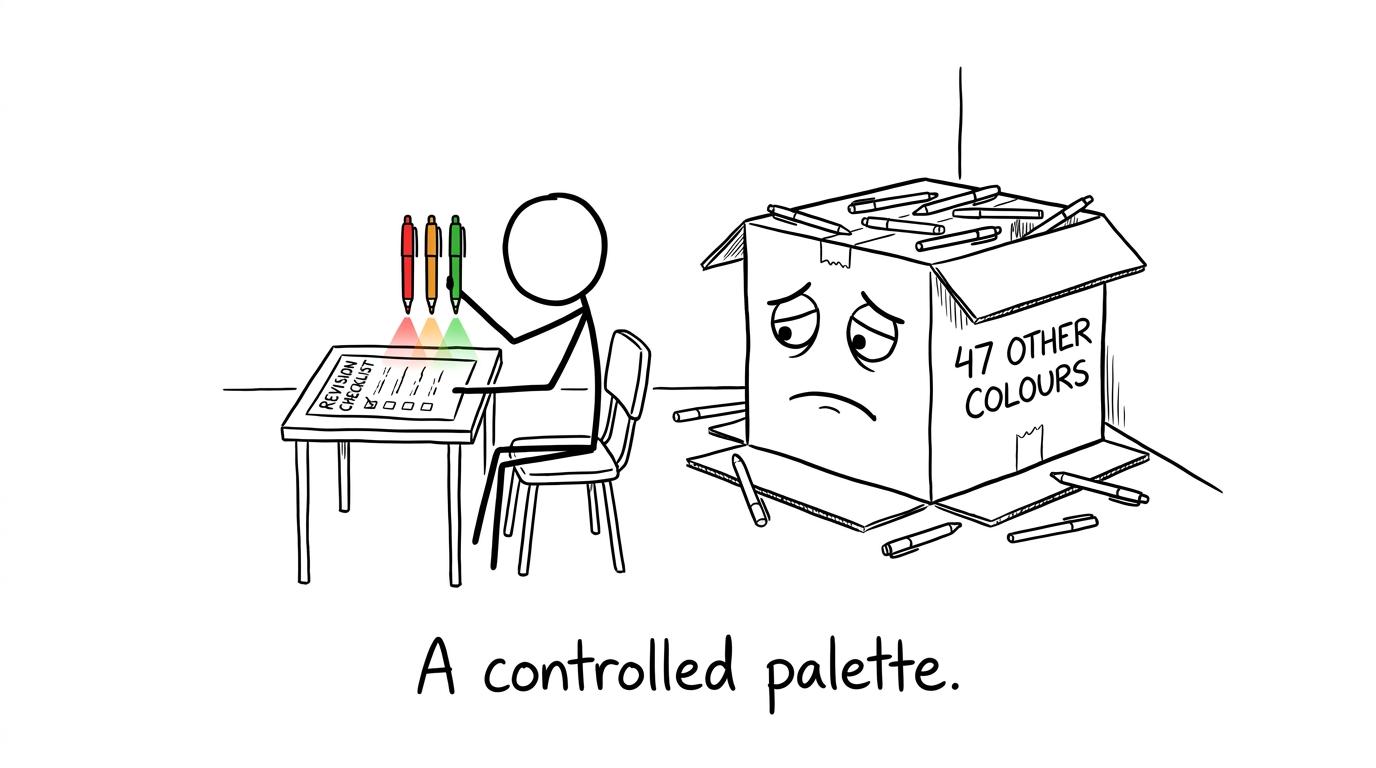 A three-colour revision system while a box of forty-seven other colours sulks
A better way to colour-code mistakes
Colour is particularly valuable after you answer questions. Instead of marking everything wrong in red, classify the reason.
You could use:
- one colour for missing knowledge;
- one for an incorrect method;
- one for misreading or incomplete interpretation;
- one for arithmetic and presentation errors.
This turns a page of corrections into a revision plan. If most lost marks come from interpretation, more formula cards will not solve the problem. You need questions requiring conclusions in context. If histogram errors repeatedly involve class width, return to that specific skill.
When you begin full papers, use the GCSE past-paper collection with its mark schemes and record recurring errors. Past papers should generate actions, not merely scores.
Common colour-coding mistakes
Highlighting too much
If every sentence is bright, nothing is prioritised. Highlight only information with a defined role: a crucial condition, a contrast, a formula or a frequent misconception.
Mistaking familiarity for recall
A page can look instantly recognisable while remaining difficult to reproduce. Test this by closing the notebook. If you cannot state or apply the idea, the colour has not learnt it for you.
Recopying whole pages
Rewriting may be justified when you are condensing disorganised material. Copying the same content neatly without making decisions, retrieving ideas or answering questions offers much less value.
Creating an elaborate key
A system with numerous colours becomes another thing to remember. Keep the code small enough to use automatically. Three or four categories are normally sufficient.
Colour-coding instead of correcting
Marking a wrong answer in red identifies a problem but does not repair it. Write the reason, review the relevant lesson and reattempt the question later without support.
Ignoring your exam board and tier
Foundation and higher-tier content differ, and boards can organise their resources differently. Check your specification and use board-aligned material rather than colouring every statistical technique you find online.
Colour should make revision clearer, not longer
Colour-coding is not useless, and it is not magic. Its best role is modest: directing attention, organising contrasts and making mistakes visible. It becomes unhelpful when the pleasure of producing polished notes replaces the discomfort of recalling and applying what you know.
Use a few consistent colours. Keep summaries short. Then close the notebook.
MathsGenie gives you the next, more important stage for free: revision lessons to repair understanding, practice questions and mini tests to expose gaps, video solutions and mark schemes to explain errors, and past papers and predicted papers to build exam readiness. Begin at the GCSE Maths revision hub, choose your board and turn each colourful page into evidence that you can answer the question unaided.