Collecting Like Terms GCSE Maths Explained
Collecting like terms GCSE maths made clear with simple rules, worked examples, common mistakes and exam-style questions for confident revision.
A student can understand algebra perfectly well on Monday, then look at 3x+5+2x3x + 5 + 2x3x+5+2x on Tuesday and wonder whether the answer is 10x10x10x, 5x+55x + 55x+5, or something else entirely.
Let us call this student Sam. Sam's mistake is not a lack of ability. It is trying to combine everything before deciding which terms belong together. Collecting like terms GCSE maths questions become much easier once you follow one rule: only terms with exactly the same variable part can be added or subtracted.
So 3x3x3x and 2x2x2x are like terms, but 3x3x3x and 2y2y2y are not. Numbers without variables can be collected with other numbers. The correct simplification is therefore:
3x+5+2x=5x+5 3x + 5 + 2x = 5x + 5 3x+5+2x=5x+5That single distinction is the foundation of the whole topic.
The collecting like terms checklist
Use this short method whenever you simplify an expression:
- Identify the separate terms, including their signs.
- Group terms that have exactly the same variable part.
- Add or subtract their numerical coefficients.
- Collect constant numbers separately.
- Write the simplified expression clearly.
- Check that unlike terms have not been combined.
The coefficient is the number multiplying a variable. In 7x7x7x, the coefficient of xxx is 777. A term such as xxx has an unwritten coefficient of 111, while −x-x−x has a coefficient of −1-1−1.
Sam's turning point comes when the expression stops looking like one long calculation. It becomes a collection of labelled groups: the xxx terms, the yyy terms and the ordinary numbers.
What are like terms?
Like terms have identical variable parts. Their coefficients can be different.
For example, 4x4x4x, 9x9x9x and −2x-2x−2x are like terms because each contains xxx. Similarly, 3a23a^23a2 and 8a28a^28a2 are like terms because both contain a2a^2a2.
However, the following pairs are not like terms:
- 5x5x5x and 5y5y5y, because the variables differ
- 3a3a3a and 3a23a^23a2, because the powers differ
- 4xy4xy4xy and 4x4x4x, because the variable parts differ
- 2m2n2m^2n2m2n and 2mn22mn^22mn2, because the powers belong to different variables
The important question is not whether two terms look similar. Ask whether their variable parts are exactly the same.
You can think of xxx terms as one type of object and yyy terms as another. Three apples and two apples make five apples. Three apples and two pears do not make five apple-pears. Algebra follows the same logic.
For a full topic explanation, use the Maths Genie simplifying algebra lesson alongside the wider GCSE maths revision lessons.
Collecting like terms worked examples
Example with one variable
Simplify:
6x+3x 6x + 3x 6x+3xBoth terms contain xxx, so add their coefficients:
6x+3x=(6+3)x=9x 6x + 3x = (6 + 3)x = 9x 6x+3x=(6+3)x=9xNotice that the variable does not change. You are counting how many lots of xxx there are.
Example with constants
Simplify:
4a+7+3a+2 4a + 7 + 3a + 2 4a+7+3a+2First group the like terms:
4a+3a+7+2 4a + 3a + 7 + 2 4a+3a+7+2Collect the aaa terms and the constants separately:
4a+3a=7a 4a + 3a = 7a 4a+3a=7a 7+2=9 7 + 2 = 9 7+2=9Therefore:
4a+7+3a+2=7a+9 4a + 7 + 3a + 2 = 7a + 9 4a+7+3a+2=7a+9The answer cannot be simplified to 16a16a16a. The constants do not contain aaa, so they cannot join the aaa terms.
Example involving subtraction
Simplify:
9y−4+2y−7 9y - 4 + 2y - 7 9y−4+2y−7Keep each sign attached to its term:
9y+2y−4−7 9y + 2y - 4 - 7 9y+2y−4−7Then collect each group:
9y+2y=11y 9y + 2y = 11y 9y+2y=11y −4−7=−11 -4 - 7 = -11 −4−7=−11So:
9y−4+2y−7=11y−11 9y - 4 + 2y - 7 = 11y - 11 9y−4+2y−7=11y−11This is where Sam used to go wrong. Sam saw the 777 and treated it as positive. Writing each term with its sign makes the structure visible.
Example with two variables
Simplify:
5p+3q−2p+7q 5p + 3q - 2p + 7q 5p+3q−2p+7qGroup the ppp terms and the qqq terms:
5p−2p+3q+7q 5p - 2p + 3q + 7q 5p−2p+3q+7qNow collect them:
5p−2p=3p 5p - 2p = 3p 5p−2p=3p 3q+7q=10q 3q + 7q = 10q 3q+7q=10qTherefore:
5p+3q−2p+7q=3p+10q 5p + 3q - 2p + 7q = 3p + 10q 5p+3q−2p+7q=3p+10qYou cannot combine 3p3p3p and 10q10q10q because they contain different variables.
Example with powers
Simplify:
7x2+4x−3x2+6x 7x^2 + 4x - 3x^2 + 6x 7x2+4x−3x2+6xThe x2x^2x2 terms form one group. The xxx terms form another:
7x2−3x2+4x+6x 7x^2 - 3x^2 + 4x + 6x 7x2−3x2+4x+6xCollecting gives:
4x2+10x 4x^2 + 10x 4x2+10xDo not combine these final terms. Although both involve xxx, the variable parts x2x^2x2 and xxx are different.
Once the method feels clear, use the Maths Genie GCSE Question Bank to practise identifying groups before you try to simplify them quickly.
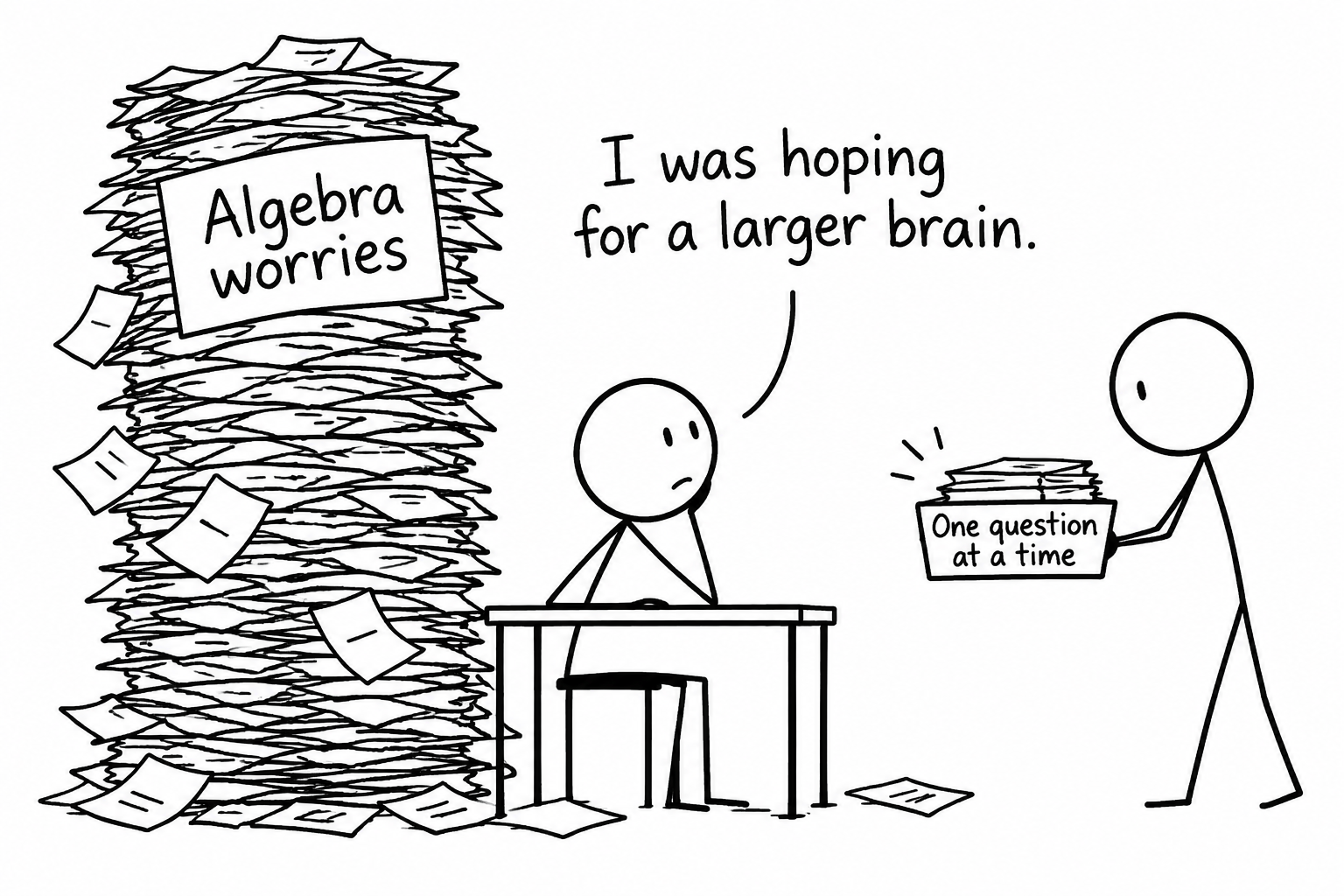 A student faces a pile of algebra worries while a helper suggests tackling one question at a time
Why the signs matter
A minus sign belongs to the term immediately after it. In the expression
8a−3a+5, 8a - 3a + 5, 8a−3a+5,the second variable term is −3a-3a−3a, not 3a3a3a. Therefore:
8a−3a=5a 8a - 3a = 5a 8a−3a=5aA useful habit is to circle each term together with the sign before it. For example, 6x−2y−4x+96x - 2y - 4x + 96x−2y−4x+9 contains the terms 6x6x6x, −2y-2y−2y, −4x-4x−4x and 999.
The result is:
6x−4x−2y+9=2x−2y+9 6x - 4x - 2y + 9 = 2x - 2y + 9 6x−4x−2y+9=2x−2y+9This small habit often prevents the largest errors. It also makes your working easier to follow if a question awards marks for a correct method.
Common mistakes when collecting like terms
Combining unlike terms
It is incorrect to write:
3x+4=7x 3x + 4 = 7x 3x+4=7xThe terms are unlike, so the expression is already simplified:
3x+4 3x + 4 3x+4Changing the power
Adding two identical variable terms does not increase the power:
x+x=2x x + x = 2x x+x=2xIt does not equal x2x^2x2. Multiplication behaves differently:
x×x=x2 x \times x = x^2 x×x=x2Keep addition and multiplication rules separate.
Losing a negative sign
For
10m−6m, 10m - 6m, 10m−6m,the calculation is 10−610 - 610−6, giving:
4m 4m 4mCopying the expression one term at a time helps preserve the signs.
Collecting coefficients incorrectly
In b+5bb + 5bb+5b, the first term has coefficient 111. Therefore:
b+5b=1b+5b=6b b + 5b = 1b + 5b = 6b b+5b=1b+5b=6bSimilarly:
7c−c=7c−1c=6c 7c - c = 7c - 1c = 6c 7c−c=7c−1c=6cThinking every question must become one term
A simplified answer can contain several terms. For example:
2x+5y+3 2x + 5y + 3 2x+5y+3cannot be simplified further because the three terms are unlike.
Exam-style collecting like terms questions
Try these without looking back at the examples. Show the grouping step if you are still building confidence.
Question A
Simplify:
7x+4x 7x + 4x 7x+4xQuestion B
Simplify:
8a+5−3a+2 8a + 5 - 3a + 2 8a+5−3a+2Question C
Simplify:
9m−4n−2m+7n 9m - 4n - 2m + 7n 9m−4n−2m+7nQuestion D
Simplify:
6y2+3y−2y2+5y 6y^2 + 3y - 2y^2 + 5y 6y2+3y−2y2+5yQuestion E
Simplify:
4p−8+p−3 4p - 8 + p - 3 4p−8+p−3The answers are:
11x 11x 11x 5a+7 5a + 7 5a+7 7m+3n 7m + 3n 7m+3n 4y2+8y 4y^2 + 8y 4y2+8y 5p−11 5p - 11 5p−11If an answer is wrong, do not simply repeat the whole question. Find the exact decision that caused the error. Did you combine unlike terms, overlook a coefficient of 111, or detach a minus sign? That diagnosis is more useful than completing another page on autopilot.
Students who are rebuilding their algebra foundations can also use the Maths Genie Grade 2 revision resources, while the Maths Genie home page provides access to the wider collection of free revision material.
Make the method automatic
Sam did not improve by memorising a longer rule. The change came from slowing down for the first few questions: mark the terms, group identical variable parts, calculate the coefficients, then check the signs. Speed followed accuracy rather than replacing it.
You now know how collecting like terms works, but knowing the rule and applying it reliably under exam pressure are different stages. Follow Sam's approach by pairing a clear explanation with focused questions until spotting like terms feels routine. Start the collecting like terms lesson, then practise it in the GCSE Question Bank.