Collecting Like Terms Exam Questions: GCSE Guide
Collecting like terms exam questions explained through three GCSE examples, with clear working, marking guidance and practice to help you avoid common errors.
You recognise the letters. You know you are supposed to simplify. Then a minus sign appears, and suddenly a short algebra question feels less certain. Collecting like terms exam questions become much more manageable when you group terms with exactly the same letters and powers, then add or subtract their coefficients. Keep each term’s sign attached throughout.
Imagine a student working through three questions, from a straightforward expression to one involving brackets. Their aim is to make every decision visible, so a small arithmetic slip does not hide a sound method.
These are original exam-style examples, with illustrative marking guidance rather than marks copied from an exam board.
The method to keep beside you
Before starting, use this checklist:
- Identify each term, including its sign.
- Match terms with exactly the same letters and powers.
- Collect the coefficients of each matching group.
- Combine constant terms separately.
- Check that your answer contains no remaining like terms.
A coefficient is the number multiplying a letter. In 7x7x7x, the coefficient is 777. In −x-x−x, it is −1-1−1.
The terms 3x3x3x and 5x5x5x are alike because their letter parts match. The terms 3x3x3x and 5x25x^25x2 are different because their powers do not match. Constants, which have no letters, form their own group.
MathsGenie’s Simplifying Algebra revision guide explains this vocabulary alongside the rules for simplifying.
Start with the matching Lessons, then use the Question Bank to practise keeping signs attached as the expressions become longer.
Collecting like terms exam questions: three worked examples
Question one: one letter and a constant
Simplify:
6x+4+3x6x+4+3x6x+4+3xThe student first identifies the two terms containing xxx. The constant stays separate.
6x+3x+46x+3x+46x+3x+4They add the coefficients:
(6+3)x+4=9x+4(6+3)x+4=\boxed{9x+4}(6+3)x+4=9x+4The answer still contains two terms. That is completely simplified because 9x9x9x and 444 are not like terms.
Where the marks come from: a short question like this may award a single mark for the correct expression. Do not assume that writing a grouping line earns a separate method mark. Its value is that it makes your reasoning clear and helps you check the answer.
The student pauses before moving on: every original term has been used once, and the constant has stayed unchanged.
Question two: two letters and negative terms
Simplify:
7a−3b−2a+5b−67a-3b-2a+5b-67a−3b−2a+5b−6This time, the challenge is keeping the signs with their terms. The student groups the aaa terms, then the bbb terms, then the constant:
(7a−2a)+(−3b+5b)−6(7a-2a)+(-3b+5b)-6(7a−2a)+(−3b+5b)−6They calculate each group separately:
(7−2)a+(−3+5)b−6(7-2)a+(-3+5)b-6(7−2)a+(−3+5)b−6 5a+2b−6\boxed{5a+2b-6}5a+2b−6The crucial decision was treating −3b-3b−3b as a negative term. Moving it without its minus sign would change the expression.
Where the marks come from: a question with several groups may award marks for correctly simplified parts. The actual allocation depends on its mark scheme. Showing the separate groups makes it clear whether you understood the algebra, even if you make an arithmetic mistake later.
An answer written as 2b+5a−62b+5a-62b+5a−6 is equivalent. Alphabetical order is a useful habit, but changing the order does not change the value.
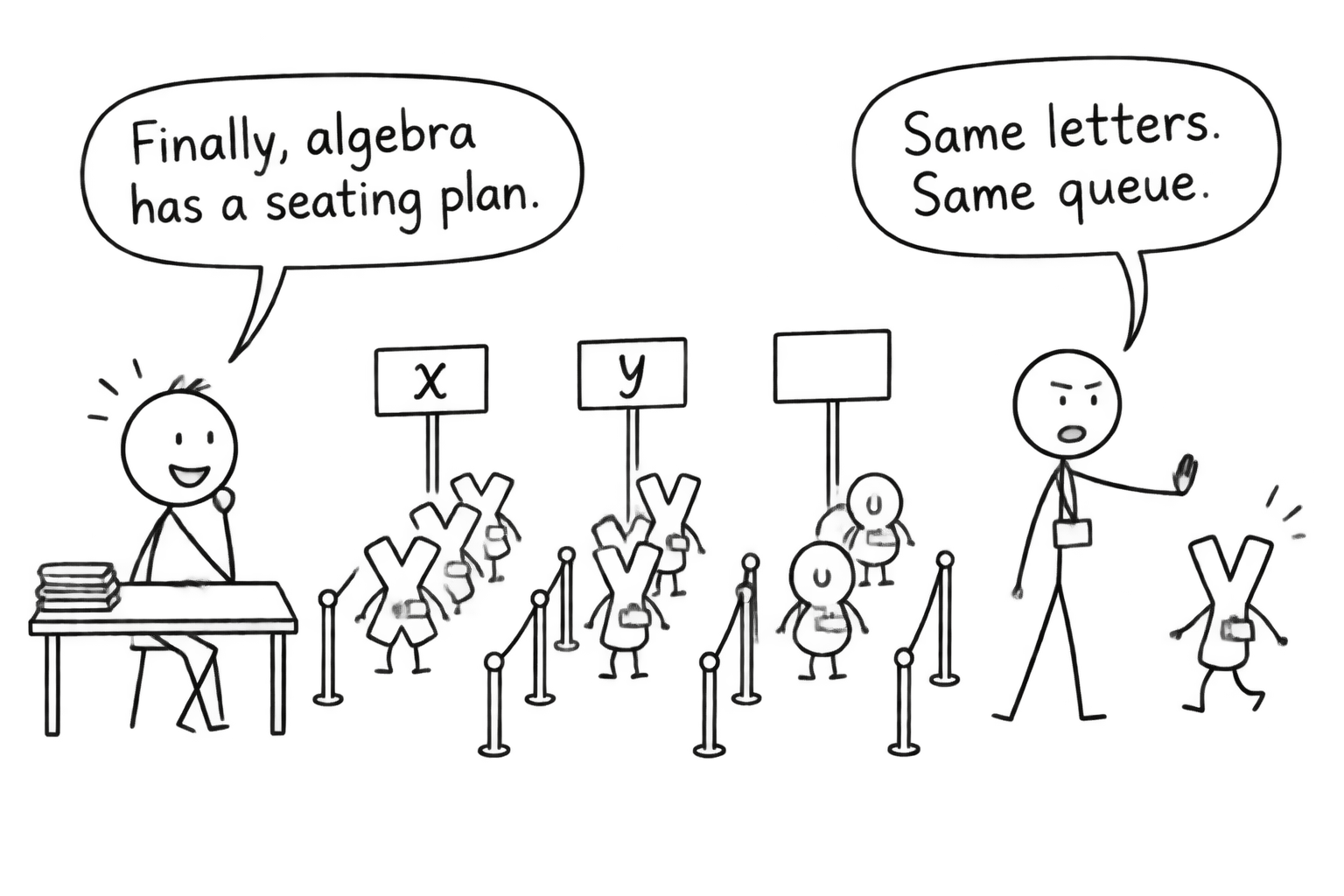 Stick-figure comic about organising algebra letters into queues
Question three: expand, then collect
Expand and simplify:
3(2x−y)−2(x+3y)+43(2x-y)-2(x+3y)+43(2x−y)−2(x+3y)+4The student now has an extra task before collecting. Each term inside a bracket must be multiplied by the factor outside it.
First bracket:
3(2x−y)=6x−3y3(2x-y)=6x-3y3(2x−y)=6x−3ySecond bracket:
−2(x+3y)=−2x−6y-2(x+3y)=-2x-6y−2(x+3y)=−2x−6yPutting those results together gives:
6x−3y−2x−6y+46x-3y-2x-6y+46x−3y−2x−6y+4Now the familiar collecting method applies:
(6x−2x)+(−3y−6y)+4(6x-2x)+(-3y-6y)+4(6x−2x)+(−3y−6y)+4 4x−9y+4\boxed{4x-9y+4}4x−9y+4Where method marks can come from: a longer expansion question may award a method mark for a correct expansion step, followed by marks for further correct work or the final answer. Here, writing both expansions separately exposes the most important decisions. The precise award must come from the question’s mark scheme.
The student checks the second bracket again. Multiplying positive 3y3y3y by −2-2−2 produces −6y-6y−6y. That small check protects the whole answer.
How to read the marking guidance
A method mark rewards a valid mathematical process. An accuracy mark rewards correct work following an appropriate method, while an independent mark can reward a correct statement or answer without depending on an earlier method mark.
However, showing working does not automatically earn marks. A one-mark simplification question may require the correct answer. A longer question may have several creditworthy stages.
When reviewing collecting like terms past paper questions, compare your working with the actual mark scheme. Ask which mathematical step earned credit, rather than counting how many lines you wrote. MathsGenie’s Simplifying Algebra topic page brings together lessons, exam-style questions and worked solutions for this practice.
Common mistakes that change the answer
Combining different letter parts. You cannot combine 4x+3y4x+3y4x+3y into one term. Different letters represent different quantities, so the expression stays as it is.
Treating addition like multiplication. Adding x+xx+xx+x gives 2x2x2x. Multiplying x×xx\times xx×x gives x2x^2x2. Check the operation before changing a power.
Losing the invisible coefficient. In 5a−a5a-a5a−a, the second coefficient is −1-1−1. Therefore the result is 4a4a4a.
Missing cancellation. Opposite terms such as 6b−6b6b-6b6b−6b sum to zero and disappear from the simplified expression.
Stopping after expanding. If the instruction says “expand and simplify”, removing brackets completes only part of the task. Look again for matching terms.
These errors are easier to spot when you write one purposeful line at a time. A crowded line saves space but can make signs difficult to follow.
Exam-style practice
Try these without looking at the answers. For each expression, identify the groups before calculating.
| Question | Expression to simplify |
|---|---|
| A | 8p+5+2p−38p+5+2p-38p+5+2p−3 |
| B | 9a−4b−3a−b+79a-4b-3a-b+79a−4b−3a−b+7 |
| C | 4(2m−n)−3(m+2n)4(2m-n)-3(m+2n)4(2m−n)−3(m+2n) |
Answers: A: 10p+210p+210p+2. B: 6a−5b+76a-5b+76a−5b+7. C: 5m−10n5m-10n5m−10n.
If your answer differs, find the first line where it changes. Was the problem recognising like terms, calculating with negatives or expanding a bracket? That diagnosis tells you what to practise next.
For printable practice, the AQA Simplifying Algebra booklet provides another relevant resource. The collecting rule stays the same across exam boards, although individual questions and marking guidance vary.
Make the method dependable
Our imagined student now has a repeatable approach: identify, group, calculate and check. Your next step is to apply it independently, especially when negatives and brackets appear together. Start MathsGenie’s Lessons and Question Bank to turn this collecting like terms method into confident exam practice.