Changing the Subject (Harder) GCSE Maths Guide
Changing the subject (harder) GCSE maths made clear with a reliable method, worked examples, common mistakes and targeted exam-style questions.
A formula can look harmless until the letter you need appears twice, sits inside a fraction or is hidden beneath a power. That is usually where changing the subject (harder) GCSE maths questions begin to feel less like rearranging and more like untangling.
Imagine a student called Sam. Sam understands that the subject must end up alone, but keeps moving terms without seeing the structure of the formula. The breakthrough comes from one idea: harder rearrangements are not solved by moving faster. They are solved by choosing the right first step.
This guide gives you that method, followed by step-by-step worked examples and exam-style practice.
The harder changing the subject checklist
Before rearranging, ask these questions in order:
- Which letter must become the subject?
- Does that letter appear once or more than once?
- Is it inside a fraction, bracket, square or square root?
- What operation should be undone first?
- If the letter appears twice, can its terms be collected and factorised?
- Is the required letter completely alone in the final expression?
The crucial distinction is simple. If the required letter appears once, use inverse operations. If it appears more than once, collect every term containing it on one side and factorise.
What changing the subject really means
The subject of a formula is the letter already alone on one side. In
y=3x+5,y = 3x + 5,y=3x+5,yyy is the subject. To make xxx the subject, rearrange until the formula begins with x=x =x=.
Every operation must preserve the equality. Rather than imagining that a term magically changes sign when it crosses the equals sign, perform the same operation on both sides. This makes the algebra easier to check and reduces sign errors.
Harder questions combine this principle with skills such as expanding brackets, clearing fractions, collecting like terms, factorising and using inverse powers. If factorising feels uncertain, revisit the Expanding and Factorising lesson before tackling the most demanding rearrangements.
Changing the subject (harder) worked examples
When the required subject appears twice
Make xxx the subject of
y=ax+bx.y = ax + bx.y=ax+bx.Sam's first instinct is to divide by aaa or bbb. Neither works because xxx appears in both terms. Instead, factorise the right-hand side:
y=x(a+b).y = x(a+b).y=x(a+b).Now divide both sides by a+ba+ba+b:
x=ya+b.x = \frac{y}{a+b}.x=a+by.The factorising step turns two appearances of xxx into one. That is the pattern to remember:
collect the terms, factorise, then divide.\text{collect the terms, factorise, then divide.}collect the terms, factorise, then divide.You can see this method taught alongside worked solutions in the Rearranging Harder Formulae lesson.
When the subject appears on both sides
Make xxx the subject of
y=x+ax−b.y = \frac{x+a}{x-b}.y=x−bx+a.The fraction is the first obstacle. Multiply both sides by x−bx-bx−b:
y(x−b)=x+a.y(x-b) = x+a.y(x−b)=x+a.Expand the bracket:
yx−yb=x+a.yx-yb = x+a.yx−yb=x+a.Collect the terms containing xxx on the left. Add ybybyb to both sides, then subtract xxx from both sides:
yx−x=a+yb.yx-x = a+yb.yx−x=a+yb.Factorise xxx:
x(y−1)=a+yb.x(y-1) = a+yb.x(y−1)=a+yb.Divide by y−1y-1y−1:
x=a+yby−1.x = \frac{a+yb}{y-1}.x=y−1a+yb.This is the moment the method clicks for Sam. The letter was never meant to be isolated immediately. First, the fraction had to be removed. Then the xxx terms could be collected and factorised.
You now have the full method; use the Maths Genie Lessons and Question Bank when you want to apply it repeatedly without finding suitable questions yourself.
When the subject is beneath a square root
Make xxx the subject of
y=x+ab.y = \sqrt{\frac{x+a}{b}}.y=bx+a.The square root is the outer operation, so square both sides first:
y2=x+ab.y^2 = \frac{x+a}{b}.y2=bx+a.Multiply both sides by bbb:
by2=x+a.by^2 = x+a.by2=x+a.Subtract aaa:
x=by2−a.x = by^2-a.x=by2−a.Work from the outside towards the required letter. The order matters. Trying to subtract aaa before removing the square root would not preserve the structure of the expression.
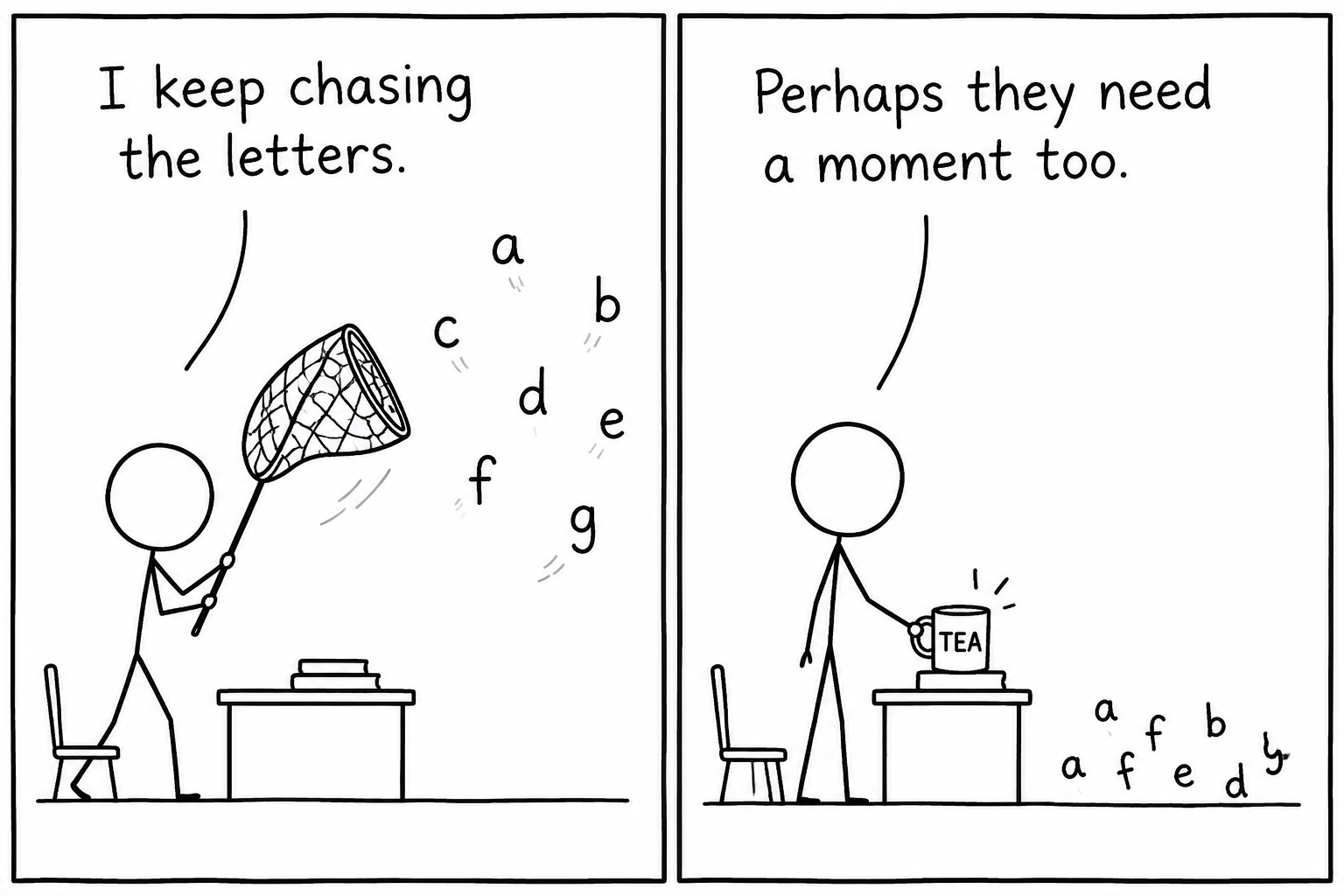 A stick-figure student stops chasing algebra letters and gives them time to settle
How to approach changing the subject (harder) questions
On an exam paper, do not begin with hurried algebra. Spend a few seconds reading the structure.
If the letter appears once
Undo operations in reverse order. Clear fractions when useful, then reverse addition, subtraction, multiplication, division, powers or roots.
If the letter appears twice
Aim for this shape:
Ax+Bx=C.Ax+Bx=C.Ax+Bx=C.Then factorise:
x(A+B)=C,x(A+B)=C,x(A+B)=C,and divide:
x=CA+B.x=\frac{C}{A+B}.x=A+BC.The terms may initially be on opposite sides or hidden inside brackets. Your job is to rearrange them into a form that can be factorised.
Check the final line
Ask three questions:
- Is the requested letter alone?
- Does it appear anywhere else in the formula?
- Are brackets needed in the denominator?
For example,
x=ya+bx = \frac{y}{a+b}x=a+byis not the same as
x=ya+b.x = \frac{y}{a}+b.x=ay+b.The denominator brackets show that the whole expression a+ba+ba+b divides yyy.
Common mistakes that lose marks
Dividing before factorising
From
y=ax+bx,y=ax+bx,y=ax+bx,you cannot divide by only aaa because the term bxbxbx remains. Factorise xxx first.
Changing a sign without showing an operation
Instead of thinking that −yb-yb−yb crosses the equals sign and becomes positive, add ybybyb to both sides. This keeps the reasoning dependable.
Expanding incorrectly
From
y(x−b),y(x-b),y(x−b),the correct expansion is
yx−yb.yx-yb.yx−yb.Both terms inside the bracket must be multiplied by yyy.
Forgetting to square the whole side
If
y=Q,y=\sqrt{Q},y=Q,then squaring gives
y2=Q.y^2=Q.y2=Q.Do not leave the left side as yyy.
Stopping before the subject is alone
A line such as
x(y−1)=a+ybx(y-1)=a+ybx(y−1)=a+ybis useful working, but xxx is not yet the subject. The final division is still required.
Exam-style practice
Try these changing the subject (harder) questions without looking back at the examples.
- Make xxx the subject of p=mx+nxp=mx+nxp=mx+nx.
- Make ttt the subject of v=t+at−bv=\frac{t+a}{t-b}v=t−bt+a.
- Make rrr the subject of q=r−cdq=\sqrt{\frac{r-c}{d}}q=dr−c.
- Make xxx the subject of k=ax−bx+ck=ax-bx+ck=ax−bx+c.
The answers are:
x=pm+n,x=\frac{p}{m+n},x=m+np, t=a+bvv−1,t=\frac{a+bv}{v-1},t=v−1a+bv, r=dq2+c,r=dq^2+c,r=dq2+c,and
x=k−ca−b.x=\frac{k-c}{a-b}.x=a−bk−c.For longer practice, use the Rearranging Harder Formulae exam booklet. You can also attempt individual exam-style rearranging questions with worked solutions.
Turn the method into a reliable exam skill
Sam's difficulty was not a lack of effort. It was trying to isolate the letter before simplifying the structure around it. Knowing the method is the first step, but following it accurately under exam pressure requires deliberate practice.
Start the Rearranging Harder Formulae lesson, then build fluency with the Maths Genie Question Bank.