Best GCSE English Language and Literature Revision Guide
Best GCSE English Language and Literature revision guide checklist: compare exam-board coverage, practice tasks, model answers and useful feedback.
Buying a revision guide can feel strangely reassuring. The cover promises clarity, the pages look organised, and for a moment the whole exam seems manageable. But a polished book is not necessarily a useful one.
The best GCSE English Language and Literature revision guide is the guide that matches your exact exam-board specification, explains how marks are awarded, makes you practise exam skills and gives you enough feedback to improve. Price, thickness and colourful design matter far less than those four things.
This matters particularly when English revision must fit alongside maths. You do not need the book containing the most information. You need one that turns limited revision time into deliberate action.
A quick revision guide checklist
Before buying or relying on a guide, check whether it:
- names your exam board and current qualification clearly;
- separates English Language from English Literature;
- covers the correct Literature texts for your course;
- reflects the papers, questions and assessment objectives in your specification;
- teaches analysis, comparison, evaluation and writing rather than supplying summaries alone;
- includes exam-style practice with realistic marks and timings;
- provides annotated responses or clear answer guidance;
- explains why an answer succeeds, not merely what it says;
- helps you identify weaknesses and plan what to do next;
- is readable enough that you will actually use it.
If a book fails the first four checks, stop there. A beautifully explained guide to the wrong course is still the wrong guide.
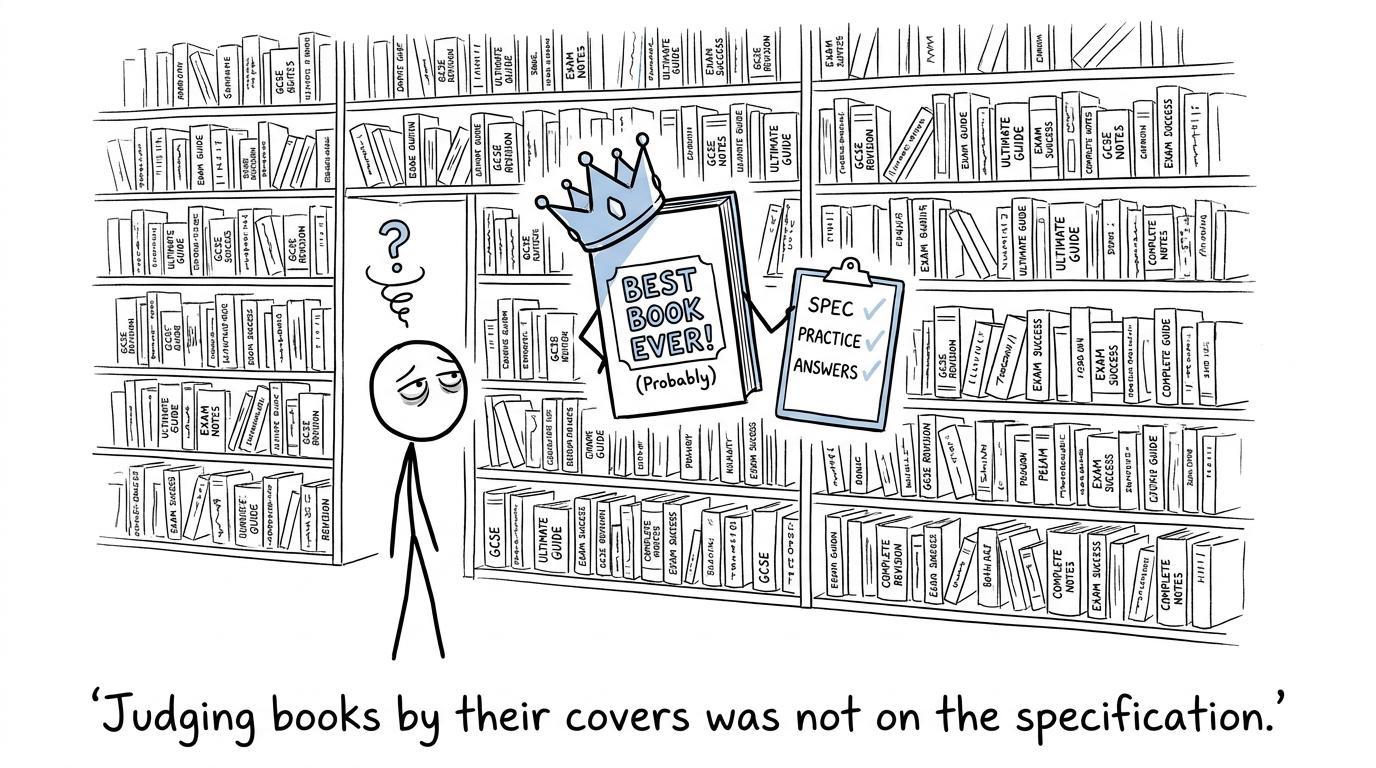 A student discovers that judging revision guides by their covers is not on the specification
Start with the exact qualification, not the subject name
“GCSE English” can hide an important distinction. English Language and English Literature are separate GCSE qualifications, even when a publisher places them in one book.
English Language assesses reading and writing skills through unseen material and purposeful writing tasks. English Literature assesses responses to the particular plays, novels, poetry and other texts required by the chosen specification. The precise paper structure, wording and content depend on whether your school follows AQA, Pearson Edexcel, OCR or Eduqas.
A strong guide should therefore identify:
- the exam board;
- the specification or qualification it supports;
- whether it covers Language, Literature or both;
- the relevant Literature texts;
- the papers and sections addressed;
- its publication or revision date.
Do not assume that a guide labelled “GCSE English” covers your course. Compare its contents with the specification information supplied by your school and the current exam-board specification. If there is any mismatch, ask your teacher before buying it.
The best guide is built around marks, not information
Revision guides often look impressive because they contain many facts. Yet examinations do not award marks simply for owning information. They reward what you can do with it.
For Literature, knowing a plot is useful but insufficient. You need to construct an argument, select relevant references, analyse writers’ methods and connect ideas to context where the question and assessment objectives require it. For Language, memorising technique names will not replace close reading, evaluation, comparison or controlled writing for a particular audience and purpose.
Look for a guide that makes the chain visible:
knowledge⟶decision⟶response⟶feedback\text{knowledge} \longrightarrow \text{decision} \longrightarrow \text{response} \longrightarrow \text{feedback}knowledge⟶decision⟶response⟶feedbackThe “decision” is crucial. Which evidence is strongest? What does the question really ask? Which interpretation can you defend? How should you organise your time?
A weak book gives you pages to highlight. A better book repeatedly asks you to make those decisions.
Check how it explains assessment objectives
Assessment objectives describe the broad skills examiners assess. Their application and weighting differ between Language and Literature, so use the current specification for your board rather than memorising generic internet advice.
A useful revision guide translates each objective into observable actions. Instead of saying only “analyse language”, it should help you understand what analysis involves: selecting relevant evidence, identifying a meaningful choice, exploring its effects and connecting that discussion to the question.
Be cautious if a guide presents one paragraph acronym as a guaranteed route to high marks. Structures can help you begin, but good responses depend on judgement. The guide should gradually remove the scaffolding so that you can adapt when the extract, text or task changes.
The same principle appears in maths. A formula sheet cannot decide which method a problem needs. MathsGenie’s GCSE maths revision lessons combine explanations with questions because recognising and applying a method is the real skill.
Demand practice that resembles the exam
Reading a guide creates familiarity. Familiarity can feel like progress, but the exam asks you to produce an answer without the explanation open beside you.
Good practice should include a sensible progression:
- short tasks focused on one skill;
- planning activities;
- complete exam-style questions;
- timed sections or papers;
- opportunities to review and improve a response.
Check that questions resemble your board’s current approach. Marks, command words, extracts and timings should not look as though they were borrowed from a different specification. Publisher-written questions are useful for building fluency, but official past papers remain the clearest reference for the real assessment format.
Maths revision works in much the same way. After learning a topic, use MathsGenie GCSE practice by grade, then test broader performance with GCSE maths past papers. Topic practice builds control; full papers reveal whether that control survives under pressure.
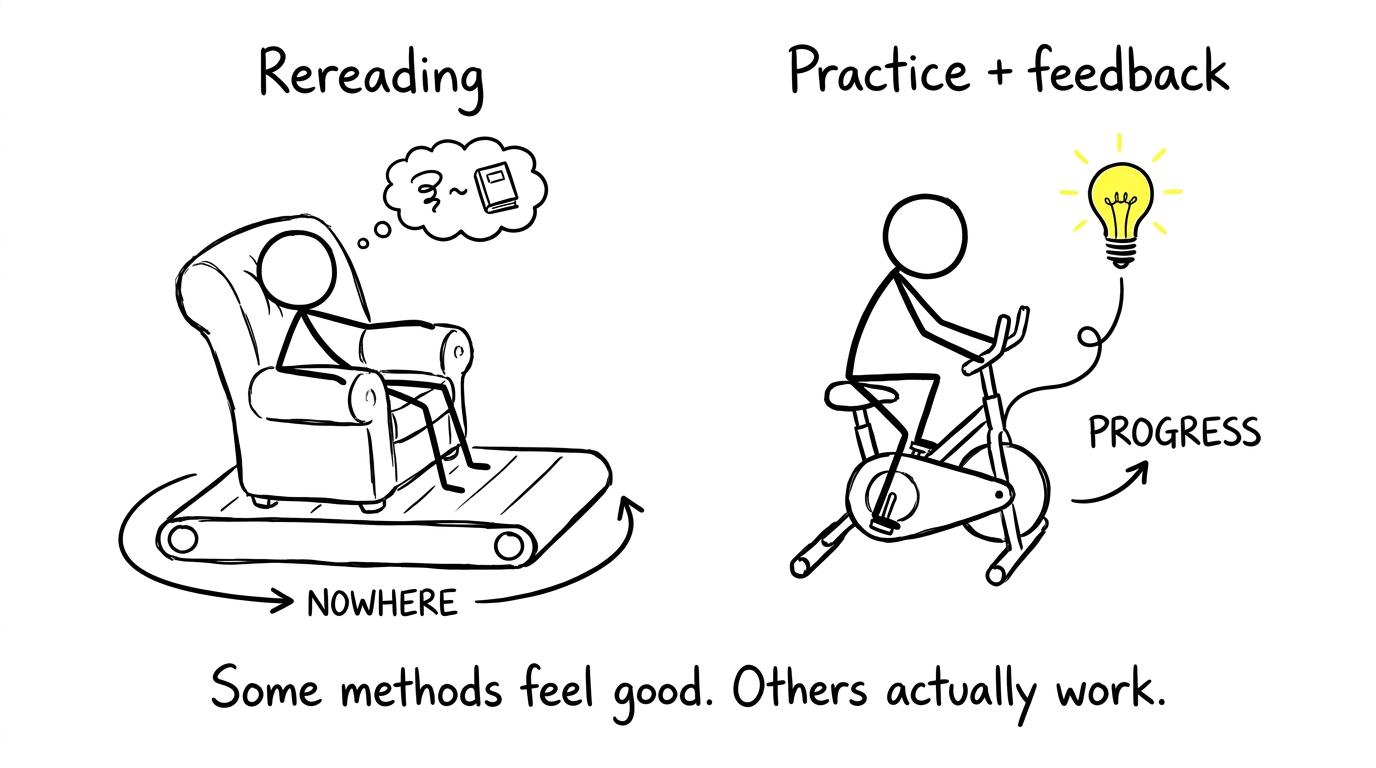 Rereading relaxes while practice and feedback power a light bulb
Model answers should reveal decisions
A model answer is valuable only if it helps you make your next answer better.
The strongest guides include annotations showing how a response addresses the question, chooses evidence, develops analysis, organises ideas and communicates clearly. Ideally, they also show responses of different quality or identify realistic improvements.
Ask these questions when inspecting an answer section:
- Can I see why marks would be earned?
- Is the response connected to a specific task?
- Does the commentary identify weaknesses as well as strengths?
- Can I turn the feedback into an action for my own writing?
A flawless model with no explanation can be intimidating rather than instructive. It shows the destination but hides the route.
Mark schemes are useful too, but they are written to support consistent assessment, not always to teach students. A good guide interprets the criteria without pretending that every valid answer must use identical wording.
Look for selective Literature coverage
A Literature guide should help you remember the text while keeping revision directed towards argument and analysis.
Useful features include:
- concise plot or structural overviews;
- themes linked across the whole text;
- characters presented as part of an argument, not as isolated fact files;
- short, versatile references placed in context;
- discussion of form, structure and language;
- contextual material connected carefully to interpretation;
- questions that require independent choices.
More quotations are not automatically better. A smaller bank of well-understood references is often more usable than pages of lines remembered without context or purpose.
Also check every title and anthology carefully. A guide for the wrong Shakespeare play, nineteenth-century novel or poetry collection may offer sound English teaching while being useless for your particular Literature paper.
Test whether the guide fits how you revise
Accuracy comes first, but usability determines whether the book leaves your shelf.
Open a difficult section and spend a few minutes with it. Are explanations concise without becoming vague? Can you locate a particular paper or skill quickly? Is there enough space or structure for retrieval, practice and review? Do visual features clarify relationships, or merely decorate the page?
The right level also matters. A guide should support you without replacing thought. If every task feels effortless, it may not develop exam independence. If every page assumes knowledge you do not yet have, it will be hard to use consistently.
You may not need one combined guide. A board-specific Language guide, a text-specific Literature guide and official papers can sometimes form a more precise set. One well-used book is better than four barely opened ones.
Balance English with GCSE maths revision
Students preparing for maths exams often make one of two plans: spend the whole evening on the subject that feels most urgent, or switch repeatedly without completing anything. Neither makes feedback easy.
Give each revision block a defined job. An English block might analyse one extract or plan one Literature response. A maths block might complete a topic lesson and mark its questions. MathsGenie provides dedicated pages for foundation GCSE maths revision and higher-tier material within the same organised topic library.
As exams approach, use Edexcel GCSE maths papers, AQA GCSE maths papers or OCR GCSE maths papers to practise the format set by your board. MathsGenie predicted papers can provide additional practice, but they should complement rather than replace past papers and full specification coverage.
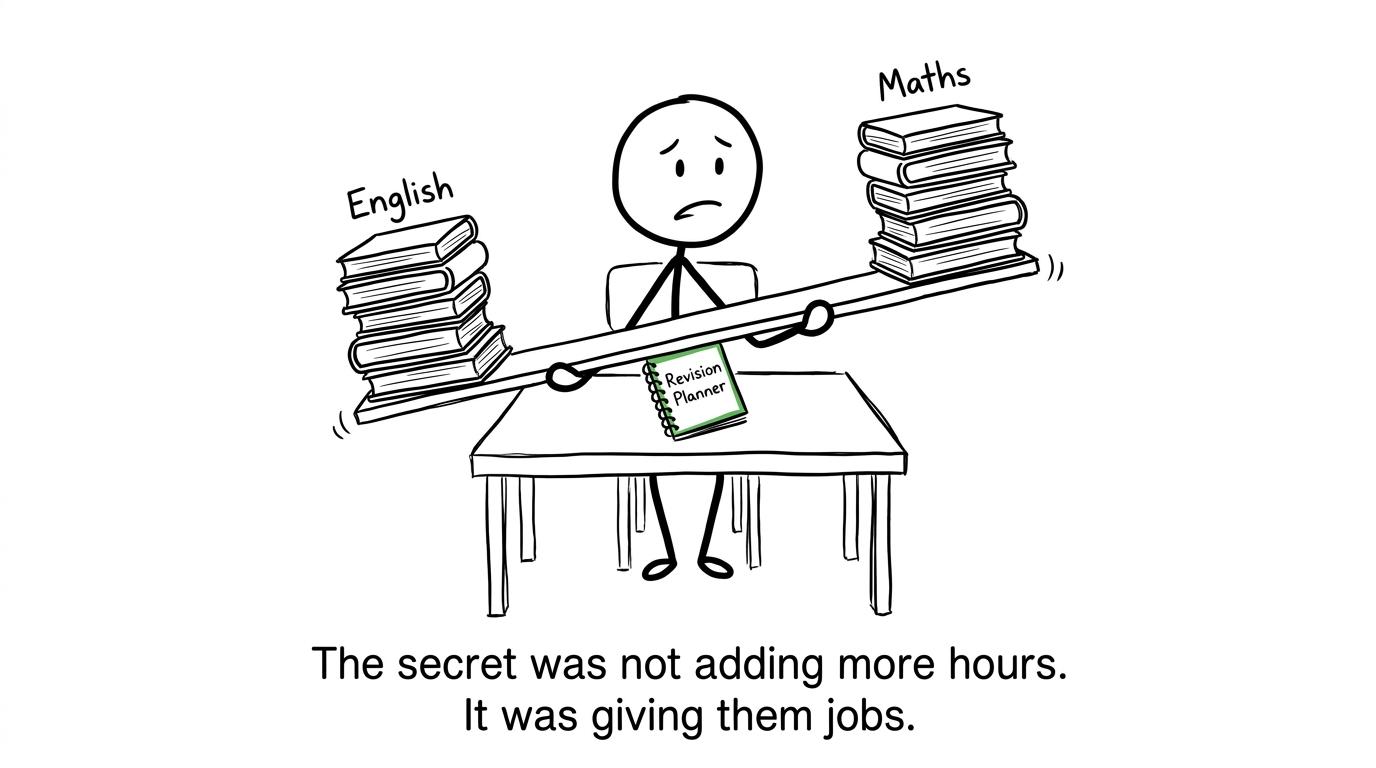 A revision planner balances English and maths without adding more hours
Common mistakes when choosing a revision guide
Buying by colour, thickness or popularity
Design may make a guide easier to navigate, but it cannot correct a specification mismatch. Verify the course first and presentation second.
Treating Language and Literature as one subject
The skills overlap, but the qualifications demand different preparation. Confirm how much of the book is devoted to each and whether all your set texts appear.
Choosing summaries instead of practice
Summaries can refresh memory. They cannot demonstrate that you can produce a relevant answer under timed conditions. Look for questions, planning prompts and feedback.
Assuming the newest-looking book must be current
Check the edition and compare its contents with current information from your school and exam board. Do not rely on a retailer’s image or a vague phrase such as “exam ready”.
Collecting resources without using them
The purpose of a guide is not to complete your desk. Choose a resource, schedule a specific task, attempt it without support, mark or review it, and record the next weakness.
Using predicted material as a forecast
Predicted papers and topic lists provide extra practice, not certainty about what will appear. Revise the whole specification and treat prediction as a way to vary questions.
Choose the guide that changes what you do
A good revision guide does not merely make English look orderly. It helps you answer a precise question, notice the gap between your response and the marking criteria, and decide what to practise next.
Check the board. Check the qualification and texts. Inspect the practice. Read the feedback. Then choose the simplest resource that supports repeated, independent work.
Apply the same discipline to maths. Begin with MathsGenie’s free GCSE maths revision resources, use the revision lessons and practice questions to strengthen individual topics, then move to past papers, predicted papers, mark schemes and video solutions. The goal is not to own more revision material. It is to make the next hour of revision count.