

Best GCSE Design and Technology Revision Guide?
Best GCSE design and technology revision guide checks: compare exam-board fit, specification coverage, practice, answers and maths support before buying.
A revision guide can look reassuring long before it becomes useful. The cover promises complete knowledge. The pages are brightly organised. The price suggests authority. Yet none of those things tells you whether it will help when a calculation is buried inside a question about materials, tolerances or production costs.
The best GCSE design and technology revision guide is the one that matches your exam board's current specification, explains ideas clearly, covers your specialist material area and gives you enough exam-style practice to reveal what you cannot yet do. It should also treat maths as part of Design and Technology, not as a small appendix added at the end.
That matters because current GCSE Design and Technology requirements in England specify that at least 15%15\%15% of the marks in the written examination reward mathematical skills applied in a Design and Technology context. A good guide prepares you to use those skills, not merely recognise their names.
A quick revision guide checklist
Before buying or relying on a guide, check whether it:
- names your exact exam board and qualification;
- states which specification or examination course it covers;
- separates core content from specialist material knowledge;
- reflects the structure and language of your written paper;
- covers mathematical and scientific applications;
- includes questions rather than pages of notes alone;
- provides complete, accurate answers or worked solutions;
- teaches command words and extended-response technique;
- is readable enough that you will actually use it;
- works alongside official past papers and your class materials.
A guide does not need to be enormous. It needs to make the right knowledge easier to retrieve and apply.
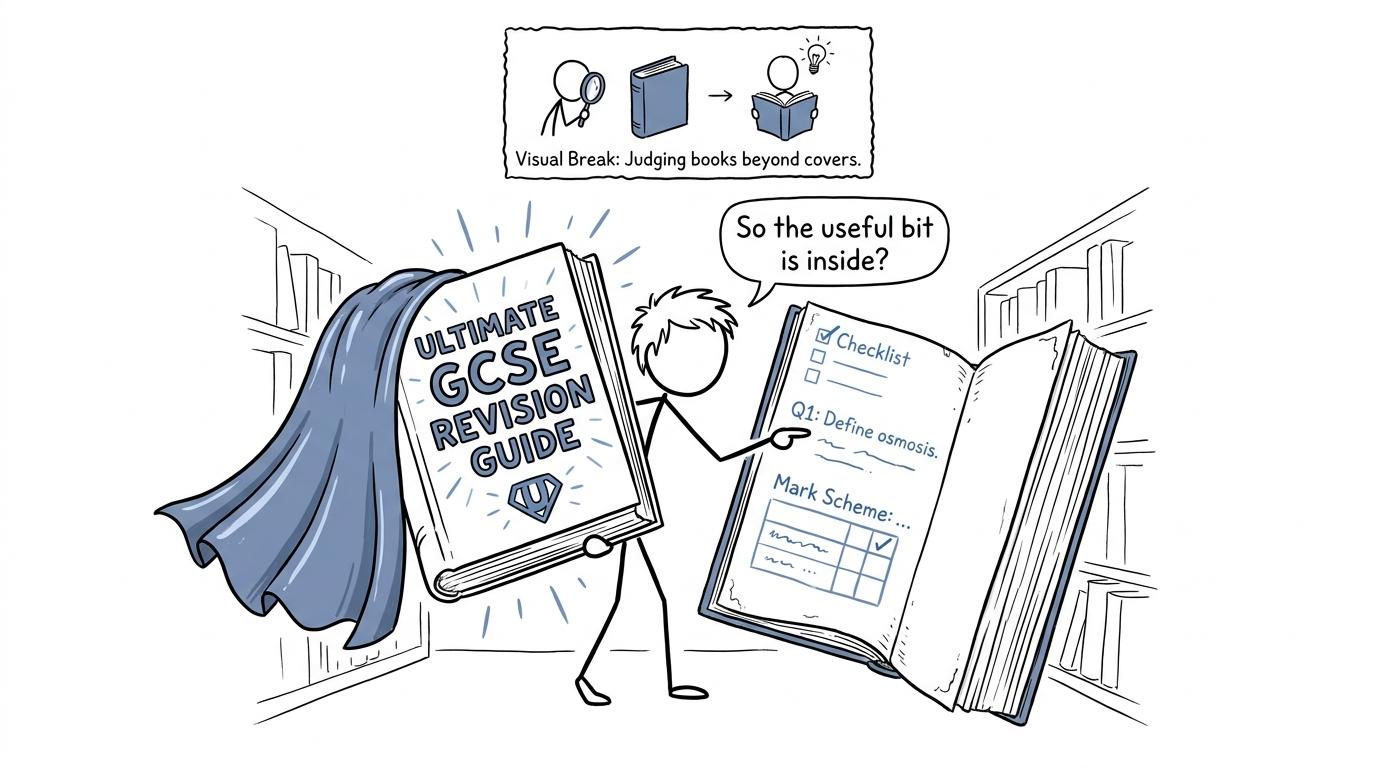 A student discovers that the useful part of a revision guide is inside the cover
Start with the exam board, not the cover
A guide written for the wrong specification can still contain accurate information. That is what makes the mistake difficult to notice. You may learn genuine facts about polymers, timbers or manufacturing processes while missing the way your own paper organises and assesses them.
AQA, Pearson Edexcel, OCR and Eduqas all assess the broad national subject content, but their paper structures, terminology and organisation are not identical. For example, the current AQA course divides examined content into core technical principles, specialist technical principles, and designing and making principles. Pearson Edexcel organises its written paper into core content and a chosen material category. OCR and Eduqas structure their content differently again.
Check the front of your latest mock paper or ask your teacher for the board and specification code. Then compare that information with the guide's title page or publication details. Do not assume that a book labelled simply “GCSE Design and Technology” is an exact match.
Edition dates can help, but a recent cover date is not proof of complete alignment. The stronger test is whether the contents page can be mapped directly to your current specification.
Look for complete specification coverage
A useful contents page behaves like a map. You should be able to take a specification statement and locate the corresponding explanation without searching through several vaguely named chapters.
A strong guide should cover the main families of knowledge relevant to your board, including:
- materials, properties and appropriate applications;
- forces, stresses, energy and mechanisms where specified;
- modern, smart and composite materials;
- manufacturing methods and scales of production;
- environmental, social and economic considerations;
- design strategies, user needs and iterative development;
- communication techniques, modelling and prototypes;
- tolerances, quality control and material management;
- your chosen specialist material or category.
Coverage must have depth as well as breadth. A one-line definition may support recall, but many examination questions require application, comparison, justification or evaluation. The guide should connect a material property to a design decision and a manufacturing process to an appropriate production context.
The best test is simple: choose several specification statements, including one you find difficult, and see whether the guide explains what the statement means, where it applies and how it may be assessed.
Check whether the maths is genuinely taught
Maths in Design and Technology is not a separate collection of abstract exercises. Ofqual's requirements say the mathematical skills must be assessed within the subject context. Official specifications identify applications including quantities, costs, scale drawings, questionnaire data, graphs, areas, surface areas, volumes and angular measures.
That means a worthwhile guide should prepare you for skills such as:
- decimals and standard form;
- fractions, ratios and percentages;
- percentage change, waste and profit;
- scale factors and scale drawings;
- metric units and conversions;
- area, surface area and volume;
- interpreting tables, charts and graphs;
- averages and survey results;
- angles and spatial representation.
You should see units throughout the guide, not only numbers. It should distinguish length, area and volume units and remind you to show a calculation method. A final answer without sensible units can be incomplete even when the calculator work is correct.
MathsGenie can strengthen this part of your revision. Use the free GCSE maths revision hub to choose your board and revisit the underlying methods. Particularly useful crossovers include percentage change revision, scale drawings practice, standard form revision and averages lessons and questions.
The labels on those pages may follow a particular GCSE Maths board, so always use your Design and Technology specification to decide which mathematical skills you need. The underlying fluency is transferable.
Prefer practice that exposes gaps
Reading can create a pleasant sense of familiarity. Unfortunately, recognising a paragraph is not the same as producing a precise answer without it.
A good guide interrupts reading with retrieval questions, short calculations, design contexts and extended responses. Better still, its questions vary. If every item follows the wording of the paragraph immediately above it, you may be testing memory of the page rather than understanding of the subject.
Look for a progression from straightforward recall to application and evaluation. The guide should make you decide which knowledge is relevant. That is closer to the challenge of an examination paper, where no heading tells you which formula, material property or manufacturing principle to use.
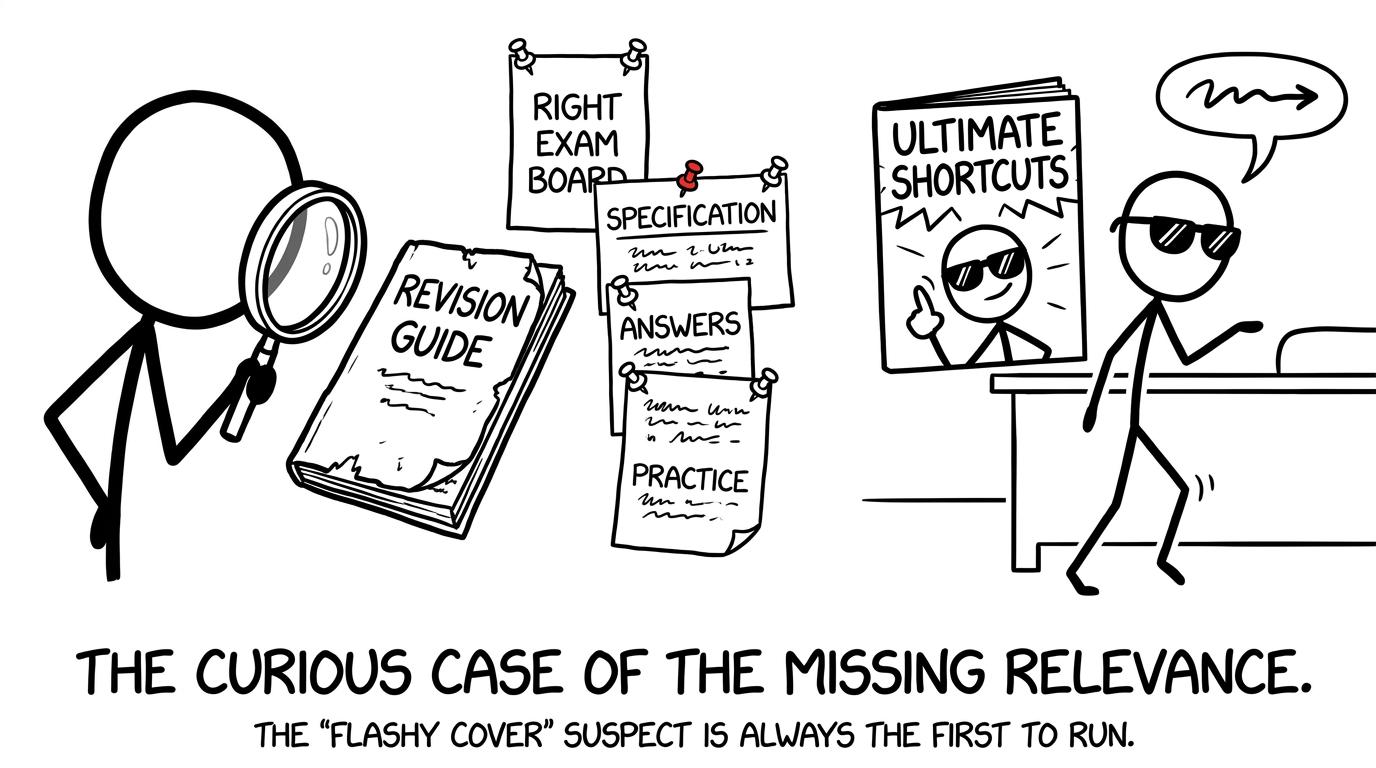 A student detective checks a revision guide for specification clues
Inspect the answers before trusting the questions
Answers are not an optional extra. They determine whether independent practice can become accurate learning.
A weak answer section gives only a final word or number. A stronger one shows the expected technical vocabulary, calculation stages, acceptable alternatives and the features needed in longer responses. It should help you understand why an answer earns marks rather than merely announce that yours is wrong.
Compare a few guide answers with the style of official mark schemes supplied by your exam board. They will not be identical, but the guide should encourage precise knowledge, contextual application and justified reasoning.
This principle is just as important in maths. MathsGenie's standard form question bank includes full solutions and mark guidance, while the similar shapes, area and volume guide can help clarify how changes in length affect area and volume.
Judge the explanation, not the page design
Colour, diagrams and concise boxes can reduce cognitive load. They can also disguise shallow content. The question is not whether a page looks simple; it is whether it makes the idea simpler without making it inaccurate.
Open the guide at a topic you already understand. Check the terminology, diagrams and links between ideas. Then open it at a weak topic. After reading a small section, close the book and explain the principle aloud. If you can only repeat the heading, the explanation has probably not done enough.
Good diagrams should clarify structures, processes or relationships. Photographs should have useful labels. Tables should support comparison. Decoration that neither explains nor tests anything adds weight rather than value.
Make sure it fits the way you revise
There is no universally perfect book because students use books differently. Some need short summaries before practising. Others need fuller explanations, visual comparisons or frequent self-tests.
Before committing to a guide, inspect sample pages where possible and ask:
- Can I read this without constantly translating the author's language?
- Are key terms defined precisely?
- Is there enough white space to annotate without losing the structure?
- Can I complete a short section in one revision session?
- Does each chapter lead naturally into active practice?
The guide should lower the friction between deciding to revise and beginning useful work. A comprehensive book that remains unopened is less valuable than a concise guide used repeatedly with questions and papers.
Use the guide as one part of a revision system
No revision guide can reproduce every unfamiliar context or exact demand of a live examination. Its job is to build knowledge and organise it. Past papers test whether that knowledge survives contact with real questions.
A dependable revision cycle is:
- choose one specification area;
- retrieve what you know before reading;
- use the guide to repair gaps;
- answer questions without notes;
- mark them carefully;
- record one precise correction;
- revisit the topic after a gap;
- test it later in a mixed paper.
For mathematical weaknesses, MathsGenie's free revision resources provide lessons, practice materials, mini tests and predicted papers. The advice in when to start GCSE past papers can also help you move gradually from topic practice to timed examination work.
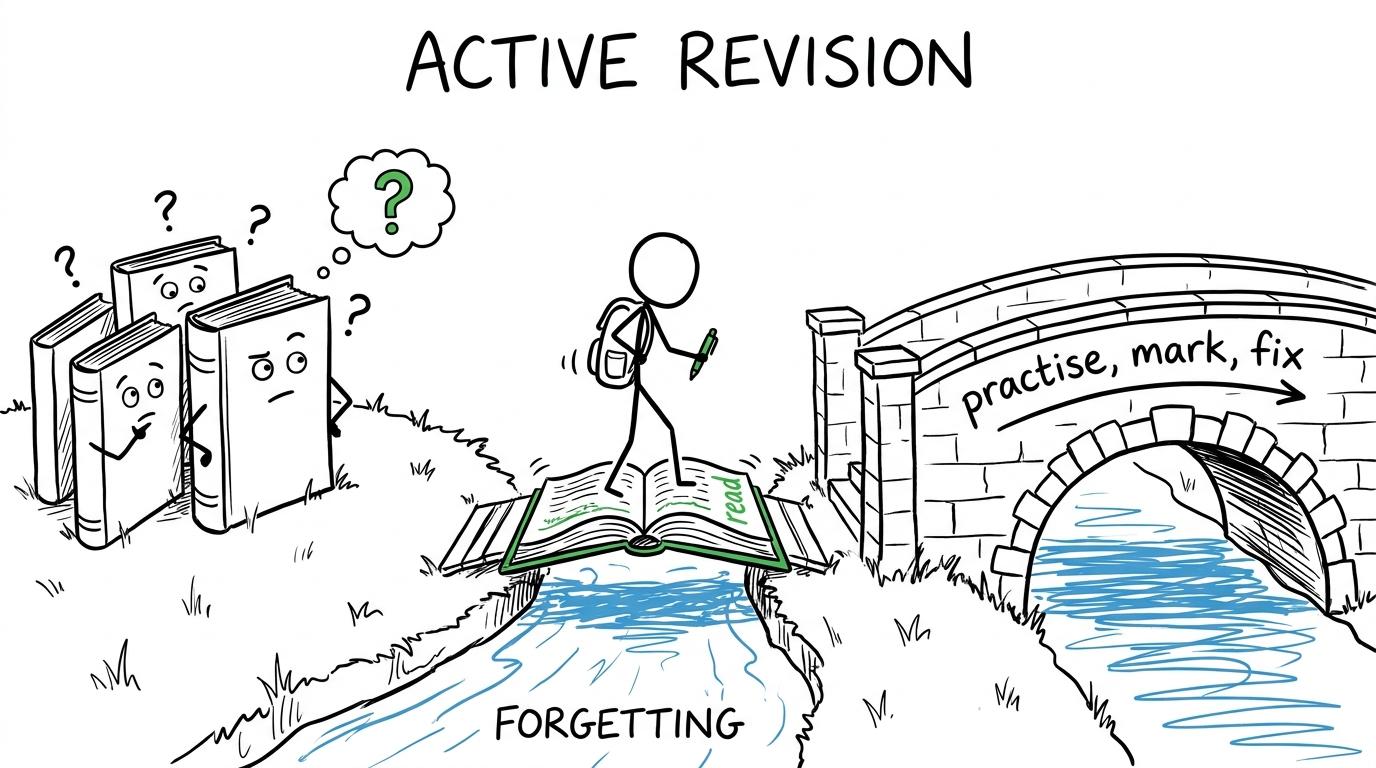 A small reading bridge leads to a stronger practise, mark and fix bridge
Common mistakes when choosing and using a guide
Buying for the wrong board
Shared subject content does not make every guide interchangeable. Confirm the board and specification before comparing prices or reviews.
Choosing the shortest guide automatically
Concise notes are helpful only when they preserve the detail needed for application and evaluation. Check a difficult topic rather than judging the total page count.
Treating reading as revision
Highlighting and rereading can feel productive because the material becomes familiar. Follow every reading session with closed-book recall or questions.
Ignoring mathematical sections
At least 15%15\%15% of written-examination marks are allocated to mathematical skills in context. Weaknesses in percentages, units, scale, data or area can therefore affect your Design and Technology result directly.
Trusting answers without checking their quality
Incorrect, vague or unexplained answers can reinforce mistakes. Compare terminology with your specification, teacher guidance and official mark schemes.
Replacing past papers with the guide
A guide organises the course; it does not fully imitate the paper. Use official past papers to learn timing, question style and how knowledge is combined.
Choose usefulness over reassurance
The best guide is not necessarily the thickest, newest-looking or most expensive. It is the one that accurately reflects your course and repeatedly moves you from recognition to independent recall, application and evaluation.
Check the exam board. Audit the contents against the specification. Inspect the questions and answers. Pay particular attention to mathematical applications. Then use the book inside a larger cycle of practice, marking and correction.
For the maths that appears within Design and Technology, and for your separate GCSE Maths preparation, make MathsGenie your next step. Start with the free revision lessons, strengthen weak methods through practice questions and video solutions, then build confidence with mini tests, past papers, mark schemes and predicted papers. A guide can show you what to know. Careful practice is what turns that knowledge into marks.











