Apprenticeship GCSE Art and Design Requirement Guide
Apprenticeship GCSE art and design requirement explained: discover which creative routes may ask for a grade and what to do if you fall short.
A vacancy can look perfect until one line makes you hesitate: “GCSE Art and Design preferred” or “grade 444 or above required”. Suddenly, the question is not whether you want the apprenticeship, but whether one result can close the door.
The short answer is reassuring. An apprenticeship GCSE art and design requirement is unusual and is not universal across a particular apprenticeship route. Individual employers and training providers set most entry criteria. Creative, fashion, textile and design vacancies are the most likely to request Art and Design, but many assess applicants through portfolios, practical tasks and evidence of creative interest instead.
The important skill is learning to distinguish a genuine minimum requirement from a preference. They are not the same thing.
The quick answer and application checklist
Before deciding whether you can apply, check the following:
- Is GCSE Art and Design described as essential, required, preferred or desirable?
- Does the vacancy specify a minimum grade, such as grade 444 or the older grade CCC?
- Does it accept an equivalent creative qualification?
- Is a portfolio, audition, practical task or design submission requested?
- Are GCSE English and maths also required?
- Can the employer or training provider consider applicants individually?
- Is the apprenticeship in England, Scotland, Wales or Northern Ireland? Apprenticeship systems and qualification arrangements are devolved.
Never assume that every vacancy with the same job title has identical requirements. Read the current advert and contact the named provider if the wording is unclear.
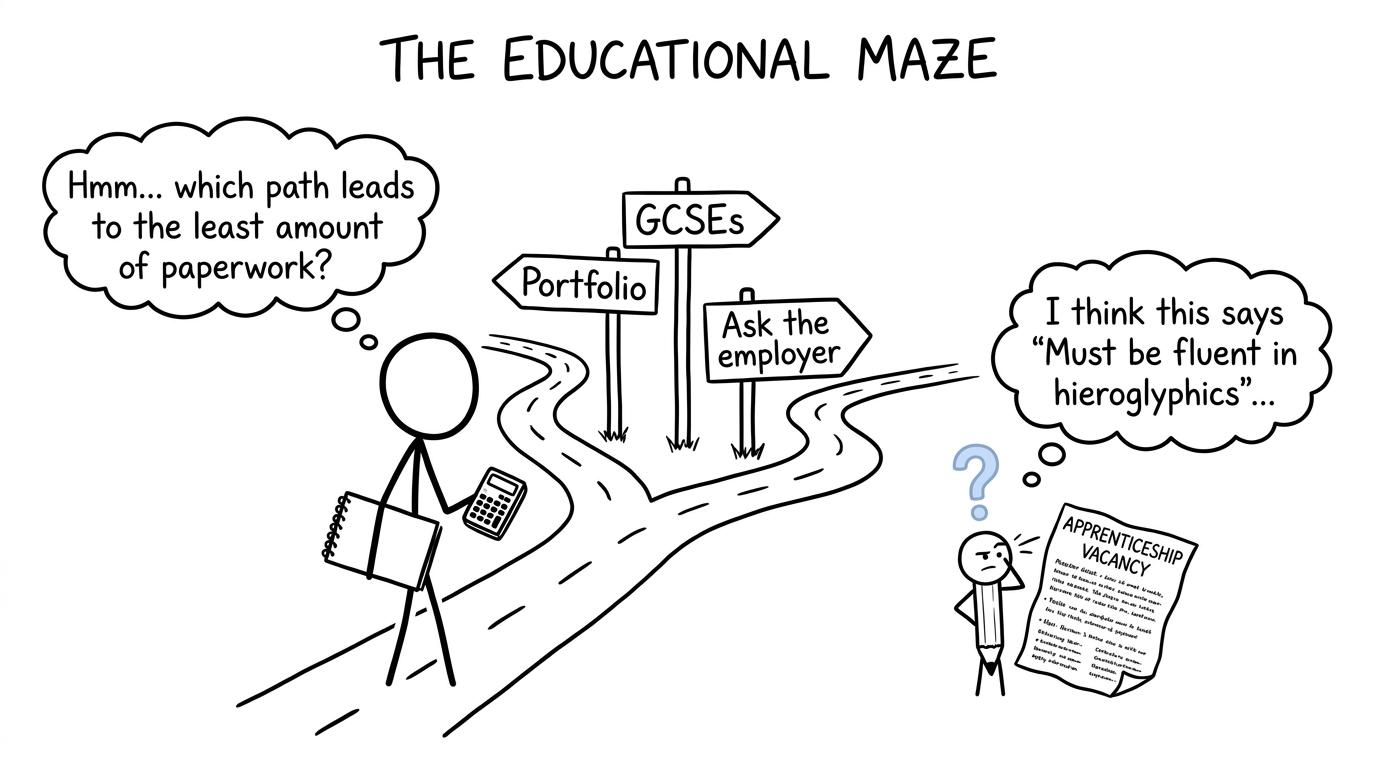 A student choosing between portfolio, GCSE and employer signposts
Do apprenticeships require a particular Art and Design grade?
Usually, no national rule says that everyone entering a creative apprenticeship must hold a specific GCSE Art and Design grade. Apprenticeship standards describe the knowledge, skills and behaviours needed for an occupation. Recruitment requirements are generally decided by the employer, sometimes in partnership with its training provider.
That distinction matters. A standard may require an apprentice to develop visual, technical or design skills without insisting that those skills were previously demonstrated through one particular GCSE.
Employers may still set their own threshold. One vacancy might ask for five GCSEs at grades 999-444, including Art and Design. Another employer recruiting for a similar role might request English and maths but judge creative ability from a portfolio. A third may accept relevant experience, a BTEC or another equivalent qualification.
Current government apprenticeship guidance also makes English and maths more prominent than Art and Design in many programmes. Exact requirements depend on the apprentice's age, prior attainment, programme and nation, so applicants should rely on the live vacancy and provider guidance rather than a general social-media claim.
Which apprenticeship routes might set an Art and Design minimum?
There is no reliable list of routes that always demand Art and Design because the requirement normally belongs to the vacancy, not the occupation as a whole. However, it appears more plausibly in routes where previous visual or practical work helps an employer select candidates.
Fashion and textile routes
Fashion, textile, garment-making and costume-related opportunities may ask for GCSE Art and Design, Design and Technology, textiles or an equivalent creative subject. Employers may want evidence that an applicant understands colour, materials, visual development or the process of turning an idea into a finished piece.
Even here, a portfolio can be central. Sketchbooks, garment experiments, photography, digital work and independently completed projects may reveal more about an applicant's thinking than a grade alone.
Graphic, digital and visual design roles
Some vacancies connected with graphic design, digital content, visual communication or print production may specify Art and Design at grade 444 or above. Others prefer a creative subject without naming one qualification.
Digital roles can also value software familiarity, communication and numeracy. Resizing artwork, interpreting dimensions and working within budgets all involve mathematical confidence. Students who need to secure a standard pass can begin with MathsGenie's grade 4 GCSE maths revision, where topics are organised with videos and exam-style questions.
Craft, jewellery and specialist making
Apprenticeships involving jewellery, ceramics, furniture, scenic work or other specialist crafts may look for an artistic or design background. A practical assessment, workshop trial or portfolio is often more directly connected to the occupation, however, so an Art and Design GCSE may be preferred rather than compulsory.
Architecture, interiors and the built environment
Design-focused built-environment vacancies may mention Art and Design, Design and Technology or a related subject. Yet maths is frequently just as relevant because drawings, scale, measurement and spatial reasoning are part of the work.
Requirements vary particularly widely in this area. Some higher or degree apprenticeships ask for A Levels, UCAS tariff evidence or specified technical subjects rather than a GCSE in Art. Students considering those routes can keep their numeracy moving beyond GCSE through MathsGenie's A Level maths revision resources.
Creative routes that often do not specify Art GCSE
Content production, marketing, photography support, theatre operations and cultural venue roles may welcome artistic evidence without requiring GCSE Art and Design. Communication, organisation, digital skills and a convincing application may carry greater weight.
The occupation's label can therefore mislead. “Creative” does not automatically mean “Art GCSE required”, just as completing GCSE Art does not automatically qualify someone for every design apprenticeship.
Essential, preferred and equivalent mean different things
Small words in a vacancy can have large consequences.
An essential or required grade is normally a screening condition. If you do not hold it, ask whether the employer accepts an equivalent before applying. Do not claim that a portfolio automatically replaces a mandatory qualification.
A preferred or desirable grade is different. It can strengthen an application, but applicants without it may still be considered. In that situation, demonstrate the same underlying qualities through other evidence.
“Art and Design or equivalent” should prompt a question rather than an assumption. Relevant BTECs, vocational awards or overseas qualifications might be accepted, but equivalence is decided by the organisation assessing the application. Send the exact qualification title, awarding body and result when asking.
Why maths may matter more than you expect
A student focused on a creative career can easily see maths revision as a separate world. Employers rarely do. Creative workplaces use measurements, proportions, costs, deadlines, data and technical specifications.
A pattern must fit. A print file needs the correct dimensions. A project must stay inside its budget. These are quiet uses of maths, but they appear every day.
GCSE English and maths requirements also occur more frequently across apprenticeship vacancies than a named Art and Design grade. If maths is the qualification putting your application at risk, focus first on the topics capable of moving your grade. MathsGenie's complete GCSE maths revision hub arranges lessons by grade and includes video explanations, practice questions and answers.
If grade 444 is secure and you are aiming higher, the grade 5 GCSE maths resources provide a sensible next step. Revision works best when it is specific: identify a weak topic, practise it, mark it and return to the mistakes.
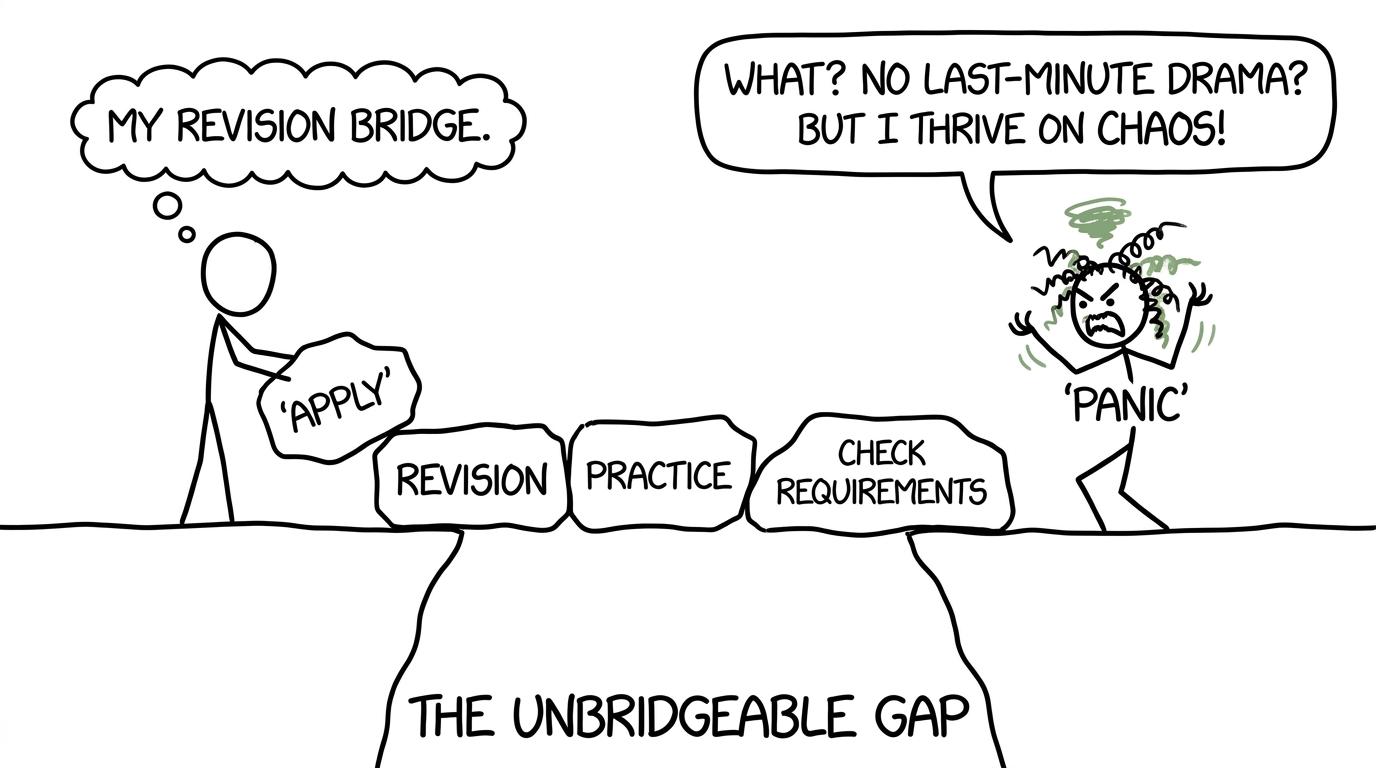 A revision bridge keeping the panic gremlin away
What to do if you are short of the requested grade
First, check whether you are genuinely short. A vacancy asking for Art and Design at grade 444 may accept an older grade CCC, but you should let the employer confirm how it treats equivalent qualifications.
Next, take practical action:
- Contact the employer or provider. Explain your actual result and ask whether equivalent experience or portfolio evidence can be considered.
- Apply when the grade is only desirable. Address the gap honestly and make the rest of the application specific.
- Strengthen your portfolio. Include selected work showing ideas, development, experimentation, feedback and finished outcomes. Quality and explanation matter more than filling every page.
- Gather evidence beyond school. Relevant personal projects, clubs, volunteering or paid experience can demonstrate sustained interest, provided everything claimed is genuine.
- Consider a related route. A college course, traineeship where available, entry-level role or apprenticeship with different criteria may build towards the same career.
- Plan a resit where appropriate. Ask your school, college or local centre about availability, costs and assessment arrangements before making plans.
If English or maths is the missing requirement, begin preparation early rather than waiting for the next application. Use Edexcel GCSE maths past papers, AQA GCSE maths past papers or OCR GCSE maths past papers, depending on your exam board.
Past papers are diagnostic tools, not merely final rehearsals. Mark each attempt, classify the lost marks by topic and return to the matching revision lesson. MathsGenie's GCSE predicted papers can provide further timed practice, but they should complement broad specification coverage rather than replace it.
Building a convincing creative application
A strong portfolio does not guarantee that an employer will waive an essential grade. It does, however, give substance to applications where the qualification is preferred or where individual consideration is possible.
Choose work that shows how you think. Include initial ideas, changes made after feedback, unsuccessful experiments and the reasoning behind your final decisions. Employers are selecting an apprentice who will learn, not simply admiring a gallery of polished pieces.
Your written application should be equally concrete. Explain why the organisation's work interests you, what you have created and what you learnt. Avoid describing yourself only as “passionate” or “creative”. Evidence is more persuasive than adjectives.
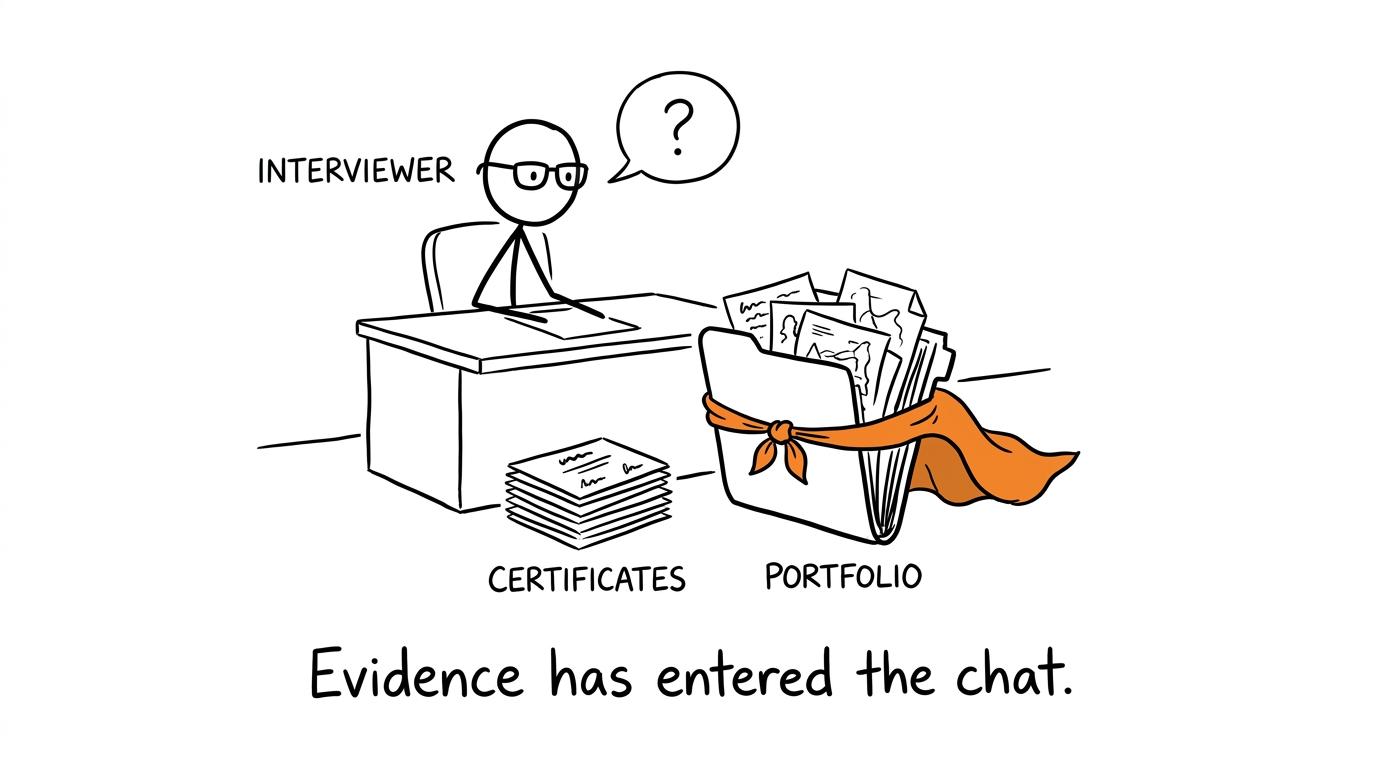 A superhero portfolio arriving beside a small certificate pile
Common mistakes when checking apprenticeship requirements
Treating one vacancy as a rule for the whole career
An employer's requirement applies to that vacancy. Search several current opportunities before concluding that an entire route is closed.
Confusing preferred with compulsory
Students sometimes withdraw because they lack a desirable subject. If every essential condition is met, a preferred grade should not automatically stop an application.
Assuming a portfolio overrides every condition
Creative evidence is valuable, but an automated application system or provider agreement may enforce an essential minimum. Ask before relying on an exception.
Ignoring English and maths
A student may spend weeks worrying about Art and Design while overlooking a more common GCSE maths condition. Check every line of the criteria and make a revision plan for any result still pending.
Sending the same application everywhere
Requirements reveal what each employer values. Tailor the portfolio selection and personal statement to the specific role without exaggerating your experience.
Waiting until results day to investigate
You can research routes, organise portfolio work and identify alternative vacancies before results arrive. If you are preparing for GCSE maths now, use revision lessons alongside mark schemes and timed papers so that each session has a clear purpose.
Your grade is information, not your entire direction
A specific GCSE Art and Design grade can matter when an individual employer makes it essential. But no universal minimum covers every creative or design apprenticeship. Routes in fashion, textiles, visual design, specialist crafts and the built environment are more likely to mention the subject, while many employers use portfolios, practical tasks or broader creative qualifications instead.
Read the exact vacancy. Ask precise questions. If you fall short, explore equivalencies, strengthen your evidence and keep alternative routes open.
Meanwhile, protect the qualifications that appear across a wider range of opportunities. Start with the MathsGenie GCSE revision programme, then use practice questions, mini tests, past papers, predicted papers, mark schemes and video solutions to turn weak areas into dependable marks. A requirement becomes less intimidating when you have a clear next action.