Algebraic Proof Exam Questions: GCSE Methods
Algebraic proof exam questions explained through three GCSE examples. Learn clear methods, where marks come from, common mistakes and questions to practise.
Algebraic proof exam questions can feel unsettling because the answer is already in the question. You are told that an expression is always a multiple of something, then asked to explain why. The way forward is consistent: represent the numbers algebraically, simplify the expression, and explain why its final form proves the claim for every permitted integer.
Imagine a student working through three questions. At first, they try a few numbers. Then they realise what the examiner needs: reasoning that covers all the numbers they could have chosen. These original exam-style examples follow that progression, showing the working that makes a proof convincing and assessable.
Your algebraic proof checklist
Before starting, identify what the question means by its numbers:
- An integer can be represented by nnn, where nnn is an integer.
- Consecutive integers can be written as nnn, n+1n+1n+1 and n+2n+2n+2.
- An even integer has the form 2n2n2n.
- An odd integer has the form 2n+12n+12n+1.
- Consecutive odd integers can be written as 2n+12n+12n+1 and 2n+32n+32n+3.
Then follow four steps: define, form, simplify, conclude.
To prove an expression is a multiple of kkk, aim to write it as kkk multiplied by an integer. The final explanation matters because it connects your algebra to the statement you were asked to prove.
For a fuller introduction alongside these examples, use the MathsGenie proof lesson.
Algebraic proof exam questions: three worked examples
The comments below identify useful evidence of method. Exact marks and their allocation depend on the question and its mark scheme; these examples do not reproduce an official marking grid.
First question: the sum of consecutive integers
Prove that the sum of three consecutive integers is a multiple of 333.
Our hypothetical student first checks a few sets of numbers. Each works, but checking examples leaves infinitely many possibilities untouched. They replace those examples with a general representation.
Define the numbers: let the three consecutive integers be nnn, n+1n+1n+1 and n+2n+2n+2, where nnn is an integer.
Form their sum:
n+(n+1)+(n+2)n+(n+1)+(n+2)n+(n+1)+(n+2)Simplify and factorise:
3n+3=3(n+1)3n+3=3(n+1)3n+3=3(n+1)Conclude: since n+1n+1n+1 is an integer, 3(n+1)3(n+1)3(n+1) is a multiple of 333. Therefore, the sum of any three consecutive integers is a multiple of 333.
The useful method is visible in the correct representation and the algebraic sum. The factorised form and concluding sentence complete the argument. Writing only “there are three numbers” would not explain why their sum is divisible by 333.
Now that you have the four-step method, use MathsGenie’s proof lessons and question bank to practise setting up another proof yourself.
Second question: squares of consecutive odd integers
Prove that the difference between the squares of two consecutive odd integers is a multiple of 888.
The student now recognises that the main decision comes before the expansion: choosing expressions that actually describe consecutive odd integers.
Define the numbers: let them be 2n+12n+12n+1 and 2n+32n+32n+3, where nnn is an integer. Taking the second square minus the first gives:
(2n+3)2−(2n+1)2(2n+3)^2-(2n+1)^2(2n+3)2−(2n+1)2Expand both brackets:
=(4n2+12n+9)−(4n2+4n+1)=(4n^2+12n+9)-(4n^2+4n+1)=(4n2+12n+9)−(4n2+4n+1)Subtract every term in the second bracket:
=4n2+12n+9−4n2−4n−1=4n^2+12n+9-4n^2-4n-1=4n2+12n+9−4n2−4n−1Collect terms and factorise:
=8n+8=8(n+1)=8n+8=8(n+1)=8n+8=8(n+1)Conclude: n+1n+1n+1 is an integer, so the difference is a multiple of 888.
Here, correct expressions for the odd integers establish the method. Accurate expansion and subtraction develop it, while 8(n+1)8(n+1)8(n+1) makes the required divisibility clear. If you reverse the subtraction, the result is −8(n+1)-8(n+1)−8(n+1), which is still a multiple of 888.
Students following AQA can also use the AQA proof revision guide alongside their course materials.
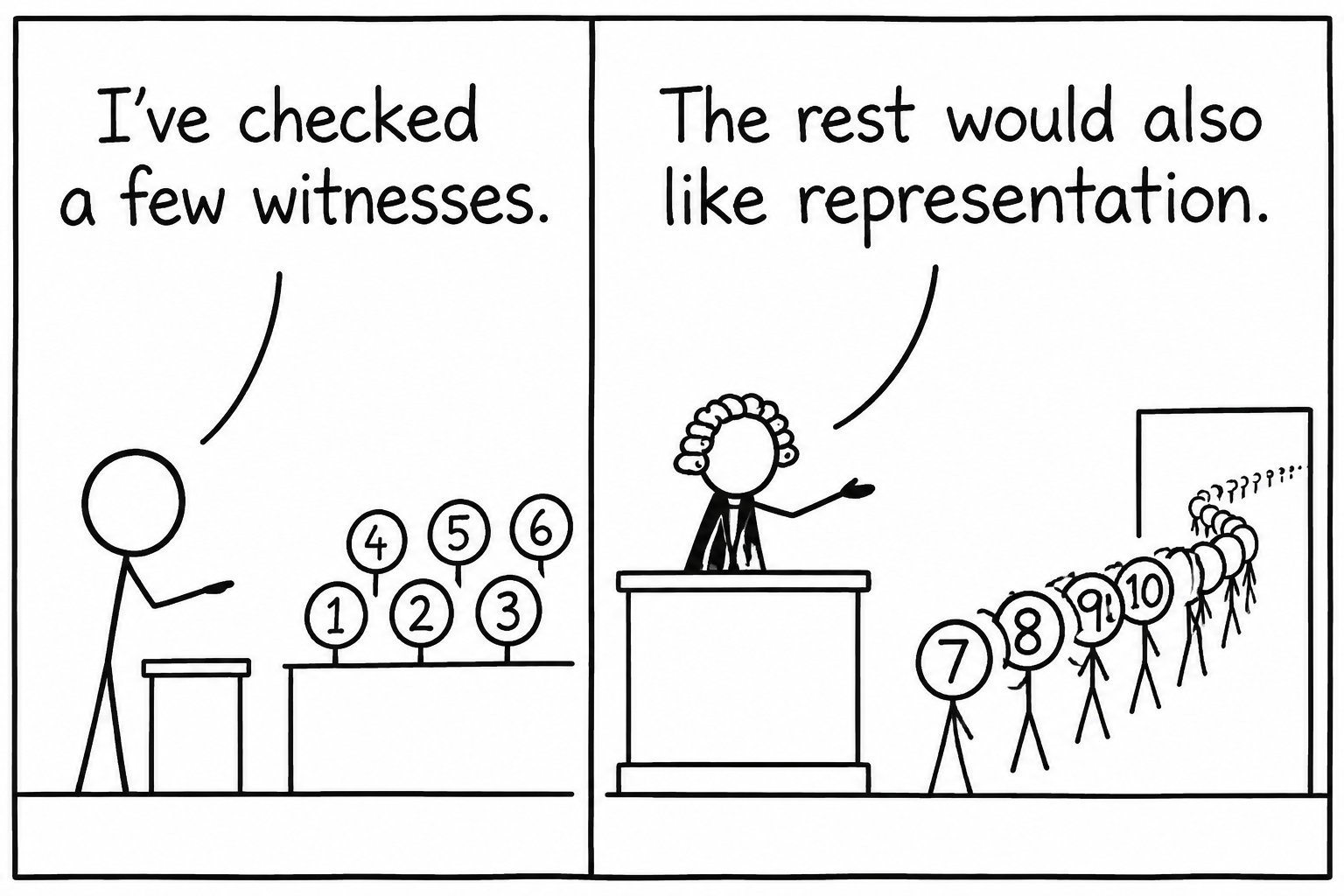 A stick-figure courtroom comic about checking a few numerical witnesses when infinitely many numbers still need representation.
Third question: a cube minus the original integer
Prove that, for any integer nnn, the expression n3−nn^3-nn3−n is a multiple of 666.
This time, expansion will not help. The student needs to reveal a structure hidden inside the expression.
Take out the common factor:
n3−n=n(n2−1)n^3-n=n(n^2-1)n3−n=n(n2−1)Use the difference of two squares:
n(n2−1)=n(n−1)(n+1)n(n^2-1)=n(n-1)(n+1)n(n2−1)=n(n−1)(n+1)The expression is therefore the product of three consecutive integers: n−1n-1n−1, nnn and n+1n+1n+1.
Among any three consecutive integers, at least one is even, so their product has a factor of 222. One is also a multiple of 333, so their product has a factor of 333.
Since 222 and 333 are coprime, the product is divisible by 666. Therefore, n3−nn^3-nn3−n is a multiple of 666 for every integer nnn.
The factorisation supplies the algebraic method. Recognising consecutive integers supplies the next step. Explaining both divisibility properties completes the proof. Stopping at the factorised expression would leave the reader to finish the reasoning.
Where method marks come from
Across these examples, assessable working starts with translating words into algebra. It continues through a valid transformation, such as expansion or factorisation, and finishes by interpreting the result.
Write each substantial transformation on a separate line. If you make an arithmetic slip, visible working can still show the valid method you used, subject to the particular mark scheme.
When attempting algebraic proof past paper questions, compare your reasoning with the solution, rather than checking only the final expression. The Edexcel GCSE revision collection provides a route to exam practice and mark schemes.
Common mistakes in algebraic proof
Treating examples as proof. Numerical checks can test your interpretation, but they cannot establish an “always” statement about every integer.
Using unrelated variables for consecutive numbers. Writing aaa, bbb and ccc does not establish that the numbers are consecutive. Writing nnn, n+1n+1n+1 and n+2n+2n+2 builds that relationship into the algebra.
Squaring only the individual terms. Remember that (a+b)2=a2+2ab+b2(a+b)^2=a^2+2ab+b^2(a+b)2=a2+2ab+b2. Missing the middle term can destroy an otherwise sensible proof.
Losing signs after subtraction. Subtracting a bracket changes the sign of every term inside it.
Ending before explaining the result. If you reach 8(n+1)8(n+1)8(n+1), state that n+1n+1n+1 is an integer. That is why the expression must be a multiple of 888.
If these errors keep returning, revisit the relevant algebra skill before attempting a harder proof. MathsGenie’s guidance on building the algebra needed for GCSE maths explains why those foundations deserve revision time.
Exam-style practice
Try these without looking back at the worked examples:
- Prove that the sum of two consecutive odd integers is a multiple of 444.
- Prove that the difference between the squares of consecutive integers is odd.
- Prove that the product of four consecutive integers is a multiple of 242424.
Check your destination: the first can simplify to 4(n+1)4(n+1)4(n+1); the second to 2n+12n+12n+1. For the third, explain that four consecutive integers contain a multiple of 333, a multiple of 444, and another even integer, supplying a factor of 242424.
Turn the method into independent practice
Our hypothetical student now has a repeatable approach: define the numbers, manipulate the expression, and explain the result. Your next step is to produce that reasoning without following a finished solution. Start with the MathsGenie proof Lessons and Question Bank, attempt a question independently, then check whether every line supports your conclusion.