Can You Pass GCSE Maths Without Algebra?
GCSE revision guide: can you pass without algebra? Learn what’s needed for grades 9-1, plus quick algebra wins and Maths Genie links to practise.
The uncomfortable truth students whisper before the GCSE
The night before a GCSE paper, lots of students make the same quiet deal with themselves: “If I can just avoid algebra, I’ll be fine.”
It makes sense. Algebra feels like maths with the safety rails removed. Numbers become letters, and suddenly you’re not sure what you’re allowed to do anymore.
But here’s the problem: algebra isn’t a single topic you can skip. In GCSE Maths it’s more like electricity in a house; you can ignore the wiring, but you’ll still need the lights to work. Even questions that look like number, ratio, graphs, sequences, probability, and geometry often turn into algebra halfway through.
So, can you pass GCSE Maths without algebra? You can survive parts of the paper with minimal algebra, especially on foundation tier, but passing reliably without any algebra is a risky plan. The better plan is simpler: learn just enough algebra to stop it stealing marks.
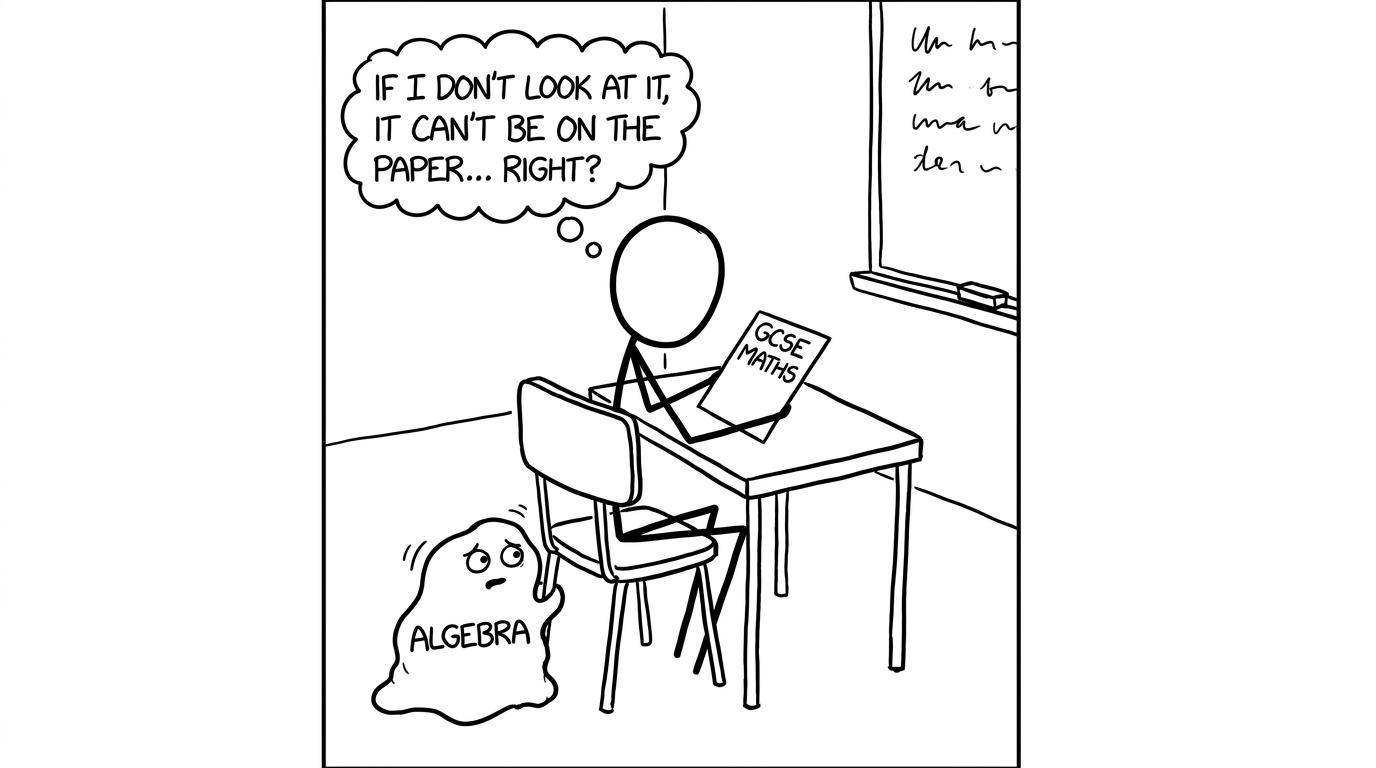 A student trying to ignore algebra under the desk
A quick checklist: what “without algebra” really means
Before we answer properly, decide what you mean:
- No algebra at all: you won’t rearrange, substitute, solve, or simplify anything with letters.
- Minimal algebra: you can do basics like simplifying 3x+2x3x+2x3x+2x, solving x+5=12x+5=12x+5=12, and using a formula.
- Algebra as a tool: you can form equations from word problems and handle graphs, sequences and proportion confidently.
If your goal is a pass (grade 4+), “minimal algebra” is the realistic target for most GCSE students. If your goal is grades 6-9, algebra stops being optional and becomes one of the main ways the paper separates strong grades from the rest.
A good starting point is to work through Maths Genie’s GCSE revision structure so you don’t guess what matters: GCSE Scheme of Learning.
Where algebra appears in GCSE Maths (even when it’s pretending not to)
The GCSE papers from Edexcel, AQA, OCR and Eduqas are written to test connections. Algebra is one of the main connectors.
Foundation tier vs higher tier: the algebra “tax”
- Foundation tier still includes solving linear equations, substitution into formulas, and basic algebraic manipulation. Those marks are often some of the most “available” marks on the paper.
- Higher tier uses algebra to unlock harder problem-solving: quadratic graphs, algebraic fractions, proof, iteration, and simultaneous equations.
In other words: on foundation tier you can sometimes scrape a pass with weak algebra if your number and geometry are strong. On higher tier, avoiding algebra is like avoiding words in an English exam.
To see what your paper actually looks like, use Maths Genie’s board-specific papers and mark schemes:
“Non-algebra” topics that quietly use algebra
Here are common GCSE areas that often become algebra:
- Ratio and proportion: 3:53:53:5 problems often become equations.
- Perimeter and area: shapes with sides like (x+3)(x+3)(x+3).
- Graphs: straight lines are basically algebra drawn.
- Sequences: finding the nnnth term is algebra.
- Rearranging formulas: physics-style questions live here.
So the more accurate question is:
Can you pass GCSE Maths without being comfortable with algebra?
And the answer becomes: it’s possible, but it’s unstable. One awkward paper and the floor drops out.
The safest strategy: learn “pass-level” algebra and bank marks
There’s a comforting idea in revision: you don’t need to love a topic to score marks in it. You need a method you can repeat under pressure.
These are the algebra skills that pay back fastest for GCSE:
- Simplifying expressions (collecting like terms)
- Expanding brackets
- Solving linear equations
- Substitution into formulas
- Straight line graphs basics
Maths Genie has targeted practice for the key skills. For example, if solving equations is your sticking point, start here: Solving Equations (Grade 1-9) practice questions.
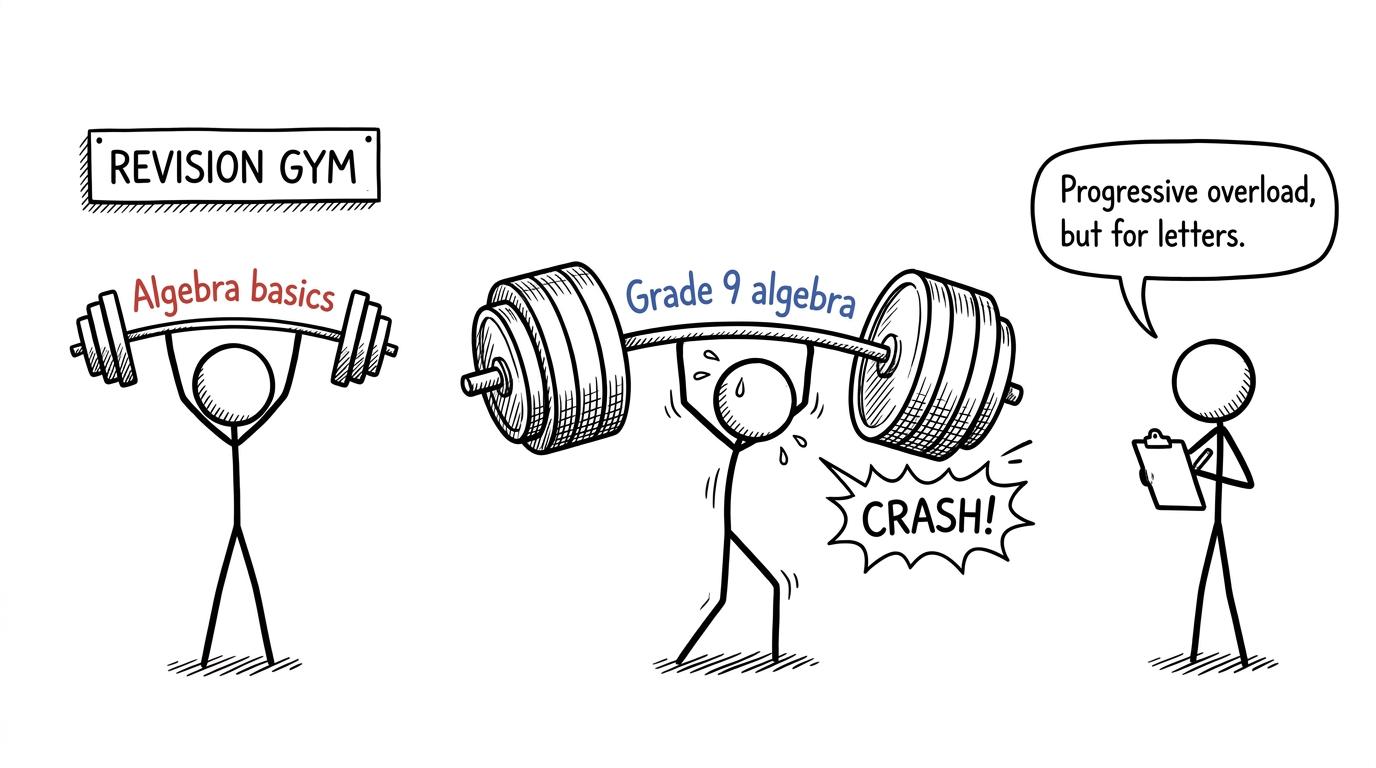 Revision gym metaphor for algebra progress
Worked examples: the algebra you need to pass GCSE
These are the kinds of questions that appear again and again because they test understanding and they’re easy to mark.
Simplifying expressions (quick marks)
Simplify 7x−3+2x+57x - 3 + 2x + 57x−3+2x+5.
Combine like terms:
- 7x+2x=9x7x + 2x = 9x7x+2x=9x
- −3+5=2-3 + 5 = 2−3+5=2
So the simplified expression is 9x+29x + 29x+2.
This is GCSE algebra at its most honest: same letters, add the numbers in front.
Expanding brackets
Expand and simplify 3(2x−5)+4x3(2x - 5) + 4x3(2x−5)+4x.
Expand first:
3(2x−5)=6x−15 3(2x-5)=6x-15 3(2x−5)=6x−15Now add 4x4x4x:
6x−15+4x=10x−15 6x-15+4x=10x-15 6x−15+4x=10x−15Final answer: 10x−1510x - 1510x−15.
Solving a linear equation
Solve 5x−7=185x - 7 = 185x−7=18.
Add 777 to both sides:
5x=25 5x = 25 5x=25Divide by 555:
x=5 x = 5 x=5That’s a typical GCSE method-mark question: even if you panic, showing these steps often earns marks.
A “real-life” question that turns into algebra
A taxi charges a fixed fee of £3 plus £2 per mile. The total cost is £17. How many miles did you travel?
Let miles be mmm. Then:
3+2m=17 3 + 2m = 17 3+2m=17Subtract 333:
2m=14 2m = 14 2m=14Divide by 222:
m=7 m = 7 m=7You travelled 777 miles.
This is why avoiding algebra hurts in GCSE: the story looks like money, but the scoring method is an equation.
What if you genuinely can’t do algebra yet?
If you’re weeks (or days) from GCSE and algebra feels impossible, you don’t need a miracle. You need a triage plan.
Use the paper structure to your advantage
- On Paper 1 (non-calculator), basic algebra can appear early because it doesn’t need a calculator.
- On calculator papers, algebra still appears, but often mixed with proportion, graphs, and geometry.
A smart move is practising full papers with mark schemes so you learn the style of algebra your exam board asks. Maths Genie makes this easy with predicted papers and worked solutions: GCSE resources and predicted papers hub.
Build confidence through stages
When you practise randomly, algebra feels like it’s everywhere. When you practise in a sequence, it becomes predictable. Maths Genie’s staged approach is designed for this: Maths Genie GCSE Stage system.
Common mistakes that lose easy GCSE algebra marks
Even strong students drop marks on algebra for boring reasons. Here are the big ones.
Mixing unlike terms
Students write 3x+5=8x3x + 5 = 8x3x+5=8x.
But 3x+53x + 53x+5 cannot combine because one term depends on xxx and the other does not. The expression is already simplified.
Sign errors when moving terms
From 5x−7=185x - 7 = 185x−7=18, a common mistake is writing 5x=18−75x = 18 - 75x=18−7. That’s actually correct, but many then calculate 18−7=918-7=918−7=9 instead of 111111. Under pressure, arithmetic and algebra mistakes merge.
Expanding brackets incorrectly
A frequent error is:
3(2x−5)=6x−5 3(2x-5)=6x-5 3(2x−5)=6x−5But the 333 multiplies both terms, so it must be 6x−156x-156x−15.
Dividing only part of an expression
From 2x+6=102x+6=102x+6=10, some students do x+6=5x+6=5x+6=5.
You can only divide a whole side by 222 if you divide every term:
Not showing method
GCSE mark schemes reward process. If you jump to an answer and it’s wrong, you often get 000. If you show steps, you may still earn method marks. This is why practising with mark schemes matters, not just doing questions.
The mindset shift that makes algebra manageable
Algebra feels personal when you struggle with it. Like it’s revealing something about you. But it isn’t. It’s revealing something about exposure.
Every confident GCSE student has done the same quiet thing: they stopped trying to “understand it all at once” and started collecting small wins. One method. One type of question. One page of practice. Then another.
Or, put differently: you don’t pass GCSE by avoiding your weak topics. You pass GCSE by shrinking them until they’re no longer scary.
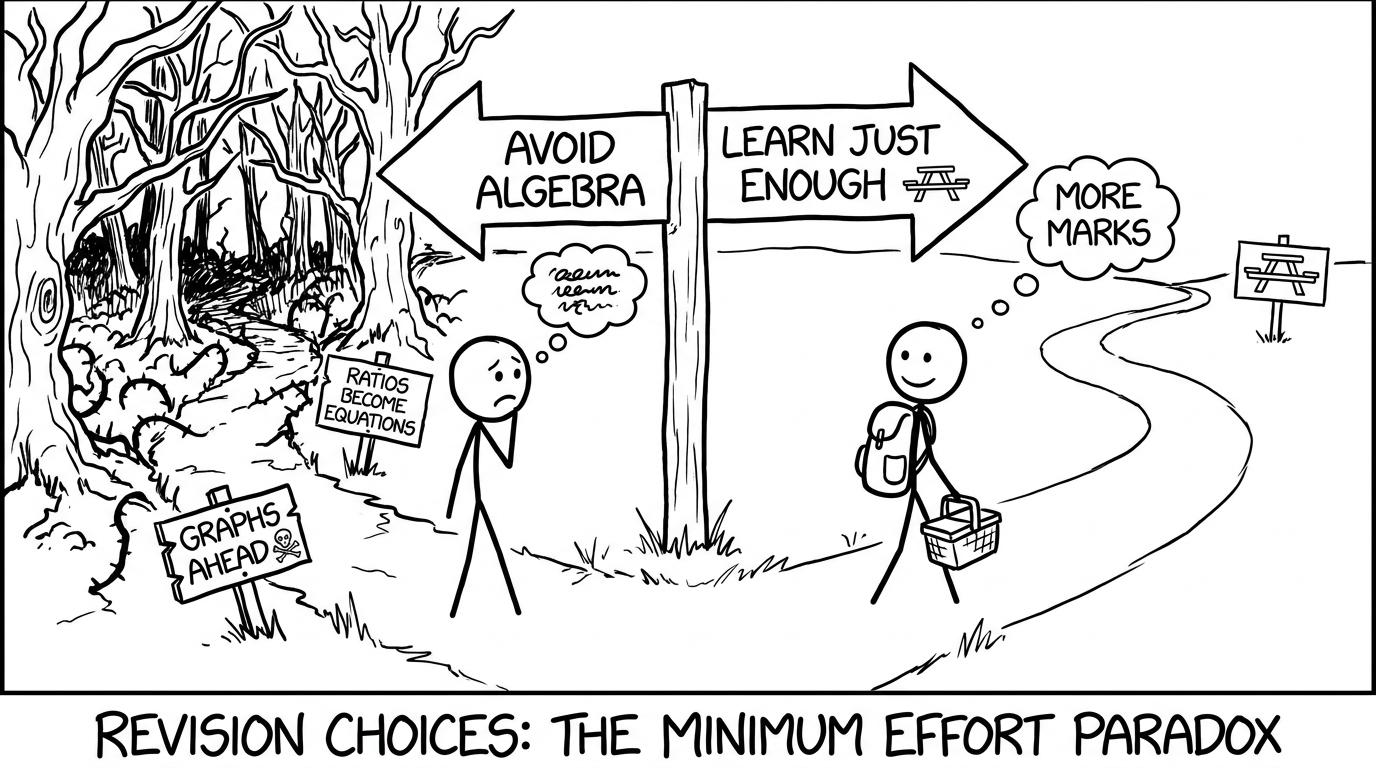 Two revision paths: avoid algebra vs learn just enough
A practical GCSE revision plan (that doesn’t rely on luck)
If you’re serious about passing GCSE Maths, use this simple structure:
- Build the basics with lessons and topic practice.
- Check understanding with mark schemes.
- Then switch to timed papers so you learn exam rhythm.
On Maths Genie, that means:
- Use the GCSE Scheme of Learning to cover what your tier needs.
- Practise key algebra topics using exam-style PDFs like Solving Equations (and revisit until it’s automatic).
- Move onto full papers using AQA GCSE past papers or Edexcel GCSE predicted papers.
- If you want an extra subject that strengthens your data skills, explore GCSE Statistics Revision.
Conclusion: Can you pass GCSE Maths without algebra?
You might pass GCSE Maths with almost no algebra if your other topics are exceptionally strong and your paper is kind. But that’s not a strategy; it’s a gamble.
The more dependable answer is this: you don’t need to become an algebra person to pass GCSE. You need to learn the small set of algebra skills that appear constantly, practise them until they’re familiar, and then use past papers and predicted papers to turn familiarity into marks.
If you’re revising right now, make Maths Genie your home base. Use the free revision lessons, practise questions, mark schemes, video solutions, mini tests, and predicted papers to build the algebra you need, and the confidence that comes with it. Your next GCSE paper won’t be algebra-free, but it can be fear-free if you prepare well.