

AI Tools to Revise GCSE Food and Nutrition
AI tools revise GCSE Food and Nutrition more safely with this practical guide to prompts, fact-checking, exam practice, NEA rules and core maths skills.
Revision can create a strange temptation. When your notes on nutrients, food science and safety begin to blur together, a chatbot offers instant clarity. No waiting. No embarrassment about asking the same question twice.
Can AI tools revise GCSE Food and Nutrition with you effectively? Yes, but only as assistants. ChatGPT and similar tools can generate questions, simplify difficult ideas and organise revision. They can also invent facts, overlook your specification and produce work that is not genuinely yours. The safest approach is to use AI for practice and feedback, then verify everything against trusted course materials, mark schemes and your teacher's guidance.
The quick checklist
Use AI tools to:
- create retrieval questions from verified notes;
- explain a concept in simpler language;
- compare related ideas in a table;
- suggest a revision timetable;
- test definitions and key terminology;
- give feedback on an unassessed practice answer;
- build confidence with food-related calculations.
Do not rely on AI to:
- write or rewrite assessed NEA work;
- provide food safety or allergy advice without verification;
- predict exactly what will appear in the exam;
- reproduce an exam board's mark scheme accurately;
- replace practical cooking experience;
- decide whether its own answer is correct.
Start by confirming your exam board and opening the GCSE Food and Nutrition revision hub. AQA, OCR and Eduqas organise their content and assessments differently, so a polished explanation is still unhelpful if it teaches material outside your specification.
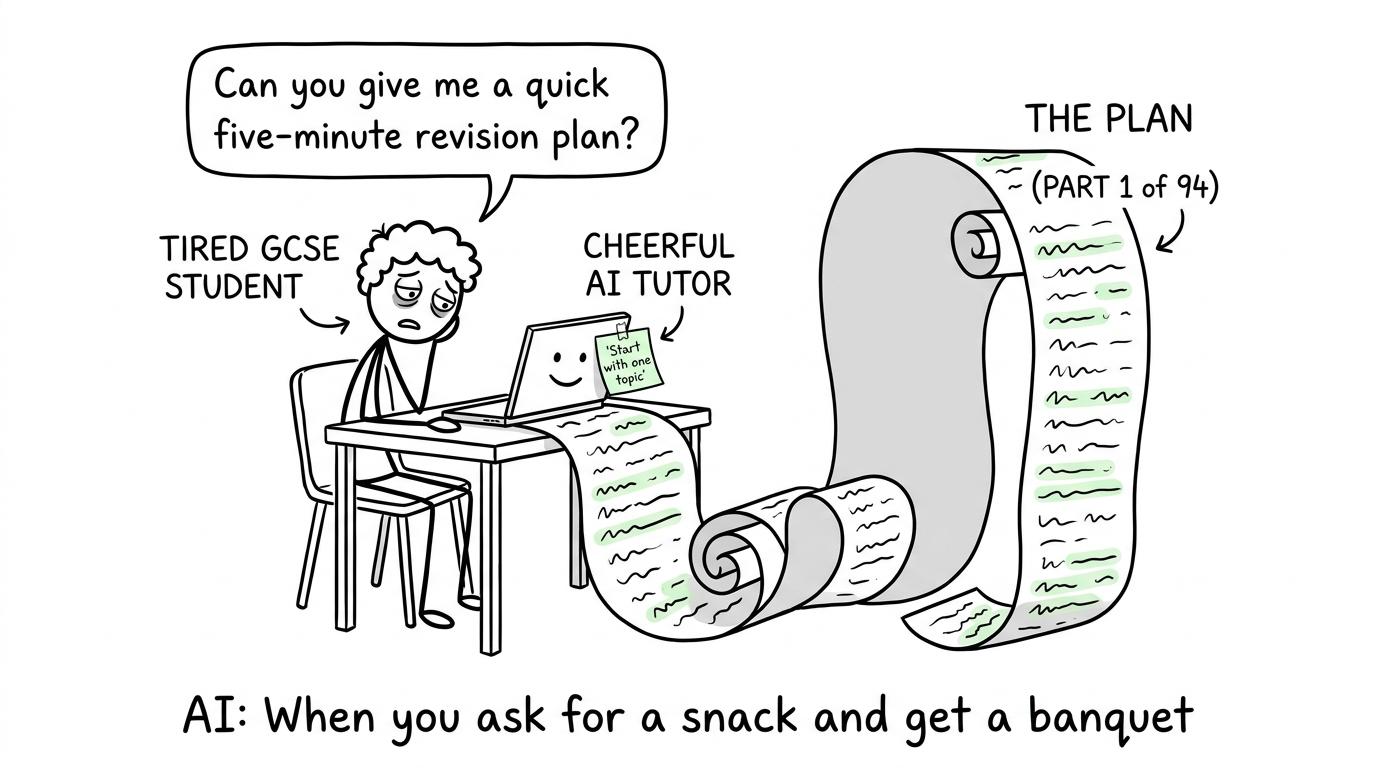 A student receives a comically oversized revision plan from an AI chatbot
Where AI can genuinely help
Turning notes into active recall
Rereading feels productive because everything looks familiar. Unfortunately, recognising a page is not the same as recalling an answer under exam conditions.
Give an AI tool a short section of your own verified notes and ask it to create questions without showing the answers. These might cover macronutrients, micronutrients, food provenance, bacterial contamination or the functional properties of ingredients. Answer from memory first, then check against your original material.
A useful instruction is:
Using only the notes below, create ten GCSE retrieval questions. Mix definitions, explanations and application questions. Do not add information that is not in my notes. Put the answers in a separate section.
The phrase "using only the notes below" matters. It narrows the task and reduces the opportunity for unsupported additions, although you must still check the output.
Explaining difficult concepts in stages
Food science contains ideas that are easy to memorise badly. Gelatinisation, coagulation, enzymic browning, gluten formation and shortening all involve processes rather than isolated definitions.
AI can present one concept at several levels: a one-sentence definition, a fuller GCSE explanation and a short sequence of stages. You can then compare that explanation with your specification and class notes.
Ask for precise language rather than a vague summary. For instance, request the scientific process, the conditions required, the visible result and one relevant food context. This encourages an explanation with structure, but it does not make the content automatically reliable.
Creating practice questions
AI-generated questions are useful for low-stakes practice, especially when you have exhausted a small set of classroom questions. Ask for a mixture of command words such as state, describe, explain, compare, analyse and evaluate.
However, treat these questions as rehearsal rather than authentic exam material. A chatbot does not control the assessment and may attach unrealistic marks or produce a weak imitation of an exam board's style. Official past papers and mark schemes remain the better measure of exam readiness.
Improving an unassessed practice response
AI can act as a critical reader. Paste an answer that is not part of submitted assessment and ask it to identify:
- claims that need evidence;
- missing links between cause and effect;
- repeated ideas;
- specialist vocabulary used incorrectly;
- places where the answer describes rather than explains.
Ask for feedback, not a replacement answer. The thinking you do while improving your response is where much of the learning occurs.
Using AI for the maths inside Food and Nutrition
Food and Nutrition is not a maths qualification, but numerical confidence still matters. Recipes, nutritional information and investigation data can involve ratio, proportion, percentages, averages, units and graphs.
AI can generate extra questions or check your method, but the underlying maths should be practised independently. Useful MathsGenie resources include:
- ratio revision for comparing quantities;
- direct proportion and recipe scaling;
- percentages revision for nutritional proportions and changes;
- averages revision for investigation results;
- scatter graphs revision for relationships between paired variables.
For scaling quantities, the general relationship is:
new amount=original amount×new number of portionsoriginal number of portions\text{new amount}=\text{original amount}\times\frac{\text{new number of portions}}{\text{original number of portions}}new amount=original amount×original number of portionsnew number of portionsFor a percentage of a total, use:
percentage amount=percentage100×total amount\text{percentage amount}=\frac{\text{percentage}}{100}\times\text{total amount}percentage amount=100percentage×total amountFor the mean of repeated investigation results:
mean=total of the resultsnumber of results\text{mean}=\frac{\text{total of the results}}{\text{number of results}}mean=number of resultstotal of the resultsDo not ask AI merely for the final number. Ask it to check the method you have already attempted, including units and rounding. That preserves the part of revision that strengthens your own problem-solving.
Where AI tools tend to lead students astray
Confident but inaccurate information
Generative AI predicts plausible language. It does not guarantee factual truth. A response may confuse two food science processes, give an unreliable storage rule or invent a source that appears convincing.
This matters particularly for food safety, allergies and cooking guidance. Never use a chatbot as the sole authority for something that could affect health. Check safety claims against teacher-approved and authoritative materials.
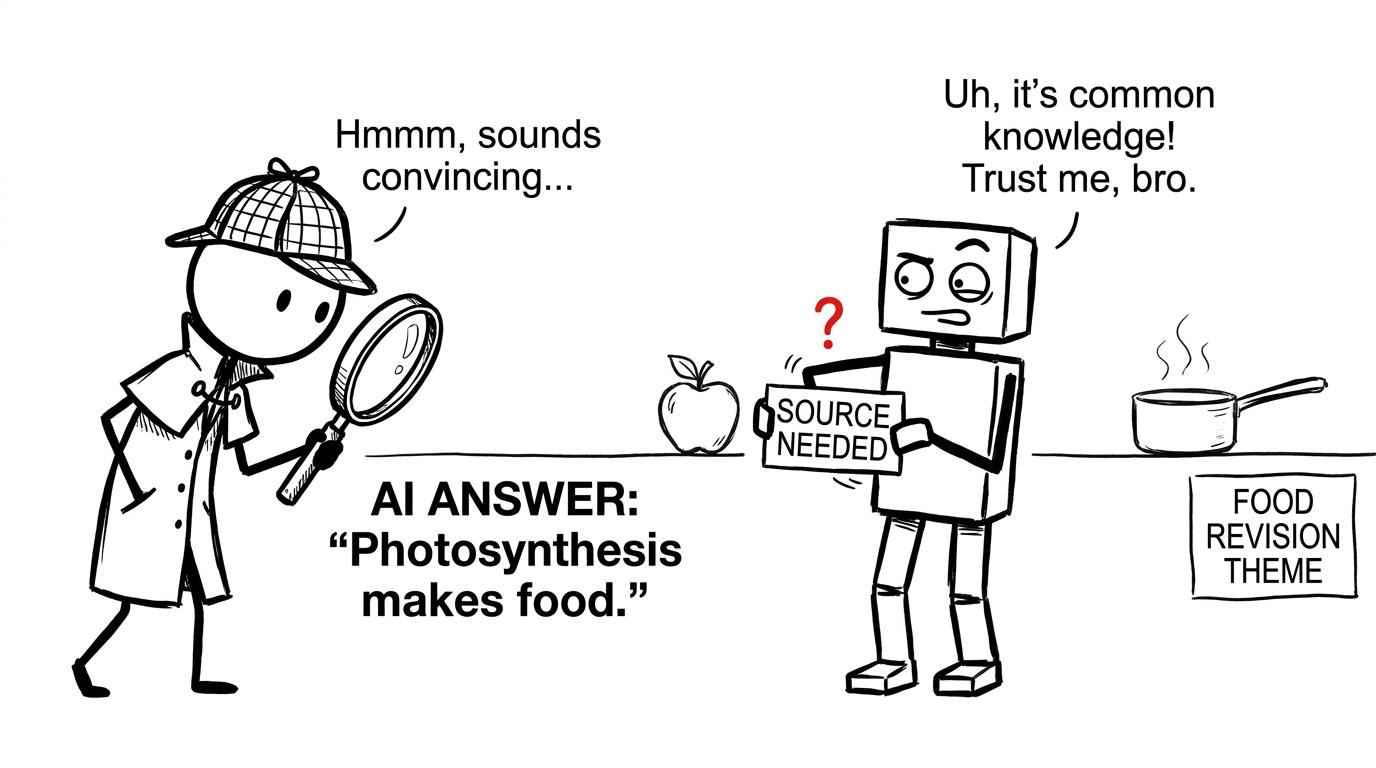 A student detective investigates an AI answer hiding a source-needed label
Specification drift
An AI answer may blend material from AQA, OCR, Eduqas, WJEC, another qualification or a different country. The science might be broadly relevant while the terminology, depth or assessment advice is wrong for your course.
A better prompt names your board, qualification and precise topic. Even then, keep the specification beside you. AI should help you navigate the map, not redraw it.
Weak marking advice
A chatbot can comment on clarity, but it cannot reliably award official marks. It may reward a long answer that misses the command word or penalise a concise answer that would satisfy the actual mark scheme.
Use genuine mark schemes whenever possible. They show what examiners accept and how marks are allocated. The difference is important: AI gives an opinion; a mark scheme represents the assessment standard.
Missing practical and sensory understanding
No prompt can reproduce the texture of overworked dough, the visual signs of a sauce thickening or the organisation required during a timed practical. Food Preparation and Nutrition assesses connections between theory and practice.
Use AI before practical work to help create a personal checklist, and afterwards to suggest reflective questions. Your observations, decisions and evaluations must come from what actually happened.
AI, coursework and NEA rules
This is the boundary students must understand clearly. Current JCQ guidance requires assessed work to be the student's own. Submitting AI-generated or AI-paraphrased content as your own can constitute malpractice. Material copied directly from AI also does not demonstrate that you independently met the assessment criteria.
GCSE Food Preparation and Nutrition commonly includes non-exam assessment alongside the written examination. For example, current AQA, OCR and Eduqas specifications each allocate half of the qualification to written assessment and half to NEA, although the task structures differ.
Before using AI anywhere near NEA:
- ask your teacher whether it is permitted for that stage of the task;
- follow your school and exam board rules;
- never use it to generate analysis, evaluation or conclusions for submission;
- acknowledge permitted use as instructed;
- retain the prompt and generated material if the rules require it;
- be prepared to explain every decision and sentence yourself.
JCQ guidance says acknowledged AI-generated material may still fail to earn marks because it does not prove independent achievement. Referencing AI is not a shortcut that turns generated work into your own work. When uncertain, stop and ask your teacher before proceeding.
A safer AI revision routine
A reliable session has five stages:
Choose one precise topic
Avoid asking for "everything about nutrition". Choose a narrow area such as protein functions, heat transfer or factors affecting food choice.
Learn from verified material
Use your specification, lesson notes and MathsGenie revision resources first. AI should not be the foundation of the topic.
Retrieve without help
Close the notes and answer questions from memory. If the chatbot displays answers immediately, the task becomes reading rather than retrieval.
Check every claim
Compare the generated answer with trusted materials. When sources disagree, do not ask the chatbot to vote for itself. Consult your teacher or an authoritative source.
Practise under exam conditions
Finish with genuine exam-style material, then mark it carefully. The same principle applies to maths preparation: the GCSE maths revision hub brings together lessons, practice questions, mini tests, past papers, predicted papers, mark schemes and video solutions.
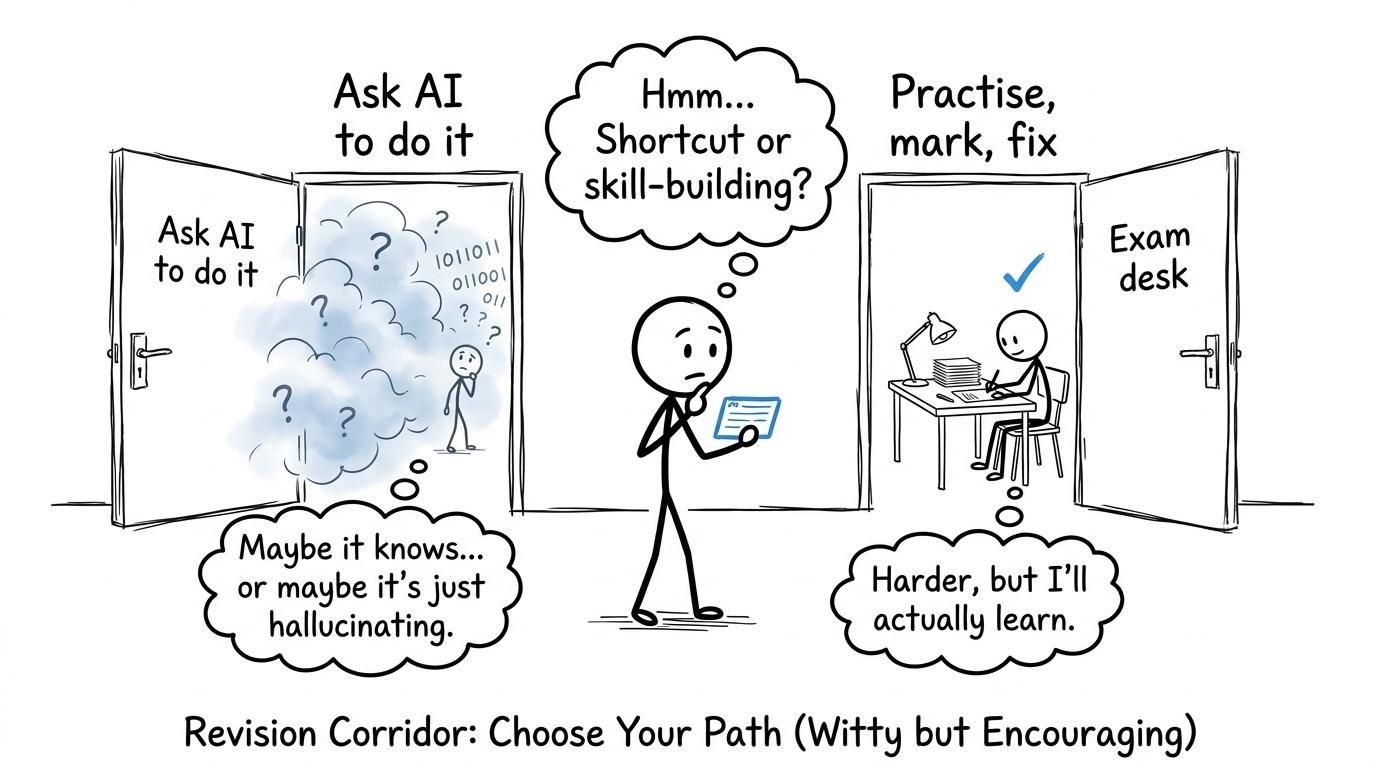 A student chooses between asking AI to do the work and practising, marking and fixing
Common mistakes when revising with AI
Accepting the first response. Fluency can look like accuracy. Verify definitions, processes and figures.
Using prompts that are too broad. Large requests usually produce shallow summaries. Revise one specification point at a time.
Reading instead of answering. Ask AI to hide solutions until you have committed to a response.
Trusting invented references. Open and verify any claimed source rather than assuming it exists.
Letting AI rewrite your voice. Feedback can help; replacement writing removes the thinking that revision is meant to develop.
Ignoring NEA restrictions. Rules for informal revision and submitted assessment are not the same.
Avoiding real papers. AI questions cannot replace authentic papers, command words and mark schemes. A structured one-month GCSE revision plan can also be adapted to balance retrieval, topic repair and timed practice across subjects.
Make AI the assistant, not the author
The best revision tools reduce friction without removing thought. AI is useful when it asks you a better question, exposes a gap or helps you organise the next half-hour. It becomes harmful when it supplies certainty you have not checked or work you could not reproduce alone.
Start with the free MathsGenie Food and Nutrition resources, then use AI selectively around trusted content. For the numerical skills that support your course and your maths exams, combine revision lessons with practice questions, mini tests, past papers, predicted papers, mark schemes and video solutions. Let technology shorten the route to meaningful practice; never the practice itself.










