

AI Tools to Revise GCSE Art and Design Safely
AI tools revise GCSE Art and Design safely: learn where ChatGPT can support ideas and planning, where it risks marks, and how to protect original work.
Revision is usually easier when the next step is obvious. Learn a fact. Answer a question. Check the mark scheme. GCSE Art and Design feels different because the work is personal, practical and developed over time. That uncertainty makes it tempting to ask ChatGPT to supply the missing ideas.
So, can AI tools revise GCSE Art and Design effectively? Yes, but only as assistants for revision, organisation, questioning and carefully acknowledged research. They should not create the artwork, analysis, evaluation or creative decisions you submit as your own. Current assessment guidance is built around a simple principle: assessed work must demonstrate your knowledge, skills and independent creative development.
Used well, AI can help you think. Used badly, it can replace the very thinking for which marks are awarded.
The quick AI revision checklist
Before using ChatGPT or another AI tool, ask:
- Is this helping me understand the course rather than producing assessed work?
- Have I checked my teacher's instructions and school AI policy?
- Can I verify every factual claim through a reliable original source?
- Will my sketchbook still show my own observations, experiments and decisions?
- If the output influences assessed work, have I recorded the tool, prompt, date and response?
- Could I explain exactly what I contributed without the AI?
If any answer is unclear, pause and ask your teacher. Rules can depend on the task, assessment conditions, exam board and your centre's policy.
What GCSE Art and Design actually rewards
Art revision is not mainly about memorising paragraphs. Across GCSE Art and Design specifications, work is assessed through four connected objectives. Their wording can vary slightly in classroom materials, but they broadly require you to:
- AO1: develop ideas through investigations and show critical understanding of sources;
- AO2: refine work by exploring and experimenting with media, materials, techniques and processes;
- AO3: record relevant ideas, observations and insights as the work progresses;
- AO4: present a personal and meaningful response that realises your intentions.
For GCSE qualifications regulated in England, each objective carries 25%25\%25% of the overall weighting. The portfolio accounts for 60%60\%60% and the externally set component for 40%40\%40%. The externally set component includes preparatory work followed by a 101010-hour supervised period.
That structure explains the central risk of AI. A polished generated image may look impressive, but appearance alone is not the assessment. Teachers and moderators need evidence of investigation, experimentation, recording, refinement and personal judgement. If software performs those actions for you, the resulting material cannot demonstrate your independent achievement.
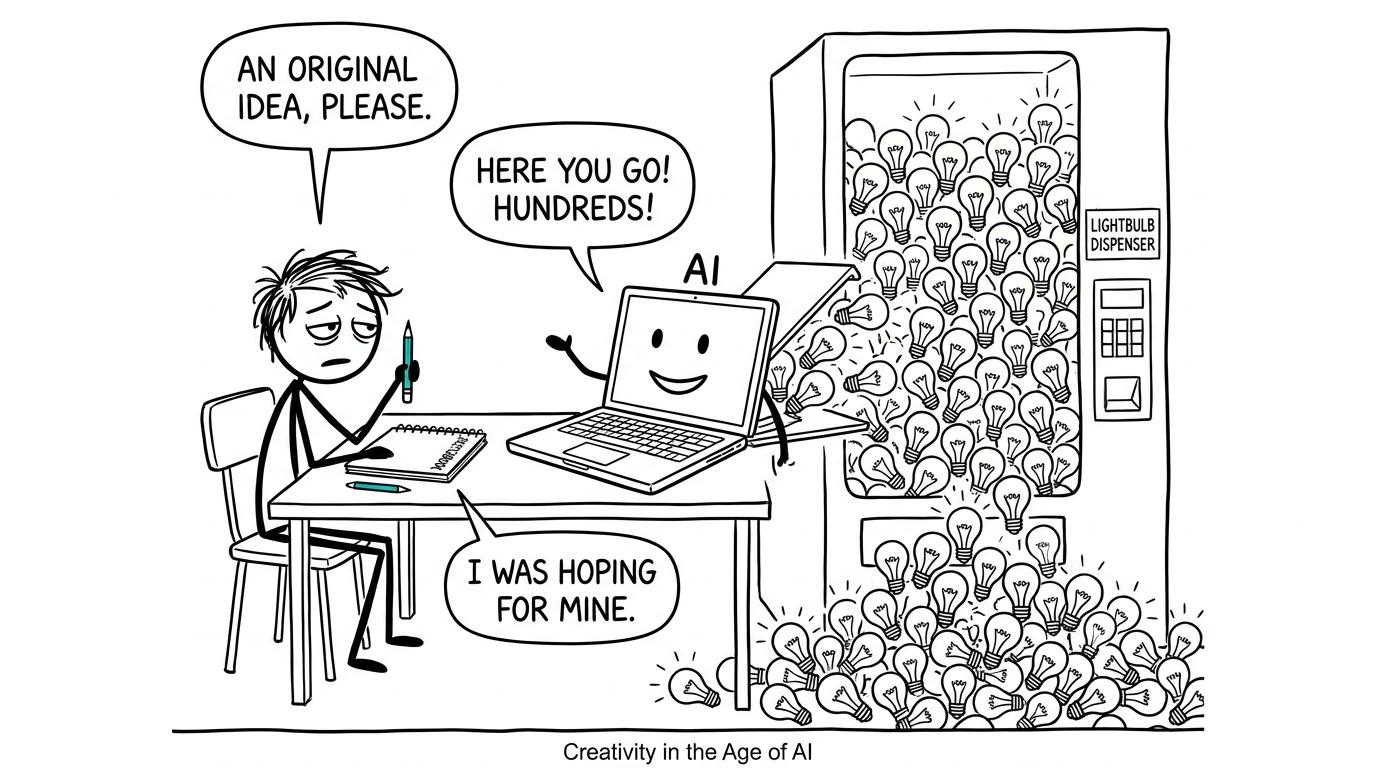 A student receives identical lightbulbs after asking AI for an original idea
Where AI tools can genuinely help
Turn the specification into questions
AI is useful as a questioning partner. You can provide the published wording of an assessment objective and ask for retrieval questions about what it means. For example, it might ask you to identify where your project records observations or how one experiment changed your intentions.
The important distinction is that AI asks the question while you inspect your sketchbook and answer it. Do not ask the tool to invent the evidence or write the annotation.
Organise a revision session
A chatbot can turn a limited amount of time into a practical checklist. A useful session might include:
- recalling the four assessment objectives without notes;
- reviewing teacher feedback;
- identifying an experiment that needs further development;
- checking artist references;
- practising a technique in a separate study;
- recording what changed and why in your own words.
This is administration, not authorship. The AI helps arrange the work, while the artistic thinking remains yours.
Students balancing Art with foundation or higher tier maths can apply the same principle to both subjects. MathsGenie's GCSE maths revision timetable can help you protect regular maths sessions instead of allowing one coursework deadline to consume the entire week.
Quiz you on terminology and processes
AI can test your understanding of terms such as composition, tone, negative space, impasto, relief or primary source. Ask it to give one question at a time, wait for your response and then compare your definition with a trusted textbook or teacher-approved resource.
This is more useful than asking for a completed glossary. Retrieval reveals what you can explain independently. A generated list merely shows what the tool can explain.
Suggest research routes, not research conclusions
You might ask for categories to investigate around a broad theme: relevant movements, materials, cultural contexts, primary-source opportunities or contrasting approaches. Treat every suggestion as an unverified lead.
AI systems can produce plausible but incorrect names, dates, titles and quotations. Find the artist's official website, a museum collection, gallery archive, exhibition catalogue or published book before relying on a claim. Never cite the chatbot as proof that an artwork or artist exists.
Rehearse a conversation about your work
Ask the tool neutral questions such as:
- What was your original intention?
- Which experiment was least successful, and what did it teach you?
- How did your source material influence a specific visual decision?
- What would you refine if you repeated the process?
Answer aloud or in rough notes. This can expose vague thinking before you discuss the project with your teacher. The final annotation and evaluation must still reflect your own judgement and language.
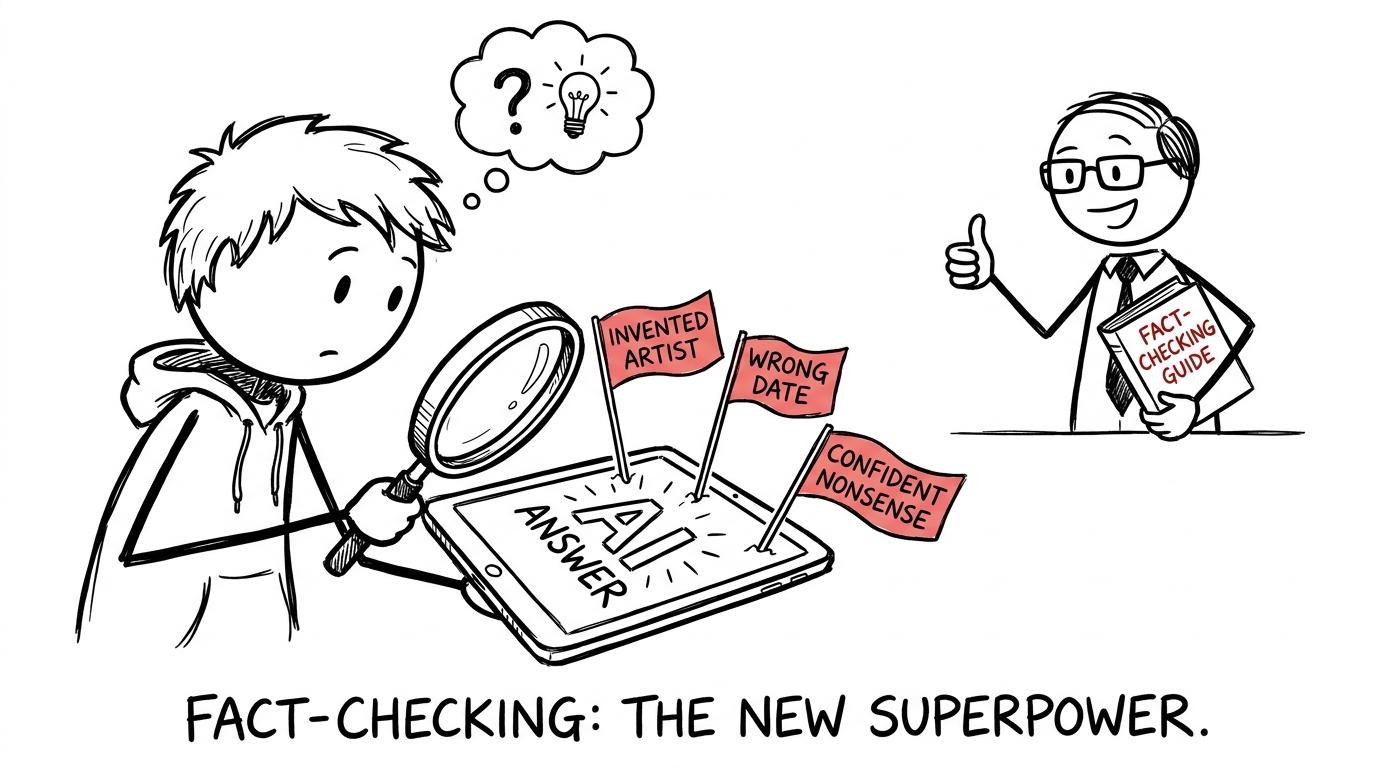 A student fact-checks an AI answer containing several warning signs
Where ChatGPT and image generators lead students astray
Generating a final piece or substantial visual content
Submitting an AI-generated image as original artwork conflicts with the requirement that assessed work must be your own. Referencing the tool does not automatically make generated material rewardable. If the software replaces your ideas, decisions or technical application, it cannot provide evidence of your independent skills.
Even using AI to complete, enhance or transform your practical work can create an authentication problem. Ask your teacher before using any generative or automated feature, including features built into familiar design software.
Writing artist analysis and annotations
A chatbot can produce fluent paragraphs almost instantly. Fluency is not the same as critical understanding. Generic phrases about an artist's “bold use of colour” do not show what you noticed, how you interpreted it or how it changed your project.
AI-written annotations also tend to flatten the creative journey. Real development contains abandoned ideas, awkward experiments and changes of direction. Those moments are valuable evidence. A smooth retrospective account can conceal rather than demonstrate them.
Asking AI to evaluate your work
Evaluation is an artistic decision. The student must judge whether intentions were achieved, what succeeded technically and what should happen next. Letting AI supply that judgement removes evidence of personal reflection.
A safer prompt asks for questions that help you evaluate. Your answers should refer to visible, specific decisions in your own work.
Trusting invented information
Chatbots predict plausible language; they are not guaranteed reference databases. They may combine artists, misattribute artworks or invent quotations. Confident wording makes the risk harder to notice, not smaller.
Use AI to find possible avenues, then verify them independently. If the original source cannot be found, leave the claim out.
AI acknowledgement and authentication
Current JCQ guidance says students must submit work that is their own. Misuse of AI in assessed work can be treated as malpractice, and work that cannot be authenticated may not be accepted for assessment.
Where AI use is permitted and its output contributes to an assessment, guidance requires clear acknowledgement. Students should retain a non-editable copy, such as screenshots, of the prompt and generated response. The record should identify the tool and generation date, explain how the material was used and include the underlying sources where appropriate.
Pearson's subject guidance also emphasises that Art and Design students must develop work independently beyond any AI input. Properly referencing generated material does not transfer ownership of the generated skill to the student.
The safest routine is therefore:
- ask your teacher before using AI in portfolio or preparatory work;
- save prompts and complete outputs rather than selected fragments;
- record when and why the tool was used;
- identify generated elements clearly;
- verify research through original sources;
- preserve sketches, trials, photographs and drafts showing your own process.
Your teacher must be able to recognise and authenticate your development. A clear process is not paperwork added after creativity. It is evidence that the creativity belongs to you.
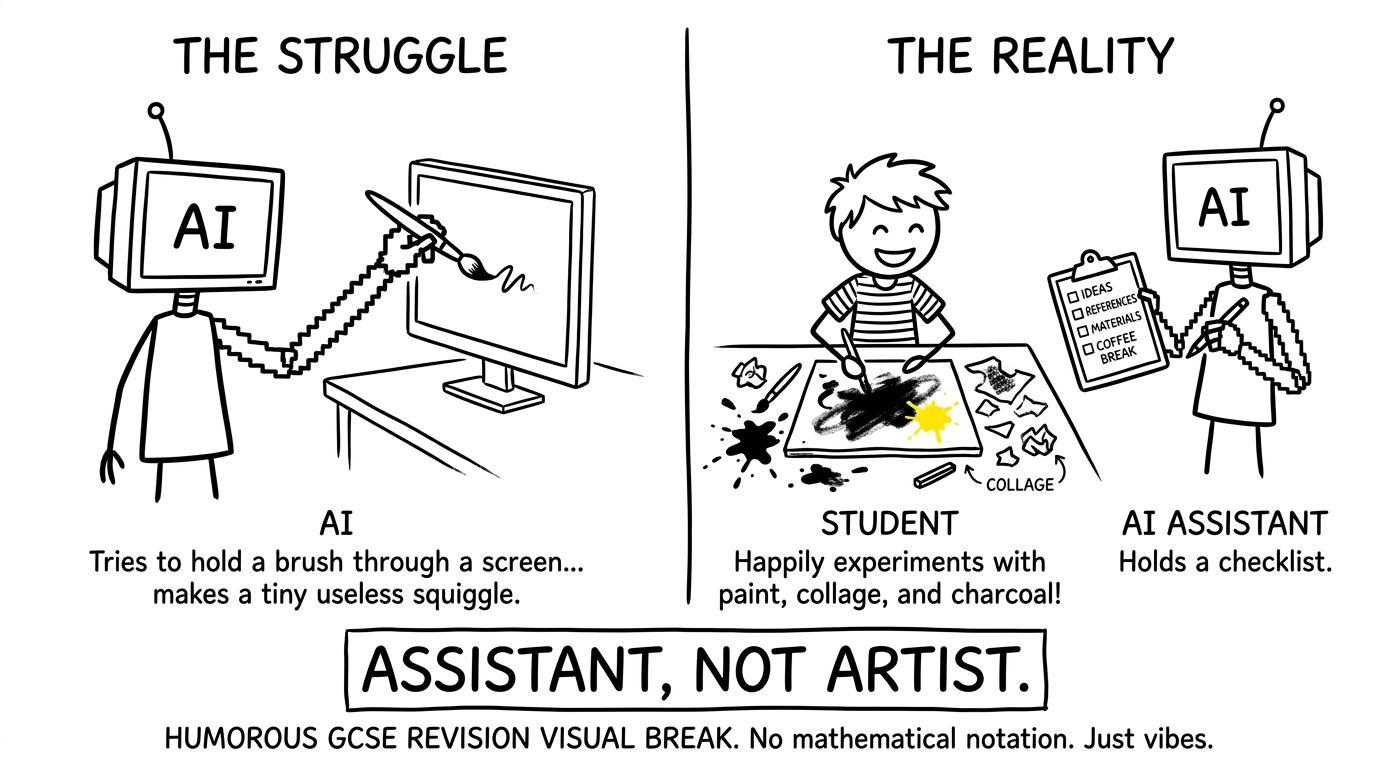 An AI robot holds the checklist while the student makes the artwork
A safe revision workflow for Art and maths
GCSE students rarely revise one subject in isolation. Art deadlines can expand quietly, while maths practice is postponed because it feels easier to restart tomorrow.
Use separate loops for separate purposes.
The Art loop
- Read one assessment objective.
- Find evidence of it in your sketchbook.
- Identify a genuine gap using teacher feedback.
- Complete your own observation, experiment or reflection.
- Record what you changed and why.
- Ask your teacher whether the evidence is relevant and sufficient.
AI may quiz, organise or ask reflective questions around this loop. It should not complete the evidence.
The maths loop
- Choose one weak topic from the GCSE maths revision hub.
- Use a revision lesson or video solution to rebuild the method.
- Complete practice questions without AI assistance.
- Mark them and record the precise error.
- Re-test with a mini test or paper section.
Maths requires independent performance too. A chatbot showing a solution can create the feeling of understanding without the ability to reproduce the method. MathsGenie's Edexcel GCSE mini tests give you a short, measurable check.
For full-paper practice, choose resources that match your board and tier. MathsGenie provides dedicated Edexcel GCSE Maths past papers, AQA GCSE Maths past papers and an OCR GCSE Maths revision hub. Nearer the examinations, use GCSE predicted papers to practise unfamiliar questions under realistic conditions.
Common mistakes when using AI for GCSE Art
Assuming acknowledged AI always earns marks
Acknowledgement is necessary where permitted AI-generated material is used, but it does not make the output your own achievement. Marks must reflect the skills and understanding you demonstrate independently.
Hiding AI use because it was “only inspiration”
If generated content influenced assessed development, hiding it makes authentication harder. Show your teacher the prompt, output and the exact way it affected your decisions.
Rewriting generated text to disguise its origin
Paraphrasing does not transform AI analysis into independent analysis. Read reliable sources, close them, inspect the artwork and write what you genuinely understand.
Replacing experimentation with instant variations
Rapid image generation can produce many compositions without teaching you what happens when materials resist, colours mix unexpectedly or a process fails. Physical and digital experimentation carried out by you is part of the assessed journey.
Letting Art revision erase maths revision
Portfolio pressure can make every free evening feel like an Art evening. Keep maths active with small, repeatable sessions. The one-month GCSE maths revision plan provides a manageable structure using topic practice, marking and timed papers.
Use AI to create questions, not your qualification
The best use of AI in GCSE Art and Design is modest. It can organise a session, test terminology, suggest research routes and ask questions that sharpen reflection. It becomes dangerous when it supplies the artwork, analysis, evaluation or personal decisions being assessed.
Keep the boundary clear: AI can hold the checklist; you must make the work.
Then give maths the same honesty. Start at the free MathsGenie GCSE revision area, choose your board and tier, and combine revision lessons with practice questions, mini tests, past papers, mark schemes and video solutions. Add predicted papers when the exams approach. The aim is not to make revision look effortless; it is to ensure that the knowledge and skill visible on the final day are genuinely yours.










