A Level Philosophy Tutor Cost: Is It Worth It?
A level philosophy tutor cost typically ranges from £25 to £60 an hour. Compare tutor types, benefits, hidden fees and effective free alternatives.
A difficult philosophy essay can create a strangely personal kind of doubt. You may understand the argument in class, yet find that the same ideas become slippery when you try to evaluate them under timed conditions. At that point, private tuition can look like the obvious answer.
The short answer is that a level philosophy tutor cost commonly falls between approximately £25£25£25 and £60£60£60 per hour in the UK. Experienced teachers, exam specialists and premium agencies may charge £60£60£60 to £100£100£100 or more. However, not every student needs weekly tuition. A focused block of lessons, support from school and disciplined independent revision may solve the problem for much less.
This guide explains what affects the price, when tutoring offers genuine value and which alternatives to try before committing.
A quick tutor decision checklist
Before comparing profiles, ask:
- Is the problem missing knowledge, weak essay structure or limited exam practice?
- Does the tutor know the exact specification being followed?
- Will lessons include feedback on the student's own writing?
- Is there a clear objective for each session?
- Could the same need be met through a teacher, peer group or structured self-study?
- Are the fees, cancellation policy and safeguarding arrangements clear?
- Will progress be reviewed after a short trial period?
The key question is not simply, "Can we afford tutoring?" It is, "What precise job are we paying the tutor to do?"
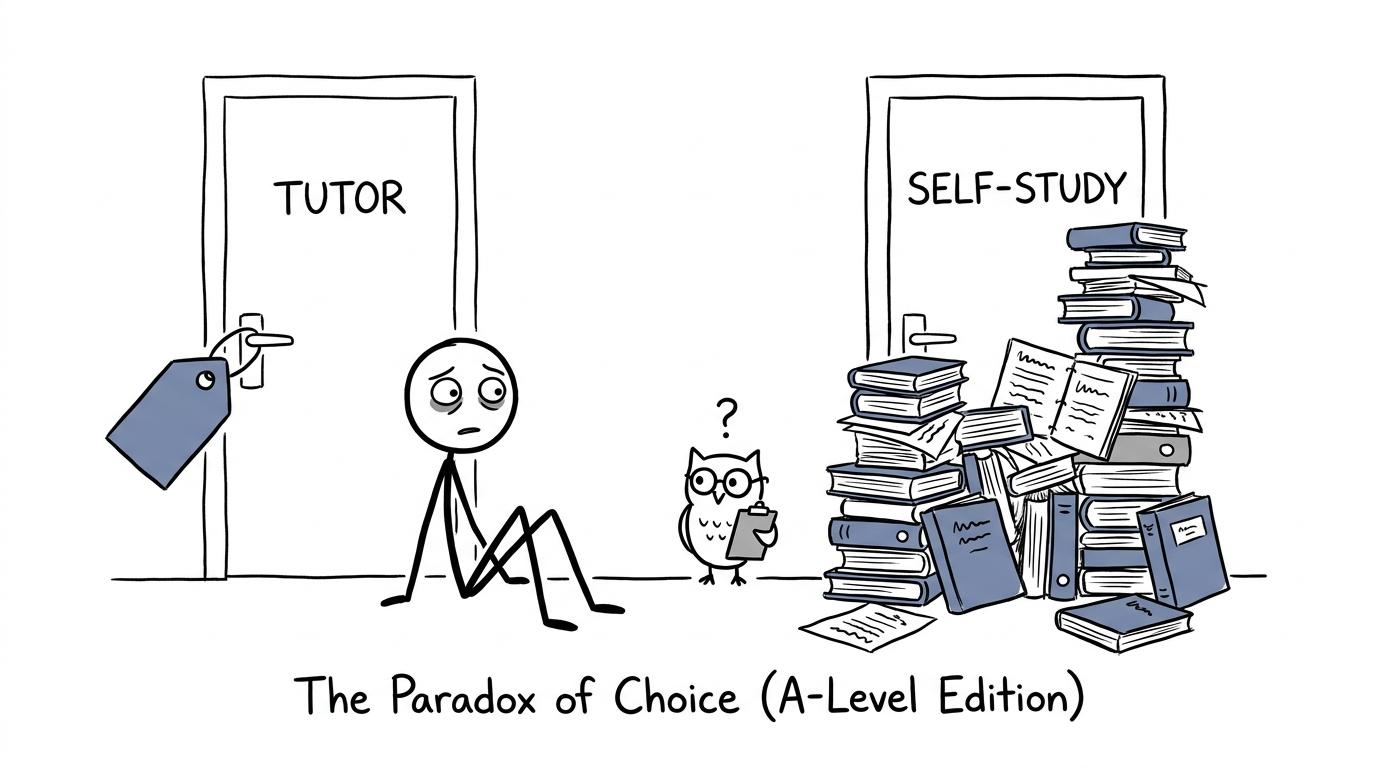 A student choosing between tutoring and self-study while an owl looks uncertain
How much does an A Level philosophy tutor cost?
There is no national tariff for private tuition. Rates vary by experience, location, lesson format, agency fees and the amount of preparation or marking included.
Recent UK marketplace listings suggest that many A Level tutors charge roughly £25£25£25 to £60£60£60 per hour. Current platform averages for online A Level tuition sit around the low £40£40£40s, while advertised philosophy rates range from budget student tutors to specialists charging well above £60£60£60.
These figures are a snapshot rather than a guaranteed price. Always compare the actual service offered.
| Tuition option | Indicative hourly cost | Approximate cost for four sessions | Best suited to |
|---|---|---|---|
| University student or newer tutor | £20£20£20, £30£30£30 | £80£80£80, £120£120£120 | Discussion, accountability and basic topic support |
| Established online A Level tutor | £30£30£30, £50£50£50 | £120£120£120, £200£200£200 | Regular specification-led support and essay feedback |
| Experienced teacher or examiner-style specialist | £45£45£45, £75£75£75 | £180£180£180, £300£300£300 | Detailed assessment guidance and targeted intervention |
| Premium agency or highly specialised tutor | £75£75£75, £100+£100+£100+ | £300£300£300, £400+£400+£400+ | Intensive support where expertise and availability justify the premium |
| Small-group tuition | £10£10£10, £30£30£30 per student | £40£40£40, £120£120£120 | Students comfortable sharing lesson time |
| School and independent revision | Often free | Often £0£0£0 | Motivated students with access to reliable feedback |
For weekly tuition over a 121212-week term, a tutor charging £40£40£40 per lesson would cost:
12×£40=£48012 \times £40 = £48012×£40=£480That total matters more than the hourly rate. Also ask whether the tutor charges separately for marked essays, trial lessons, travel, resources or late cancellations.
Online versus face-to-face tuition
Online tutoring is often cheaper because there is no travel time or venue cost. It also widens the pool of philosophy specialists available, which can be useful for a comparatively specialised A Level subject.
Face-to-face tuition may suit students who concentrate better away from screens. The value depends less on the format than on whether the student talks, writes and receives specific feedback. A polished lecture delivered through a webcam is still only a lecture.
Why specialist tutors charge more
A stronger tutor may bring:
- secure knowledge of the student's current specification;
- experience identifying gaps in philosophical reasoning;
- accurate feedback on analysis and evaluation;
- carefully selected essay questions;
- lesson preparation and marking outside the paid hour;
- an understanding of how arguments should be reconstructed and challenged.
Higher cost does not automatically mean higher quality. It becomes worthwhile only when the extra expertise matches the student's actual difficulty.
What should an A Level philosophy tutor help with?
For AQA A Level Philosophy, the current specification covers epistemology, moral philosophy, the metaphysics of God and the metaphysics of mind. Assessment consists of two written papers, each lasting three hours and worth 100100100 marks. Each paper contributes 50%50\%50% of the qualification.
The official assessment weighting is approximately 60%60\%60% for knowledge and understanding and 40%40\%40% for analysis and evaluation. That distinction is important. A student may know what Descartes, Aristotle or Hume argued but still struggle to form a reasoned judgement.
A useful tutor should therefore do more than explain content. Lessons might focus on:
- defining technical terms precisely;
- reconstructing an argument in a valid and charitable form;
- separating an objection from a response;
- comparing the strength of competing claims;
- planning essays under time pressure;
- improving paragraphs using specific feedback;
- interpreting question wording and mark schemes.
A tutor should not write assessed work for the student or provide memorised essays to reproduce blindly. Philosophy rewards disciplined thinking. The student's judgement must remain their own.
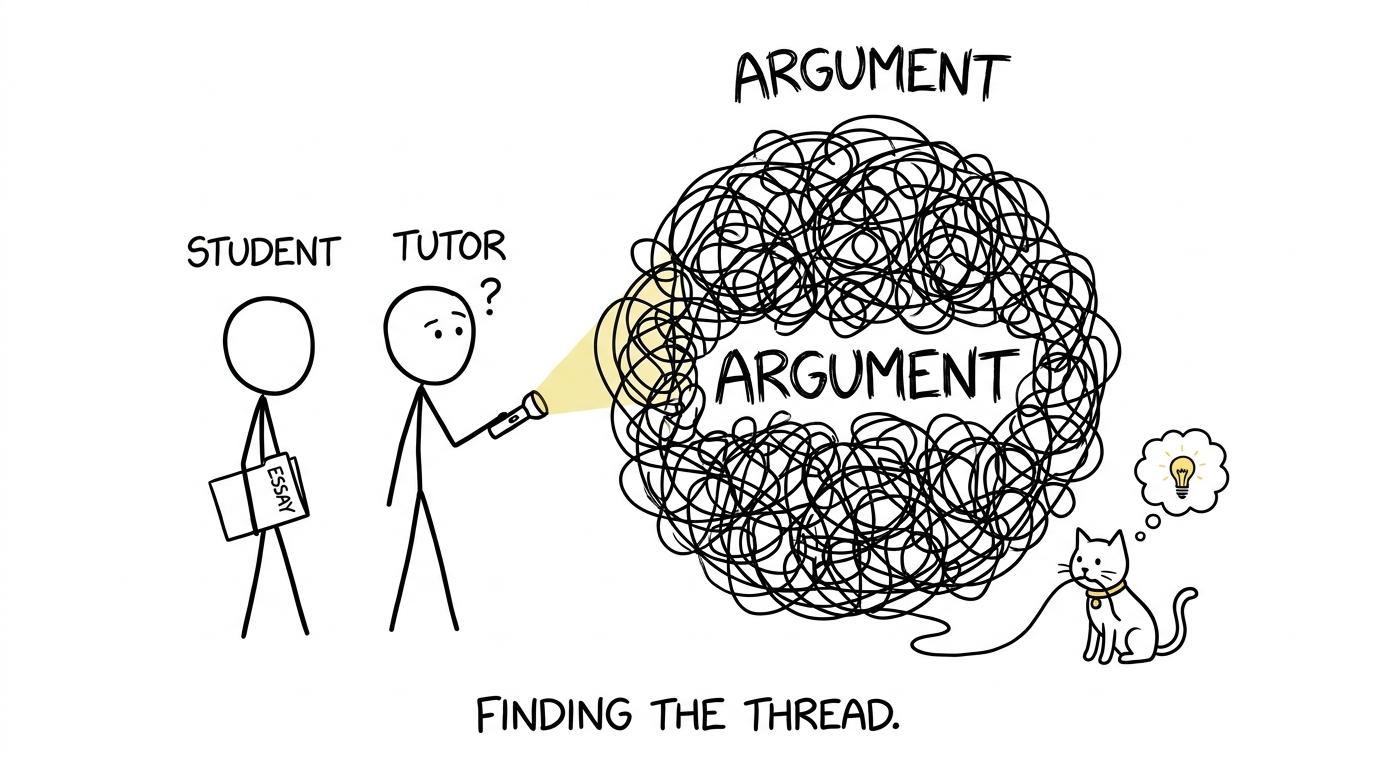 A philosophy tutor and student untangling a giant ball of argument while a cat finds the loose end
When is private tuition worth the cost?
Tutoring is most defensible when the need is narrow, important and difficult to solve elsewhere.
The student repeatedly receives the same feedback
Comments such as "too descriptive", "assertion rather than evaluation" or "not focused on the question" indicate a recurring skill problem. A tutor can watch how the student plans and writes, then intervene at the point where the reasoning becomes unclear.
School support has been disrupted
Teacher absence, a late course change or missed lessons can leave identifiable specification gaps. Short-term tuition may help rebuild those areas without turning tutoring into a permanent commitment.
The student needs responsive essay feedback
Reading more notes does not necessarily improve writing. If the main difficulty is constructing a sustained judgement, individual feedback can be more useful than another hour of content review.
A specific exam period is approaching
A short block before mocks or final examinations can help with timing and prioritisation. Agree a fixed number of sessions and review the evidence afterwards: essay quality, teacher feedback and performance on fresh questions.
The same principle works in maths. Students improve when they diagnose a gap, practise it and test it again. MathsGenie's guide to building a GCSE maths revision timetable explains how to organise that cycle across a busy week.
When a tutor may not be necessary
A tutor is unlikely to solve a problem caused mainly by inconsistent work. If essays are not being completed, notes are disorganised or feedback is being ignored, adding another appointment may simply add cost.
Try lower-cost support first when:
- the teacher offers useful clinics or written feedback;
- the student understands corrections but needs to practise applying them;
- the difficulty is general time management across several A Levels;
- reliable notes, past questions and mark schemes are already available;
- anxiety is the central issue and educational support alone may not address it.
Start with a two-week diagnostic period. Complete one timed essay or substantial plan, obtain feedback, revise the weak area and answer a fresh question. If the same obstacle remains, tutoring has a clearer purpose.
For managing several subjects, the free MathsGenie revision planner can build a day-by-day schedule around subjects, exam dates and available time. Philosophy should sit within the whole revision plan, not consume every evening because one essay went badly.
Effective alternatives to weekly tutoring
Use teachers and school support deliberately
Instead of asking, "How can I improve?", take one paragraph and ask a focused question: "Where does this stop being analysis and become assertion?" Precise questions make feedback easier to act upon.
Create a small philosophy discussion group
Take turns presenting arguments, objections and replies. The group should demand reasons rather than reward confident speaking. Keep sessions attached to the specification and finish by writing individual essay plans.
Use past questions and mark schemes
Plan from memory, write under timed conditions and compare the response with the assessment criteria. Record one knowledge omission and one reasoning weakness. Then answer a different question so improvement has to transfer.
This learn-practise-mark-repair loop is central to MathsGenie. Students taking A Level Maths alongside philosophy can use the A Level Maths revision hub for lessons and topic questions, then move into Edexcel A Level Maths past papers with mark schemes and solutions.
Book occasional feedback rather than weekly lessons
One lesson every few weeks may be enough if the student arrives with completed work and precise questions. A tutor can diagnose patterns, set a next step and allow independent practice between appointments.
Protect revision in other subjects
Philosophy's long essays can expand to fill every available hour. Students still need active practice elsewhere. MathsGenie's GCSE mini tests offer manageable timed practice, while GCSE predicted papers and Edexcel GCSE past papers help students move towards full exam conditions. The qualification level should always match the student taking it.
How to choose a philosophy tutor
A trial lesson should test fit, not merely friendliness. Ask the tutor to explain how they would diagnose an essay and measure progress.
Check:
- familiarity with the exact exam board and specification;
- relevant teaching, academic or tutoring experience;
- whether marking is included in the fee;
- how lesson objectives will be agreed;
- cancellation, payment and communication policies;
- references, identity, qualifications and appropriate safeguarding checks;
- arrangements for supervision and online communication where the student is under 181818.
Private tutors are not automatically qualified teachers. Parents should take reasonable steps to verify suitability, remain involved in arrangements and make sure lessons take place in an appropriate, observable environment. If using an agency, ask what checks it conducts rather than assuming every platform follows the same process.
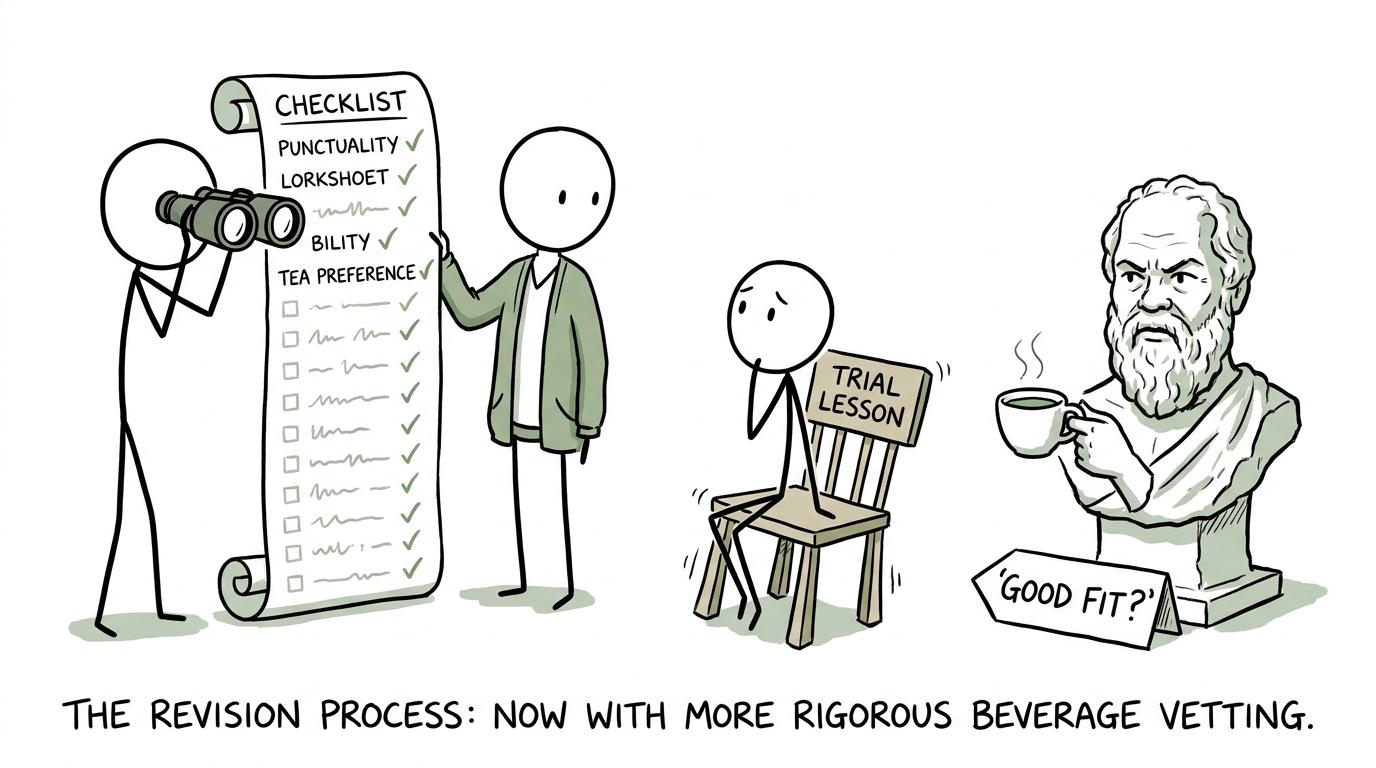 A parent inspecting a tutor checklist while a student tries the trial-lesson chair
Common mistakes when paying for tuition
Choosing by price alone
The cheapest tutor may lack specification knowledge. The most expensive may offer expertise the student does not need. Compare relevance, preparation and feedback rather than treating price as proof.
Starting without a defined outcome
"Get better at philosophy" is not measurable. "Write focused evaluations that respond directly to the question" gives the tutor and student something concrete to review.
Paying for passive explanation
The student should spend part of the lesson retrieving, planning, explaining or writing. Comfortable listening can feel productive without revealing whether anything can be done independently.
Continuing indefinitely
Set a review point after perhaps three or four sessions. Look at new work, not the student's memory of the lesson. If the intervention is working, the student should gradually need less prompting.
Neglecting the wider revision plan
A strong philosophy grade should not be purchased with weaker preparation elsewhere. The GCSE one-month revision plan shows how diagnosis, timed practice and repeated review can create a balanced routine.
Make the decision around the problem
A tutor can be valuable, but tuition is a tool rather than a verdict on the student. Begin by naming the obstacle. Estimate the full cost. Test lower-cost support. If you hire someone, choose a tutor who makes the student think more clearly and independently, then review progress after a defined period.
For maths revision alongside A Level Philosophy, make MathsGenie your free starting point. Use revision lessons and practice questions to repair weak topics, mini tests to check fluency, and past papers, predicted papers, mark schemes and video solutions to prepare for the examination. Build those tasks into the revision planner, and let paid tuition remain what it should be: targeted support where it adds genuine value.