The phase velocity v v\,v of electromagnetic signals in a high-frequency coaxial transmission line is given by the relation:
v=1L′C′ v = \frac{1}{\sqrt{L' C'}} v=L′C′1where L′ L'\,L′ is the inductance per unit length and C′ C'\,C′ is the capacitance per unit length of the line.
Calculate the theoretical propagation speed of the signals in the transmission line to four significant figures.
Use the values:
- Inductance per unit length, L′=2.65×10⁻⁷ H m−1L' = 2.65 \times 10^{-7}\,\text{H m}^{-1}L′=2.65×10⁻⁷H m−1
- Capacitance per unit length, C′=8.24×10⁻¹¹ F m−1C' = 8.24 \times 10^{-11}\,\text{F m}^{-1}C′=8.24×10⁻¹¹F m−1
In an experiment to verify this theoretical speed, standing waves of voltage are set up inside a coaxial cable of total length 0.85 m. The cable is connected to a signal generator operating at a frequency of 500 MHz at one end, and is short-circuited at the other end to create a reflecting boundary.
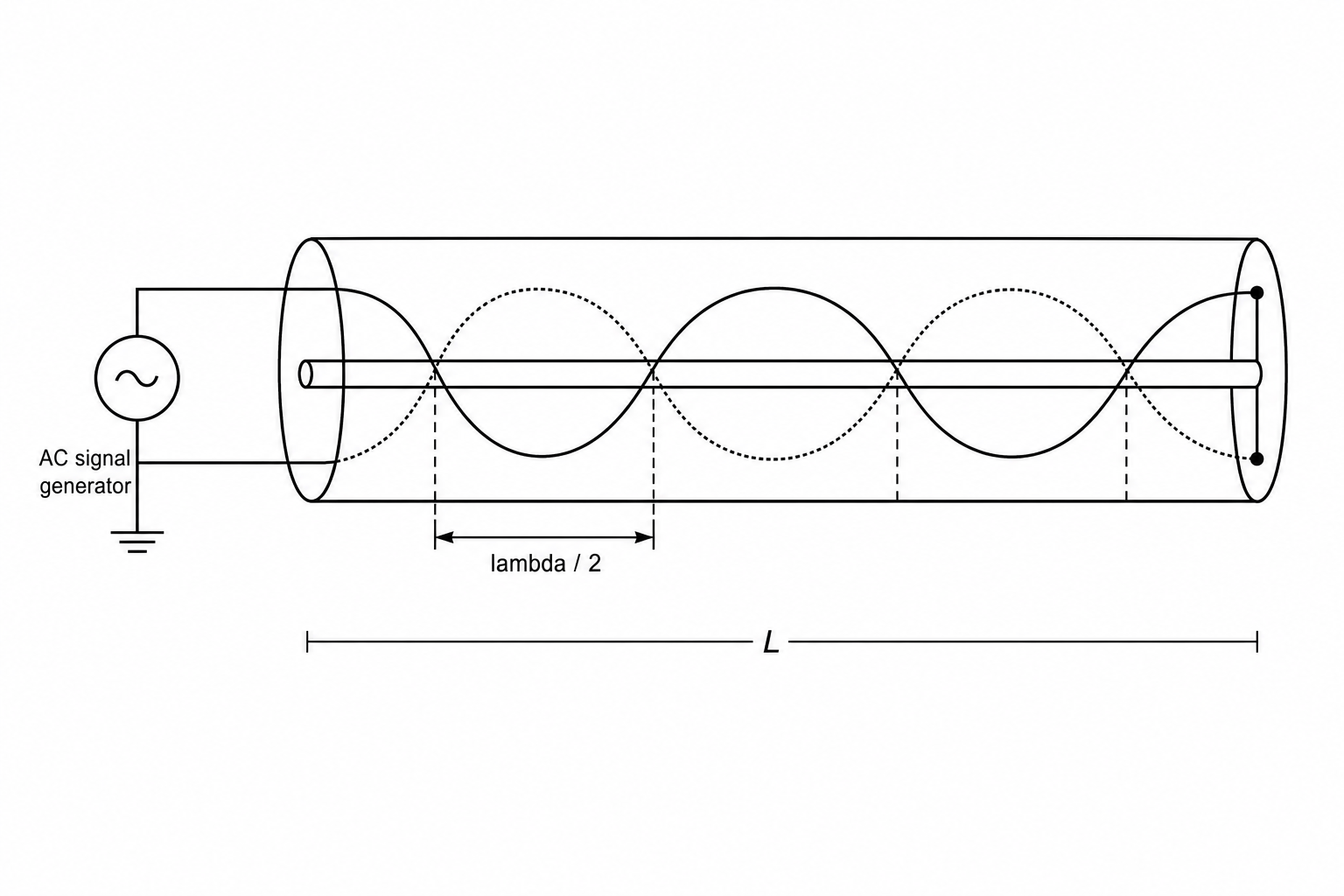
Deduce whether this experimental arrangement is suitable for determining the propagation speed of the signals by measuring the positions of voltage nodes and antinodes. Support your answer with a calculation of the distance between adjacent nodes.