An acoustic test rig is used to calibrate and monitor the fundamental vibrational harmonics of a titanium alloy wire under tension. The wire is clamped at one end and passes over a fixed knife-edge bridge at a distance LLL from the clamp, before being tensioned by a winch.
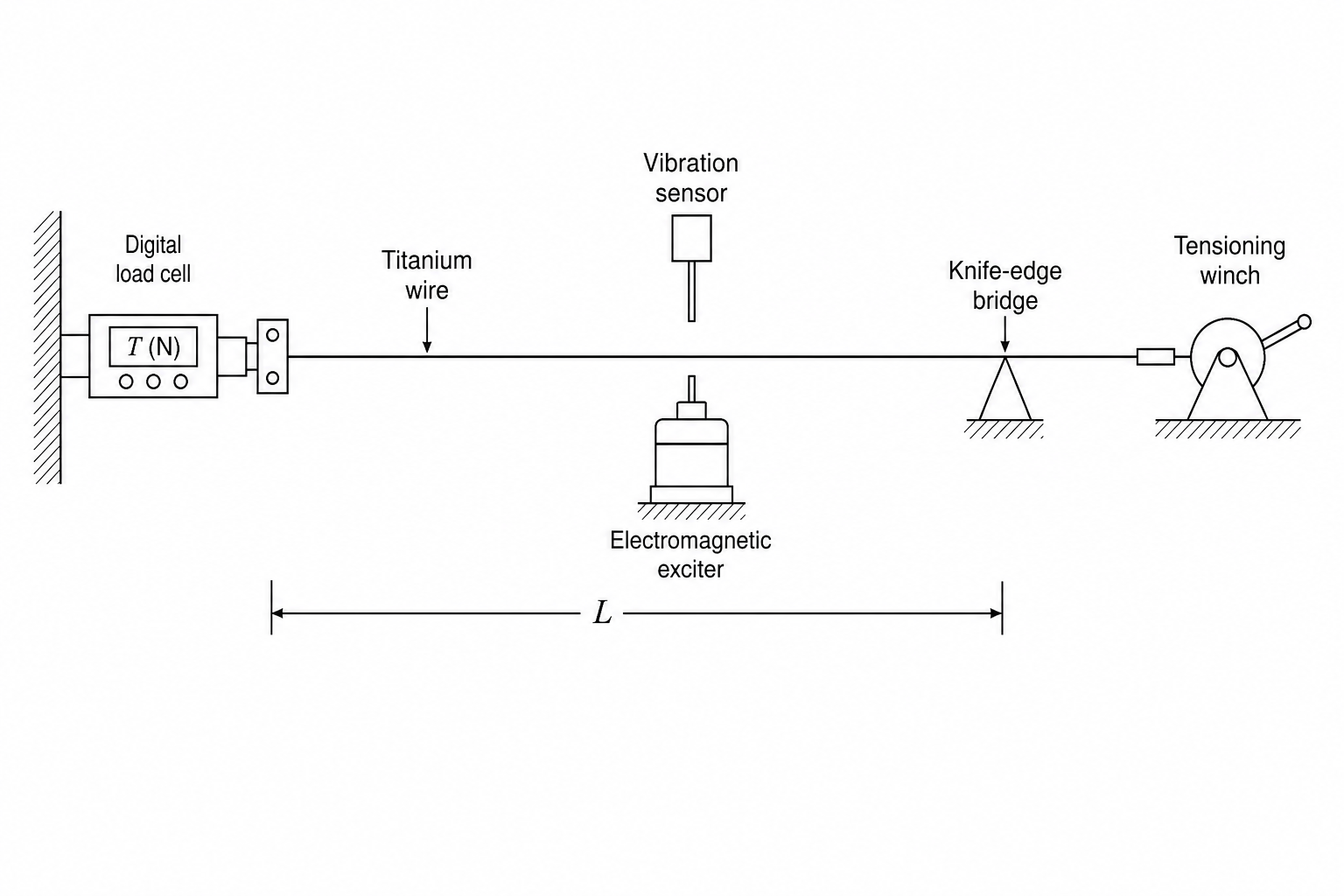
An electromagnetic exciter and a vibration sensor are used to measure the fundamental frequency fff of the wire under different tensions TTT. Table 1 shows the recorded values.
Table 1
| T/NT / \text{N}T/N | f/Hzf / \text{Hz}f/Hz |
|---|---|
| 36.0 | 150 |
| 64.0 | 200 |
| 100.0 | 250 |
Show that the data are consistent with the relationship f∝Tf \propto \sqrt{T}f∝T.
The titanium alloy wire has a density of 4500 kg m−34500 \text{ kg m}^{-3}4500 kg m−3 and a uniform diameter of 5.0×10⁻⁴ m5.0 \times 10^{-4} \text{ m}5.0×10⁻⁴ m. Determine the length LLL of the wire.
At much higher tensions, the wire begins to stretch significantly, reducing its diameter. Assuming the distance LLL between the clamp and the bridge remains fixed, explain how the measured fundamental frequency would differ from the frequency predicted by the relationship in part 1.