An experiment is carried out to investigate stationary waves on a taut steel wire of length 1.50 m1.50\text{ m}1.50 m. The wire is fixed at both ends and excited electromagnetically at a frequency of 120 Hz120\text{ Hz}120 Hz.
Figure 1 shows the variation of displacement with distance from the left end of the wire at time t=0t = 0t=0. At this instant, all points on the wire have achieved their maximum displacement. QQQ is a specific point on the wire.
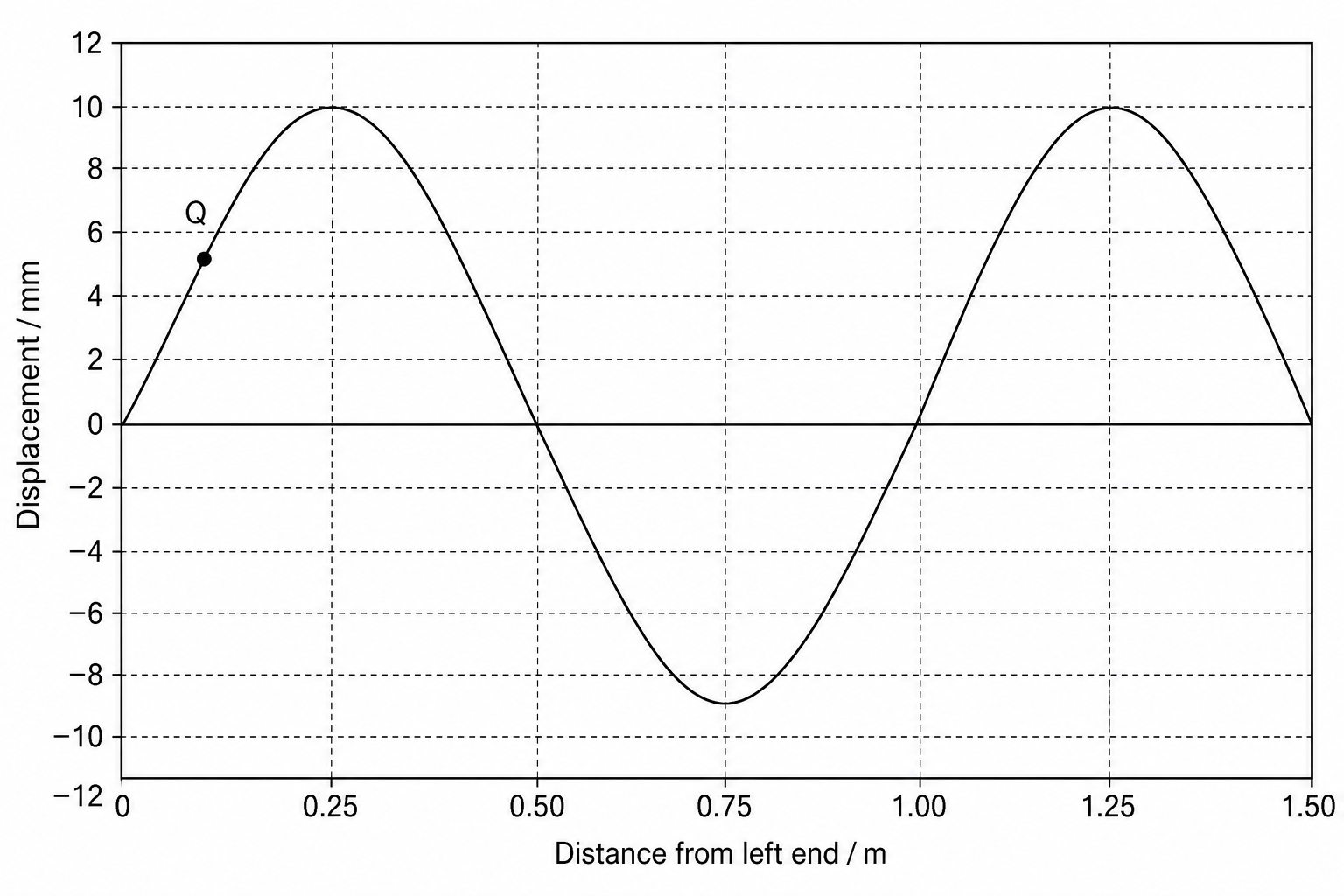
The stationary wave is formed by the superposition of two progressive waves travelling in opposite directions along the wire.
Deduce the amplitude of one of these progressive waves.
Determine the speed, in m s−1\text{m s}^{-1}m s−1, of the progressive waves.
State the phase relationship between the two progressive waves at t=0t = 0t=0.
For point QQQ on the wire:
- Calculate its oscillation period.
- State its amplitude of oscillation.
- Describe its displacement-time behavior starting from t=0t = 0t=0.