Figure 1 shows a vertical sonometer experiment used to investigate the harmonics of a vibrating nylon wire. The wire, of fixed vibrating length LLL, is secured at a rigid support and passes vertically over a bridge. The tension is varied by suspending a mass mmm from the free end of the wire. The fundamental frequency fff is measured for various suspended masses.
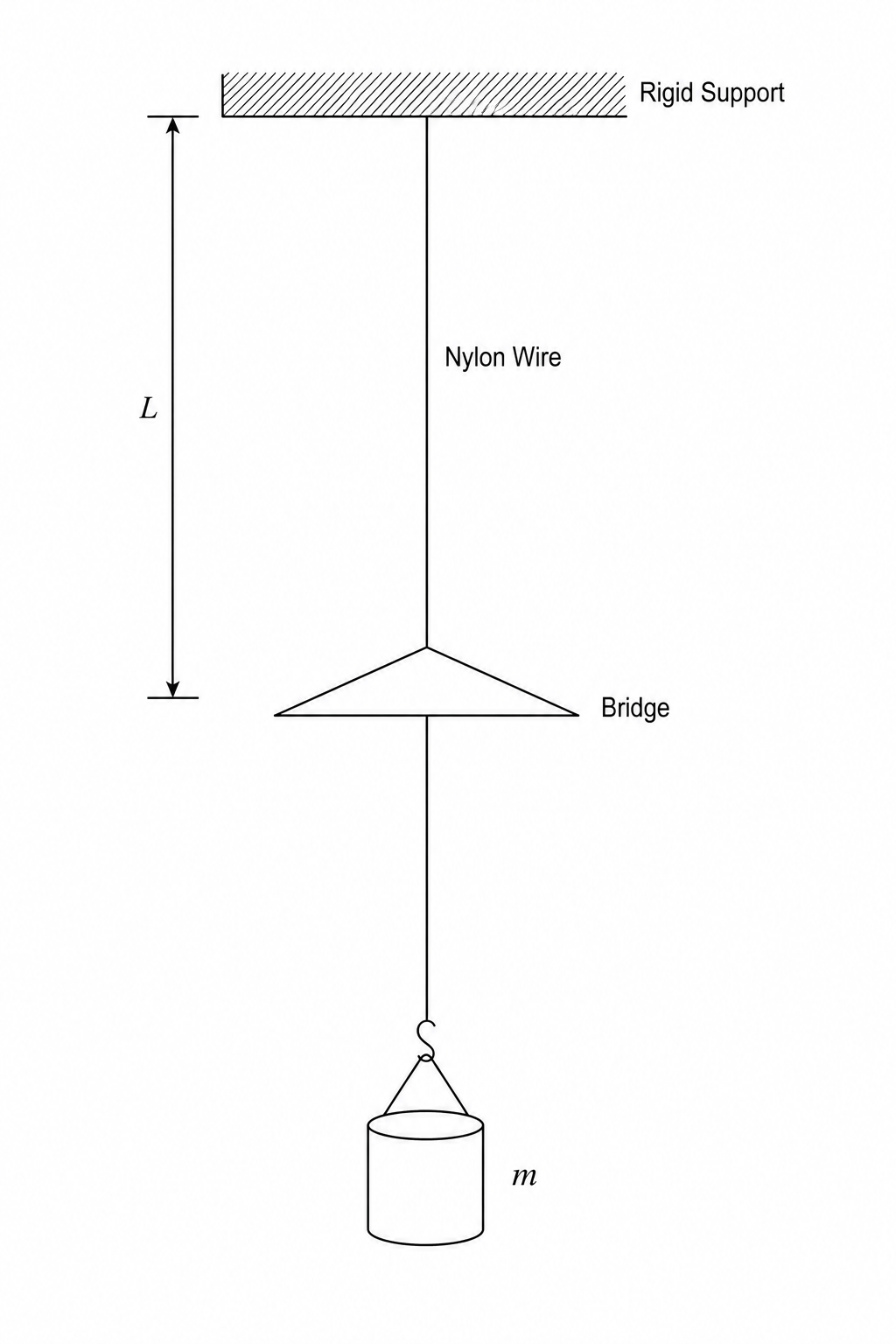
Table 1 shows the experimental data.
Table 1
| mmm / kg | fff / Hz |
|---|---|
| 0.36 | 150 |
| 0.64 | 200 |
| 1.00 | 250 |
Show that the data are consistent with the relationship f∝Tf \propto \sqrt{T}f∝T, where TTT is the tension.
The nylon wire has a density of 1150 kg m−3^{-3}−3 and a uniform diameter of 6.0×10−46.0 \times 10^{-4}6.0×10⁻⁴ m. Determine the vibrating length LLL of the wire.
At much higher tensions, the nylon wire begins to stretch significantly, reducing its cross-sectional area. Explain how the measured fundamental frequency would differ from the frequency predicted by the relationship in part (a).