Question 15
In this question use g=9.8g = 9.8g=9.8 m s−2^{-2}−2.
Two heavy boxes, M M\,M and NNN, are connected securely by a length of rope.
The mass of M M\,M is 40 kilograms and the mass of N N\,N is 60 kilograms.
M M\,M is placed near the bottom of a rough slope inclined at 30° 30°\,30° above the horizontal. The rope passes over a smooth pulley at the top of the slope so that N N\,N hangs with the rope vertical. The boxes are held with the rope taut and running parallel to a line of greatest slope.
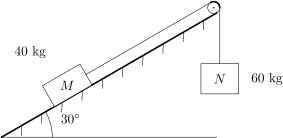
When the boxes are released, M M\,M moves up the slope as N N\,N descends, with acceleration a a\,a m s−2^{-2}−2. The tension in the rope is T T\,T newtons.
a.[1]
Explain why the equation of motion for N N\,N is 60g−T=60a60g - T = 60a60g−T=60a.
b.[2]
Show that the normal reaction force between M M\,M and the slope is 203g 20\sqrt{3}g\,203g newtons.
c.[5]
The coefficient of friction, μ\muμ, between the slope and M M\,M is such that 0≤μ≤10 \le \mu \le 10≤μ≤1. Show that a≥(2−3)g5\displaystyle a \ge \frac{(2 - \sqrt{3})g}{5}a≥5(2−3)g.
d.[1]
State one modelling assumption you have made throughout this question.
3.3 R: Forces and Newton's laws Questions
139 exam-style questions on AQA A Level Maths 3.3 R: Forces and Newton's laws, covering 3.3.1 Concept of a force and Newton's first law, 3.3.2 Newton's second law, 3.3.3 Weight and motion under gravity, 3.3.4 Newton's third law and equilibrium, 3.3.5 Addition of forces and resultants (A-level only), and 3.3.6 Friction (A-level only). Each one has a worked solution and a mark scheme showing where the marks go.