This question is about reactions of alkanes and halogenoalkanes.
1.[1]
Alkanes can be used as fuels. Give an equation for the complete combustion of octane (C8H18\text{C}_8\text{H}_{18}C8H18) in an excess of oxygen.
2.[3]
Octane can be obtained from the catalytic cracking of pentadecane (C15H32\text{C}_{15}\text{H}_{32}C15H32) at a high temperature.
- Identify a suitable catalyst for this process.
- Give one condition other than high temperature.
- Give an equation for the catalytic cracking of one molecule of pentadecane to produce one molecule of octane, one molecule of cyclopentane, and one other product.
3.[2]
Alkanes can be used in free-radical substitution reactions to produce halogenoalkanes. Give equations for the propagation steps in the reaction of propane to form 2-bromopropane.
4.[4]
Chlorofluorocarbons (CFCs) are a group of halogenoalkanes whose use has been restricted due to their environmental impact. The structure of a CFC is shown below:
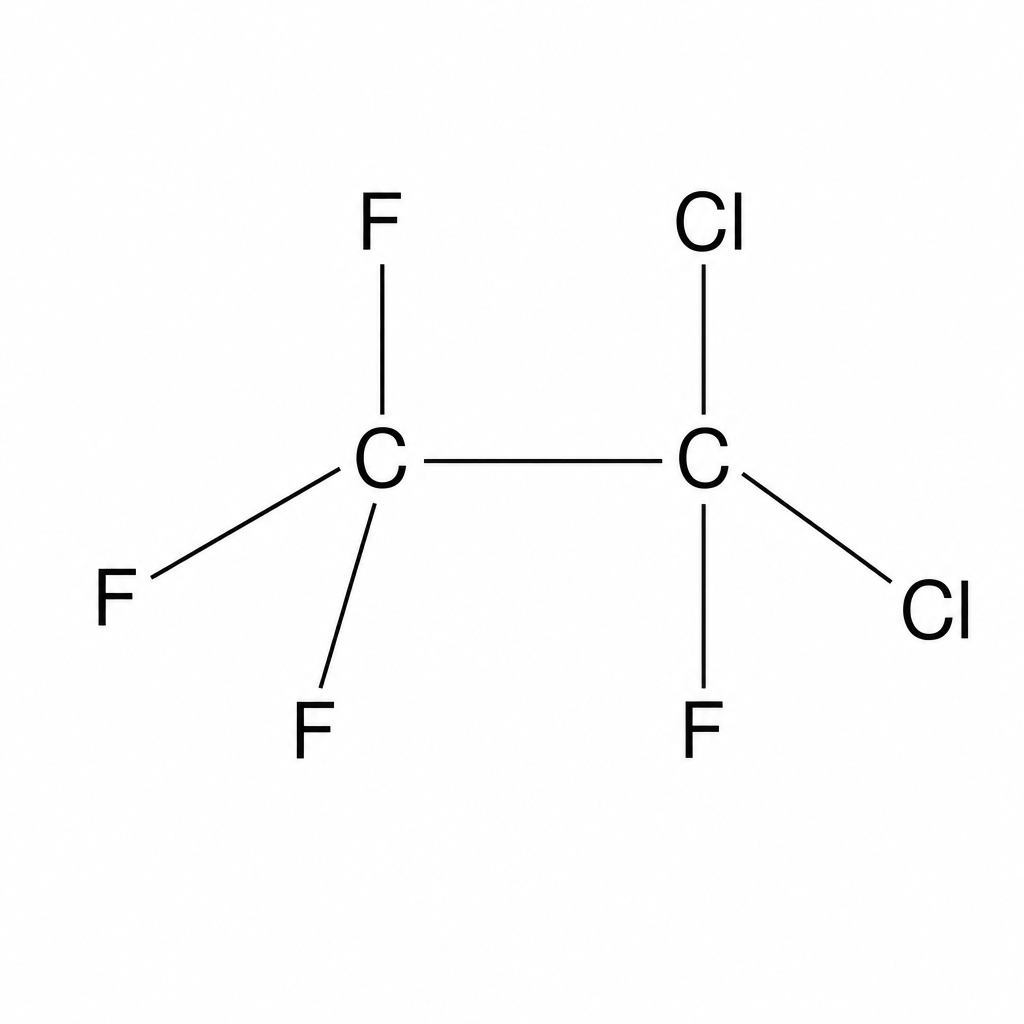
- Identify the radical produced from this CFC that is responsible for the depletion of ozone in the atmosphere.
- Explain, with the aid of equations, why a single radical can cause the decomposition of many molecules of ozone.