When 2-bromobutane is heated under reflux with potassium hydroxide in ethanol, it undergoes an E2 E2\,E2 elimination reaction to form but-2-ene, water, and bromide ions:
OH−+CH3−CH(Br)−CH2−CH3→H2O+CH3−CH=CH−CH3+Br− \text{OH}^- + \text{CH}_3-\text{CH}(\text{Br})-\text{CH}_2-\text{CH}_3 \rightarrow \text{H}_2\text{O} + \text{CH}_3-\text{CH}=\text{CH}-\text{CH}_3 + \text{Br}^- OH−+CH3−CH(Br)−CH2−CH3→H2O+CH3−CH=CH−CH3+Br−The diagram below shows four proposed curly arrows (A\text{A}A, B\text{B}B, C\text{C}C, and D\text{D}D) representing potential electron movements during this mechanism:
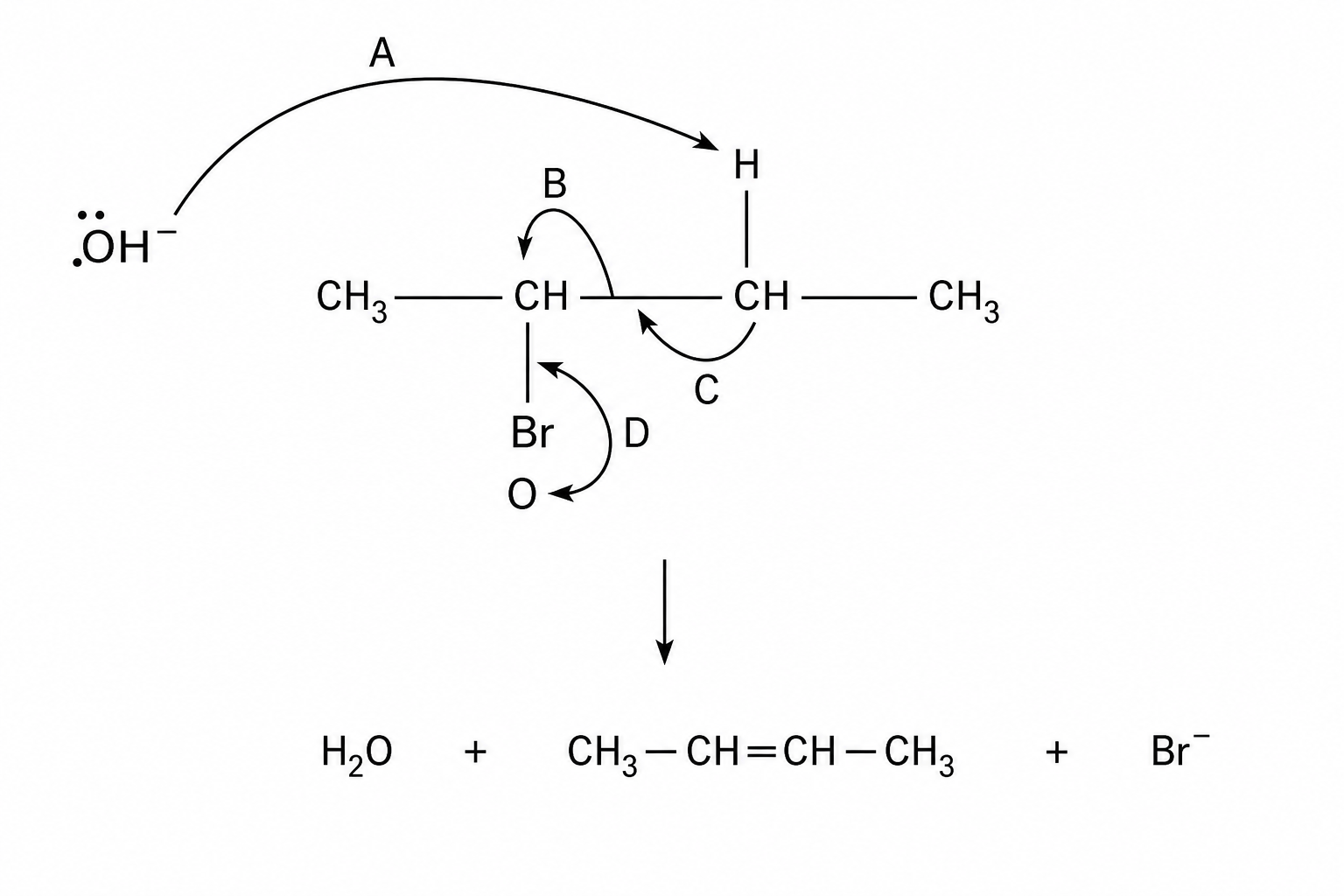
Which of these curly arrows does not appear in the correct E2 E2\,E2 mechanism of this reaction?
Arrow A\text{A}A
Arrow C\text{C}C
Arrow B\text{B}B
Arrow D\text{D}D