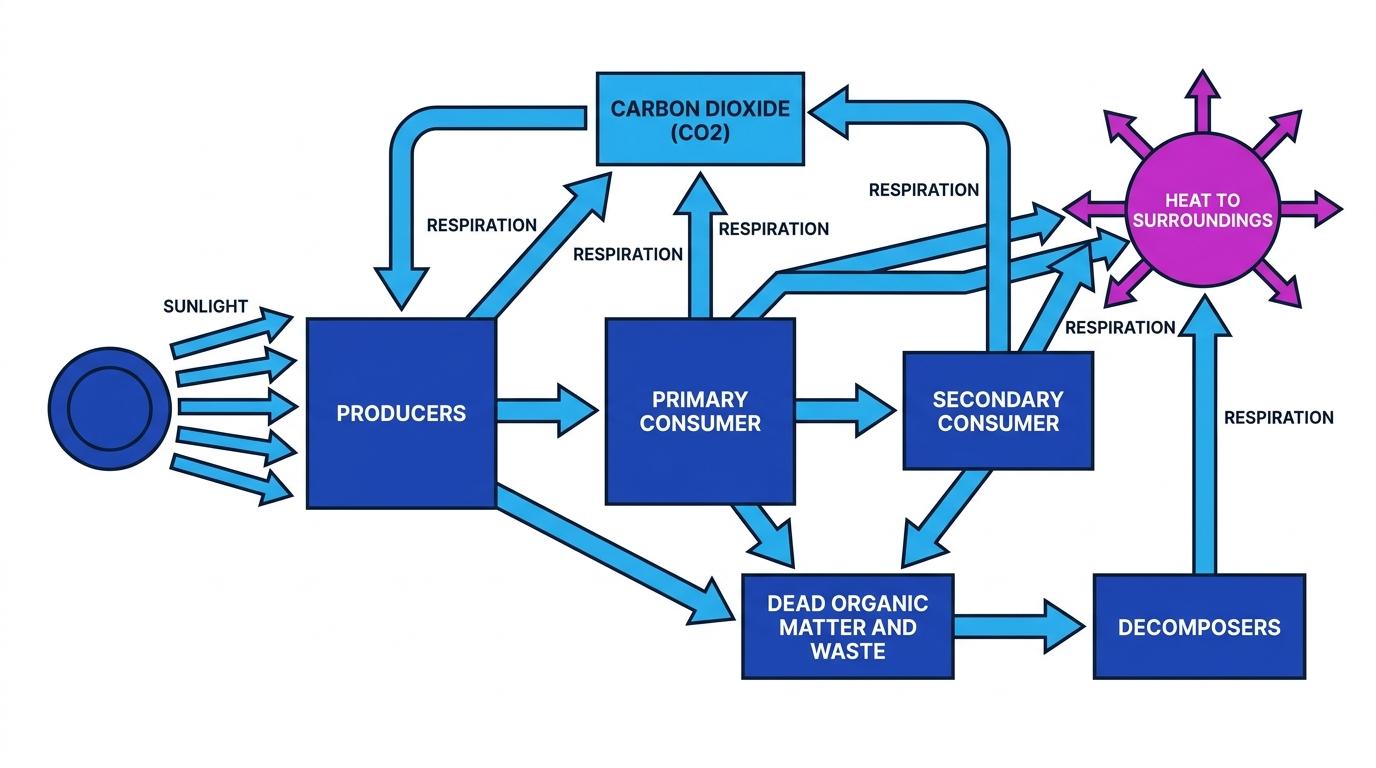
Welcome to the flow of energy through ecosystems! In this section, you will learn:
- How plants turn inorganic carbon into organic biomass, and how we measure its energy content.
- The difference between gross and net primary production in plants.
- How to calculate the net production of consumers (animals).
- How farming practices manipulate these energy transfers to increase yields.
Where Does the Energy Come From?
In any ecosystem, the ultimate source of energy is usually the sun. Plants (and some other photosynthetic organisms) act as producers. They synthesise organic compounds, such as glucose, from atmospheric or aquatic carbon dioxide.
Once a plant has made these sugars, it splits them into two main pathways:
- Respiratory substrates: Most of the sugars are broken down in respiration to release energy for the plant's immediate metabolic needs.
- Biological molecules: The rest of the sugars are used to synthesise other complex biological molecules like cellulose, proteins, and lipids.
These biological molecules form the physical "stuff" of the plant.
Biomass
Biomass is the total mass of living material in a specific area at a given time. It represents the chemical energy stored within an organism.
Measuring Biomass
Because biological samples contain highly variable amounts of water, simply weighing a fresh plant (its "fresh mass") isn't a reliable way to measure its energy content. Instead, biomass is usually measured in one of two ways:
- Mass of carbon per given area.
- Dry mass of tissue per given area.
To find the dry mass, a sample is dried in an oven set to a low temperature (around 100 ∘C100\text{ }^\circ\text{C}100 ∘C to evaporate the water without burning the tissue). The sample is weighed at regular intervals until the mass becomes constant. A constant mass proves that all the water has been driven off.
Using Calorimetry to Find Energy
Once you have dry biomass, you can estimate the chemical energy stored inside it using a technique called calorimetry.
The standard apparatus used is a bomb calorimeter. A known mass of the dry sample is placed in a sealed combustion chamber (the "bomb") and ignited electrically. The chamber is surrounded by a known volume of water. As the biomass burns, the chemical energy is released as heat, which transfers to the water.
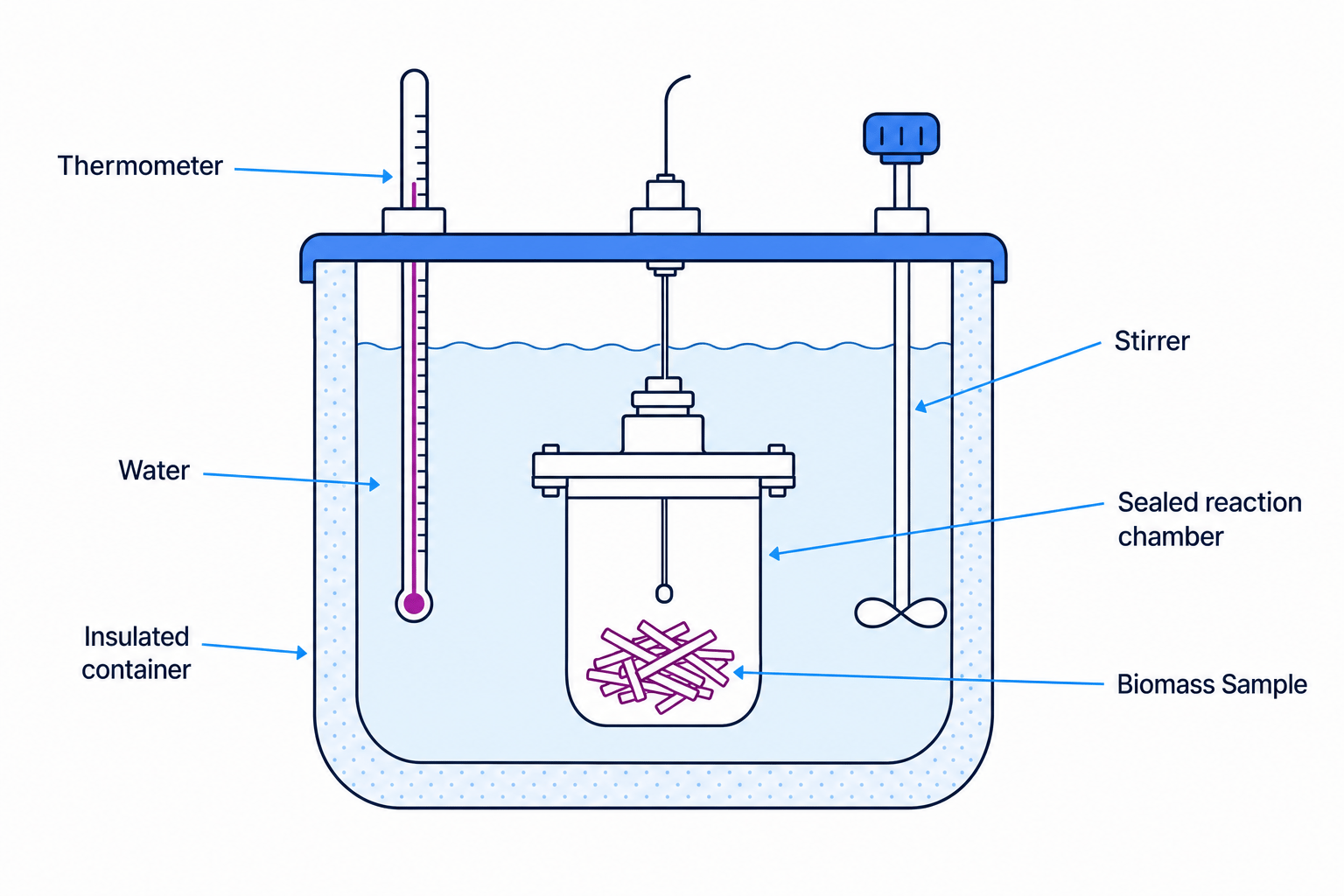
By measuring the temperature rise of the water, you can calculate the energy released from the biomass. The sealed chamber and the insulated outer container ensure that heat loss to the environment is minimised, making the estimate highly accurate.
Primary Production: Energy in Plants
When we talk about the energy plants capture, we use specific terms to separate the total energy they trap from the energy they actually keep.
- Gross primary production (GPPGPPGPP): This is the total chemical energy store in plant biomass, in a given area or volume, over a given time. It represents all the chemical energy the plant successfully captured from photosynthesis.
- Respiratory losses (RRR): The plant must use some of this energy to stay alive, so a portion is lost to the environment as heat during respiration.
- Net primary production (NPPNPPNPP): This is the chemical energy store left over in the plant biomass after respiratory losses have been taken into account.
Gross vs Net
Think of Gross Primary Production (GPPGPPGPP) like a gross salary — it's the total amount of money you earn. Respiratory losses (RRR) are like the taxes you pay. Net Primary Production (NPPNPPNPP) is your net salary — the actual take-home pay you get to keep and spend.
The relationship is written as:
NPP=GPP−R NPP = GPP - R NPP=GPP−RThe NPPNPPNPP is incredibly important because it is the energy available for the plant's own growth and reproduction. More importantly for the ecosystem, it is the energy available to organisms in the next trophic level — such as the herbivores that eat the plants, or the decomposers that break them down.
Calculating NPP and energy efficiency
A field of wheat captures a Gross Primary Production (GPPGPPGPP) of 24 500 kJ m−2 year−124\,500 \text{ kJ m}^{-2} \text{ year}^{-1}24500 kJ m−2 year−1. The wheat loses 11 200 kJ m−2 year−111\,200 \text{ kJ m}^{-2} \text{ year}^{-1}11200 kJ m−2 year−1 as heat from respiration. Calculate the Net Primary Production (NPPNPPNPP) and determine what percentage of the GPPGPPGPP is successfully converted into NPPNPPNPP.
- State the formula relating the variables:
- Substitute the given values to find NPPNPPNPP:
- Set up the percentage efficiency calculation (part over whole, multiplied by 100):
- Substitute the values and evaluate:
Secondary Production: Energy in Consumers
When a consumer (an animal) eats a plant, it does not absorb all the NPPNPPNPP. Animals are not perfectly efficient machines.
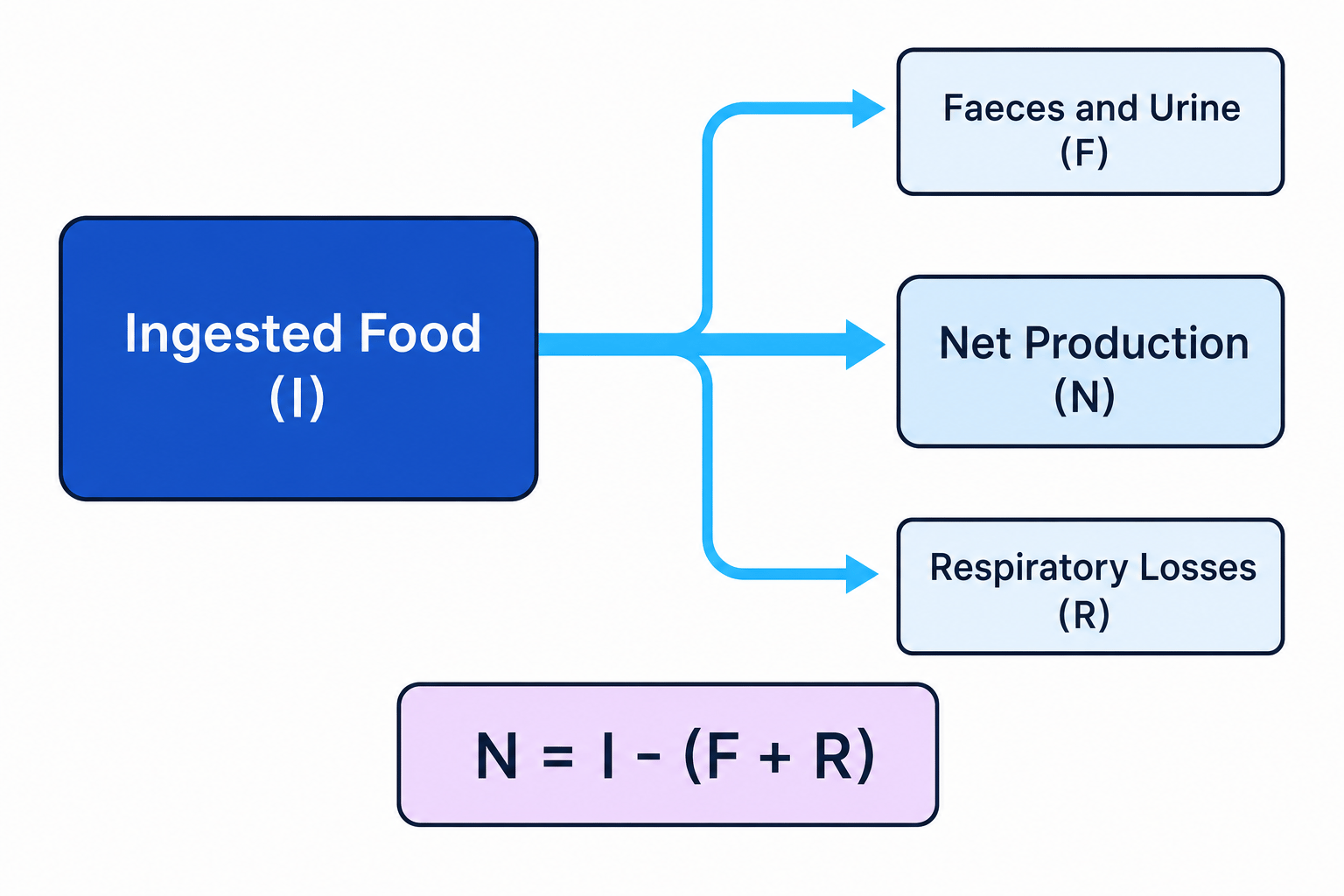
When an animal ingests food (III), a large amount of the chemical energy passes straight through the digestive system and is lost to the environment in faeces and urine (FFF). The energy that is successfully absorbed is then subjected to the animal's own high respiratory losses (RRR), which are lost to the environment as heat.
The net production of consumers (NNN) — sometimes called secondary production — is the energy left over to form new animal biomass. It is calculated as:
N=I−(F+R) N = I - (F + R) N=I−(F+R)- NNN: Net production
- III: Chemical energy store in ingested food
- FFF: Chemical energy lost to the environment in faeces and urine
- RRR: Respiratory losses to the environment
Calculating consumer net production
A cow ingests 140 000 kJ140\,000 \text{ kJ}140000 kJ of energy from grass per day. It loses 65 000 kJ65\,000 \text{ kJ}65000 kJ in faeces and urine, and 55 000 kJ55\,000 \text{ kJ}55000 kJ through respiration. Calculate the net production of the cow and find the percentage of ingested energy converted to biomass.
- State the formula for consumer net production:
- Substitute the values for faeces/urine and respiration into the brackets to find total losses:
- Subtract the total losses from the ingested energy to find NNN:
- Calculate the percentage of ingested energy converted into biomass:
Productivity Rates and Units
When we look at production over time, we call it productivity. Productivity is measured as a rate. The standard units for primary or secondary productivity are often kJ ha−1 year−1\text{kJ ha}^{-1} \text{ year}^{-1}kJ ha−1 year−1 (kilojoules per hectare per year).
Decoding the units
You need to understand why these specific units are used:
- per hectare (ha−1\text{ha}^{-1}ha−1): Ecosystems come in different sizes. Standardising by a specific area allows us to fairly compare the productivity of different environments (e.g., a huge forest vs a small meadow).
- per year (year−1\text{year}^{-1}year−1): Taking an annual average smooths out the effects of seasons. A plant photosynthesises much faster in summer than in winter, so a yearly rate gives a more accurate overall picture.
How Farming Practices Increase Efficiency
Human agriculture is essentially the deliberate manipulation of food webs to maximise the net production (NPPNPPNPP of crops or NNN of livestock) that ends up on our plates. Farmers use two main strategies to increase the efficiency of energy transfer:
1. Simplifying Food Webs
In a natural ecosystem, energy flows to many different organisms. Pests and weeds act as rival consumers or rival producers. By simplifying the food web, farmers reduce energy losses to these non-human food chains:
- Herbicides kill weeds, removing competition for light, water, and soil minerals, allowing the crop to achieve a higher GPPGPPGPP.
- Pesticides / Insecticides kill insects that eat the crop, preventing the crop's biomass from being transferred to pests.
2. Reducing Respiratory Losses
If you look at the equation N=I−(F+R)N = I - (F + R)N=I−(F+R), decreasing RRR will automatically increase NNN. Intensive farming practices reduce the respiratory losses of livestock:
- Restricting movement: Keeping animals in small pens means less muscle contraction, which requires less ATP, meaning a lower rate of respiration.
- Keeping animals warm: Housing animals indoors in heated environments means the animals don't have to respire as much to generate body heat.
Because less energy is lost as heat to the environment, more of the ingested energy goes towards growth (increasing biomass).
The goal of agriculture
Farming mathematically aims to maximise NPPNPPNPP in crops (by reducing competition) and maximise NNN in livestock (by maximising III with high-nutrition feed, and minimising RRR through restricted movement and heating).
In the exam
- Watch out for units: In calculation questions, you may be given a daily rate but asked for an annual rate. Multiply by 365365365 before stating your final answer.
- Be specific about heat loss: When defining respiratory losses (RRR), do not just say "energy used for respiration". State that it is energy lost to the environment as heat during respiration.
- Link to the equations: If an exam question asks how a farming practice increases yield, write out the terms in the formula. For example, "Keeping cows indoors reduces heat loss, which decreases respiratory losses (RRR). Since N=I−(F+R)N = I - (F + R)N=I−(F+R), a lower RRR means a higher net production (NNN)."
Check yourself
- What is the difference between biological fresh mass and dry mass, and why is dry mass used to measure biomass?
- How does gross primary production (GPPGPPGPP) differ from net primary production (NPPNPPNPP)?
- If a caterpillar ingests 50 J50 \text{ J}50 J of plant material, excretes 20 J20 \text{ J}20 J in faeces, and uses 15 J15 \text{ J}15 J in respiration, what is its net production?
- Explain why expressing productivity in kJ ha−1 year−1\text{kJ ha}^{-1} \text{ year}^{-1}kJ ha−1 year−1 is better than just kJ\text{kJ}kJ.
- How does keeping chickens in enclosed, temperature-controlled barns increase their net production?