

What you'll learn
- Why chemical elements such as nitrogen and phosphorus must be recycled in ecosystems.
- How saprobionts, bacteria and mycorrhizae keep nutrients available to plants.
- The key stages of the nitrogen cycle and phosphorus cycle.
- Why fertilisers can increase yield but also cause leaching and eutrophication.
Why nutrients need to be recycled
An ecosystem is a community of organisms interacting with each other and with the non-living environment. Energy flows through ecosystems and is eventually lost as heat, but matter is recycled.
Plants need mineral ions from the soil to build biological molecules. For example, they need nitrogen to make amino acids and proteins, and phosphorus to make ATP, phospholipids, DNA and RNA. If these elements stayed locked in dead organisms, faeces or rocks, plant growth would eventually stop.
Nutrient cycle
A nutrient cycle is the movement and recycling of chemical elements between living organisms and the non-living environment, such as soil, water, rocks and the atmosphere.
Matter is recycled, energy is not
In natural ecosystems, nutrients are repeatedly reused. Decomposers and other microorganisms return elements from dead organic matter to forms that producers can absorb.
Decomposition and saprobionts
Decomposition is the breakdown of dead organisms, fallen leaves, faeces and other waste organic matter.
The most important decomposers are saprobionts. These include many bacteria and fungi.
Saprobic nutrition
Saprobic nutrition is a type of feeding in which saprobionts secrete enzymes onto dead organic matter, digest large biological molecules outside their cells, then absorb the smaller soluble products.
For example, proteins in dead organisms are hydrolysed into amino acids. These can be absorbed by saprobionts and used in respiration, growth, or further breakdown. Nitrogen-containing compounds are eventually converted into ammonium ions, NH₄⁺, in a process called ammonification.
Decomposition is usually faster in warm, moist, oxygenated conditions because enzymes and aerobic respiration work more effectively.
Decomposition is not just “rotting”
In A-Level answers, say what decomposers actually do: saprobionts secrete extracellular enzymes, digest organic matter into smaller soluble molecules, absorb them, and release mineral ions back into the environment.
The nitrogen cycle
Nitrogen is essential for amino acids, proteins, nucleotides, DNA, RNA and ATP. Although nitrogen gas, N₂, makes up most of the atmosphere, plants cannot use it directly because N₂ is very unreactive.
Plants mainly absorb nitrogen as nitrate ions, NO₃⁻, from the soil. Animals then obtain nitrogen by feeding on plants or on other animals.
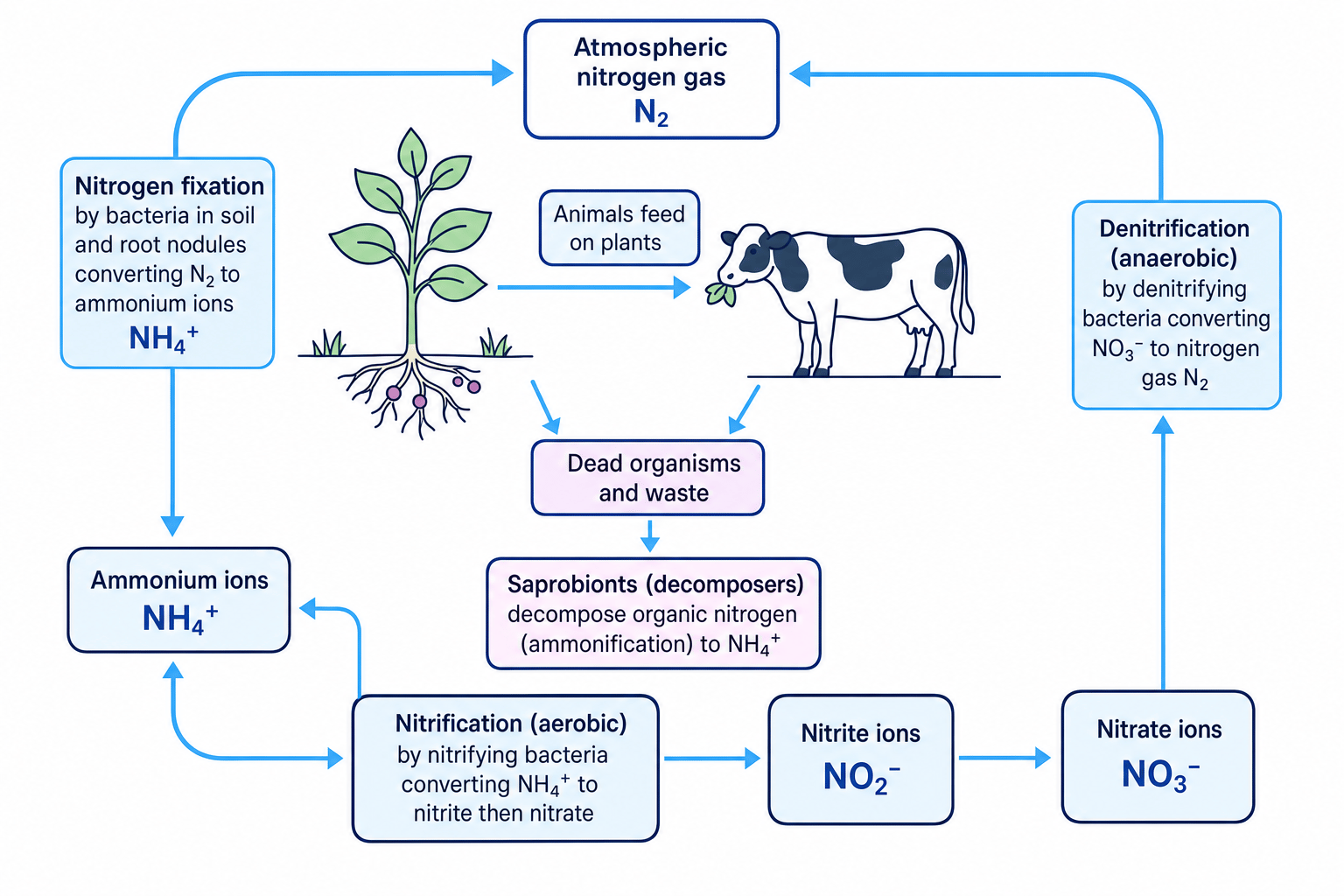
The nitrogen cycle is best learned as a set of named processes with clear directions.
Nitrogen fixation
Nitrogen fixation converts atmospheric nitrogen gas, N₂, into reduced nitrogen compounds such as ammonia or ammonium ions, NH₄⁺.
This is carried out by nitrogen-fixing bacteria. Some live freely in the soil, while others live in root nodules of leguminous plants such as peas and beans. You do not need to know individual bacterial species names for this specification.
Ammonification
Ammonification is the production of ammonium ions, NH₄⁺, from organic nitrogen compounds in dead organisms and waste.
This is done by saprobionts during decomposition. It links decomposition directly to the nitrogen cycle.
Nitrification
Nitrification is the oxidation of ammonium ions to nitrite ions, NO₂⁻, and then to nitrate ions, NO₃⁻.
It is carried out by nitrifying bacteria in aerobic soil conditions. “Aerobic” means oxygen is present. This matters because nitrifying bacteria require oxygen for respiration.
Nitrate ions are soluble and can be absorbed by plant roots. Plants then use them to make amino acids and proteins. This incorporation of mineral ions into organic molecules is called assimilation.
Denitrification
Denitrification converts nitrate ions, NO₃⁻, back into nitrogen gas, N₂.
It is carried out by denitrifying bacteria, especially in anaerobic conditions such as waterlogged soil. “Anaerobic” means little or no oxygen is available. Denitrification lowers soil nitrate concentration, which can reduce plant growth.
Predicting the effect of waterlogging
A field becomes waterlogged after heavy rain. Explain how this could reduce crop growth.
- Waterlogging fills air spaces in the soil with water, so less oxygen is available for aerobic organisms in the soil.
- Nitrification decreases because nitrifying bacteria need aerobic conditions to convert NH₄⁺ into NO₃⁻.
- Denitrification increases because denitrifying bacteria are favoured by anaerobic conditions and convert NO₃⁻ into N₂.
- The nitrate ion concentration in the soil falls, so plants absorb less nitrogen for making amino acids and proteins.
- Protein synthesis and growth are reduced, so crop yield may decrease.
Remember the nitrogen processes
Fixation brings nitrogen into the soil from N₂. Nitrification makes nitrate. Denitrification removes nitrate and returns nitrogen to the atmosphere.
The phosphorus cycle
Phosphorus is needed for ATP, DNA, RNA and phospholipids in cell membranes. Plants absorb it mainly as phosphate ions, PO₄³⁻.
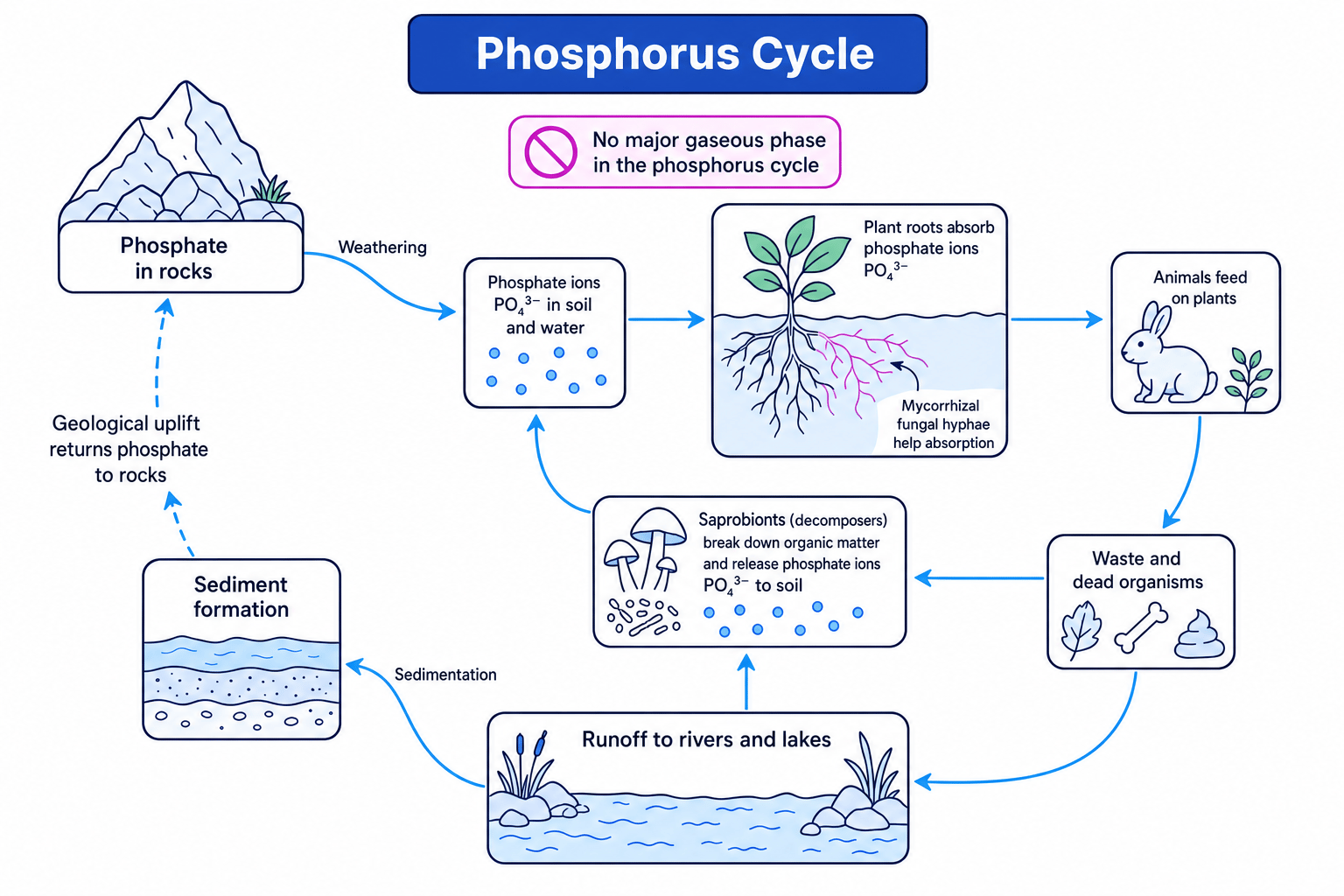
Unlike nitrogen, the phosphorus cycle has no major gaseous phase. Most phosphorus is found in rocks, sediments, soil and water.
Main stages of the phosphorus cycle
Phosphate-containing rocks are weathered, slowly releasing phosphate ions into soil and water. Plant roots absorb these phosphate ions and assimilate them into biological molecules.
Animals obtain phosphorus by feeding on plants or other animals. When organisms excrete waste or die, saprobionts decompose the organic matter and release phosphate ions back into the soil.
Some phosphate ions are washed into rivers, lakes and seas. They may become part of sediments and eventually form rocks again over very long timescales. Geological uplift can expose these rocks, allowing weathering to restart the cycle.
Mycorrhizae and mineral ion uptake
Mycorrhizae
Mycorrhizae are mutualistic associations between fungi and plant roots. The fungus receives organic compounds from the plant, while the plant gains improved uptake of water and inorganic ions, especially phosphate ions.
Fungal hyphae are long, thin threads that spread through the soil. They give the root system a much larger surface area for absorption. This helps plants take up water and mineral ions from a greater volume of soil.
Mycorrhizae extend the root system
Mycorrhizae act like an extended absorbing network for the plant, improving access to water and inorganic ions in the soil.
Fertilisers and nutrient replacement
When crops are harvested, nutrients in plant biomass are removed from the ecosystem. When livestock are removed from farmland, nutrients in their bodies are also removed. Farmers use fertilisers to replace lost nitrate and phosphate ions so that plant growth is not limited.
Natural fertilisers include manure, compost and slurry. They contain organic matter that decomposes gradually, releasing mineral ions. They can also improve soil structure.
Artificial fertilisers are manufactured mineral fertilisers, often described as NPK fertilisers because they contain nitrogen, phosphorus and potassium. They are more concentrated and often more soluble, so they can act quickly.
More fertiliser is not always better
Once another factor becomes limiting, such as light, temperature or water availability, adding more nitrate or phosphate will not keep increasing growth. Excess fertiliser also increases the risk of environmental damage.
Leaching and eutrophication
Leaching
Leaching is the loss of soluble mineral ions from soil when rainwater washes them away into streams, rivers and lakes.
Nitrate ions are especially prone to leaching because they are very soluble. Phosphate ions can also enter water systems, particularly through runoff and soil erosion.
Eutrophication
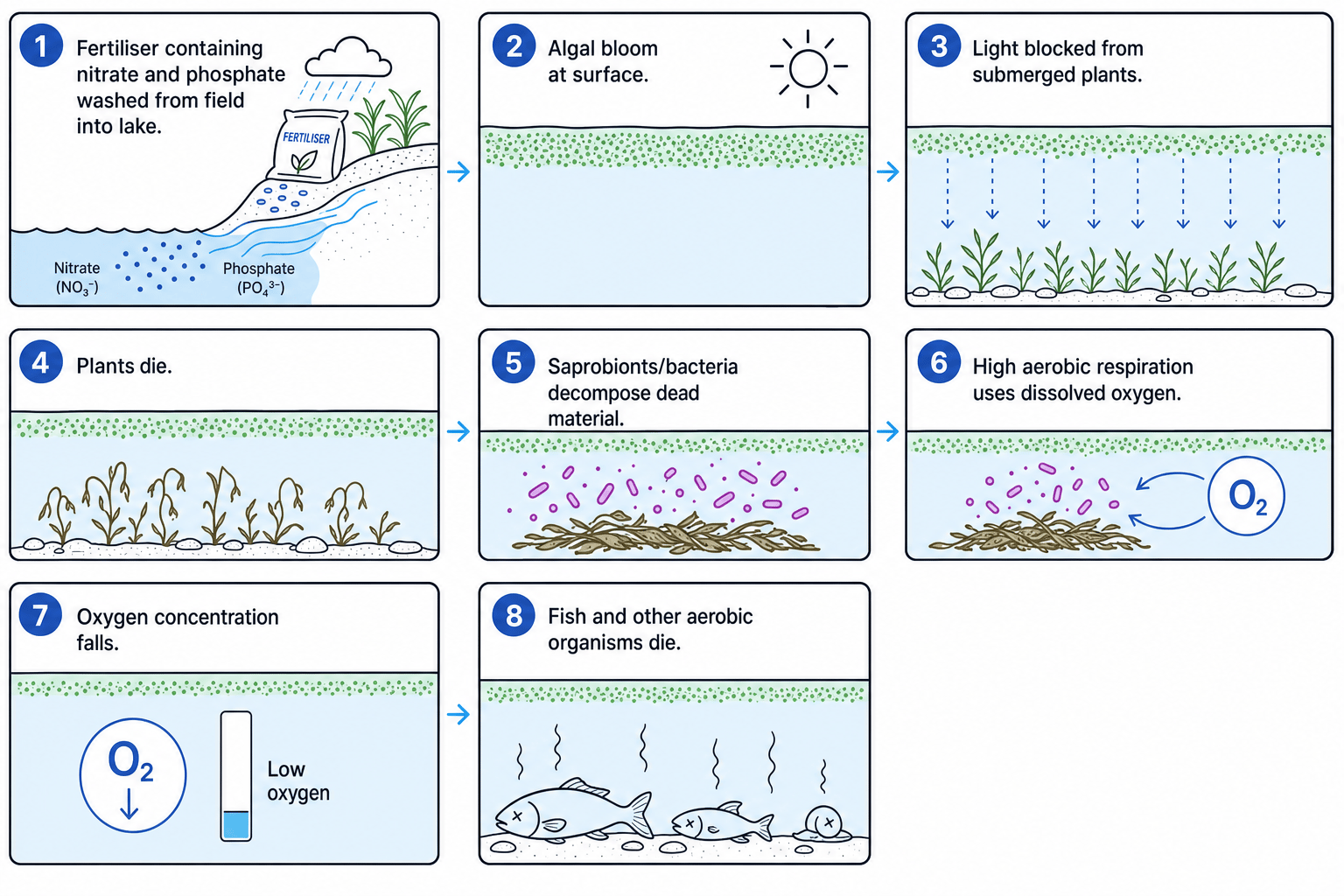
Eutrophication is the nutrient enrichment of water, often by nitrate and phosphate ions, leading to excessive algal growth and oxygen depletion.
The usual sequence is:
- Fertiliser containing nitrate and phosphate ions is washed into a pond, lake or river.
- Algae grow rapidly, forming an algal bloom at the surface.
- The algal bloom blocks light from reaching submerged plants.
- Submerged plants cannot photosynthesise enough and die.
- Saprobionts decompose the dead plant and algal material.
- Decomposer bacteria respire aerobically, using up dissolved oxygen.
- Oxygen concentration falls, so fish and other aerobic organisms die.
Explaining low oxygen after fertiliser runoff
A lake near farmland has a large algal bloom and many dead fish. Explain the link with fertiliser use.
- Fertiliser runoff adds nitrate and phosphate ions to the lake, removing mineral ion limitation for algae.
- Algae reproduce rapidly, forming a surface bloom that reduces light penetration into the water.
- Submerged plants die because their rate of photosynthesis decreases.
- Saprobionts decompose the dead plant and algal material, increasing the rate of aerobic respiration.
- Dissolved oxygen is used up faster than it is replaced, so aerobic organisms such as fish die.
Do not say algae directly use up all the oxygen
The main oxygen drop is usually due to aerobic respiration by decomposer bacteria after plants and algae die, not simply because algae are present.
Practical skills angle: mineral ions and plant growth
This topic can be linked to planning investigations into how named minerals affect plant growth. For example, you could compare seedlings grown in a complete nutrient solution with seedlings grown in a solution lacking nitrate or phosphate.
Good control variables include light intensity, temperature, pH, volume of solution, starting size of seedlings, plant species and duration of growth. Useful dependent variables include increase in height, leaf number, fresh mass or dry mass. Dry mass is often better because it removes variation due to water content.
Designing a phosphate-deficiency investigation
- Choose the independent variable: phosphate availability, using one complete nutrient solution and one solution lacking phosphate ions.
- Choose a measurable dependent variable, such as mean dry mass increase after 14 days.
- Control other factors, including light intensity, temperature, pH, starting seedling size, solution volume and plant species.
- Use several seedlings in each treatment so you can calculate a mean and reduce the effect of individual variation.
- Compare growth between the two groups; lower mean dry mass in the phosphate-deficient group would suggest phosphate ions are needed for normal growth.
In the exam
- For nitrogen-cycle questions, name the process and the direction of conversion, for example “nitrification converts ammonium ions to nitrate ions under aerobic conditions”.
- Link fertilisers to both sides: increased plant growth by replacing lost nitrates/phosphates, but possible leaching and eutrophication if overused.
- In eutrophication answers, keep the sequence in order: fertiliser runoff → algal bloom → light blocked → plants die → decomposition → oxygen falls → aerobic organisms die.
Check yourself
- Why does waterlogged soil often reduce nitrate availability to plants?
- How do saprobionts return nitrogen and phosphorus to the soil?
- Why does the phosphorus cycle have no major atmospheric stage?
