

What you'll learn
- How respiration transfers energy from respiratory substrates to ATP.
- Why glycolysis happens in both aerobic and anaerobic respiration.
- How the link reaction, Krebs cycle and oxidative phosphorylation work in mitochondria.
- How to investigate respiration rate in single-celled organisms, such as yeast.
The big idea: respiration makes ATP
Cells need a usable energy currency for active transport, muscle contraction, synthesis of large molecules, and many other processes.
Respiration and ATP
Respiration is the enzyme-controlled release of energy from respiratory substrates in cells, with energy transferred to ATP. ATP, or adenosine triphosphate, is a phosphorylated nucleotide that releases energy when it is hydrolysed to ADP and inorganic phosphate.
A respiratory substrate is a molecule that can be broken down in respiration. Glucose is the usual example, but lipids and amino acids can also be used.
The useful reaction is:
ATP+H2O→ADP+Pi\text{ATP} + \text{H}_2\text{O} \to \text{ADP} + \text{P}_{\text{i}}ATP+H2O→ADP+PiRespiration does not “make energy”. It transfers energy from chemical bonds in substrates into ATP.
Redox: the language of respiration
A lot of respiration is about moving hydrogen and electrons.
Oxidation, reduction and coenzymes
Oxidation is loss of electrons or hydrogen. Reduction is gain of electrons or hydrogen. NAD and FAD are coenzymes: small molecules that help enzymes by carrying hydrogen and electrons. When NAD accepts hydrogen, it becomes reduced NAD.
This matters because reduced NAD and reduced FAD carry energy-rich electrons to the final stage of aerobic respiration.
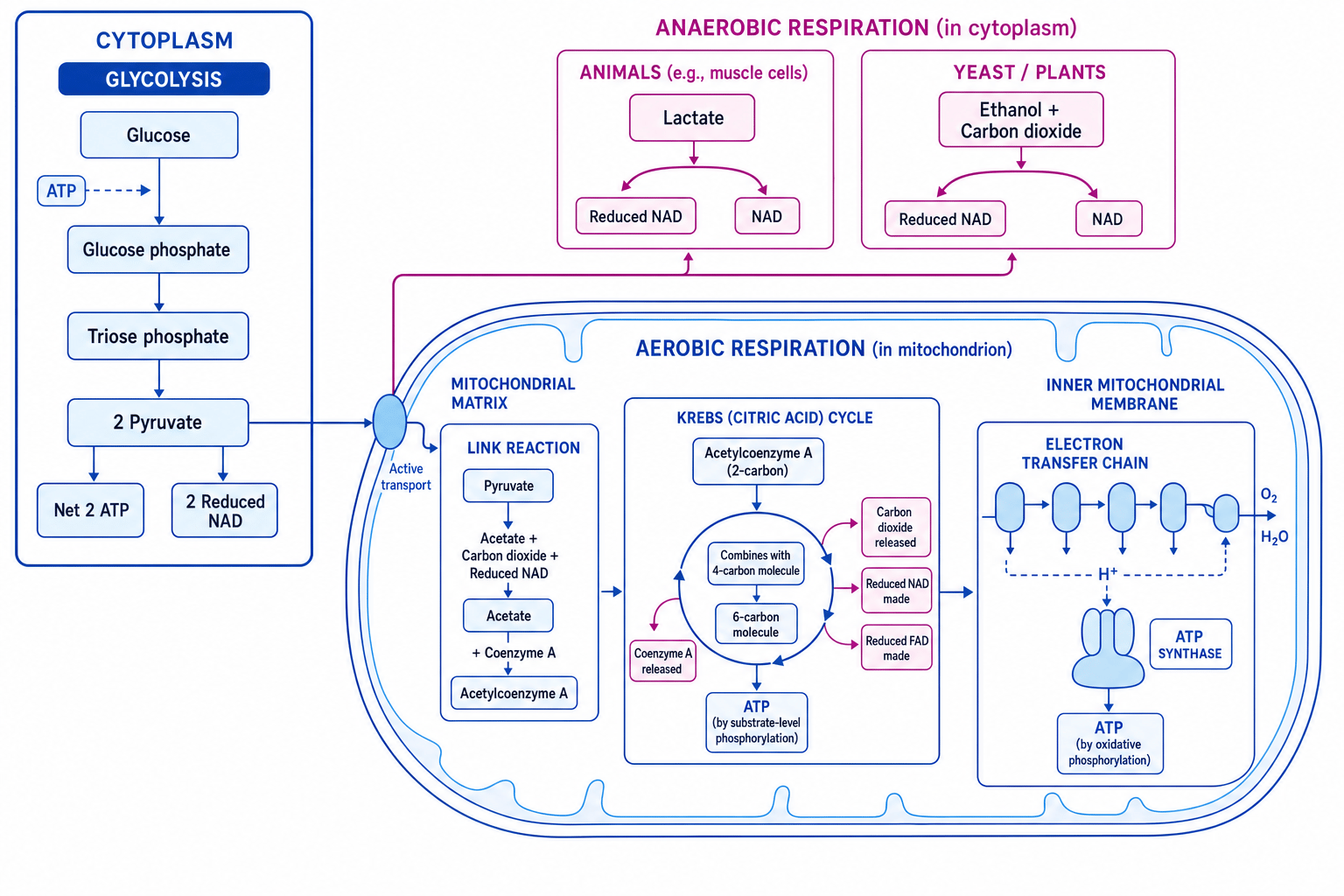
This overview shows how glycolysis can feed either anaerobic pathways in the cytoplasm or aerobic pathways in the mitochondrion.
Glycolysis: the first stage
Glycolysis is the first stage of both aerobic and anaerobic respiration. It happens in the cytoplasm and is anaerobic, meaning it does not require oxygen.
Glycolysis involves three main ideas:
- Phosphorylation of glucose: phosphate groups are added to glucose using ATP.
- The phosphorylated glucose is split into two triose phosphate molecules. “Triose” means three-carbon.
- Triose phosphate is oxidised to pyruvate, a three-carbon compound. This produces reduced NAD and ATP.
The ATP accounting is important: ATP is used at the start, but more ATP is made later, giving a net gain of 2 ATP per glucose.
Substrate-level phosphorylation
Substrate-level phosphorylation is the direct formation of ATP by transferring a phosphate group from a phosphorylated intermediate molecule to ADP.
Accounting for glycolysis products
-
One glucose molecule is split into two pyruvate molecules, so four glucose molecules would form eight pyruvate molecules.
-
For each glucose molecule, 2 ATP are used early and 4 ATP are made later, so the net gain is 4−2=24 - 2 = 24−2=2 ATP.
-
Four glucose molecules therefore give a net gain of eight ATP and produce eight reduced NAD molecules.
Calling glycolysis aerobic
Glycolysis can happen during aerobic respiration, but glycolysis itself is anaerobic because it does not use oxygen and occurs in the cytoplasm.
Anaerobic respiration: regenerating NAD
If respiration is only anaerobic, pyruvate is not sent into the mitochondrion. Instead, it is converted into another product using reduced NAD.
In animals, pyruvate is converted to lactate. In yeast and many plant tissues, pyruvate is converted to ethanol and carbon dioxide.
The key purpose is to regenerate oxidised NAD. This NAD can then be reused in glycolysis, allowing glycolysis to continue producing a small amount of ATP.
Why pyruvate is converted
Anaerobic respiration does not produce lots of extra ATP after glycolysis. Its main value is regenerating NAD so that glycolysis can continue.
Aerobic respiration: moving into the mitochondrion
If oxygen is available, pyruvate enters the mitochondrial matrix by active transport. The mitochondrial matrix is the fluid-filled space inside the inner mitochondrial membrane. Active transport is movement using energy, usually involving carrier proteins.
This mitochondrial detail is A-level only and often separates stronger answers from vague ones.
The link reaction
The link reaction connects glycolysis to the Krebs cycle.
For each pyruvate molecule:
- Pyruvate, a three-carbon compound, is oxidised.
- Carbon dioxide is removed.
- Reduced NAD is produced.
- A two-carbon compound called acetate is formed.
- Acetate combines with coenzyme A to form acetylcoenzyme A.
Because one glucose forms two pyruvate molecules, the link reaction happens twice per glucose molecule.
The Krebs cycle
The Krebs cycle happens in the mitochondrial matrix.
Acetylcoenzyme A enters the cycle and combines with a four-carbon molecule. Coenzyme A is released, and a six-carbon molecule is formed.
The six-carbon molecule then goes through a series of oxidation-reduction reactions. During these reactions:
- Carbon dioxide is lost.
- Reduced NAD and reduced FAD are produced.
- ATP is made by substrate-level phosphorylation.
- The four-carbon molecule is regenerated, so the cycle can continue.
Per glucose molecule, the Krebs cycle turns twice because there are two acetylcoenzyme A molecules.
Tracking carbon through aerobic respiration
-
One glucose molecule has six carbon atoms and is split into two three-carbon pyruvate molecules during glycolysis.
-
In the link reaction, each pyruvate loses one carbon atom as carbon dioxide, so two carbon dioxide molecules are released per glucose.
-
The two remaining two-carbon acetyl groups enter the Krebs cycle. Each loses two carbon dioxide molecules, so the Krebs cycle releases four more carbon dioxide molecules per glucose.
Oxidative phosphorylation and chemiosmosis
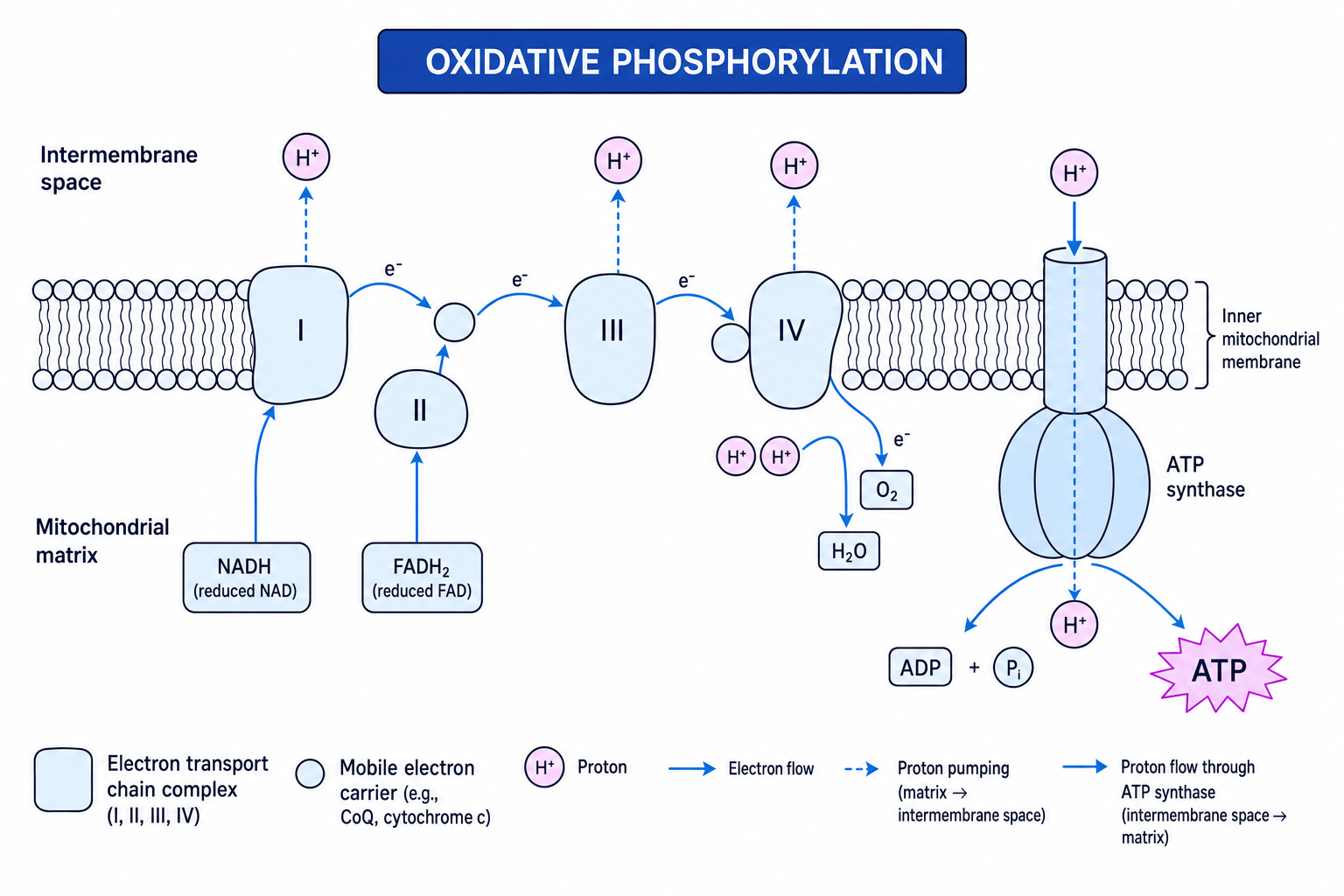
Most ATP in aerobic respiration is made by oxidative phosphorylation. This happens on the inner mitochondrial membrane, which contains the electron transfer chain and ATP synthase.
Chemiosmotic theory
Chemiosmotic theory explains ATP synthesis as the result of protons moving down a proton gradient through ATP synthase, after electron transfer has been used to pump protons across the inner mitochondrial membrane.
The diagram shows how reduced NAD and reduced FAD provide electrons for the electron transfer chain, leading to ATP synthesis.
The sequence is:
- Reduced NAD and reduced FAD are oxidised, releasing electrons and protons.
- Electrons move along the electron transfer chain in the inner mitochondrial membrane.
- Energy released from electron transfer pumps protons from the matrix into the intermembrane space.
- This creates a proton gradient across the inner mitochondrial membrane.
- Protons diffuse back into the matrix through ATP synthase.
- ATP synthase catalyses the formation of ATP from ADP and inorganic phosphate.
- Oxygen acts as the final electron acceptor, combining with electrons and protons to form water.
Predicting the effect of no oxygen
-
Without oxygen, electrons cannot be passed to the final electron acceptor, so electron transfer along the chain stops.
-
Proton pumping stops, so the proton gradient across the inner mitochondrial membrane is no longer maintained.
-
ATP synthase cannot make much ATP, and reduced NAD/reduced FAD cannot be oxidised back to NAD/FAD, so the link reaction and Krebs cycle slow or stop.
Oxygen does not make ATP directly
Oxygen’s role is to act as the final electron acceptor. ATP is made by ATP synthase as protons move down their gradient.
Other respiratory substrates
Glucose is not the only respiratory substrate.
Lipids can be broken down into glycerol and fatty acids. Glycerol can enter pathways linked to glycolysis, while fatty acids can be converted into acetylcoenzyme A and enter the Krebs cycle.
Amino acids can also be used after deamination, which means removal of the amino group. The remaining carbon skeleton can enter respiration at different points, including the Krebs cycle.
Lipids usually release more energy per gram than carbohydrates because they contain more hydrogen atoms, leading to more reduced NAD and reduced FAD.
Required practical 9: measuring respiration rate
Required practical 9
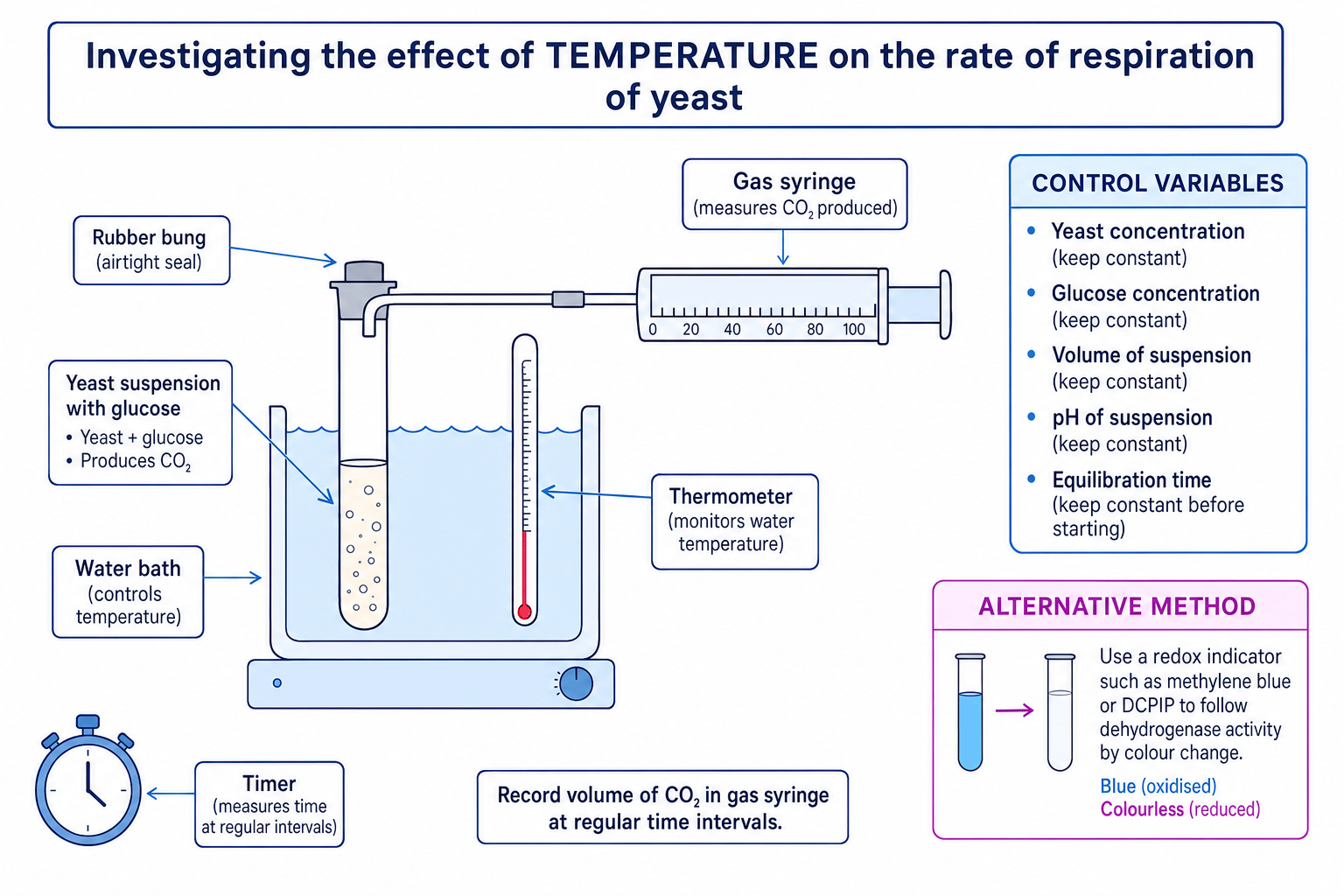
You need to be able to describe an investigation into the effect of a named variable on the rate of respiration of cultures of single-celled organisms, such as yeast.
A common method is to investigate the effect of temperature on yeast respiration by measuring carbon dioxide production over time.
A good method should include:
- Choose an independent variable, such as temperature or glucose concentration.
- Measure a dependent variable, such as volume of carbon dioxide produced per second.
- Control variables such as yeast concentration, glucose concentration, pH, total volume and equilibration time.
- Use repeats and calculate a mean.
- Plot volume of carbon dioxide against time; the rate is the gradient of the graph.
A redox indicator is a dye that changes colour when it is reduced or oxidised. Methylene blue or DCPIP can be used to investigate dehydrogenase activity, because dehydrogenase enzymes remove hydrogen from respiratory substrates.
Colour-change results
If the result is time taken for a redox indicator to change colour, a shorter time means a faster respiration rate. For comparisons, use relative rate as 1time taken\frac{1}{\text{time taken}}time taken1.
Calculating respiration rate
A yeast culture produces 6.0 cubic centimetres of carbon dioxide in 180 s. Calculate the rate in cubic metres per second.
-
Convert the volume to cubic metres: 6.0 cm3=6.0×10⁻⁶ m36.0\ \text{cm}^3 = 6.0 \times 10^{-6}\ \text{m}^36.0 cm3=6.0×10⁻⁶ m3.
-
Use the rate formula:
- Substitute the values with units:
In the exam
-
Link each stage to its location: glycolysis in cytoplasm; link reaction and Krebs cycle in matrix; oxidative phosphorylation on the inner mitochondrial membrane.
-
When explaining anaerobic respiration, always mention regeneration of NAD so glycolysis can continue.
-
For practical questions, name the independent variable, dependent variable, control variables, repeats, and how you calculate rate.
Check yourself
- Why does glycolysis need NAD, and what happens if NAD is not regenerated?
- How does the electron transfer chain lead to ATP synthesis by ATP synthase?
- In required practical 9, what variables would you control when investigating temperature and yeast respiration?

