

What you'll learn
- How atoms and nuclei are described using nuclear symbols.
- What alpha, beta and gamma radiation are, and how they differ.
- How to balance simple nuclear equations and use half-life.
- How radioactivity is detected, used, and made safer.
Atoms, nuclei and nuclear symbols
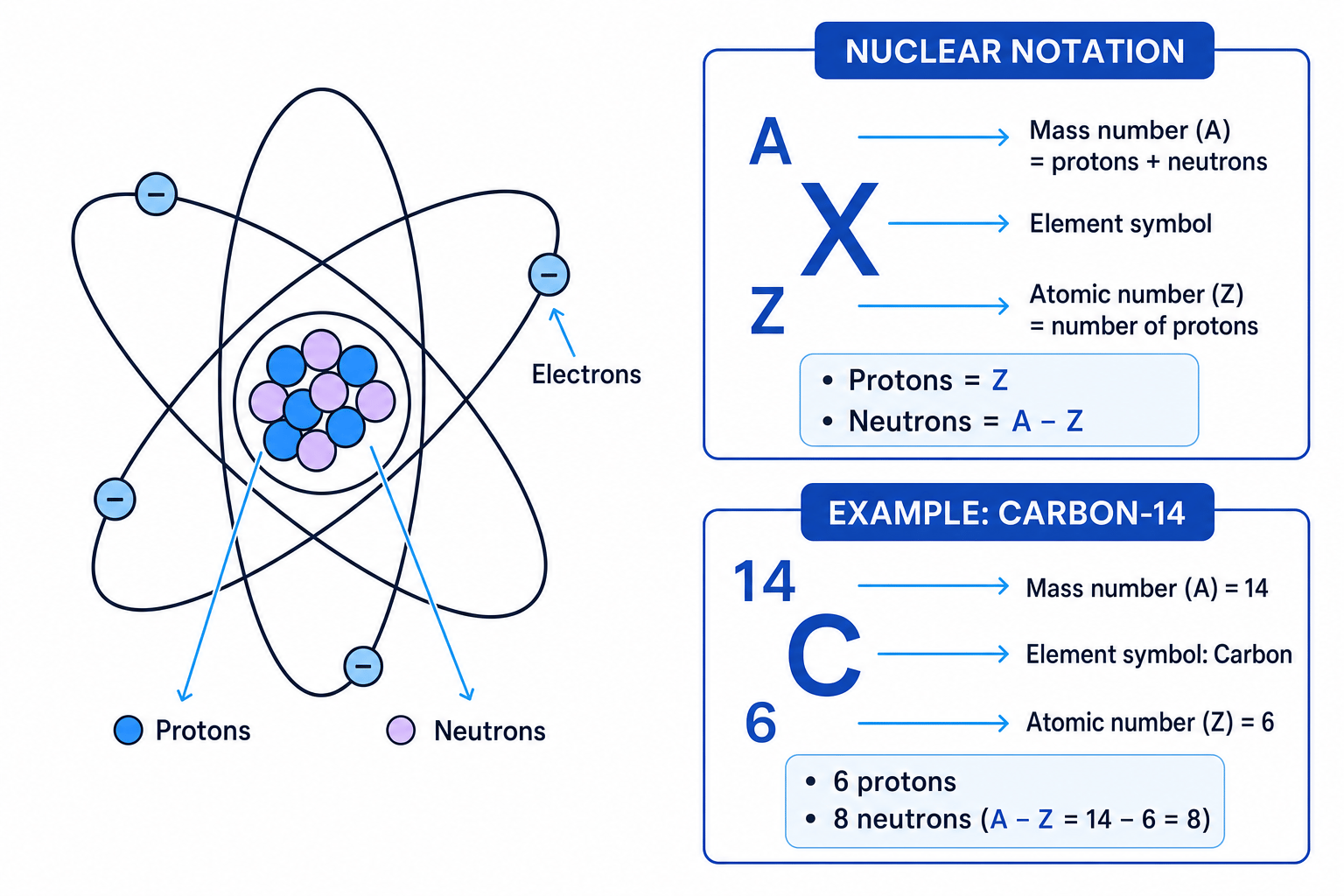
An atom is the smallest particle of an element that still behaves like that element. At the centre is the nucleus, which contains protons and neutrons. Around the nucleus are electrons.
- A proton has positive charge.
- A neutron has no charge.
- An electron has negative charge.
Protons and neutrons are together called nucleons, because they are particles in the nucleus.
A nuclear symbol is written as ZAX{}^{A}_{Z}\text{X}ZAX, where X is the element symbol.
Atomic number, mass number and isotopes
- The atomic number or proton number, ZZZ, is the number of protons in the nucleus.
- The mass number or nucleon number, AAA, is the total number of protons and neutrons.
- An isotope is an atom of the same element with the same number of protons but a different number of neutrons.
For example, carbon-14 is written as 614C{}^{14}_{6}\text{C}614C. It has 6 protons and 14−6=814 - 6 = 814−6=8 neutrons.
Finding protons and neutrons
For 1123Na{}^{23}_{11}\text{Na}1123Na:
- The lower number is the atomic number, so sodium has 11 protons.
- The upper number is the mass number, so the nucleus contains 23 nucleons in total.
- The number of neutrons is mass number minus atomic number: 23−11=1223 - 11 = 1223−11=12 neutrons.
Unstable nuclei and ionising radiation
Some nuclei are unstable. They can become more stable by emitting radiation from the nucleus. This process is called radioactive decay.
Radioactive decay is random: you cannot predict exactly when one particular nucleus will decay. However, with a large number of nuclei, you can predict the overall pattern.
Ionising radiation
Ionising radiation is radiation that can remove electrons from atoms or molecules, forming ions. This can damage living cells.
The three main ionising radiations in this topic are:
- Alpha radiation, α\alphaα: a helium nucleus, made of 2 protons and 2 neutrons.
- Beta-minus radiation, β−\beta^-β−: a fast-moving electron emitted from the nucleus when a neutron changes into a proton.
- Gamma radiation, γ\gammaγ: high-energy electromagnetic radiation emitted from the nucleus.
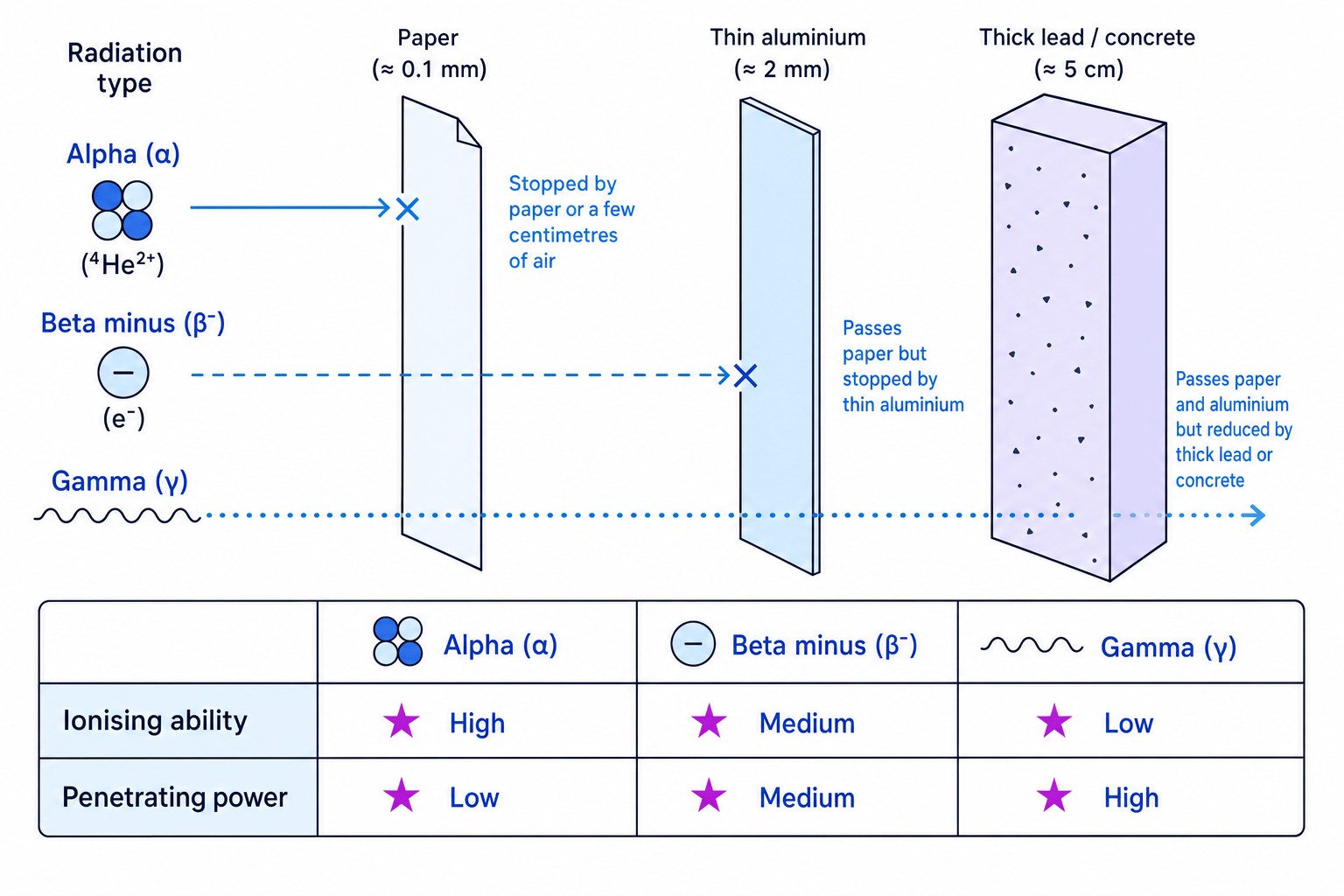
Alpha is the most strongly ionising but the least penetrating. Gamma is the least strongly ionising but the most penetrating.
Ionising power and penetrating power
A radiation that ionises strongly usually does not penetrate far. Alpha is stopped easily but causes lots of ionisation over a short distance.
Practical: investigating penetrating power
You may be asked about the named practical to investigate how far different radiations penetrate. This can be done using real radioactive sources or a simulation.
A typical method is:
- Measure the background count rate with no source present.
- Place a radioactive source a fixed distance from a Geiger–Müller tube.
- Record the count rate with no absorber.
- Put different absorbers between the source and detector, such as paper, aluminium and lead.
- Repeat readings and subtract the background count rate.
- Compare how much the corrected count rate falls for each absorber.
The independent variable is the absorber material or thickness. The dependent variable is the corrected count rate. Important control variables include the source, the distance from the source to the detector, and the counting time.
You could plot corrected count rate in counts/s against absorber thickness, or use a bar chart if comparing different absorber materials.
Identifying radiation using absorbers
A source gives a high count rate. Paper hardly changes the reading, but thin aluminium reduces it almost to background.
- Paper does not stop the radiation, so it is unlikely to be alpha.
- Thin aluminium stops most of it, which matches beta-minus radiation.
- Gamma would still pass through aluminium more easily, so the source is mainly beta-minus.
Forgetting background radiation
If you do not subtract the background count rate, the source can seem more active than it really is, especially when the source count is low.
Nuclear changes and equations
When radiation is emitted, the nucleus may change into a different element. In nuclear equations, the total mass number and total charge must balance on both sides.
The main changes are:
-
Alpha emission: mass number decreases by 4, atomic number decreases by 2.
ZAX→Z−2A−4Y+24α{}^{A}_{Z}\text{X} \to {}^{A-4}_{Z-2}\text{Y} + {}^{4}_{2}\alphaZAX→Z−2A−4Y+24α -
Beta-minus emission: mass number stays the same, atomic number increases by 1.
ZAX→Z+1AY+−10β−{}^{A}_{Z}\text{X} \to {}^{A}_{Z+1}\text{Y} + {}^{0}_{-1}\beta^-ZAX→Z+1AY+−10β− -
Gamma emission: mass number and atomic number stay the same.
ZAX→ZAX+γ{}^{A}_{Z}\text{X} \to {}^{A}_{Z}\text{X} + \gammaZAX→ZAX+γ -
Neutron emission: mass number decreases by 1, atomic number stays the same.
ZAX→ZA−1Y+01n{}^{A}_{Z}\text{X} \to {}^{A-1}_{Z}\text{Y} + {}^{1}_{0}\text{n}ZAX→ZA−1Y+01n
Balancing an alpha decay equation
Complete the decay of radium-226 by alpha emission.
- Alpha radiation has mass number 4 and atomic number 2, so write the emitted particle as 24α{}^{4}_{2}\alpha24α.
- Balance the mass numbers: 226−4=222226 - 4 = 222226−4=222, so the new nucleus has mass number 222.
- Balance the atomic numbers: 88−2=8688 - 2 = 8688−2=86, so the new element has atomic number 86, which is radon:
88226Ra→86222Rn+24α{}^{226}_{88}\text{Ra} \to {}^{222}_{86}\text{Rn} + {}^{4}_{2}\alpha88226Ra→86222Rn+24α
Detecting radiation and background radiation
Ionising radiation can be detected using:
- Photographic film, which darkens when exposed to radiation.
- A Geiger–Müller detector, which produces clicks or a count rate when radiation enters it.
There is always some background radiation around us. Sources from Earth include rocks, soil, building materials, radon gas and some food. Sources from space include cosmic rays, which are more significant at high altitude.
Background correction
For experiments, use: corrected count rate = measured count rate with source minus background count rate.
Activity and half-life
The activity of a radioactive source is the rate at which its unstable nuclei decay. Activity is measured in becquerels, Bq.
1 Bq means one nuclear decay per second.
As time passes, the activity decreases because fewer unstable nuclei remain undecayed.
Half-life
The half-life of a radioactive isotope is the time taken for the activity, or corrected count rate, to fall to half its original value. Different isotopes have different half-lives.
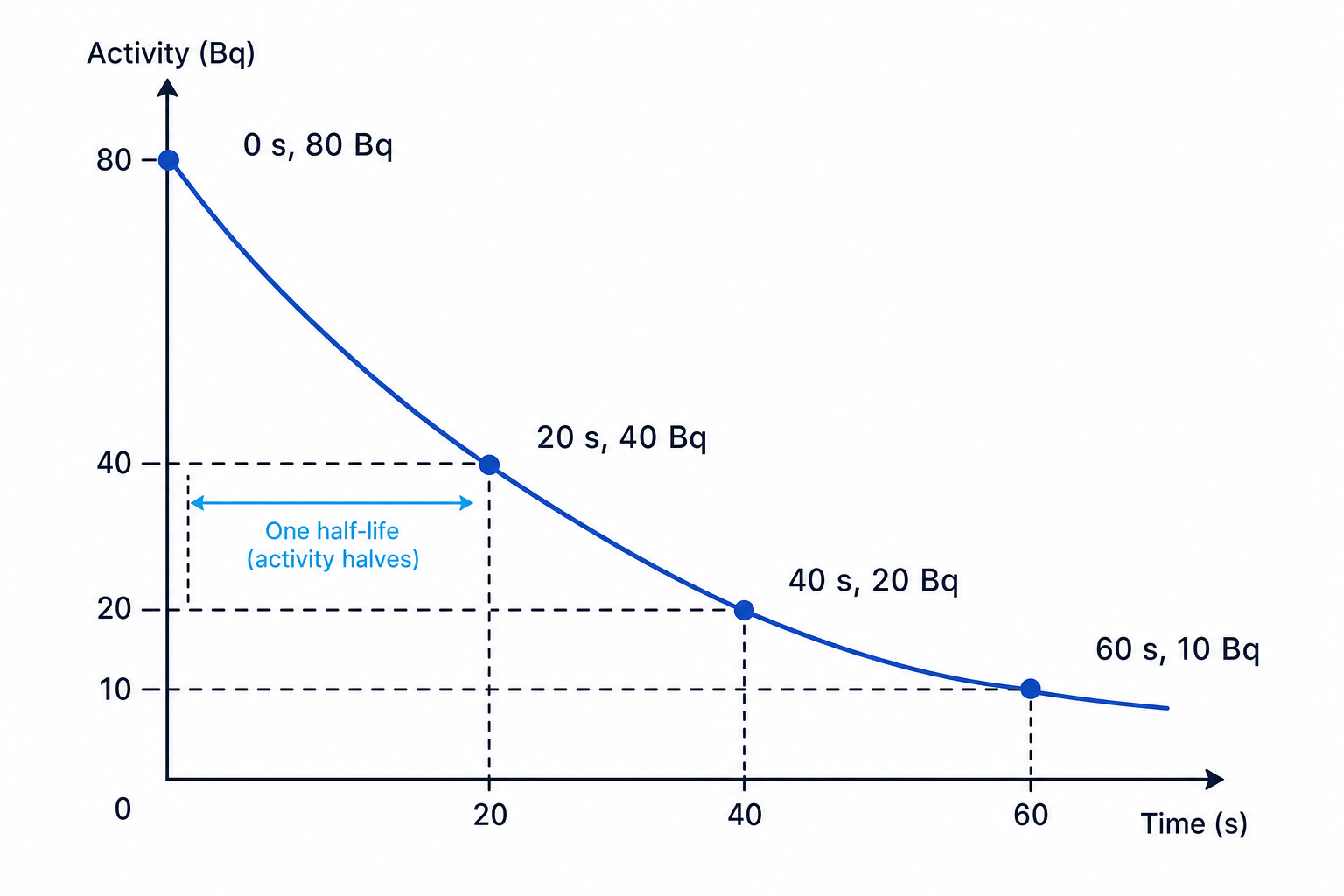
For simple calculations, count how many half-lives have passed:
n=tT1/2n = \frac{t}{T_{1/2}}n=T1/2twhere nnn is the number of half-lives, ttt is the time passed, and T1/2T_{1/2}T1/2 is the half-life.
Then halve the activity once for each half-life.
Calculating activity after several half-lives
A source has an initial activity of 960 Bq. Its half-life is 30 s. Calculate its activity after 120 s.
- Find the number of half-lives: n=120 s30 s=4n = \frac{120\ \text{s}}{30\ \text{s}} = 4n=30 s120 s=4.
- Halve the activity four times: 960 Bq → 480 Bq → 240 Bq → 120 Bq → 60 Bq.
- The activity after 120 s is 60 Bq.
To find half-life from a graph, choose an activity, find the time when it halves, and read the time difference. Repeating this for another pair of points can improve reliability.
Uses of radioactivity
In medicine, radioactivity can be used for:
- Tracers: a gamma-emitting isotope is put into the body and detected from outside.
- Radiotherapy: radiation is used to kill cancer cells.
- Sterilising equipment: gamma radiation kills microorganisms on medical equipment.
In industry, radioactivity can be used for:
- Thickness control: beta radiation checks the thickness of paper, plastic or foil.
- Leak detection: a radioactive tracer is added to a pipe system.
- Smoke alarms: alpha radiation helps ionise air inside some detectors.
Useful medical tracers often have a short half-life, so they do their job but do not remain active in the body for too long.
Irradiation, contamination and danger
Irradiation means being exposed to radiation from a source outside your body or object. Once the source is removed, the irradiation stops.
Contamination means radioactive material gets onto or inside an object or person. The contaminating material is itself a source, so it can keep emitting radiation.
Irradiated does not mean radioactive
An object exposed to radiation has been irradiated, but it does not automatically become radioactive. Contamination is more serious because radioactive material is actually present.
Ionising radiation is dangerous because it can:
- damage cells and tissue
- cause mutations in DNA
- increase the risk of cancer
Radioactive waste is a problem because it may remain active for a long time. Risks can be reduced by using sealed containers, shielding, remote handling, secure storage, and choosing suitable disposal sites away from people and water supplies.
Alpha inside the body
Alpha radiation is stopped by skin outside the body, but it is very dangerous if an alpha source is swallowed or breathed in because it ionises strongly inside tissue.
In the exam
- In nuclear equations, check both the top numbers and bottom numbers balance.
- For half-life questions, halve the activity once for each half-life and keep the unit Bq.
- For practical questions, mention background radiation, fixed distance, repeated readings and suitable shielding.
Check yourself
- What do the top and bottom numbers mean in ZAX{}^{A}_{Z}\text{X}ZAX?
- How do alpha, beta-minus and gamma compare for ionising ability and penetration?
- What is the difference between contamination and irradiation?
