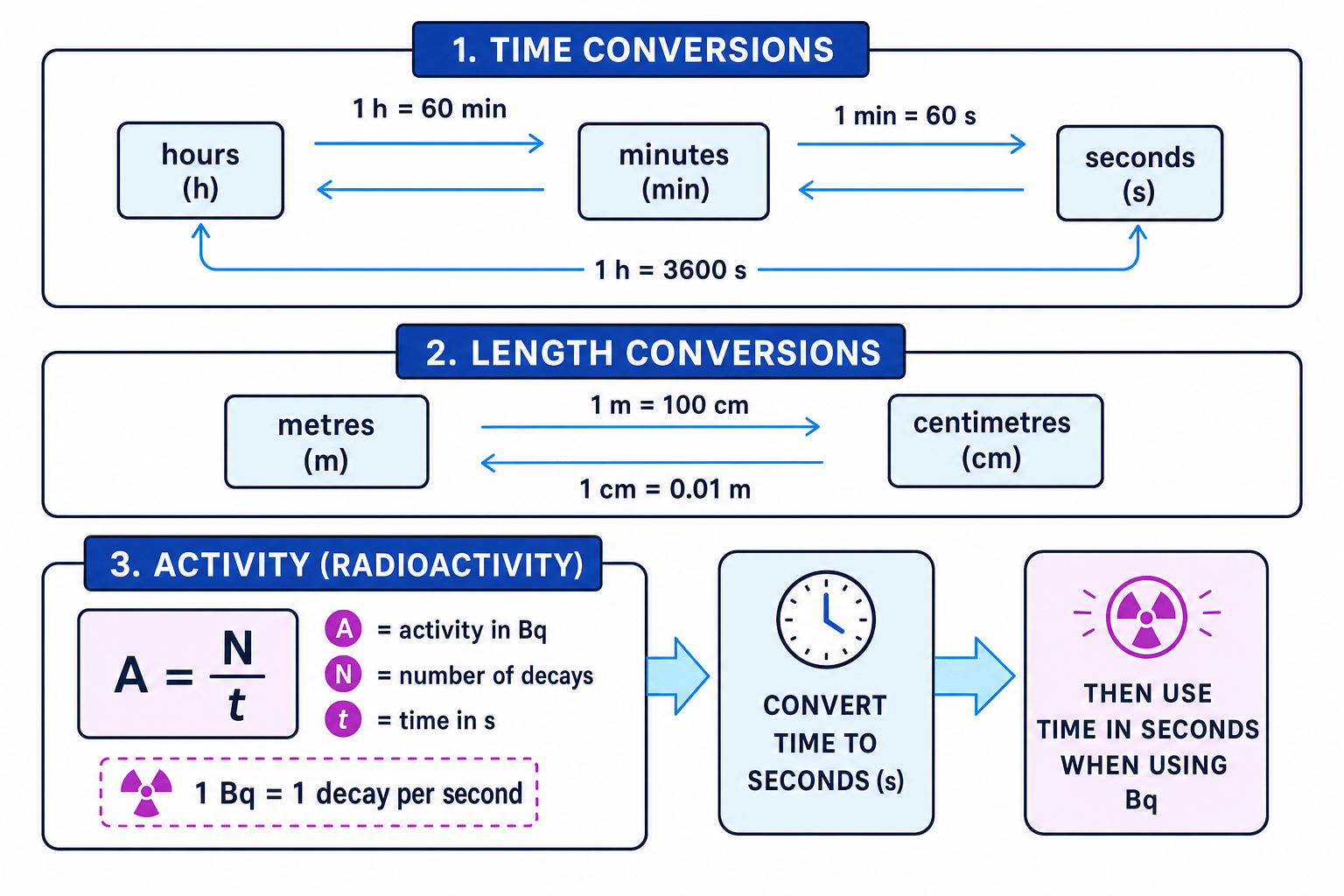
What you'll learn
- How a measurement is made from a number and a unit.
- The unit symbols you must use in spec point 7.1: Bq, cm, h, min and s.
- How to convert between centimetres and metres, and between hours, minutes and seconds.
- What the becquerel means in radioactivity questions.
Why units matter
In Physics, a number on its own is usually not enough. If you write “10”, that could mean 10 s, 10 cm, 10 Bq, or something else entirely.
A measurement needs both:
- a numerical value, such as 10
- a unit, such as s, cm or Bq
Physical quantity and unit
A physical quantity is something that can be measured, such as time, length or activity. A unit is the agreed standard used to state the size of that quantity, such as second, centimetre or becquerel.
Units carry the meaning
Always write the unit with a value. In calculations, convert quantities into suitable units before you substitute numbers.
The units in spec point 7.1
In this radioactivity topic, Edexcel expects you to use these units accurately.
| Quantity measured | Unit name | Unit symbol | Meaning or use |
|---|---|---|---|
| radioactive activity | becquerel | Bq | one nuclear decay per second |
| length or distance | centimetre | cm | one hundredth of a metre |
| time | hour | h | 60 minutes |
| time | minute | min | 60 seconds |
| time | second | s | standard unit for time |
A nuclear decay is when an unstable nucleus — the central part of an atom — changes to become more stable, often emitting radiation.
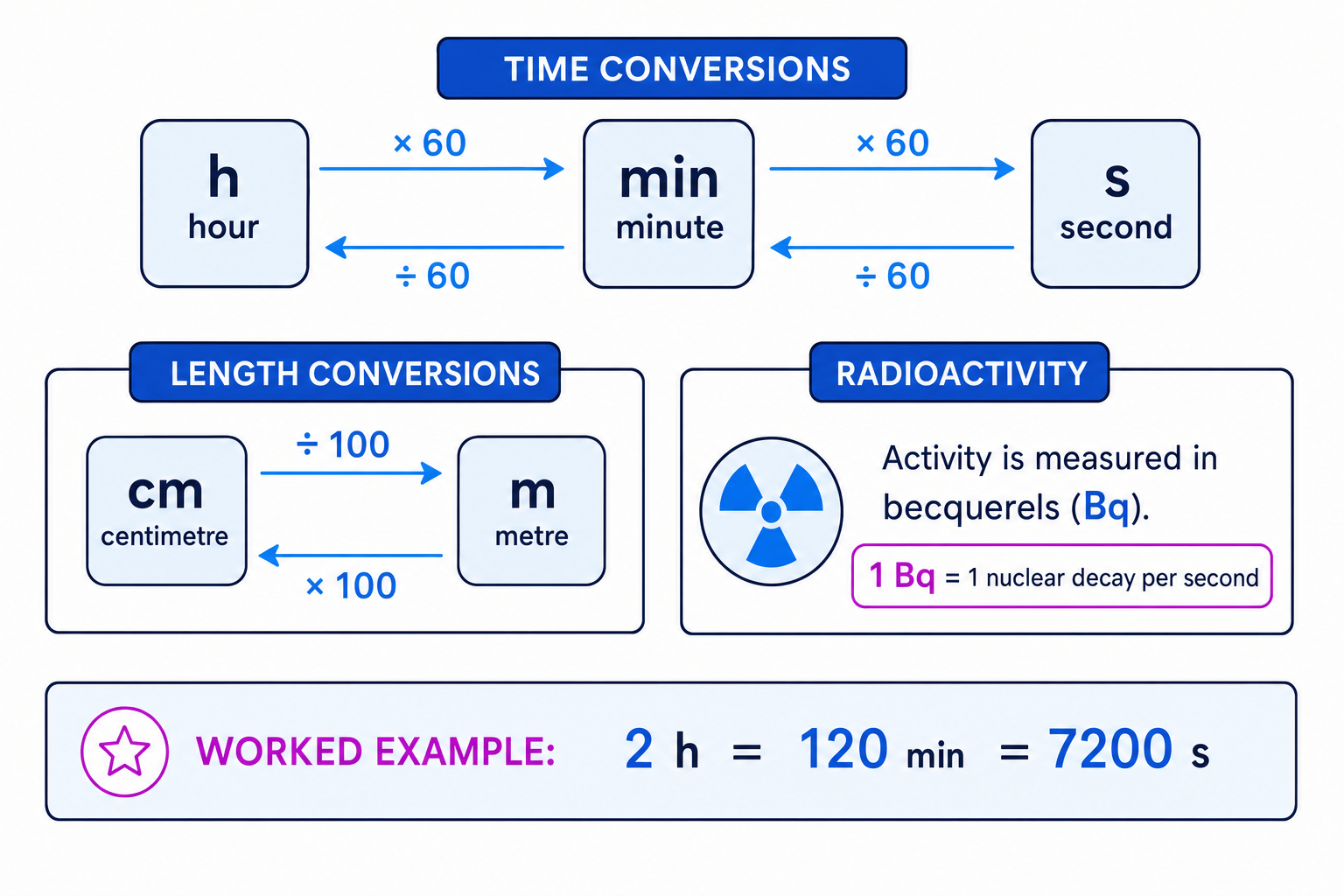
This diagram summarises the key conversion links you need for this section.
Time units: seconds, minutes and hours
Time is a measure of how long something lasts.
The unit symbols are:
- second: s
- minute: min
- hour: h
The key conversions are:
1 min=60 s1\ \text{min} = 60\ \text{s}1 min=60 s 1 h=60 min=3600 s1\ \text{h} = 60\ \text{min} = 3600\ \text{s}1 h=60 min=3600 sFor radioactivity calculations, seconds are especially important because Bq means “per second”.
Smaller unit, bigger number
When you convert to a smaller time unit, the number gets bigger. For example, hours to minutes means multiply by 60, and minutes to seconds means multiply by 60 again.
Converting a counting time
A radioactive source is observed for 3 min 20 s. Convert this time into seconds.
- Convert the minutes into seconds: 3 min=3×60 s=180 s3\ \text{min} = 3 \times 60\ \text{s} = 180\ \text{s}3 min=3×60 s=180 s.
- Add the extra seconds: 180 s+20 s=200 s180\ \text{s} + 20\ \text{s} = 200\ \text{s}180 s+20 s=200 s.
- The total time is 200 s, which is now in the correct unit for any “per second” radioactivity calculation.
Clock units are not decimal
Do not treat 1 h as 100 min or 1 min as 100 s. Time uses 60s: 1 h = 60 min and 1 min = 60 s.
Length unit: centimetre
A length is a distance between two points. In radioactivity experiments, distances may be given in centimetres, for example the distance between a radioactive source and a detector.
The unit symbol for centimetre is cm.
The prefix centi- means one hundredth, so:
100 cm=1 m100\ \text{cm} = 1\ \text{m}100 cm=1 mand
1 cm=0.01 m1\ \text{cm} = 0.01\ \text{m}1 cm=0.01 mTo convert:
- cm to m: divide by 100
- m to cm: multiply by 100
Comparing source-detector distances
A detector is placed 8 cm from a source in one test. In another test, it is placed 0.15 m from the source. Which distance is larger, and by how much?
- Convert 0.15 m into cm so both distances use the same unit: 0.15 m=0.15×100 cm=15 cm0.15\ \text{m} = 0.15 \times 100\ \text{cm} = 15\ \text{cm}0.15 m=0.15×100 cm=15 cm.
- Compare the two distances: 15 cm is larger than 8 cm.
- Find the difference: 15 cm−8 cm=7 cm15\ \text{cm} - 8\ \text{cm} = 7\ \text{cm}15 cm−8 cm=7 cm, so the second distance is larger by 7 cm.
Radioactivity unit: becquerel
Radioactivity is measured using activity.
Activity and becquerel
Activity is the rate at which unstable nuclei decay. The unit of activity is the becquerel, symbol Bq. An activity of 1 Bq means 1 nuclear decay per second.
Because Bq already means “per second”, it is a rate unit. For example:
- 5 Bq means 5 nuclear decays each second.
- 200 Bq means 200 nuclear decays each second.
You can think of the definition like this:
activity = number of nuclear decays divided by time taken
In symbols:
A=NtA = \frac{N}{t}A=tNwhere AAA is activity in Bq, NNN is the number of nuclear decays, and ttt is time in s.
Finding activity in becquerels
A radioactive sample undergoes 2400 nuclear decays in 2 min. Find its activity in Bq.
- Convert the time into seconds: 2 min=2×60 s=120 s2\ \text{min} = 2 \times 60\ \text{s} = 120\ \text{s}2 min=2×60 s=120 s.
- Use the meaning of activity as decays per second: A=2400 decays120 s=20 decays per secondA = \frac{2400\ \text{decays}}{120\ \text{s}} = 20\ \text{decays per second}A=120 s2400 decays=20 decays per second.
- Since 1 Bq means 1 decay per second, the activity is 20 Bq.
Do not write Bq per second
Bq already means “decays per second”. A source with activity 50 Bq has 50 decays each second, not 50 Bq/s.
Writing unit symbols correctly
Unit symbols are case-sensitive. For this spec point, use:
- Bq, not bq
- cm, not CM
- h, not hr
- min, not mins
- s, not sec or secs
Unit symbols do not become plural. You write 30 s, not 30 secs, and 12 cm, not 12 cms.
Space before the unit
In written answers, put a space between the number and the unit: write 25 cm, 40 s and 12 Bq. This makes your answer clearer and more standard.
Bringing the units together
Radioactivity questions often mix these units. A question might give a time in minutes, a distance in centimetres and ask for activity in Bq. Your job is to keep the units under control.
A good habit is:
- Identify the quantity being measured: time, length or activity.
- Check whether you need to convert the unit.
- Carry the unit through the calculation.
Using time conversion with activity
A source has an activity of 30 Bq. How many nuclear decays occur in 5 min?
- Convert the time to seconds because Bq means decays per second: 5 min=5×60 s=300 s5\ \text{min} = 5 \times 60\ \text{s} = 300\ \text{s}5 min=5×60 s=300 s.
- Interpret the activity: 30 Bq means 30 nuclear decays every second.
- Multiply the decay rate by the time: 30 decays per second×300 s=9000 decays30\ \text{decays per second} \times 300\ \text{s} = 9000\ \text{decays}30 decays per second×300 s=9000 decays.
In the exam
- Write a unit with every numerical answer unless the question clearly asks for a unitless value.
- Convert min and h into s before using Bq, because Bq means nuclear decays per second.
- Check unit symbols carefully: Bq, cm, h, min and s are the expected forms.
Check yourself
- What does it mean if a radioactive source has an activity of 75 Bq?
- Convert 4 min 30 s into seconds.
- Which is larger: 0.06 m or 5 cm?