

What you'll learn
- How changes inside atomic nuclei, the central parts of atoms, can release energy.
- How one split nucleus can lead to a continuing chain reaction.
- What the main control and protection parts of a nuclear reactor do.
- Why stars need extreme temperature and pressure to join small nuclei.
Before fission and fusion: the nucleus
An atom has a tiny central nucleus. The plural of nucleus is nuclei. The nucleus contains protons, which are positively charged, and neutrons, which have no electric charge.
An isotope is a form of an element with the same number of protons but a different number of neutrons. Uranium-235 is an isotope of uranium. The number 235 is its mass number, meaning the total number of protons and neutrons in one nucleus.
Nuclear reaction
A nuclear reaction is a change involving an atomic nucleus, not just the electrons around an atom. Fission means splitting a nucleus, fusion means joining nuclei, and radioactive decay is the spontaneous change of an unstable nucleus.
Nuclear reactions, including fission, fusion and radioactive decay, can be a source of energy. Kinetic energy is the energy a moving object or particle has because it is moving. In nuclear reactions, energy often first appears as kinetic energy of particles or as radiation, then can be transferred to the surroundings as heating.
Energy from the nucleus
Fission, fusion and radioactive decay can all release energy because the nucleus changes. In power stations, that released energy is eventually used to heat a coolant and generate electricity.
Nuclear fission of uranium-235
Fission
Nuclear fission is the splitting of a large atomic nucleus into two smaller nuclei, usually after the large nucleus absorbs a neutron.
In uranium-235 fission, an incoming neutron collides with a U-235 nucleus and is absorbed. This makes the nucleus unstable, so it splits.
The fission of U-235 produces:
- two smaller daughter nuclei — the nuclei formed as products of the reaction
- a small number of neutrons, usually two or three
- energy released as kinetic energy of the fission products
The daughter nuclei from U-235 fission are radioactive, meaning unstable and able to emit ionising radiation. Ionising radiation has enough energy to remove electrons from atoms and can damage living cells.
Energy form in fission
Do not jump straight to “electricity”. In the fission event itself, energy is released mainly as kinetic energy of the daughter nuclei and emitted neutrons. Electricity is produced later by energy transfers in the power station.
Following energy transfer in fission
A question asks why fission in a reactor can heat the fuel.
- A neutron is absorbed by a U-235 nucleus, making it unstable enough to split into two radioactive daughter nuclei.
- The daughter nuclei fly apart at high speed, so they have kinetic energy.
- These fast-moving fission products collide with nearby atoms in the fuel, transferring energy to them and increasing the fuel’s temperature.
- A coolant can then carry this thermal energy away from the reactor core.
Chain reactions
Chain reaction
A chain reaction is a process where neutrons released by one fission go on to strike other U-235 nuclei, causing further fissions.
Each U-235 fission can release several neutrons. If some of these neutrons collide with more U-235 nuclei, more fissions happen, releasing more neutrons again. This is how a chain reaction can be set up.
The diagram below links the first neutron-induced fission of U-235 to the repeated fissions that make a chain reaction.
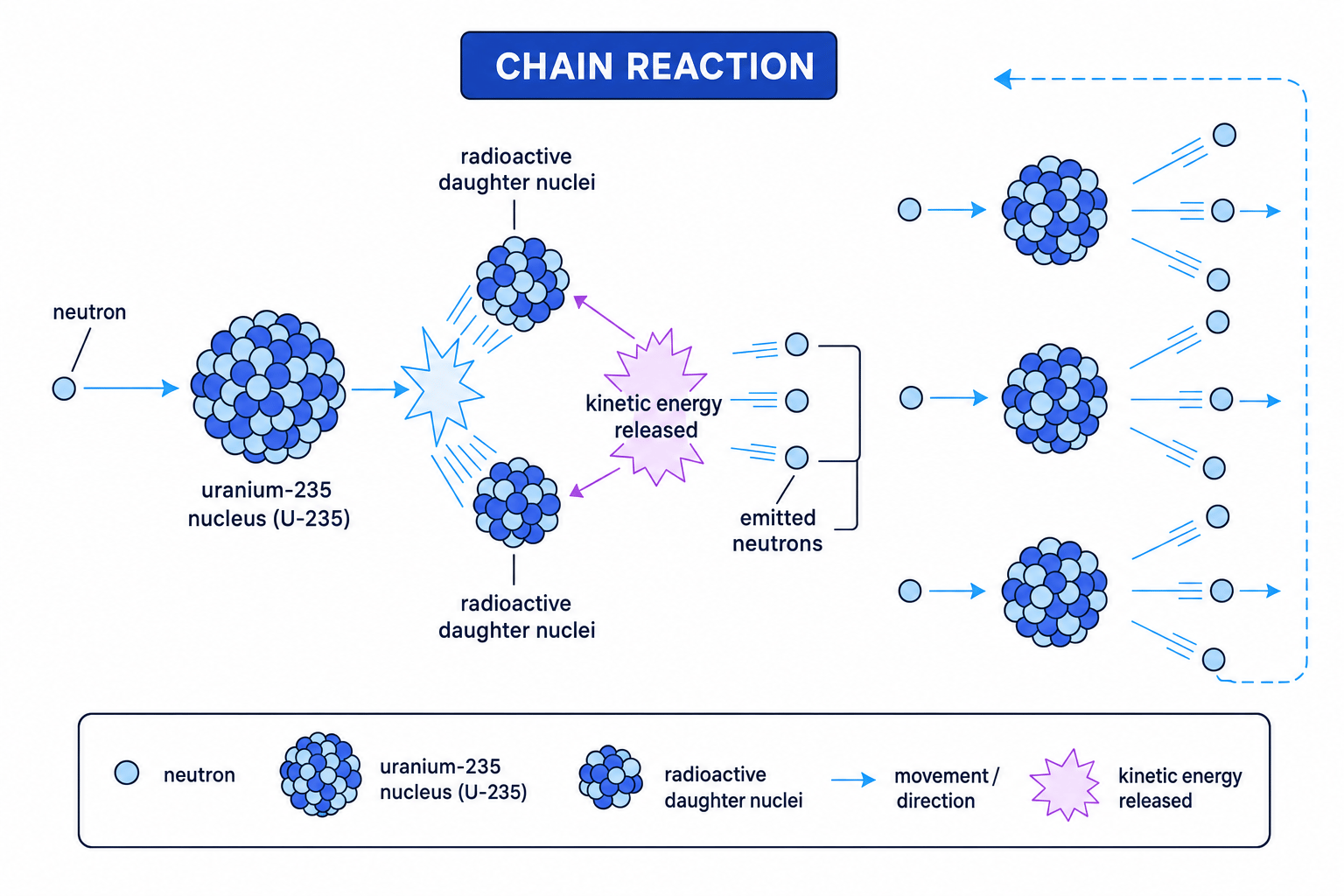
For a controlled reactor, the chain reaction must be kept steady. If too many neutrons cause further fissions, the rate of energy release rises. If too few do, the reaction dies away.
Predicting whether a chain reaction continues
Suppose 100 U-235 fissions happen, but only 60 neutrons from those fissions go on to cause new fissions.
- Compare the number of new fissions with the original number: 60 new fissions is fewer than 100 original fissions.
- Fewer fissions means fewer neutrons are produced in the next round.
- The chain reaction will decrease and may die away unless fewer neutrons are lost or absorbed.
Controlling fission in a reactor
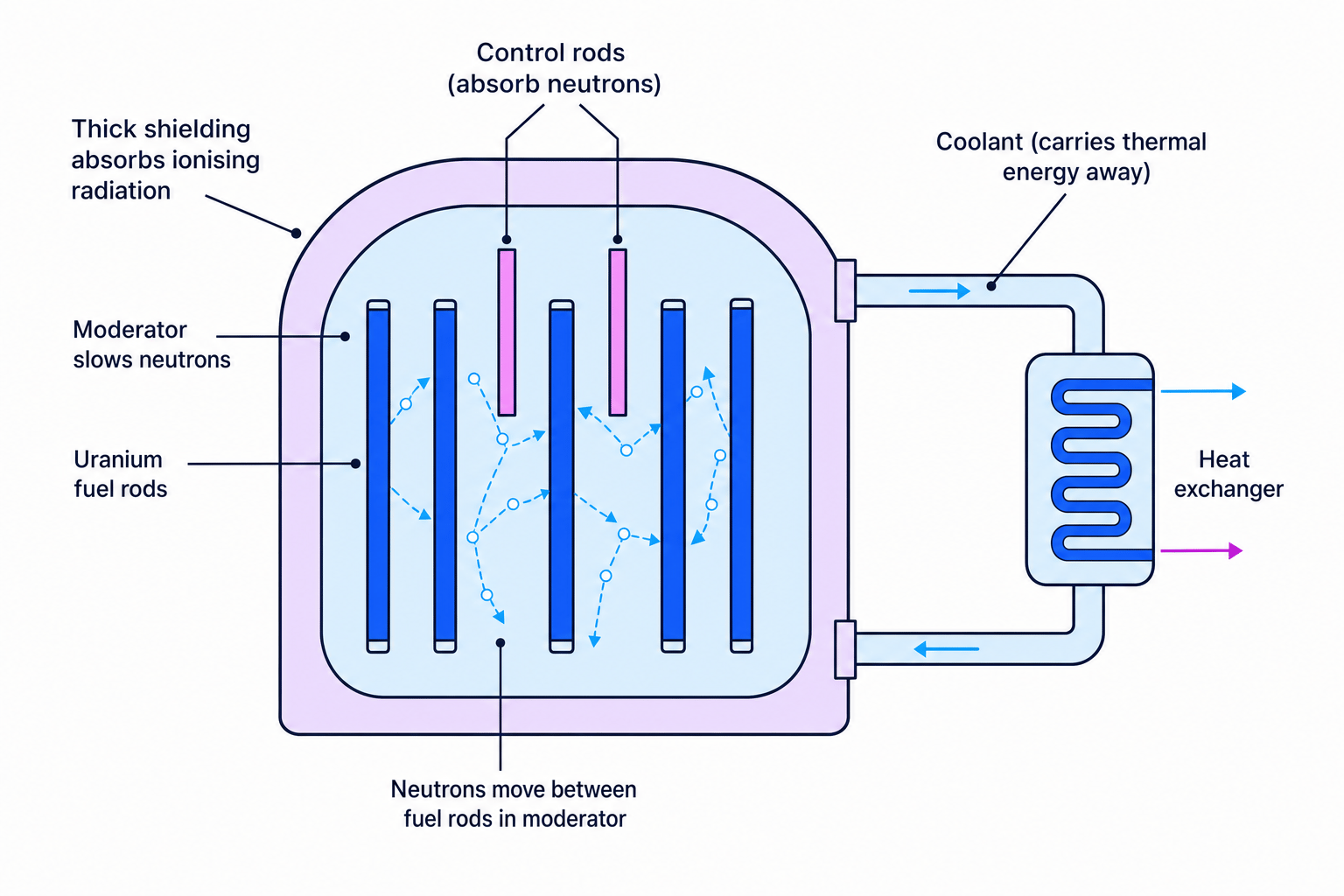
A nuclear reactor is a machine designed to keep fission happening at a controlled rate. The central region where fission occurs is the core.
The main parts are:
- fuel rods: rods containing uranium fuel
- moderator: material that slows neutrons down
- control rods: rods that absorb neutrons
- shielding: thick material that absorbs ionising radiation
- coolant: a fluid that carries thermal energy away from the core
A simple reactor core uses these parts together.
The moderator
The moderator slows down fast neutrons by collisions. Slower neutrons are more likely to be absorbed by U-235 nuclei and cause fission, so the moderator helps maintain the chain reaction.
The control rods
Control rods absorb neutrons. Lowering the rods absorbs more neutrons, so fewer neutrons are available to cause fission and the reactor power decreases. Raising the rods absorbs fewer neutrons, so the fission rate can increase.
The shielding
Shielding surrounds the reactor and absorbs ionising radiation. Its job is to protect workers and the environment; it is not mainly used to control the chain reaction.
Moderator vs control rods
The moderator slows neutrons down. The control rods absorb neutrons. Mixing these up is one of the most common fission-reactor mistakes.
Changing reactor power
A reactor is releasing energy too quickly, so the operator needs to reduce the fission rate.
- The fission rate must be reduced by stopping some neutrons from reaching U-235 nuclei.
- The control rods should be lowered further into the core, so they absorb more neutrons.
- With fewer neutrons causing further fissions, less kinetic energy is released per second, so the reactor power falls.
Nuclear fusion
Fusion
Nuclear fusion is the joining of small nuclei to create a larger nucleus. In fusion, there is a small loss of mass from the starting nuclei, accompanied by a release of energy.
Fusion is the energy source for stars, including the Sun. In star cores, small nuclei such as hydrogen nuclei can join to form larger nuclei such as helium nuclei.
The key difference is simple: fission splits, while fusion joins.
| Feature | Fission | Fusion |
|---|---|---|
| What happens | A large nucleus splits | Small nuclei join |
| Typical place | Nuclear reactor fuel | Cores of stars |
| Example in this topic | Uranium-235 hit by a neutron | Hydrogen nuclei forming larger nuclei |
| Products | Two radioactive daughter nuclei and a few neutrons | A larger nucleus |
| Energy release | As kinetic energy of fission products | From a loss of mass, releasing energy |
Quick distinction
Fission sounds like “split”. Fusion sounds like “fuse together”. This is a useful quick check, but still explain the nuclear details in longer answers.
Why fusion needs high temperature and pressure
Electrostatic repulsion
Electrostatic repulsion is the pushing force between objects with the same electric charge. Since protons are positive, nuclei repel other nuclei when they get close.
Fusion does not happen at low temperatures and pressures because nuclei are positively charged. The protons in one nucleus repel the protons in another nucleus.
High temperature gives nuclei more kinetic energy, helping them get close enough for fusion. High pressure means the nuclei are closer together, so collisions are much more frequent.
Explaining why fusion needs extreme conditions
A question asks why hydrogen nuclei in a cool, low-pressure gas do not fuse.
- Hydrogen nuclei contain protons, so they are positively charged and repel each other.
- Low temperature means the nuclei have too little kinetic energy to get very close before electrostatic repulsion pushes them apart.
- Low pressure means the nuclei are spread out, so collisions are too rare for fusion to happen often.
- In a star core, very high temperature and pressure make close collisions possible, so fusion can release energy.
In the exam
- For U-235 fission, include all four key points: neutron collision, two radioactive daughter nuclei, a small number of neutrons, and energy released as kinetic energy.
- For chain reactions, explicitly link “neutrons produced” to “strike further U-235 nuclei”.
- For reactor questions, write: moderator slows neutrons, control rods absorb neutrons, shielding absorbs ionising radiation.
- For fusion, state that small nuclei join to form larger nuclei, with a loss of mass and energy release, and that stars need high temperature and pressure because protons repel.
Check yourself
- In U-235 fission, what is the incoming particle and what are the main products?
- How do the jobs of the moderator and control rods differ?
- Why does fusion not happen at low temperatures and pressures?
