An experiment is designed to study the deflection of different types of radiation in an electric field. A collimated beam containing several types of radiation travels in a vacuum between two oppositely charged horizontal plates. The top plate is connected to a positive high-voltage supply, and the bottom plate is connected to a negative high-voltage supply.
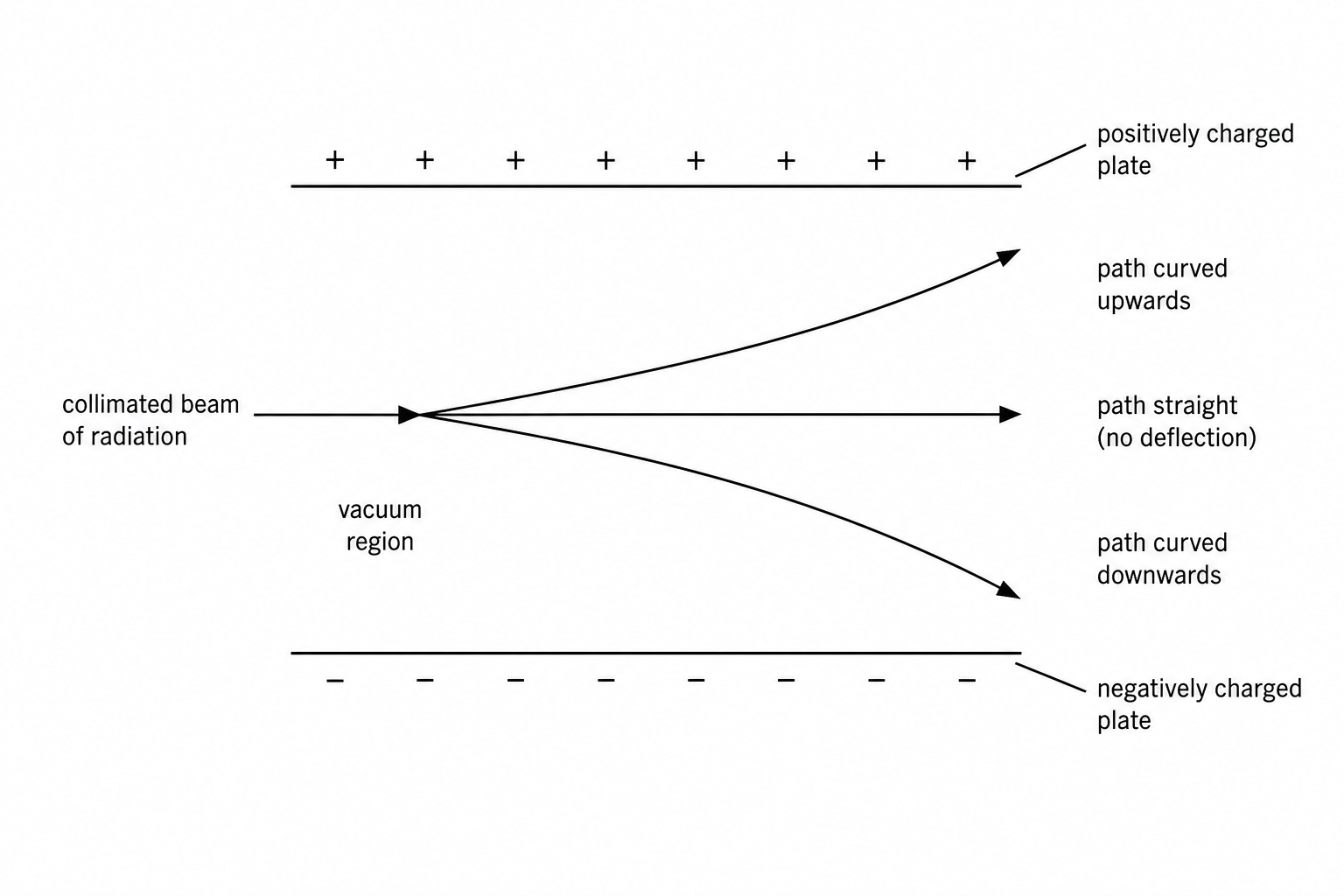
Complete the table below by indicating the direction of deflection (Upwards, Downwards, or Not deflected) for each type of radiation.
| Type of radiation | Deflection |
|---|---|
| Alpha (α\alphaα) | |
| Beta-minus (β−\beta^-β−) | |
| Gamma (γ\gammaγ) | |
| Neutrons | |
| Positrons (β+\beta^+β+) |
In 1911, Ernest Rutherford, Hans Geiger, and Ernest Marsden investigated the structure of the atom by launching alpha particles at a very thin gold foil.
Alpha particles have a typical range in air of only a few centimeters. Explain why it was necessary to evacuate the air from the apparatus.
Describe the two main experimental observations made during this experiment regarding the paths of the alpha particles.
Describe how Rutherford's nuclear model of the atom explains the two observations you described in Part (b)(ii).

