An environmental monitoring satellite orbits Earth and is equipped with a retroreflector consisting of two flat plane mirrors joined at a 90∘ 90^\circ\,90∘ angle.
An incident laser light ray strikes Mirror 1 with an angle of incidence of 28∘28^\circ28∘.
State the angle of reflection of the ray at Mirror 1.
Calculate the angle of incidence of the reflected ray when it strikes Mirror 2, and explain why the final reflected ray from Mirror 2 is parallel to the incident ray.
Ground tracking stations aim laser pulses at the satellite's retroreflector to measure its precise altitude.
Show that the average distance to the satellite is 24,000 km24,000\text{ km}24,000 km.
The round-trip travel time of the laser pulses varies over the course of the satellite's orbit, as shown in the graph below.
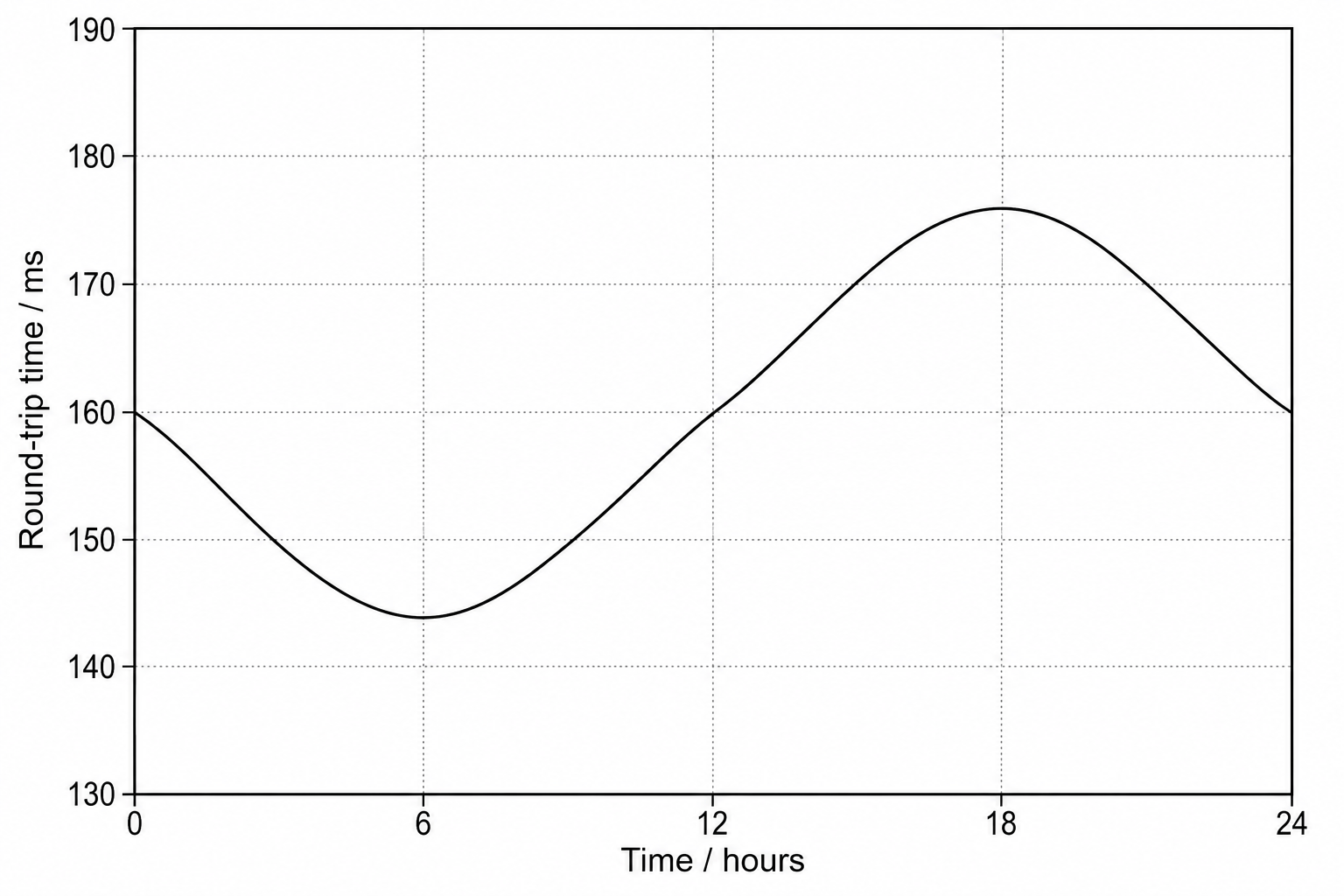
Suggest what can be deduced about the satellite's orbit from the variation shown in the graph.
Very precise measurements over several decades show that the average round-trip travel time decreases by a tiny fraction of a microsecond each year. What further information does this give about the orbit of the satellite?

